Hour One's Series A deck is a concise, 11-slide masterclass in demonstrating product-market fit within the generative AI sector. By 2022, the company had already produced over 100,000 videos and secured high-profile clients like NBC Universal and DreamWorks. The deck avoids technical jargon, instead focusing on the 'Reals' self-service platform that transforms text into studio-grade video. A standout feature is the case study with Berlitz, which quantifies the value proposition by showing a saving of one year of internal staffing hours. While the deck lacks a formal 'Ask' slide or detailed fi…
Key takeaways
- The company was founded in 2019 and had already produced 100,000+ videos by the time of this deck (Slide 2).
- Hour One raised a $5M Seed round from investors including Galaxy Interactive and Kindred Ventures prior to this Series A (Slide 2).
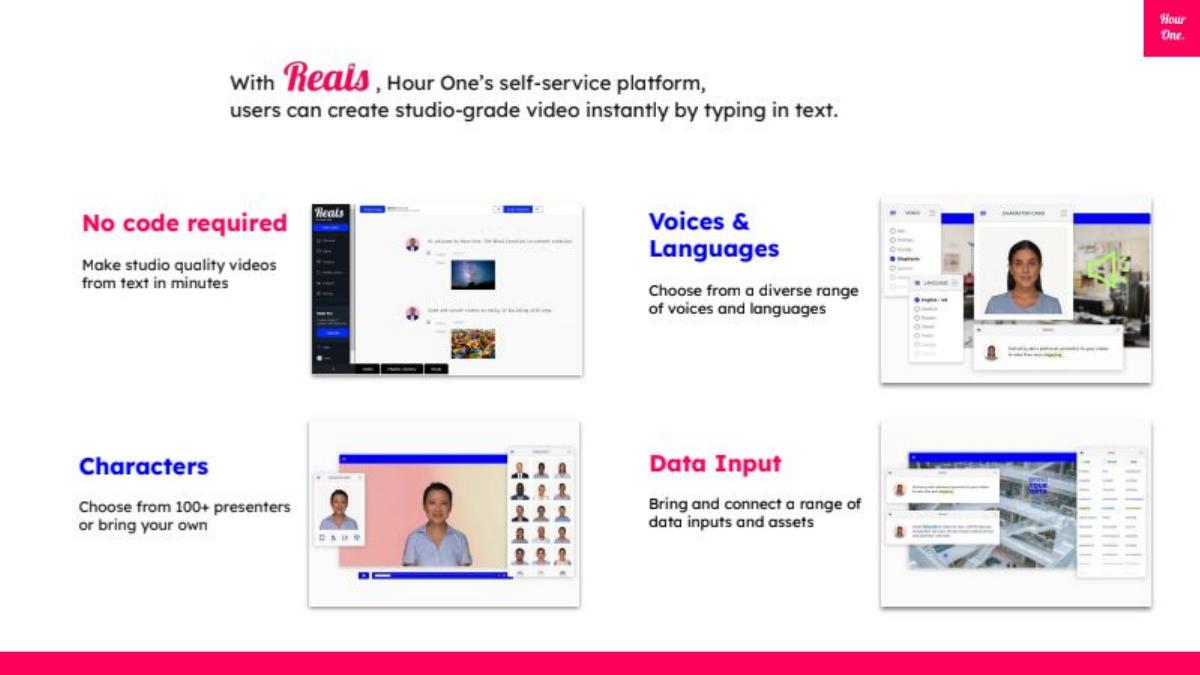
- The platform, named Reals, allows users to create video by simply typing text, removing the need for traditional production (Slide 3).
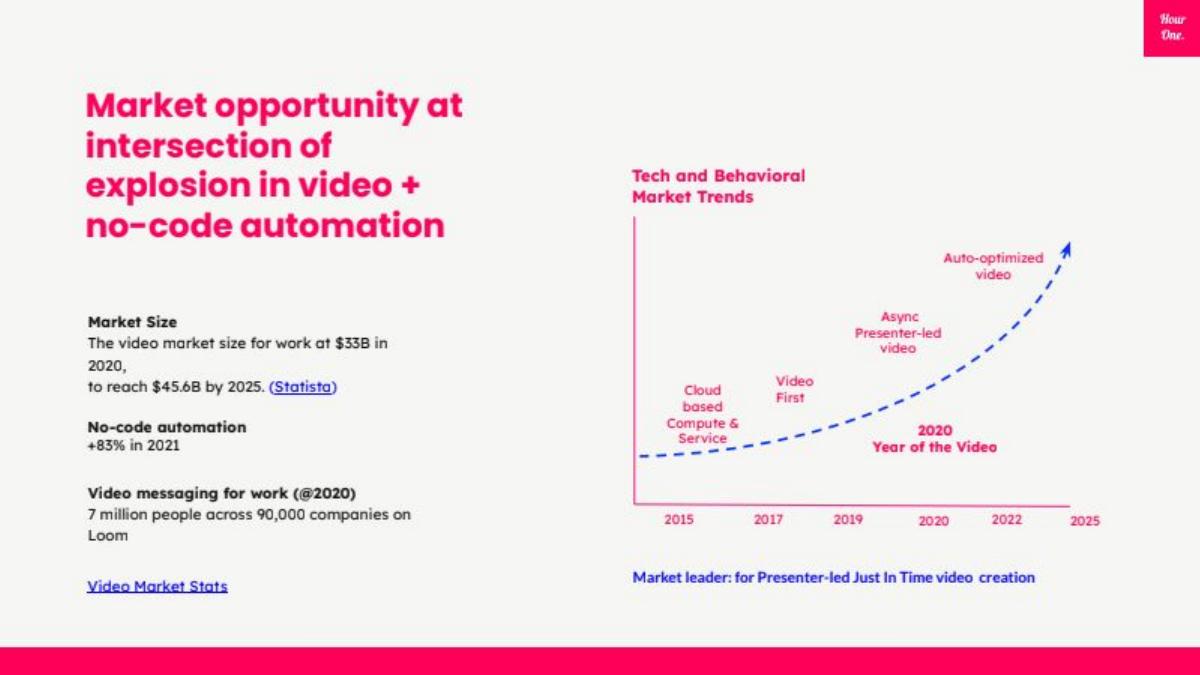
- Market data cites the video market for work at $33B in 2020, projected to reach $45.6B by 2025 (Slide 4).
- The character library includes 100+ presenters, with the option for users to bring their own (Slide 6).
- A case study with Berlitz demonstrates the creation of 18,000+ full HD videos in weeks, saving a year of staffing hours (Slide 9).
- The team slide highlights significant academic and corporate pedigree, including multiple PhDs and a four-time Oscar winner (Slide 10).
- The deck omits a specific funding request, use of funds, or detailed revenue metrics (Slide 1-11).
Hour One: A Case Study in Generative AI Commercialization
The Hour One Series A pitch deck is a lean, 11-slide presentation that focuses heavily on the 'why now' of generative AI video. Raised in 2022, the $11.4M round led by Insight Partners came at a time when the market was beginning to realize the potential of synthetic media. The deck succeeds by positioning the technology not as a futuristic novelty, but as a practical tool for enterprise digital transformation.
Slide 1: Title Slide
The deck opens with a minimalist title slide featuring the company name, 'Hour One,' and the tagline 'Bringing the Human to the Virtual.' It is dated November 2021, suggesting the fundraising process was initiated late in the year prior to the 2022 announcement. The branding is clean, using a high-contrast magenta and white color palette that persists throughout the deck.
Slide 2: Hour One at a Glance
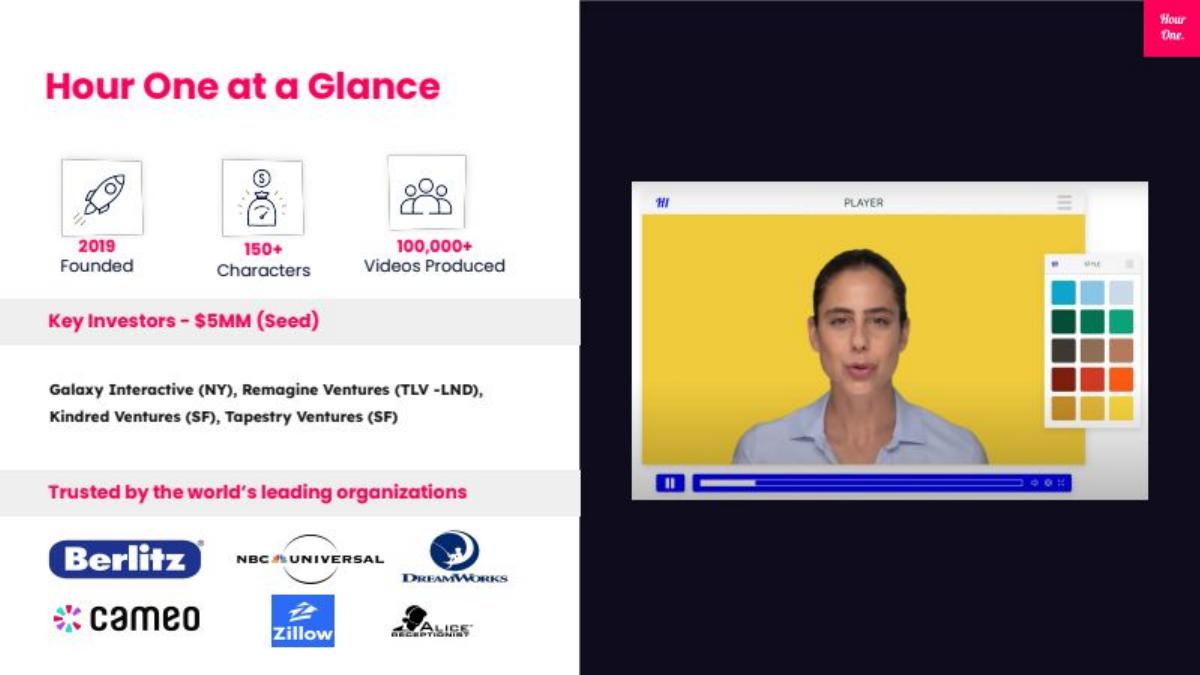
This is a high-impact traction slide. It establishes three key pillars: the company was founded in 2019, it offers 150+ characters, and it has produced 100,000+ videos. By leading with these numbers, Hour One immediately addresses the 'scale' question. The slide also discloses a $5M Seed round and lists a 'who's who' of early investors like Galaxy Interactive and Kindred Ventures. The inclusion of logos from Berlitz, NBC Universal, and DreamWorks serves as powerful social proof, indicating that major media and education players are already using the tech.
Slide 3: The Mission Statement
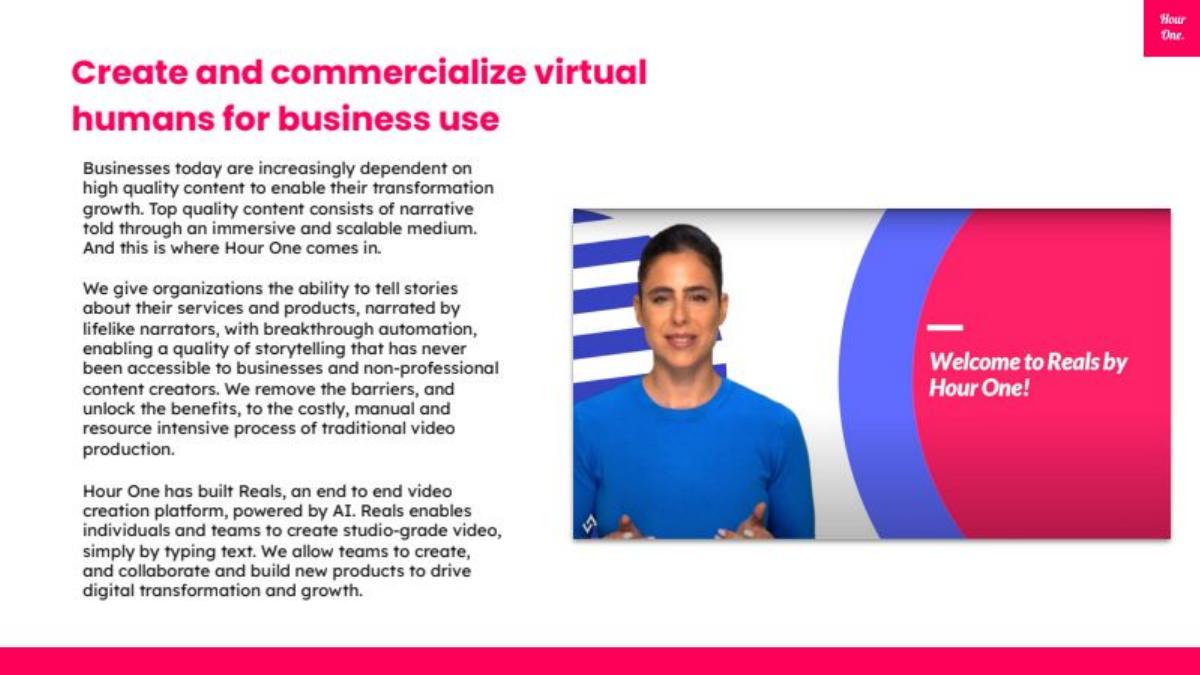
Slide 3 defines the core objective: 'Create and commercialize virtual humans for business use.' The text explains that businesses are dependent on high-quality content but are limited by the 'costly, manual and resource intensive process of traditional video production.' This slide introduces the product name, 'Reals,' and emphasizes that it enables studio-grade video 'simply by typing text.' It effectively bridges the gap between a complex AI technology and a simple user benefit.
Slide 4: Market Opportunity
Hour One frames its opportunity at the intersection of video growth and no-code automation. The slide cites Statista data, noting the video market for work was $33B in 2020 and is projected to reach $45.6B by 2025. It also highlights the rise of video messaging, citing Loom's 7 million users across 90,000 companies. The chart on the right visualizes the trend from 'Cloud based Compute' in 2015 to 'Auto-optimized video' in 2025, positioning Hour One as the 'Market leader for Presenter-led Just In Time video creation.'
Slide 5: Value Proposition
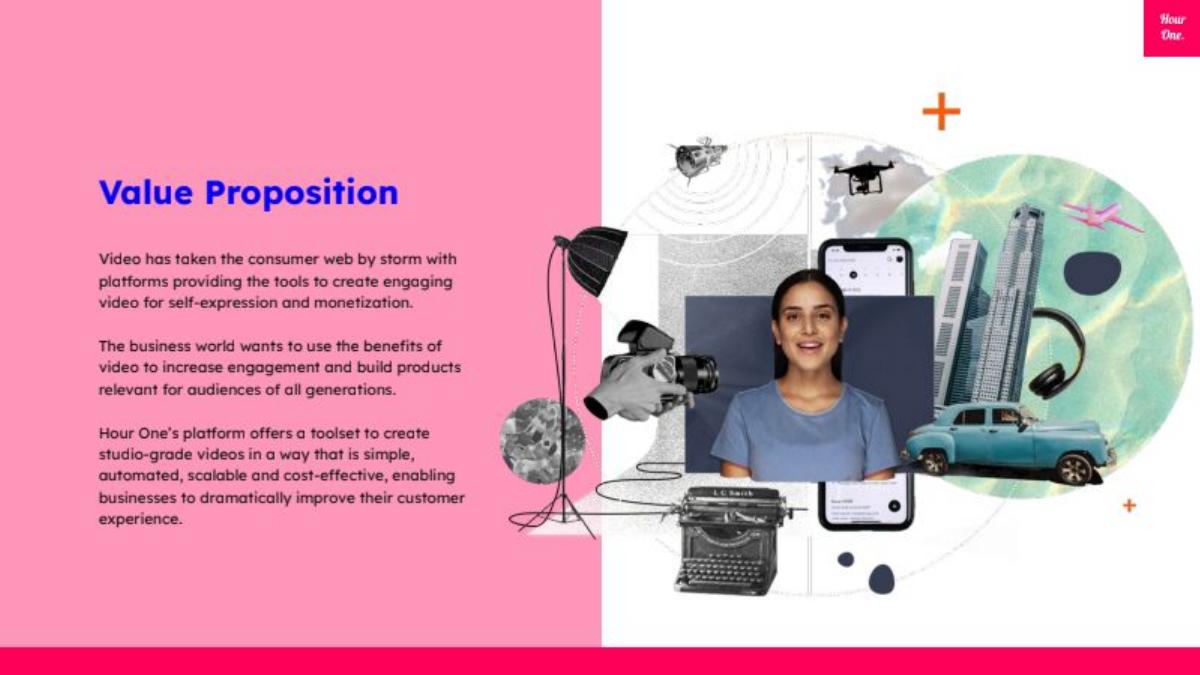
This slide reiterates the pain point: the business world wants the benefits of video but needs a toolset that is 'simple, automated, scalable and cost-effective.' The visual collage on the right—mixing vintage cameras and typewriters with modern smartphones and skyscrapers—suggests a leap from old methods to new ones. The text explicitly states the goal is to 'dramatically improve their customer experience.'
Slide 6: The 'Reals' Platform
Slide 6 provides a look at the product interface. It breaks the platform down into four components: No code required (text-to-video in minutes), Voices & Languages (diverse range), Characters (100+ presenters or bring your own), and Data Input (connecting assets). This is the 'how it works' slide, and it keeps the explanation focused on the user experience rather than the underlying neural networks.
Slide 7: Product Demo (Tutorial Video)
This slide features a screenshot of a 'Demo project' within the Reals interface. It shows a text box where a user can 'Type in your narrative' and a sidebar for selecting media. The caption notes that the platform is ideal for creating 'presenter-led tutorials to explain your product features.' This is a specific use case that resonates with SaaS companies and product teams.
Slide 8: Target Customer
Slide 8 segments the market. It lists target customers as 'video-enabled companies' and 'digital product & customer experience teams.' It identifies key verticals: E-learning, E-commerce, Digital Health, and Human Resources. The right side of the slide shows visual examples of these use cases, such as 'Financial Reports' and 'Real Estate,' demonstrating the versatility of the virtual avatars across different professional contexts.
Slide 9: Case Study - Berlitz
This is arguably the most important slide for a Series A deck. It provides a concrete example of the platform's value. Berlitz used Hour One to create 'Over 18,000 full HD videos... in a matter of weeks.' The most compelling metric is the claim that this saved 'a year of internal staffing hours.' A quote from Berlitz CEO Curt Uehlein reinforces the idea that the technology allows the brand to 'extend our reach into new markets' while 'removing barriers of location and affordability.'
Slide 10: The Team
The team slide is exceptionally strong, showcasing a mix of academic rigor and corporate experience. Oren Aharon, PhD (CEO) has a background in Samsung's Corporate Strategy Office. Lior Hakim (CTO) is credited as a co-inventor of Colored Coins (blockchain). The team includes veterans from Microsoft, Google, and Publicis. Notably, Oded Granot (VP VFX) is described as a 'Four-times oscar winner (group)' for his work on films like Spiderman and Blade Runner. This combination of AI research, enterprise strategy, and high-end visual effects talent is a significant competitive moat.
Slide 11: Closing
The final slide in this version of the deck is a placeholder for the platform where the deck was hosted (bestpitchdeck.com). In the original pitch, this would typically be a contact slide or a 'Thank You' slide. As noted in the takeaways, the deck ends without a formal 'Ask' or financial summary, which is common in decks shared publicly after a round closes, though these slides are usually present in the live room.
What Hour One Does Well
The deck is a masterclass in clarity over complexity . While the underlying technology involves sophisticated generative adversarial networks or diffusion models, the deck never mentions them. Instead, it focuses on the user action ('type text') and the business result ('save a year of staffing hours').
The social proof is also handled expertly. By listing NBC and DreamWorks on Slide 2 and providing a deep-dive case study on Slide 9, the company proves that it has moved past the 'experimental' phase and is ready for enterprise-wide deployment. The team slide further reinforces this, showing that the company is led by adults with significant industry pedigree.
What is Missing
The most glaring omissions are the financials and the ask . While we know from the catalogue facts that they raised $11.4M, the deck itself does not state the target amount or how the capital will be allocated (e.g., R&D vs. Sales). Additionally, there is no competitive landscape slide. In 2022, companies like Synthesia were already active in the space, and a Series A investor would typically want to see how Hour One differentiates itself from other AI avatar platforms.
Finally, the deck lacks a roadmap . It shows what the product does today, but for a Series A, investors are buying into the future. Will the avatars become interactive? Will they integrate with live streaming? The deck stays very much in the 'here and now.'
Founder Lessons
Quantify the Value: If your product saves time, say exactly how much. 'Saving a year of internal staffing hours' (Slide 9) is a metric an investor can easily model into a ROI calculation. · Lead with Traction: If you have produced 100,000 of anything (Slide 2), put it on the first or second slide. It immediately validates that the tech works at scale. · Simplify the Tech: You don't need to explain how the AI works; you need to explain how the user works the AI. Slide 6 and 7 do this perfectly by showing a simple text-entry interface. · Pedigree Matters: If your team has worked at Google, Microsoft, or won Oscars (Slide 10), use those logos. They act as a shorthand for 'this team can execute.'
Frequently asked questions
- How much did Hour One raise with this deck?
- According to the catalogue listing, Hour One raised $11.4M in a Series A round in 2022. The round was led by Insight Partners, with participation from Galaxy Interactive, Remagine Ventures, Kindred Ventures, and others. Slide 2 mentions a previous $5M Seed round.
- What is the core product offered by Hour One?
- The core product is a self-service platform called 'Reals.' As described on Slide 3 and Slide 6, it is an AI-powered end-to-end video creation platform that allows businesses to create studio-grade videos with virtual narrators by simply typing text, requiring no coding or video production skills.
- Who are Hour One's primary customers?
- Slide 8 identifies target customers as video-enabled companies and digital product teams across E-learning, E-commerce, Digital Health, and Human Resources. Slide 2 lists specific 'trusted' organizations including Berlitz, NBC Universal, DreamWorks, Cameo, and Zillow.
- Does the deck show any traction metrics?
- Yes, Slide 2 provides high-level traction figures: 150+ characters available on the platform and 100,000+ videos produced since the company's founding in 2019. Slide 9 adds a specific case study metric, noting that Berlitz produced 18,000+ videos in a matter of weeks.
- What is missing from the Hour One pitch deck?
- The deck is notably missing a slide detailing the specific 'Ask' (how much they are raising in this specific round) and the intended 'Use of Funds.' It also lacks a detailed roadmap, a competitive landscape analysis, and specific financial performance data such as MRR or ARR.