HoverStat is an aerial roof inspection and analytics processing company that utilizes drone technology to replace manual roof assessments. The deck focuses heavily on the efficiency gains for the solar industry, claiming a reduction in inspection time from 1.5 hours to just 15 minutes (Slide 3). With a technical team led by a CTO with 10 years of machine vision experience, the company aims to improve accuracy from 5 inches down to 1.5 centimeters (Slide 4). While the deck highlights a pilot program with USAAA valued at $3,200 monthly, it lacks critical financial data, including a specific fun…
Key takeaways
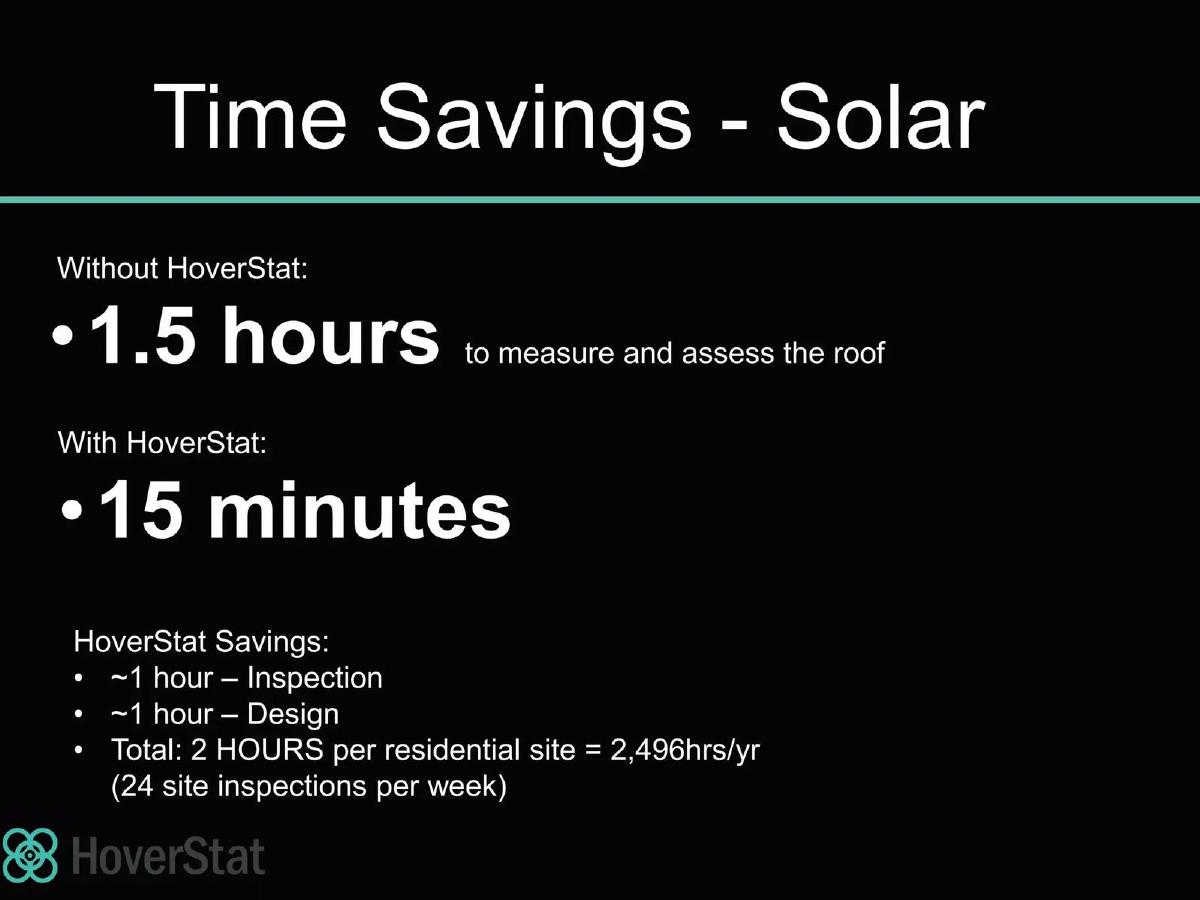
- The company claims to reduce roof measurement and assessment time for solar installations from 1.5 hours to 15 minutes (Slide 3).
- HoverStat calculates a total savings of 2 hours per residential site, totaling 2,496 hours per year based on 24 inspections per week (Slide 3).
- Current technical accuracy is stated at 5 inches, with a development goal to reach 1.5 centimeters (Slide 4).
- The sales pipeline includes USAA at the 'Vetting Us' stage, with a pilot value of $3,200 based on 16 claims assessments per week (Slide 5).
- The target market expansion list includes Insurance, Solar, Roofing, Agriculture, and Construction (Slide 6).
- CTO Mark Sapp brings 10 years of machine vision experience, providing technical credibility to the automated reporting claims (Slide 7).
- The deck lists three advisors with ties to StartFast Venture Accelerator and the aviation industry (Slide 8).
- There is no mention of a specific investment ask, valuation, or use of funds in the provided slides.
HoverStat Pitch Deck Analysis
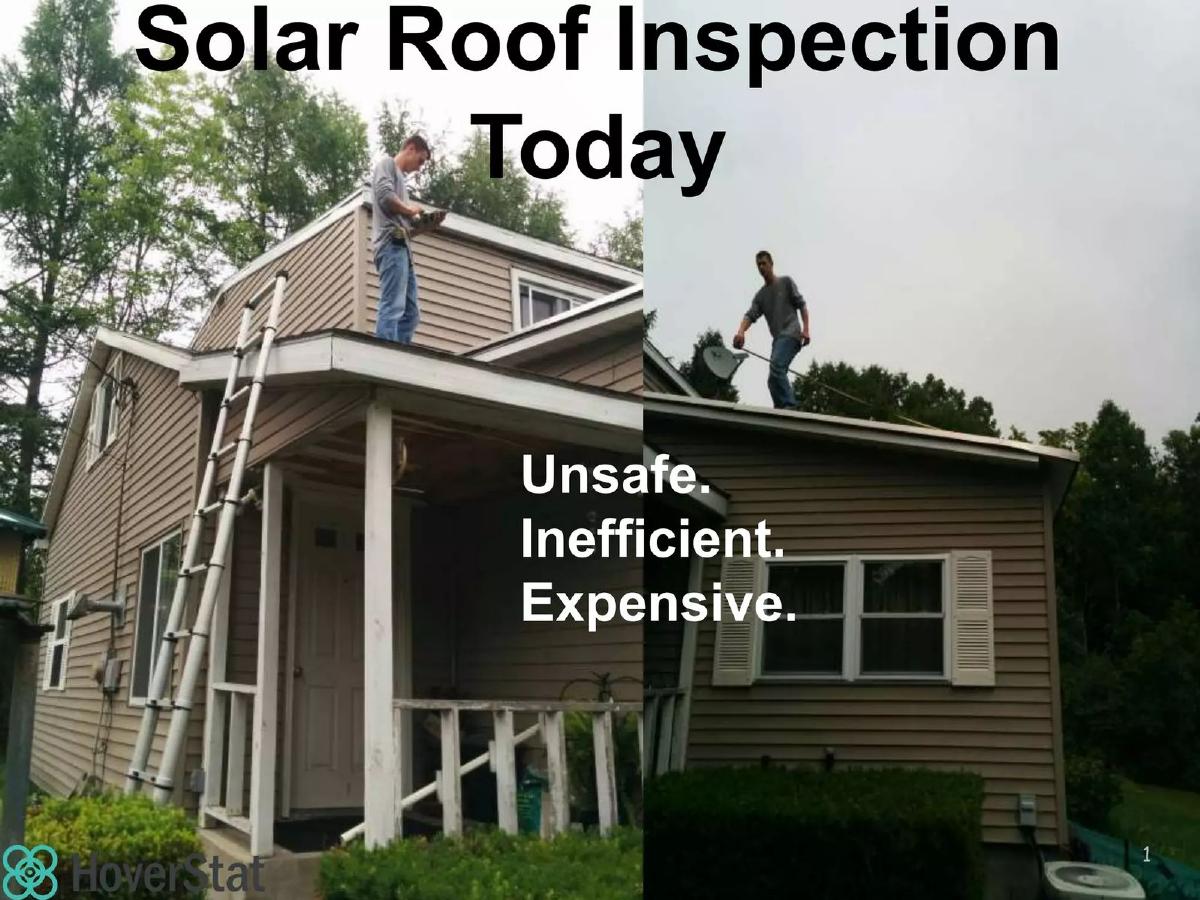
HoverStat enters the market at the intersection of drone hardware and automated data analytics. The deck is structured to address the immediate pain points of the roofing and solar industries—specifically the danger and inefficiency of manual labor. While the visual design is minimalist, the deck relies on specific time-saving metrics to build its case.
Slide 1: Title and Tagline
The cover slide introduces HoverStat as an "Aerial Roof Inspections and Analytics Processing" company. The tagline, "Keep your feet on the ground!" immediately identifies the primary safety benefit of the service. The branding is clean, using a teal and gray color palette that persists throughout the deck.
Slide 2: The Solution Workflow
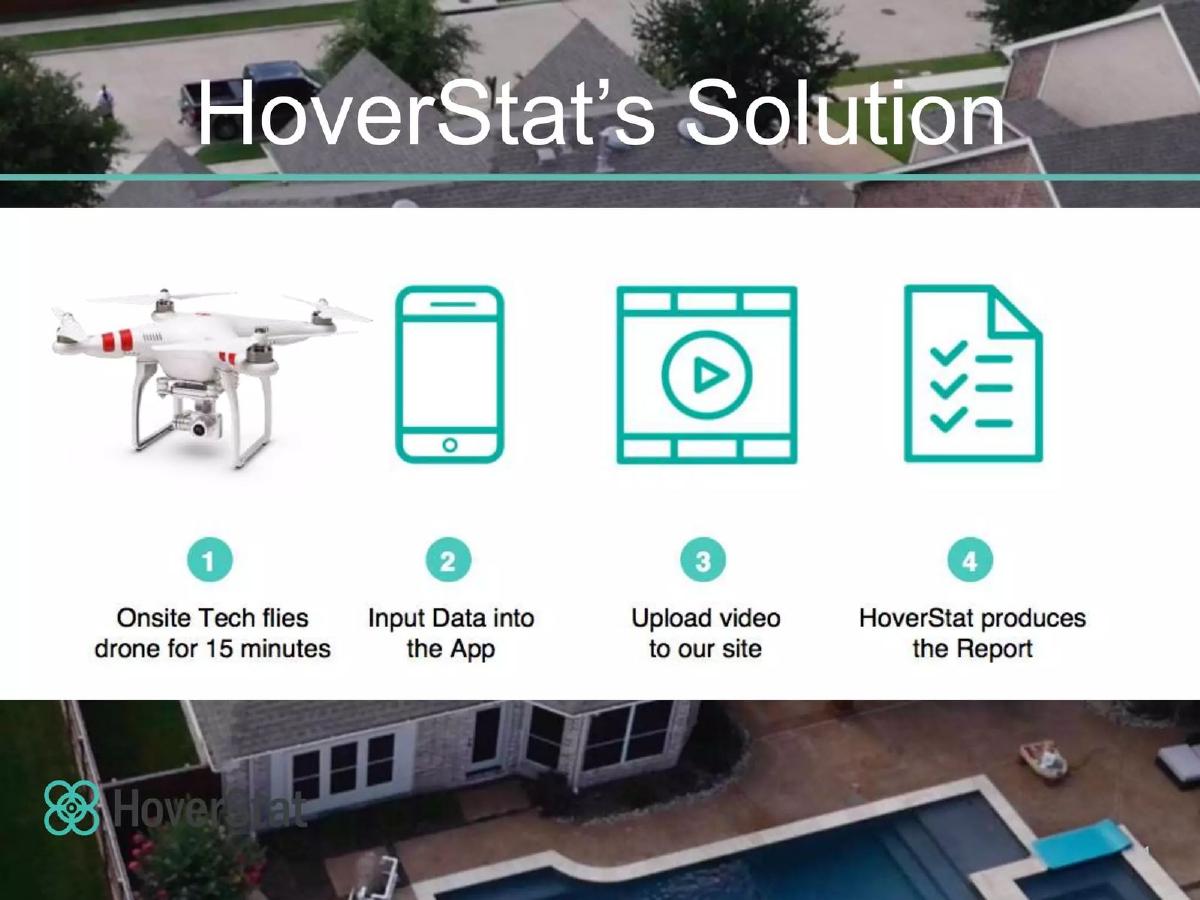
Slide 2 outlines a four-step operational process. It starts with an onsite technician flying a drone for 15 minutes. The data is then input into an app and uploaded to the HoverStat website. The final output is a report produced by HoverStat. This slide is crucial because it clarifies that HoverStat is not just a drone company, but a data processing company. It does not specify if the "Onsite Tech" is a HoverStat employee or a third-party contractor, which is a significant distinction for the business model's scalability.
Slide 3: Time Savings - Solar
This is the strongest slide in the deck. It provides a direct comparison: 1.5 hours for manual assessment versus 15 minutes with HoverStat. It breaks down the savings further, citing 1 hour saved on inspection and 1 hour saved on design. The calculation of 2,496 hours saved per year for a company doing 24 inspections per week provides a tangible ROI for potential customers. This level of specificity is exactly what investors look for in a value proposition.
Slide 4: Differentiators
HoverStat identifies three pillars: Faster, More Accurate, and Safer. The slide includes current performance vs. future goals. They currently offer a 24-hour turnaround and 5-inch accuracy, with goals of 10 minutes and 1.5cm respectively. While the safety claim ("No one has to get up on the roof") is absolute, the speed and accuracy goals are ambitious and would likely require significant capital to automate the machine vision pipeline.
Slide 5: Prospects - Insurance
This slide focuses on a single prospect: USAA. It lists the sales stage as "Vetting Us" and notes an annual revenue figure of $24,033,000 (though it is unclear if this refers to the prospect's revenue or the potential account size, the former is more likely given the scale of USAA). The pilot value is stated as $3,200 per month based on 16 claims per week. While the pipeline is thin, naming a major player like USAA provides a degree of institutional credibility.
Slide 6: Market Expansion
A word cloud style slide lists potential markets including Insurance, Surveying, Real Estate, Electric, Water, Wind, Agriculture, Construction, Architecture, Solar, and Roofing. While this shows the versatility of the technology, it lacks a prioritized go-to-market strategy. Investors generally prefer to see a focused entry point rather than a broad list of every possible industry that uses maps.
Slide 7: The Team
The team slide features two founders. CEO Leanne Eckelberg has a background in Business Administration and Psychology, with specific experience in a roofing automation startup. CTO Mark Sapp is the technical anchor, with an MS in Electrical Engineering and 10 years of machine vision experience. This is a strong pairing for this specific product, as machine vision is the core technology required to turn drone footage into actionable roof reports.
Slide 8: Advisors
The company lists three advisors. Nasir Ali and Chuck Stormon are both associated with the StartFast Venture Accelerator, suggesting the company may have participated in or been scouted by that program. Marc Viggiano provides aviation and aerospace expertise. Having advisors with both startup scaling experience and industry-specific technical knowledge is a positive indicator for a seed-stage company.
Slide 9: Contact Information
The final slide provides direct email addresses for the CEO and CTO over a high-quality aerial image of a residential building with solar panels. This reinforces the primary target market (Solar) one last time.
What Works in This Deck
Quantifiable Value: The time-savings breakdown on Slide 3 is excellent. It moves beyond vague promises of "efficiency" and gives a hard number that a business owner can use to calculate labor cost reductions.
Technical Credibility: Highlighting the CTO's 10 years of machine vision experience is vital. In a crowded drone market, the ability to actually process the data (rather than just fly the hardware) is the real moat.
Clarity of Process: Slide 2 makes it very clear how the product works. There is no mystery about where the data comes from or what the customer receives.
What Is Missing
The Ask: The most significant omission is the lack of a funding request. There is no mention of how much money is being raised, the valuation, or what the milestones for the next 18 months look like.
Unit Economics: While we see a pilot value for USAA, we don't see the cost to produce a report. If the "Analytics Processing" involves manual human intervention, the margins may be lower than a pure SaaS play.
Competitive Landscape: The drone inspection space is highly competitive, with players like Kespry and DroneDeploy already established. HoverStat does not explain how it wins against these incumbents.
Business Model: It is unclear if HoverStat sells software, services, or a combination. Do they sell the drones, or does the customer provide their own? This is a fundamental question for an investor.
Founder Takeaways
Lead with ROI: If your product saves time, show the math. Slide 3 is a template for how to present efficiency gains. · Be Honest About Tech Maturity: HoverStat's decision to list "Current" vs. "Aiming for" metrics on Slide 4 builds trust. It shows they know where the product is and where it needs to go. · Leverage Advisor Pedigree: If you are part of an accelerator or have industry veterans on your board, give them a dedicated slide. It signals to investors that you have been vetted by others. · Don't Forget the Financials: Even a preliminary deck should include a slide on the business model (how you make money) and the ask (what you need to get to the next level).
Frequently asked questions
- What is HoverStat's primary value proposition?
- HoverStat focuses on speed, accuracy, and safety. By using drones, they eliminate the need for personnel to climb onto roofs, reducing liability. They specifically highlight a 90-minute task being reduced to 15 minutes for solar installers, which translates to nearly 2,500 hours of labor savings annually for a typical high-volume contractor.
- How does the HoverStat workflow function?
- The process is a four-step cycle: an onsite technician flies a drone for 15 minutes, data is input into a mobile app, video is uploaded to the HoverStat site, and the company produces a final analytics report. This suggests a hybrid model where hardware is operated locally but processing is centralized.
- What is the current state of their technology?
- According to Slide 4, the technology currently offers a 24-hour turnaround time for reports with a 5-inch accuracy margin. The company is pitching a roadmap to reduce turnaround to 10 minutes and increase accuracy to 1.5 centimeters, which would likely require significant advances in their machine vision processing.
- Who are the key members of the HoverStat team?
- The team is led by CEO Leanne Eckelberg, who has experience in a roofing automation startup, and CTO Mark Sapp, who holds an MS in Electrical Engineering and has a decade of experience in machine vision. This combination suggests a balance between industry-specific sales knowledge and technical execution.
- What market traction does the deck demonstrate?
- Traction is primarily demonstrated through a single high-profile prospect: USAA. The deck notes they are in the 'Vetting' stage for a pilot program. While the monthly value of $3,200 is modest, the association with a major insurer serves as a validation of the product's potential utility in the claims industry.