Real Estate Competition Slides: 6 Real Proptech Pitch Deck
How real estate and proptech startups show competition in a pitch deck: compare on price per user or rent, name the local options renters and buyers use.
Real Estate Competition Slide: Compare on Price and the Options Customers Already Use
Real estate customers already have options: a local landlord, an incumbent data provider, a broker, a spreadsheet. A proptech competition slide works when it names those options and compares them on something a customer pays or feels, such as price, rent or turnaround. This guide compares six real real-estate competition slides, from a priced comparison table to a slide that claims to remove competition altogether.
TL;DR
Name the options customers use today and compare on price. Filestory puts itself in a table with four named rivals, monthly price per user ($11 against $15 to $200) and two yes/no features, and adds that Dropbox is a substitute. Luxe Living lists three local student-housing options with average rent and what students dislike about each. HoverStat names two incumbents with estimated revenue and gives one rival's accuracy and turnaround, but not its own. Bridge Software claims to be the only product with one integration. RoommateFax says "only indirect competition", and HouseLab plans to "remove competition".
Real estate competition slides from real pitch decks
Each example shows the exact stored slide above its analysis and links to the full teardown. The most complete comparisons come first; weaker ones follow for contrast. Claims are as shown on the slides; comments are ours.
Filestory competition slide — slide 5
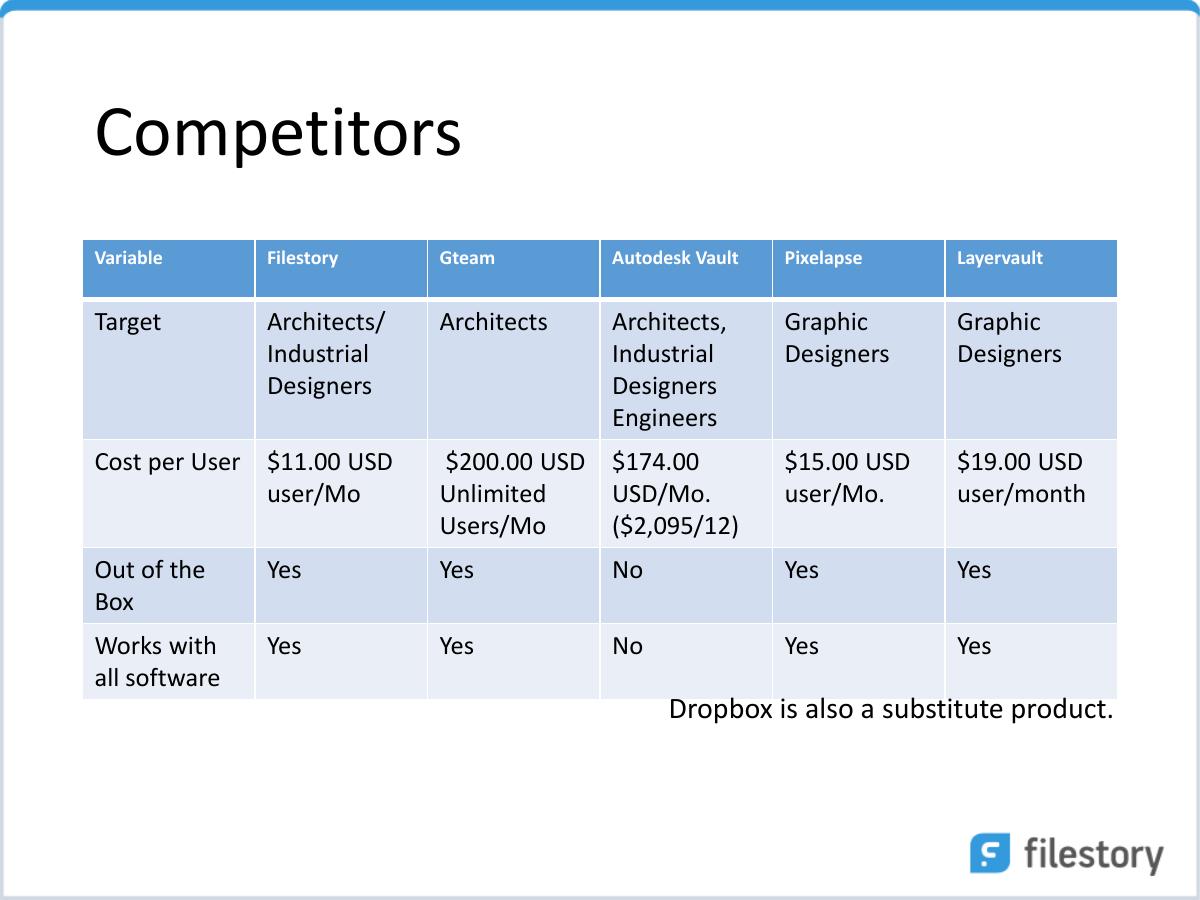
File versioning for architects and industrial designers, tagged as real estate in our library. Slide titled "Competitors".
Filestory deck, slide 5. Exact stored slide matched to this analysis.
Our analysis: The most complete table here: Filestory has its own row, a price column, and it admits Gteam, Pixelapse and Layervault match it on both features.
Evidence and limitation: Prices are the company's own reading of rivals' plans; no date or source is given. Autodesk Vault's $174 is annual $2,095 divided by 12, and Gteam's $200 covers unlimited users, so the prices are not all per user.
What a founder can adapt: Give every rival and yourself a row, one price column on the same basis, and a note on the free or generic tool customers fall back on.
Supporting analysis
What the deck claims: Table: Filestory (target architects/industrial designers; $11.00 USD user/Mo; out of the box yes; works with all software yes), Gteam (architects; $200.00 USD unlimited users/Mo; yes; yes), Autodesk Vault (architects, industrial designers, engineers; $174.00 USD/Mo ($2,095/12); no; no), Pixelapse (graphic designers; $15.00 USD user/Mo; yes; yes), Layervault (graphic designers; $19.00 USD user/month). "Dropbox is also a substitute product."
Presentation choice: An investor can see where Filestory wins (price for small teams, against Autodesk on setup) and where it does not. Naming Dropbox as a substitute is honest.
When it does not fit: Mixing per-user and flat team prices without saying so: for a 20-person firm Gteam's $200 flat is cheaper than $11 per user. Filestory is a design-software tool that our library files under real estate.
Student housing near a university campus. Slide titled "Market Summary: Competition".
Luxe Living deck, slide 5. Exact stored slide matched to this analysis.
Our analysis: It names the real local options a student would compare, with rent and a specific complaint for each.
Evidence and limitation: No source for the rents or the student concerns (survey, reviews or the founders' view is not stated), and no date.
What a founder can adapt: List the nearby properties or operators your tenant would tour, their rent, and the complaint you fix; add your own planned rent and answer.
Supporting analysis
What the deck claims: "Michael Goodman (4th & Adams Development) - Average Rent: $750.00 - Amenities: Community Pool - Student Concerns: Safety. Casa Bonita - Average Rent: $650.00 - Amenities: Large number of rooms - Student Concerns: Poor Quality of Homes/Safety. Local Apartments (Ex. Sam Hughes Place) - Average Rent: Approximately $900.00 - Student Concerns: Size/Lack of independence/Price."
Presentation choice: For a property business the competitors are the buildings down the street. Rent plus a named concern is exactly what a renter weighs.
When it does not fit: The slide has no line for Luxe Living's rent or how it addresses safety, so a reader cannot see where it sits between $650 and $900. Say where the concerns come from.
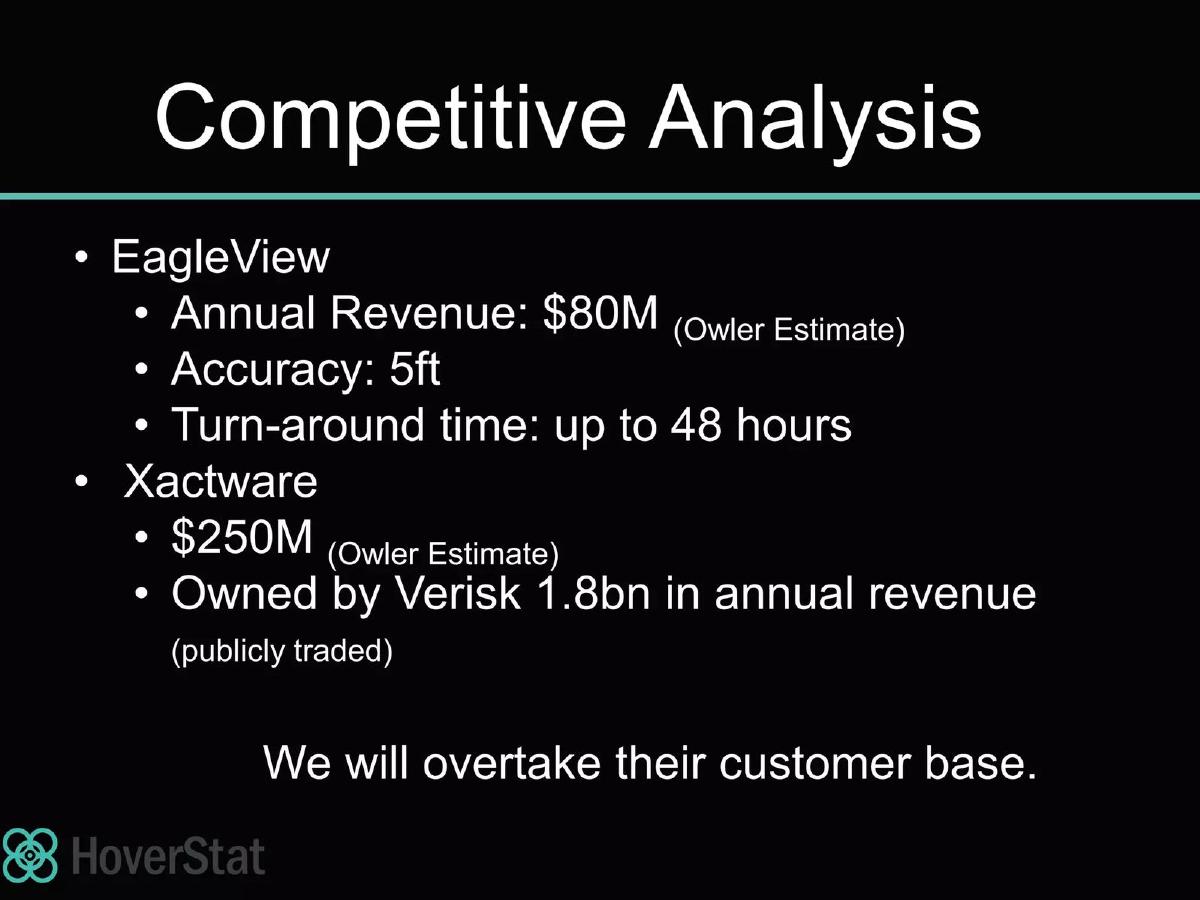
Drone roof measurement for roofing and insurance, tagged as real estate in our library. Slide titled "Competitive Analysis".
HoverStat deck, slide 6. Exact stored slide matched to this analysis.
Our analysis: It names the two incumbents that matter and gives a concrete measure for one, then stops before the comparison.
Evidence and limitation: Revenue figures are labelled Owler estimates; the accuracy and turnaround figures have no source. HoverStat's own accuracy and turnaround are not on this slide.
What a founder can adapt: Quote the incumbent's accuracy and turnaround, then yours on the same job, and say how you measured both.
Supporting analysis
What the deck claims: "EagleView - Annual Revenue: $80M (Owler Estimate) - Accuracy: 5ft - Turn-around time: up to 48 hours. Xactware - $250M (Owler Estimate) - Owned by Verisk 1.8bn in annual revenue (publicly traded). We will overtake their customer base."
Presentation choice: Accuracy in feet and turnaround in hours are exactly the right measures; the slide only needs HoverStat's own numbers beside them.
When it does not fit: "We will overtake their customer base" is a goal, not evidence. Rival revenue shows their size, not your advantage.
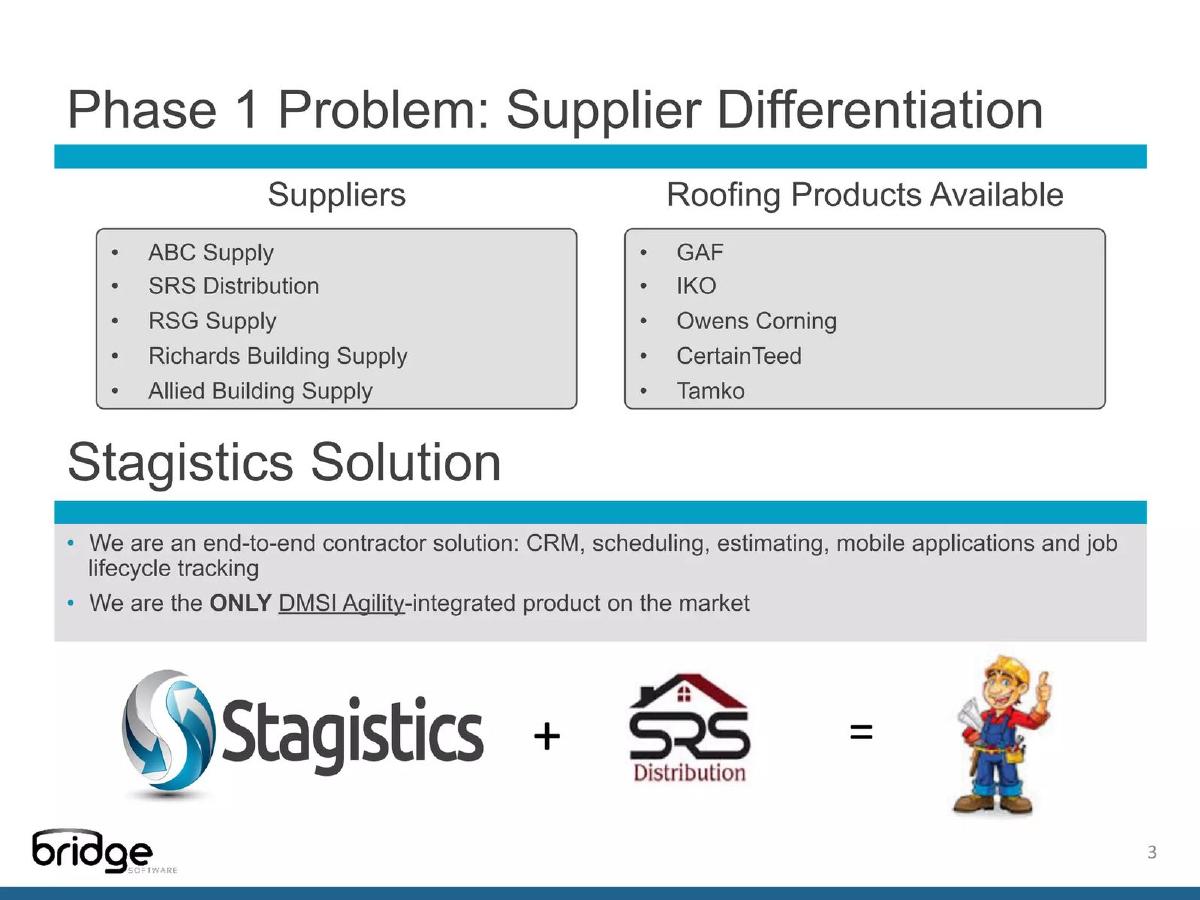
Software for roofing contractors, tagged as real estate in our library. Slide titled "Phase 1 Problem: Supplier Differentiation" with a "Stagistics Solution" section.
Bridge Software deck, slide 3. Exact stored slide matched to this analysis.
Our analysis: Its one competitive claim is a specific integration, which is testable, but no competing contractor software is named.
Evidence and limitation: The "ONLY" claim has no source or date. The named companies are suppliers and manufacturers, not software rivals.
What a founder can adapt: Keep the integration claim, then name two or three contractor software products and show which lack it.
Supporting analysis
What the deck claims: Suppliers: ABC Supply, SRS Distribution, RSG Supply, Richards Building Supply, Allied Building Supply. Roofing products available: GAF, IKO, Owens Corning, CertainTeed, Tamko. "We are an end-to-end contractor solution: CRM, scheduling, estimating, mobile applications and job lifecycle tracking. We are the ONLY DMSI Agility-integrated product on the market." Graphic: Stagistics + SRS Distribution = a contractor.
Presentation choice: Shown as weaker: a named integration is a real differentiator, but a reader cannot tell who else sells CRM and estimating to roofers.
When it does not fit: Lists of suppliers on a slide meant to show differentiation, and an "only" claim without saying how you checked.
Roommate screening service. Slide titled "Business Plan Highlights".
RoommateFax deck, slide 5. Exact stored slide matched to this analysis.
Our analysis: Competition is one bubble among five, stated as an advantage with nothing behind it.
Evidence and limitation: None. The indirect competitors are not named, and "41 Million people" has no source or definition.
What a founder can adapt: Name the indirect options, such as roommate listing sites or tenant screening firms, and say why a renter would pay you instead.
Supporting analysis
What the deck claims: Five bubbles around "Business Plan highlights": "41 Million people and growing", "Only indirect Competition", "Low Start-up costs, huge upside", "No physical Products & Few employees", "Easy to Scale".
Presentation choice: Shown for contrast: "only indirect competition" makes an investor ask what renters use today (listing sites, social groups, background-check services).
When it does not fit: Claiming little competition without naming the alternatives; it reads as not having looked.
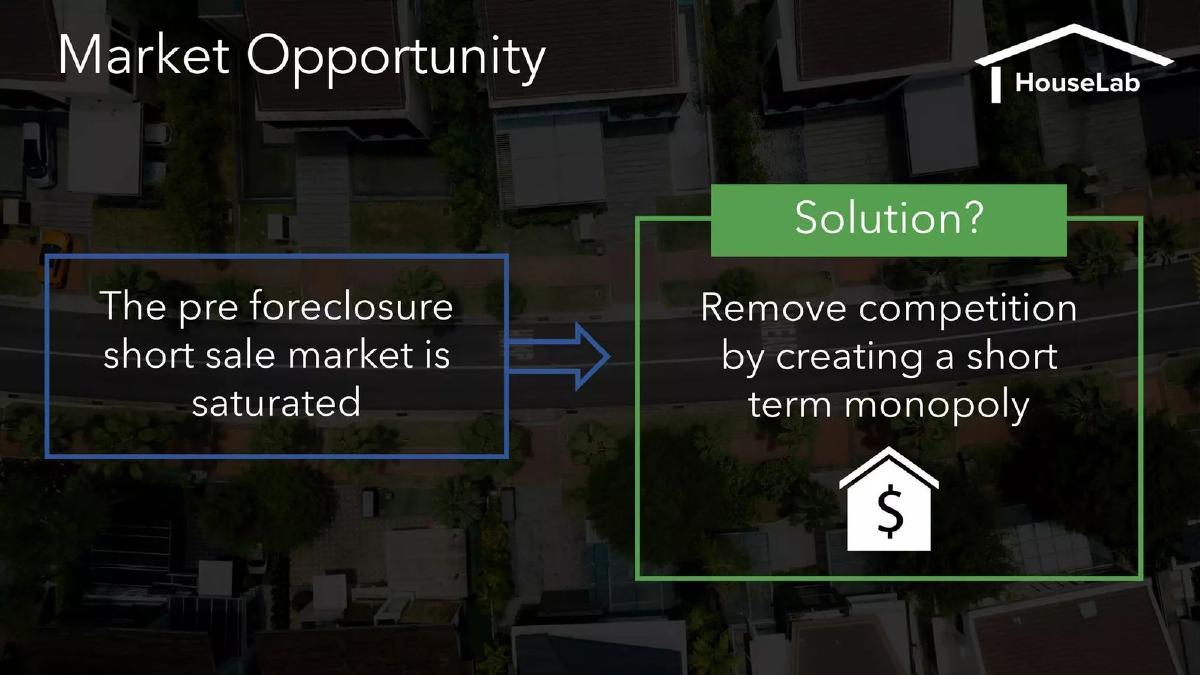
HouseLab deck, slide 3. Exact stored slide matched to this analysis.
Our analysis: It admits a crowded market, which is honest, but answers it with a slogan.
Evidence and limitation: No rivals, figures or explanation of how the monopoly would be created.
What a founder can adapt: Name who else buys pre-foreclosure homes (local investors, iBuyers, wholesalers) and state the specific edge that wins deals, such as speed to offer or access to sellers.
Supporting analysis
What the deck claims: "The pre foreclosure short sale market is saturated" leading to "Solution? Remove competition by creating a short term monopoly."
Presentation choice: Shown as the weakest: "saturated" is the most important fact on the slide, and it is left without names or numbers.
When it does not fit: Promising to remove competition without saying how; investors hear a risk, not a plan.
Whether each slide names the alternatives, includes itself in a concrete comparison, and gives a basis.
Example
Alternatives named
Own row in comparison
Evidence or source
Filestory
Yes (four rivals + Dropbox)
Yes (price, two features)
No
Luxe Living
Yes (three local options)
No
No
HoverStat
Yes (two incumbents)
No
Partly (Owler estimates)
Bridge Software
No (suppliers only)
Partly (one integration)
No
RoommateFax
No
No
No
HouseLab
No
No
No
Key Takeaways
Put your own row in the comparison, with the same measures as your rivals.
Compare on what the customer pays or waits for: price per user, rent, turnaround.
Name local and substitute options (a nearby apartment block, Dropbox), not only startups.
If you quote rivals' accuracy or speed, give yours on the same scale.
"Only indirect competition" invites the question of what customers do today.
Build your real estate competition slide
Start from what your customer would do if you did not exist.
Customer. Who is the buyer: renter, landlord, agent, contractor, insurer?
Alternatives. Which local operators, incumbents, brokers or generic tools do they use today?
Measures. Which two or three matter most: price or rent, turnaround, accuracy, fees, quality?
Your row. What are your figures on the same measures, and how were they measured?
Where you lose. Where does a rival or incumbent beat you, and why will customers still choose you?
Copyable framework: [Customer] today uses [rival A] ([price/measure]) or [rival B] ([price/measure]). We offer [our price/measure] because [reason]. Figures from [source], [date].
Illustrative example 1 — written by us
Before: Only indirect competition.
After: Renters looking for roommates use free listing sites (no screening) or pay $30 to $50 per background check through tenant screening firms. We screen both roommates for $25 each within 24 hours. Prices checked June 2026.
What improved: Our illustrative rewrite; figures are invented for the example. It names the real alternatives, compares on price and speed, includes its own row and dates the check.
What this guide adds
The general competition slide guide covers any business. Real estate adds two things: many competitors are local and never raise venture money, and big incumbents (listing sites, data providers, large landlords) are often the real threat. Both belong on the slide.
The real estate problem, solution, product, market, business model and traction guides cover other slides from similar decks. Here we look only at how each deck handles rivals and alternatives.
How we read each slide
We quote the text on the stored slide images. We have not checked any rival's price, rent or revenue. Only HoverStat names a source for its figures (Owler estimates).
Common mistakes
No row for yourself. Luxe Living and HoverStat describe rivals well but never show their own numbers beside them.
Mixed price bases. Say whether a price is per user, per team or per year; Filestory's table mixes all three.
"Only" and "no competition" claims. Name the alternatives and say how you checked.
Suppliers mistaken for rivals. Partners and suppliers belong on a different slide.
Slogans for strategy. "Remove competition" needs a mechanism.
Diagnostic checklist
Names the local, incumbent and substitute options customers use.
Includes your own row on the same measures.
Compares on price, rent, turnaround or accuracy.
States where each figure comes from and when.
Admits at least one place a rival is as good or better.
Frequently asked questions
What should a real estate startup put on its competition slide?
The options customers use today, local operators, incumbents and generic tools, compared on price or rent and one or two service measures, with a row for yourself. Filestory's table with prices and a Dropbox note is the closest example here.
Should a property startup list local landlords as competitors?
Yes, if renters compare you with them. Luxe Living lists three nearby student-housing options with average rent and what students dislike about each.
Is it fine to say there is only indirect competition?
Only if you name the indirect options and show why customers switch. RoommateFax says "only indirect competition" without naming any, which leaves the question open.
How we chose these examples
Corpus: published pitch deck teardowns on StartupFundraising.com. Founder-uploaded private decks are excluded.
Selection (2026-09-27): we searched extracted slide text in decks tagged real estate (proptech) for competition, competitors, competitive landscape, alternatives, differentiation and "vs". About 25 slides matched; most were market, problem or portfolio slides.
Kept six with stored slide images. Excluded: Endpoint p6 and Neighborhood Match (already used or no stored image for the competition slide; no new uploads requested), Koala p10 (no stored image), Campus Crest and CCG student-housing portfolio slides (listed-company or bank decks), and slides that used "competition" only in passing (BidFlat48, Smart Host).
Filestory, HoverStat and Bridge Software sell to architects, roofers and contractors and are tagged as real estate in our library; the guide says so.
Review: stored slide text and images were checked on 2026-09-27 and matched to company, deck and slide number (editorial model review). No person has yet completed an editorial review of this page. We make no claim that any slide caused a fundraising outcome.