Bridge Software's deck for their Stagistics platform focuses on solving the 'Supplier Differentiation' problem in the roofing and home improvement sector. By positioning themselves as the only DMSI Agility-integrated product, they aim to lock in distributors who then provide the software to contractors for free. The deck relies heavily on a single pilot case study in Colorado, showing a growth from 1 to 44 contractor companies over six months in early 2015. While the revenue figures are modest—peaking at $2,845 in June 2015—the deck highlights a massive untapped pipeline of 188 non-integrated…
Key takeaways
- The company identifies a lack of differentiation among major suppliers like ABC Supply and SRS Distribution as a core market problem (Slide 3).
- Stagistics claims a technical moat by being the only product integrated with DMSI Agility, a specific industry ERP (Slide 3).
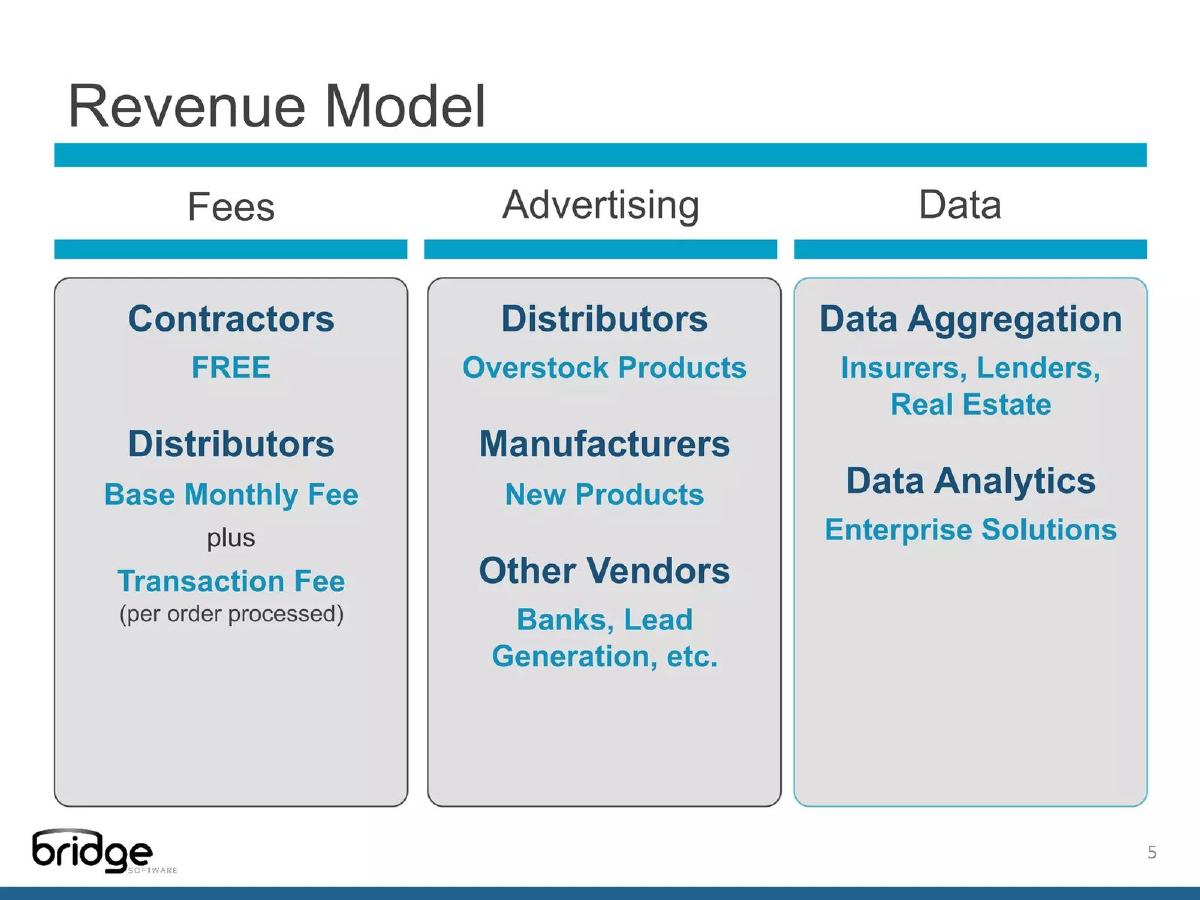
- The business model is a 'freemium' play for contractors, while charging distributors a base monthly fee plus transaction fees (Slide 5).
- Secondary revenue streams include advertising for manufacturers and data aggregation for insurers and lenders (Slide 5).
- A pilot program in Colorado resulted in 398 users and 93 completed transactions by June 30, 2015 (Slide 7).
- Monthly revenue grew from $1,277 in January to $4,845 in June 2015, split between fixed fees and transaction volume (Slide 9).
- The deck highlights a significant expansion opportunity with 188 SRS/RBS branches not yet integrated (Slide 9).
- The deck lacks a formal team slide, financial projections beyond 2015, and a specific capital 'ask' or valuation (Slides 1-13).
Executive Summary: The Integration-First Vertical SaaS
Bridge Software’s deck for Stagistics is a classic example of a vertical SaaS play that seeks to solve a 'commoditization' problem. In the roofing and home improvement industry, suppliers often sell the exact same brands. Stagistics positions itself as the value-added layer that allows a distributor to win contractor loyalty through better technology rather than just price competition. The deck is data-heavy regarding a specific pilot but light on the broader corporate vision and team credentials.
Slide 1: Title and Value Proposition
The cover slide introduces Stagistics as "Solutions for the Home Improvement Industry." It defines the product as a "Comprehensive software platform and Big Data analytics for contractors & building material suppliers." The branding is consistent, featuring the Bridge Software parent logo in the corner. The URL stagistics.com is prominently displayed, establishing the product as the primary brand for the market.
Slide 3: The Problem and The Solution
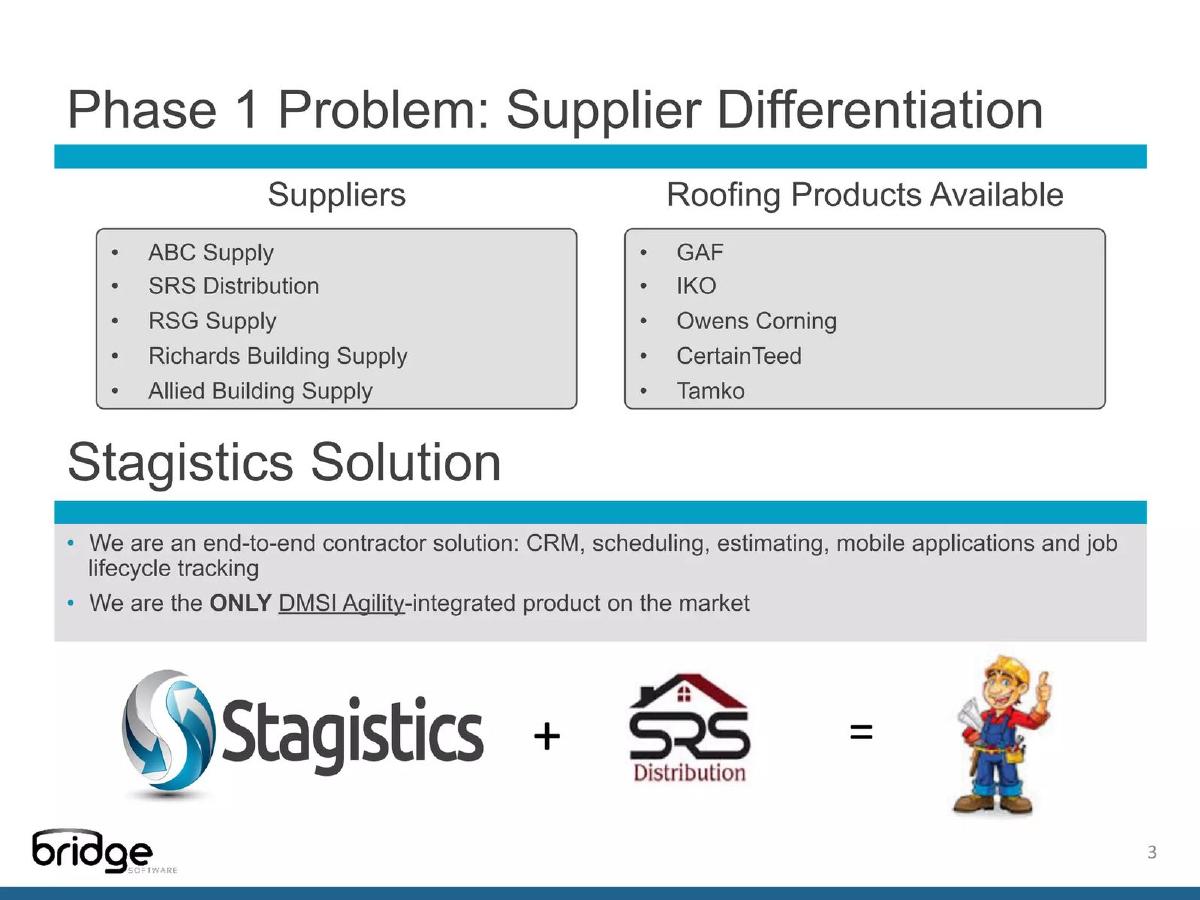
Slide 3, titled "Phase 1 Problem: Supplier Differentiation," identifies a specific pain point in the supply chain. It lists five major suppliers (ABC Supply, SRS Distribution, RSG Supply, Richards Building Supply, and Allied Building Supply) and five major roofing brands (GAF, IKO, Owens Corning, CertainTeed, and Tamko). The implication is that because every supplier carries every brand, they have no competitive edge.
The solution is presented as an end-to-end contractor tool covering CRM, scheduling, estimating, and mobile apps. The most significant claim on this slide is that Stagistics is the "ONLY DMSI Agility-integrated product on the market." This suggests a technical barrier to entry and a deep integration into the ERP systems that distributors already use.
Slide 5: Revenue Model
The revenue model is divided into three categories: Fees, Advertising, and Data. Fees: Contractors get the software for free, which lowers the barrier to adoption. Revenue is generated from distributors via a "Base Monthly Fee" and a "Transaction Fee" per order. This aligns the company’s success with the volume of materials moved through the platform. Advertising: The platform acts as a marketplace where distributors can advertise overstock and manufacturers can promote new products to the contractors using the app. Data: The company intends to aggregate data for third parties like insurers and lenders, moving beyond a simple tool into a data play.
Slide 7: Case Study - Shake & Shingle, Colorado
This slide provides a granular look at a pilot program with SRS Distribution’s Shake & Shingle branches. The data, current through 6/30/2015, shows a timeline of growth:
1/28: 1st branch visit. · 1/29: 1st signup. · 2/10: 1st order placed. · 3/17: Created first onboarding and training process. · 5/15: Formalized onboarding and sales process.
The results show 44 contractor companies and 398 users were onboarded, resulting in 93 completed transactions and 558 leads. The chart shows a steady upward trend in both transactions and contractor signups over the six-month period.
Slide 9: Progress to Date
Slide 9 expands the data to the entire company. It shows "Section Deliveries by Supplier Type," distinguishing between integrated and non-integrated deliveries. In June 2015, integrated deliveries reached 89, while non-integrated reached 178. The revenue chart shows a jump from $1,277 in January to $4,845 in June. The revenue is split between the "Monthly Fee" (which remains stable at $2,000 from April to June) and the "Transaction Fee" (which grew to $2,845). The slide concludes with "High Visibility Growth Potential," noting that 188 SRS/RBS branches are not yet integrated and a new pilot with ABC Supply started in July 2015.
Slide 11: The Evolution of an Industry
This is a transition slide featuring a high-resolution image of a contractor’s tool belt with a tablet tucked into a pouch. It serves as a visual metaphor for the digitization of a traditionally manual trade. There is no text on this slide other than the header, intended to signal the shift toward mobile technology in the field.
Slide 13: Contact Information
The final slide provides the office address in Brentwood, MO, and direct contact details for Michael D. Braun and Geoffrey G. Jones. It includes their email addresses and phone numbers. Notably, this is the only place where the leadership is mentioned, as there is no dedicated team slide in the provided sequence.
What Bridge Software Does Well
The deck excels at identifying a niche technical moat . By highlighting the DMSI Agility integration, the founders show they understand the specific software ecosystem of their target market. Investors in vertical SaaS look for these types of 'hooks' that make the software difficult to displace once installed.
The transparency of the pilot data is also a strength. Instead of vague projections, the deck shows exactly how long it took to get the first order and how the onboarding process was formalized over time. This provides a realistic roadmap for how the company intends to scale to the other 188 branches mentioned on Slide 9.
What is Missing from the Deck
Despite the strong pilot data, the deck has significant gaps that would make a professional fundraise difficult:
No Team Slide: We see names on the contact slide, but no resumes. In early-stage SaaS, the 'who' is often as important as the 'what.' Are these industry veterans or software engineers? The deck doesn't say. · No Market Size: There is no mention of the Total Addressable Market (TAM). While they mention 188 branches of one specific distributor, they don't quantify the total number of distributors or the total dollar volume of the home improvement supply chain. · No Competition: The deck assumes a vacuum. It doesn't address other contractor CRM tools or legacy systems that might compete for the contractor's attention. · No Ask: The most glaring omission is the lack of a funding request. There is no mention of how much money is being raised, the valuation, or the specific milestones the capital will fund.
Founder's Takeaway: Copy the 'Integration Hook'
Founders building in 'unsexy' industries like construction or logistics should copy the way Bridge Software identifies a specific ERP integration as a competitive advantage. Most startups try to sell a standalone tool; Bridge Software sells a tool that talks to the software the supplier already pays for. This reduces friction and creates a 'lock-in' effect. However, founders should ensure they include a robust team slide and a clear financial ask, both of which are missing here, to turn a product update into a true investment vehicle.
Frequently asked questions
- What is the primary product offered by Bridge Software?
- The primary product is Stagistics, described on Slide 1 as a comprehensive software platform and Big Data analytics tool for contractors and building material suppliers. It includes CRM, scheduling, estimating, and job lifecycle tracking. Its key competitive advantage, cited on Slide 3, is its integration with DMSI Agility, which allows it to sit directly within the supplier's existing workflow.
- How does Bridge Software make money?
- According to Slide 5, the revenue model is three-pronged. First, 'Fees': contractors use the software for free, while distributors pay a base monthly fee plus a transaction fee per order. Second, 'Advertising': distributors and manufacturers pay to promote overstock or new products. Third, 'Data': the company plans to sell aggregated data and analytics to insurers, lenders, and real estate firms.
- What traction does the deck demonstrate?
- Slide 9 shows that as of June 2015, the company had 14 integrated branches and 19 contractors active. Total monthly revenue reached $4,845 in June 2015, up from $1,277 in January. Slide 7 details a specific pilot with 'Shake & Shingle' in Colorado, which grew to 44 contractor companies and 398 users in five months.
- What are the biggest omissions in this pitch deck?
- The deck is missing several critical components for a professional fundraise. There is no 'Team' slide explaining the founders' backgrounds, no 'Market Size' (TAM/SAM/SOM) analysis, and no 'Competition' slide. Most importantly, there is no 'Ask' slide detailing how much capital is being raised or how it will be deployed to reach the 188 non-integrated branches mentioned on Slide 9.
- What is the 'Supplier Differentiation' problem mentioned in the deck?
- Slide 3 argues that major suppliers (like ABC Supply and SRS Distribution) all carry the same roofing products (like GAF, IKO, and Owens Corning). Because the inventory is identical, suppliers struggle to differentiate. Stagistics solves this by providing a superior digital experience and integration that makes a contractor more likely to stick with a specific distributor who offers the tool.