Bright.md addresses the 'crushing provider shortage' in healthcare, which they project will reach a shortfall of 130,600 physicians by 2025. The deck argues that traditional EMRs and video-based telehealth fail to improve productivity, as video visits take as much time as in-person ones. Their solution, SmartExam, automates 90% of the clinical workflow, reducing clinician time to under 2 minutes per encounter. With a reported 15-20x multiplier on physician capacity and a 90% patient satisfaction rate, the company demonstrates significant traction within major healthcare systems. Having raised…
Key takeaways
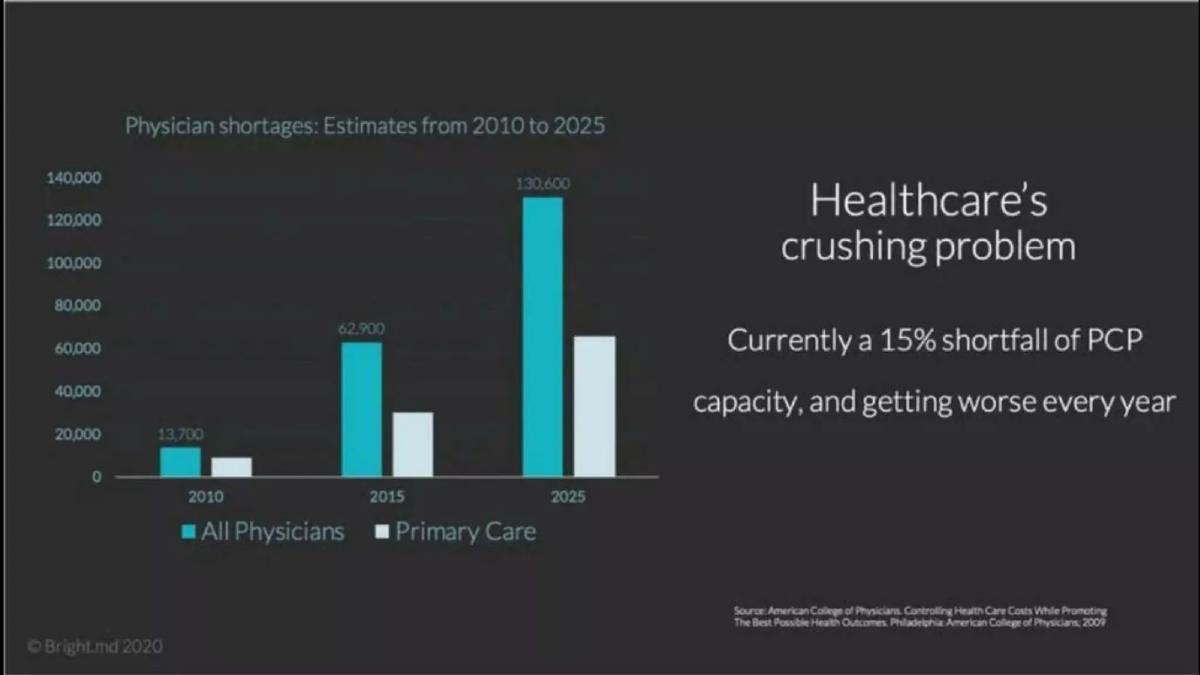
- The deck identifies a 15% shortfall in Primary Care Physician (PCP) capacity as a core market driver (Slide 3).
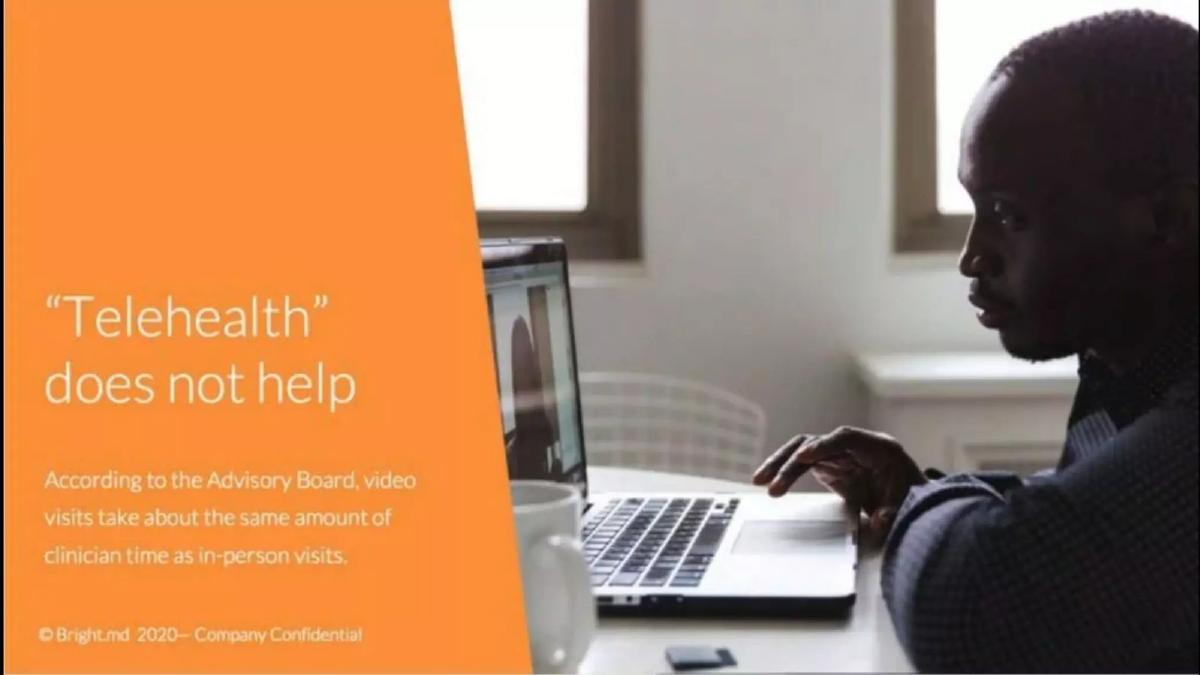
- Bright.md differentiates itself from video telehealth by stating video visits take the same amount of clinician time as in-person visits (Slide 5).
- The SmartExam platform claims to automate 90% of the work, allowing clinicians to complete encounters in less than 2 minutes (Slide 7).
- The solution provides a 15-20x multiplier on physician capacity with less than one hour of training required for proficiency (Slide 11).
- Reported outcomes include a 30% increase in new patient acquisition and a positive ROI in less than one year (Slide 12).
- The company has secured significant third-party validation, being named a 'Gartner Cool Vendor' and a 'Vendor to Watch' by Chilmark Research (Slides 16, 17).
- Bright.md had raised a total of $20M at the time of this deck, with the most recent round being $8M in August 2017 (Slide 19).
- The leadership team is led by Ray Costantini, MD, emphasizing a clinical-first approach to technical innovation (Slide 18).
Executive Summary: Automating the Clinical Encounter
Bright.md enters the market with a bold premise: telehealth is broken because it doesn't actually save time. The 2020 pitch deck focuses on 'Automating Healthcare Delivery' through their SmartExam platform. By shifting from synchronous video visits to asynchronous, AI-supported interviews, they claim to solve the fundamental math problem of modern medicine: more demand than capacity. The deck is structured to move from a macro-crisis (physician shortage) to a micro-solution (2-minute doctor visits) and concludes with heavy validation from industry analysts.
The Macro Problem: A Crushing Shortage
Slide 1: Title The deck opens with a clean, dark aesthetic. The tagline 'Automating Healthcare Delivery' immediately positions the company as a technology-first solution rather than a service-based healthcare provider.
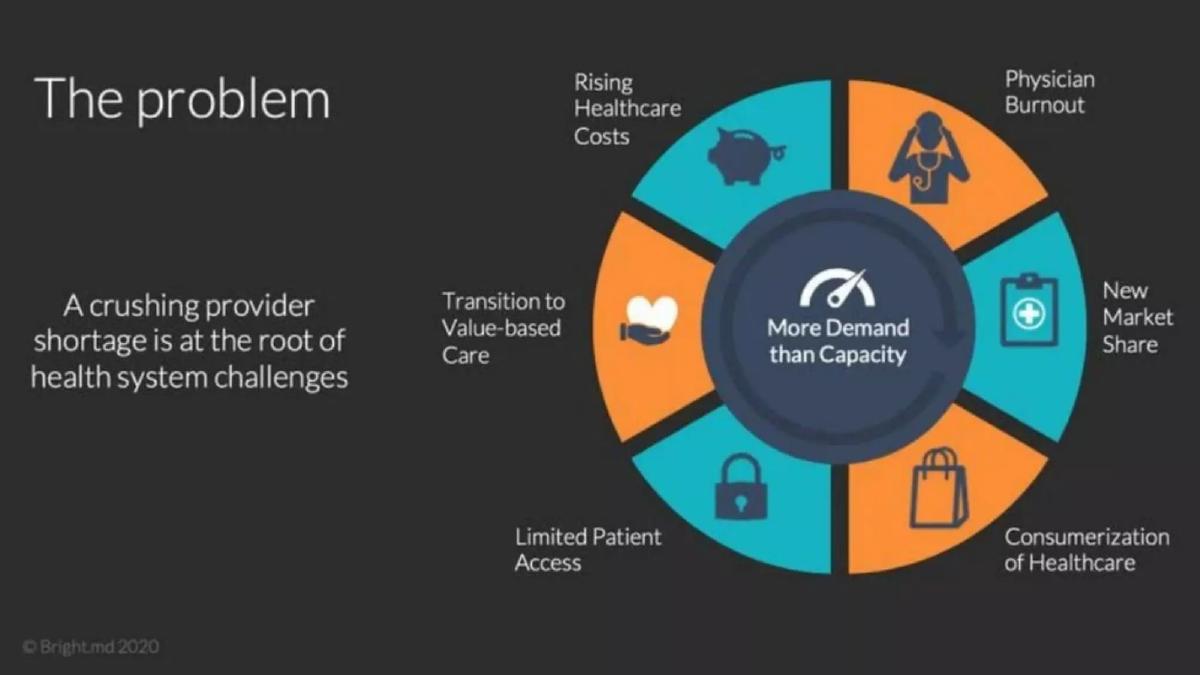
Slide 2: The Problem This slide uses a circular graphic to illustrate the 'crushing provider shortage' at the root of health system challenges. Key factors listed include rising costs, physician burnout, new market share competition, consumerization of healthcare, limited patient access, and the transition to value-based care. The central message is 'More Demand than Capacity.'
Slide 3: Physician Shortages The deck provides hard data to back up the problem. Citing the American College of Physicians, it shows a bar chart where total physician shortages grow from 13,700 in 2010 to a projected 130,600 by 2025. It specifically notes a '15% shortfall of PCP capacity' that is worsening annually.
The Failure of Current Solutions
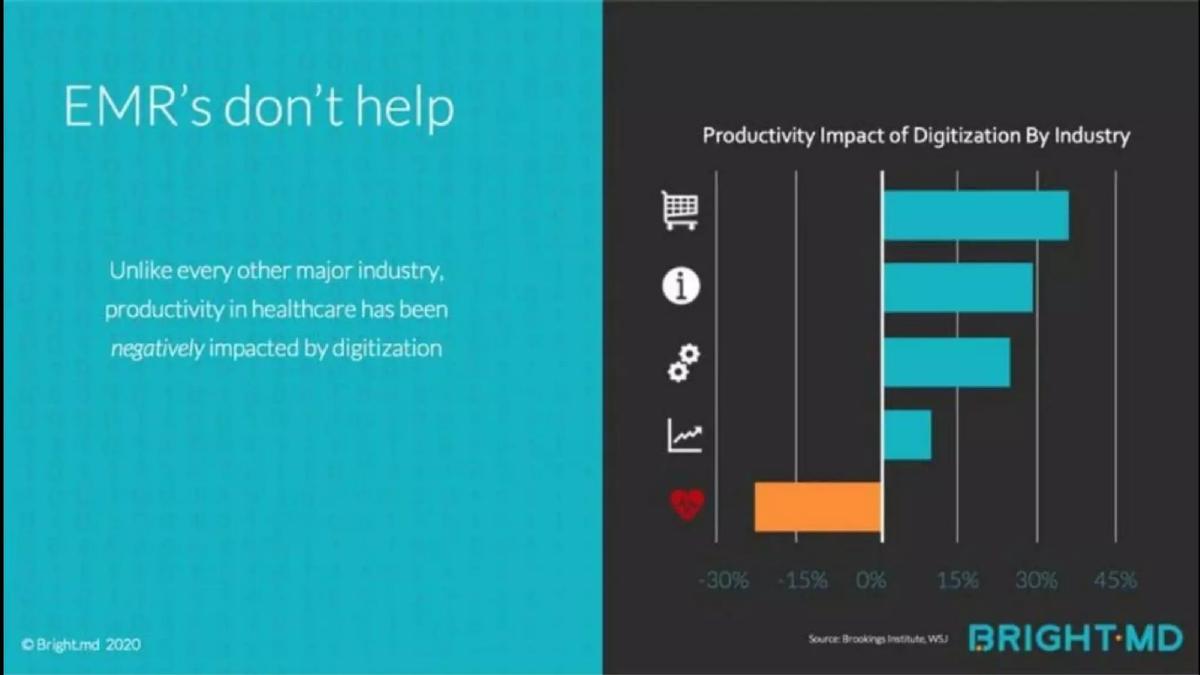
Slide 4: EMRs don't help In a striking comparison, Bright.md cites the Brookings Institute and WSJ to show that healthcare is the only industry where digitization has led to a productivity decrease (roughly -15%). This sets the stage for why simply 'going digital' isn't enough; the workflow itself must change.
Slide 5: "Telehealth" does not help This is the deck's most critical pivot. It challenges the status quo of video-based telehealth. Citing the Advisory Board, it states that video visits take about the same amount of clinician time as in-person visits. This effectively categorizes competitors like Teladoc or Amwell as 'service' companies that don't solve the capacity crisis.
The Solution: SmartExam
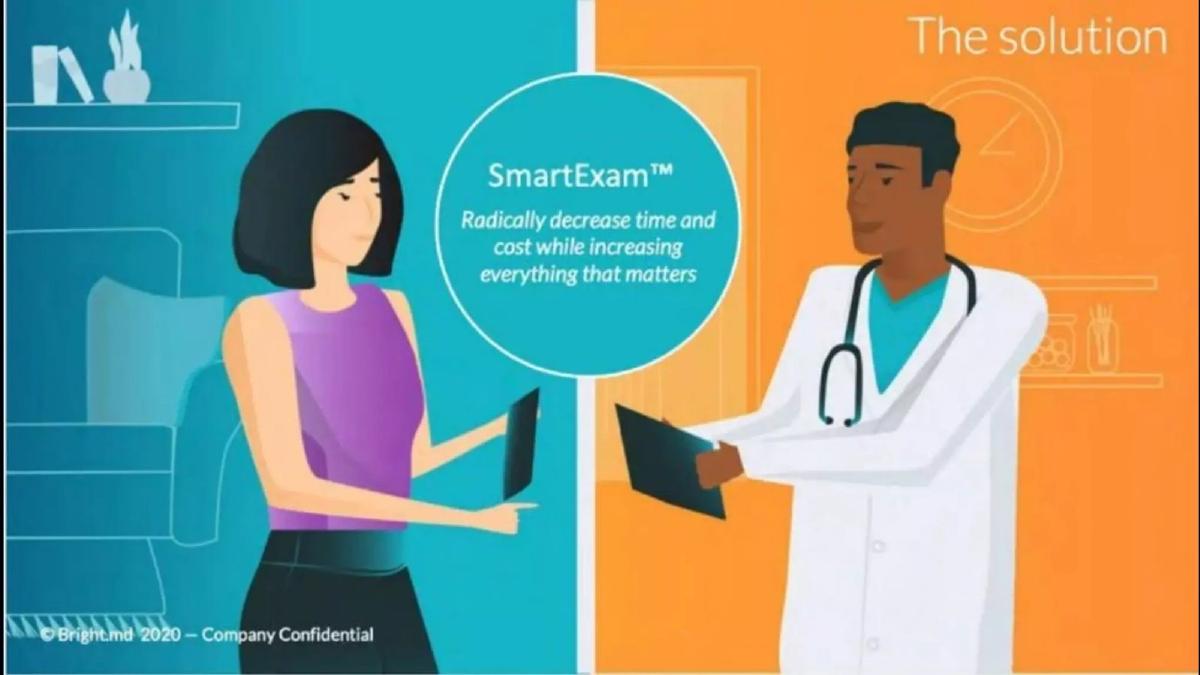
Slide 6: The solution Bright.md introduces SmartExam. The graphic shows a patient and a doctor separated by a digital interface. The promise is to 'radically decrease time and cost while increasing everything that matters.'
Slide 7: Why We are Special This slide breaks down the workflow. The patient spends 10 minutes on a smartphone/computer interview. The clinician then spends less than 2 minutes reviewing a generated provisional diagnosis and treatment plan. Finally, the system automates 90% of the work, including EMR integration, billing, and sending the After Visit Summary (AVS) to the patient.
Slide 8: The Patient Experience A mobile-first view of the patient journey. Features include eligibility checks, EHR review, clinical interviews, personalized diagnosis, prescriptions, referrals, and work excuse notes. The imagery emphasizes convenience and home-based care.
Slide 9: The Clinician Experience This slide shows what the doctor sees: an alert for patients in the queue, in-app EHR review, results of the clinical interview, and a 'chart-ready SOAP note.' This reinforces the 'under 2 minutes' claim by showing that the heavy lifting of documentation is already done.
Quantifying the Impact
Slide 10: Unique Benefits of SmartExam The company lists its 'unfair advantages':
15-20x multiplier on physician capacity. · Less than 1 hour to clinician proficiency. · COVID-19 evaluation based on CDC guidelines (timely for a 2020 deck). · Asynchronous, AI-supported care to reduce infection risk. · Built-in clinical decision support.
Slide 11: Proven Value This slide presents the 'meat' of the traction. It claims over 30% new patient acquisition, 90% patient satisfaction, and a positive ROI in less than a year. It also quantifies the value of 7 FTEs of clinical capacity at $1.75M.
Slide 12: All types of healthcare systems The company shows its versatility, stating it works for Fee-for-Service, Accountable Care Organizations (ACOs), Virtual-only, Small/Rural, For-profit, Not-for-profit, and Academic Medical Centers. This suggests a broad Total Addressable Market (TAM).
Validation and Social Proof
Slide 13: Accolades from Patients & Providers A standard testimonial slide. Quotes highlight the speed ('took me 15 minutes' vs '3 hours' at a clinic) and the thoroughness of the automated history taking.
Slide 14: Recognition A logo wall featuring WSJ, Gartner, Forrester, Wired, Bloomberg, and HIMSS. This builds institutional credibility.
Slide 15: Chilmark Research A deep dive into a specific analyst report from November 2019. It quotes Chilmark naming Bright.md a 'Vendor to Watch' and notes that the U.S. primary care system no longer meets needs.
Slide 16: Gartner Another validation slide. Bright.md is highlighted as a 'Gartner Cool Vendor in Healthcare' and described as 'Transformational' in its ability to increase satisfaction and deliver high-quality care.
Market Positioning and Team
Slide 17: Uniquely Positioned The competitive landscape 2x2. Bright.md places itself in the top-right (High Efficiency / Platform). Most other 'bubbles' (competitors) are in the 'Service' and 'Low Efficiency' quadrants. The bubble size represents visit volume supported by clinical scope, showing Bright.md as a significant player.
Slide 18: Leadership Team The team is led by Ray Costantini, MD (Founder & CEO) and Mark Swinth (Founder & CFO). The slide emphasizes collective skills in clinical expertise, virtual care, and growth scaling. It includes VPs for Marketing, Engineering, Customer Success, and Sales.
Slide 19: Capitalization History The company discloses a total of $20M raised. The most recent round was $8M in August 2017. Investors include B Capital Group and Pritzker Group. This slide is a bit dated for a 2020 deck, suggesting they might have been in the market for a new round at the time of presentation.
Slide 20: Contact A simple closing slide with the website and CEO's email address.
What Bright.md Does Well
The deck is exceptionally strong at identifying a 'gap in the gap.' While most of the world was celebrating the rise of telehealth in 2020, Bright.md was pointing out its fundamental flaw: it doesn't scale. By focusing on clinician time as the scarcest resource in healthcare, they create a compelling economic argument for their platform. The use of third-party validation (Gartner, Chilmark) is extensive and effective, moving the conversation from 'startup claim' to 'industry trend.'
What is Missing
The deck lacks a clear 'Ask' slide. While it mentions capitalization history, it doesn't specify how much they are currently raising or what the milestones for the next 18-24 months are. Additionally, there is no detailed breakdown of the business model—while they mention 'ROI,' they don't explicitly state if they charge per-visit, per-provider, or a flat licensing fee. Finally, for a platform claiming to automate 90% of the work, more detail on the 'AI' or the underlying clinical engine would help technical due diligence.
Founder's Playbook: What to Copy
Founders should look at Slide 5 as a masterclass in 'The Pivot.' By attacking the perceived solution (telehealth) as part of the problem, Bright.md creates a category of one. If you are entering a crowded market, don't just say you are better; say the current category is fundamentally incapable of solving the problem. Also, the 'Clinician Experience' vs. 'Patient Experience' slides (8 and 9) are excellent examples of showing, not just telling, how a product functions for different stakeholders.
Frequently asked questions
- What is the primary problem Bright.md is solving?
- Bright.md targets the physician shortage and the inefficiency of current digital tools. Slide 3 notes a projected shortage of 130,600 physicians by 2025. Slide 4 highlights that healthcare is the only major industry where digitization (EMRs) has negatively impacted productivity, and Slide 5 argues that video-based telehealth does not save clinician time.
- How does SmartExam actually work for a doctor?
- According to Slide 7, the process is largely automated. The patient takes a 10-minute digital interview. SmartExam then processes this to generate a provisional diagnosis, treatment plan, and chart note. The clinician spends less than 2 minutes reviewing and signing off, after which the system handles billing and sends instructions to the patient.
- What kind of ROI can healthcare systems expect?
- Slide 12 claims a positive ROI in less than a year. Specific metrics include delivering care at half the cost of a nurse advice line and creating the equivalent of 7 Full-Time Equivalent (FTE) clinical capacity, which the company values at $1.75M.
- Who are the investors in Bright.md?
- Slide 19 lists several venture capital firms: B Capital Group, Pritzker Group Venture Capital, Seven Peaks Ventures, Oregon Venture Fund, and SpringRock. The company had raised a total of $20M by the time this deck was circulated.
- How does the company view its competition?
- Slide 18 uses a 2x2 matrix comparing 'Business Model' (Service vs. Platform) and 'Efficiency' (Low vs. High). Bright.md positions itself in the top-right quadrant as a high-efficiency platform, while most competitors are clustered in the low-efficiency service quadrant (likely traditional telehealth providers).