Brightside’s Series A deck, dated December 2020, is a concise 8-slide presentation that prioritizes clinical validity over financial projections. The deck establishes a strong 'team-market fit' by highlighting veterans from 23andMe, Ginger, and Lyra. It frames the mental health crisis as a shift from generalist primary care to specialized, data-driven vertical solutions. The core of the pitch relies on a 'closed-loop' system for precision prescribing and treatment monitoring. Most notably, the deck concludes with dense clinical data showing an 80% improvement rate within 12 weeks. While it la…
Key takeaways
- The team slide (Slide 2) leverages massive brand equity from established digital health leaders like 23andMe, Lyra, and Ginger.
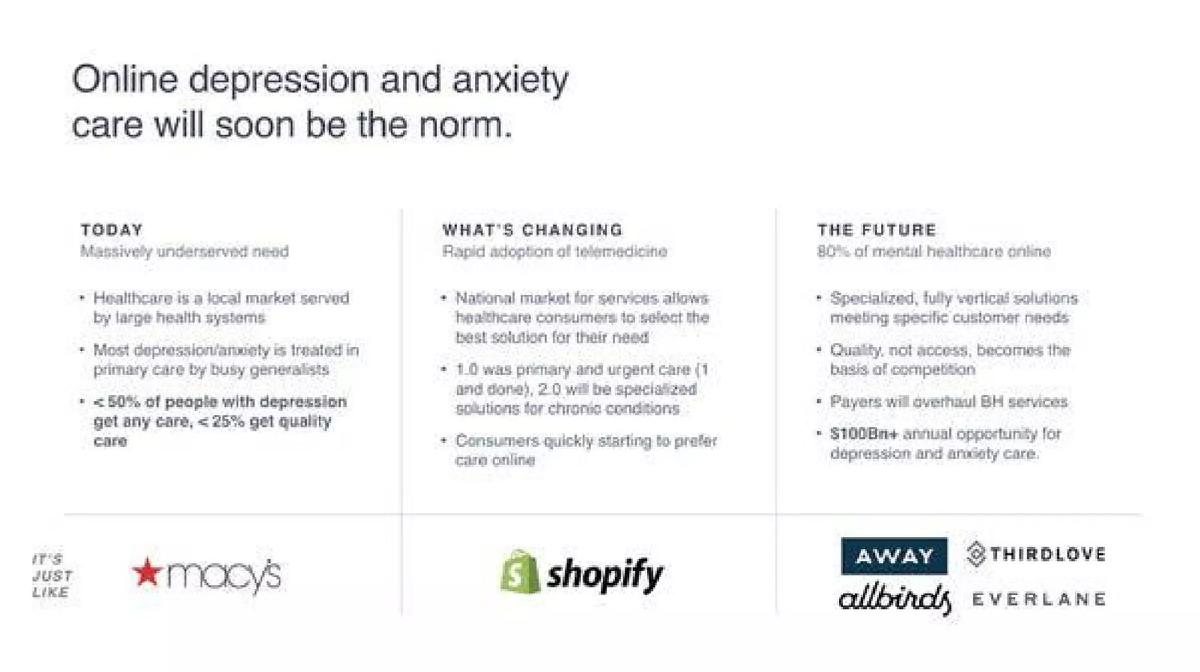
- Brightside identifies a $100Bn+ annual opportunity by moving mental health from local generalist care to specialized online verticals (Slide 3).
- The 'Big Insight' (Slide 4) focuses on the heterogeneity of depression, arguing that 'cookie-cutter' treatments are the primary cause of poor outcomes.
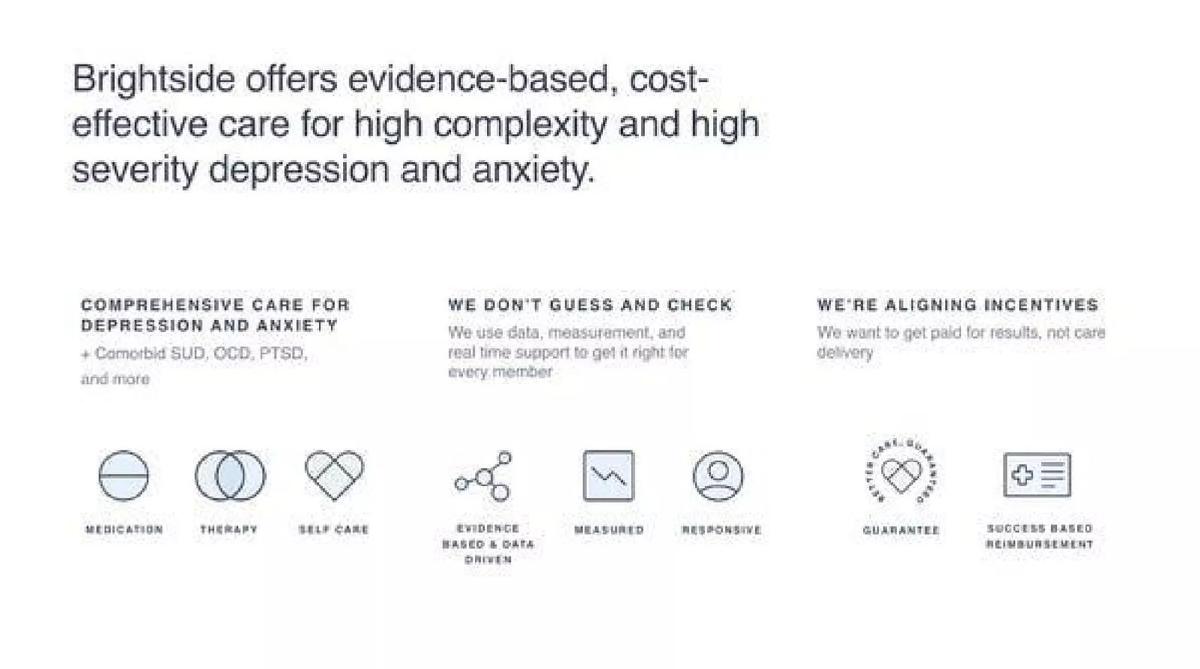
- The product is positioned as a 'Success Based Reimbursement' model, aligning incentives with patient results rather than just care delivery (Slide 5).
- The deck uses a 'closed-loop' diagram to explain how they use phenotypic data for precision medication selection (Slide 7).
- Clinical data is the climax of the deck, showing a reduction in suicidal ideation from 49% at baseline to 17% after 12 weeks (Slide 8).
- There is no mention of revenue, burn rate, or specific funding requirements within these 8 slides.
- The deck omits a traditional competitor matrix, choosing instead to compare the market shift to the evolution of retail (Macy's to Shopify to DTC brands) on Slide 3.
Brightside Series A Teardown: The Power of Clinical Proof
Brightside’s Series A deck is a focused, 8-slide presentation that leans heavily into the 'Specialized Health' thesis. In an era where telehealth was often seen as a commodity service for minor ailments, Brightside used this deck to position itself as a clinical-grade solution for high-severity depression and anxiety. The deck, dated December 2020, reflects a period when the market was shifting from 'access to care' to 'quality of outcomes.'
Slide 1: Title and Branding
The cover slide is minimalist, featuring the Brightside logo against a dark navy background. It clearly states 'Series A' and the date 'December 2020.' There are no taglines or value propositions here, which sets a professional, understated tone for the rest of the presentation.
Slide 2: The Pedigree Team
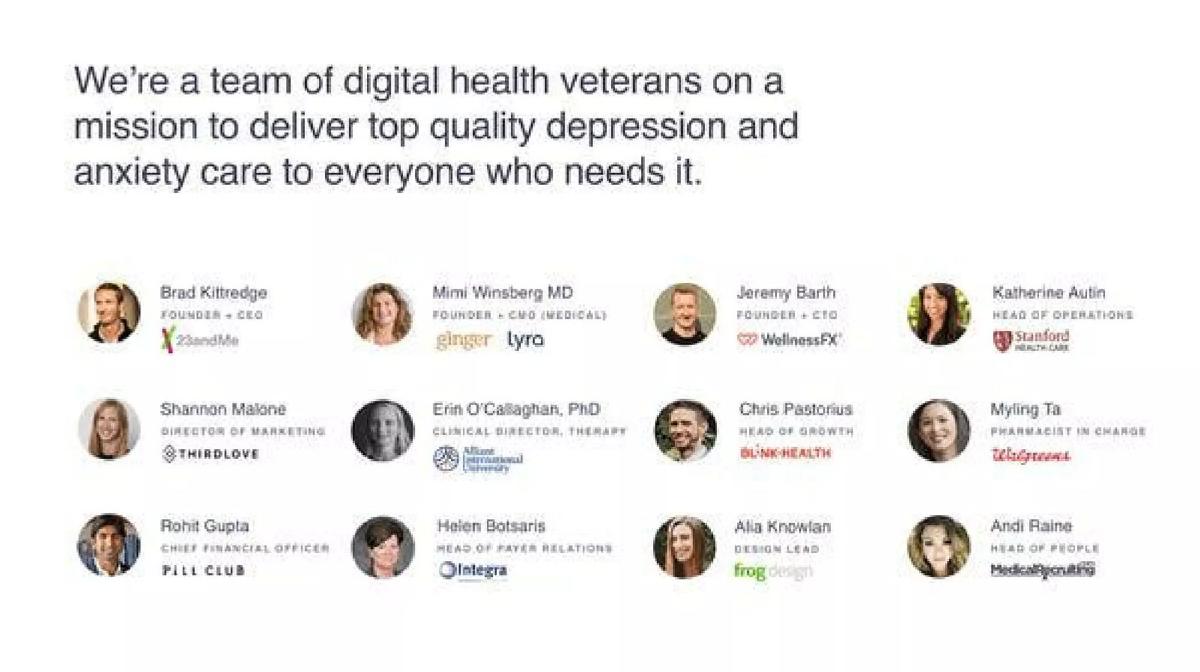
Brightside leads with its team, which is a strategic move for a Series A company in a regulated space. The headline identifies them as 'digital health veterans.' The slide features 12 team members, but the top row carries the most weight. CEO Brad Kittredge is linked to 23andMe , and CMO Mimi Winsberg is linked to Ginger and Lyra . By citing these specific, successful predecessors in the mental health and genomics space, Brightside immediately answers the 'Why you?' question. The presence of leaders from ThirdLove , Walgreens , and Stanford Health Care suggests a balance of consumer marketing, operational scale, and clinical excellence.
Slide 3: Market Evolution and the 'DTC' Healthcare Thesis
This slide is one of the most intellectually dense in the deck. It frames the current state of mental health as 'massively underserved' and 'local.' It then predicts a future where 80% of mental healthcare is online and specialized. The most interesting part of this slide is the bottom row, which uses a retail analogy. It compares the transition from Macy's (Generalist Health Systems) to Shopify (Telemedicine infrastructure) to vertical brands like Away , Allbirds , and Everlane . Brightside positions itself as the 'Everlane' of mental health—a specialized, vertical solution that competes on quality rather than just access. They value this annual opportunity at $100Bn+ .
Slide 4: The Big Insight
Slide 4 addresses the 'Problem' by identifying a 'Big Insight.' The claim is that depression and anxiety are 'highly heterogeneous' but are currently treated with a 'cookie-cutter' approach. The visual on the right—a network graph of nodes—suggests complexity. The core argument is that matching unique patient needs to specific treatments is the only way to deliver better outcomes, and in this market, 'outcomes are what truly matter.'
Slide 5: The Solution and Incentive Alignment
Brightside defines its offering as 'evidence-based, cost-effective care for high complexity and high severity' cases. They break their approach into three pillars: Comprehensive Care (medication, therapy, self-care), Data-Driven Precision ('We don't guess and check'), and Aligned Incentives . The mention of 'Success Based Reimbursement' is a critical signal to investors and payers. It suggests that Brightside is willing to be held accountable for patient recovery, a significant departure from the traditional fee-for-service model.
Slide 6: Product Interface and User Journey
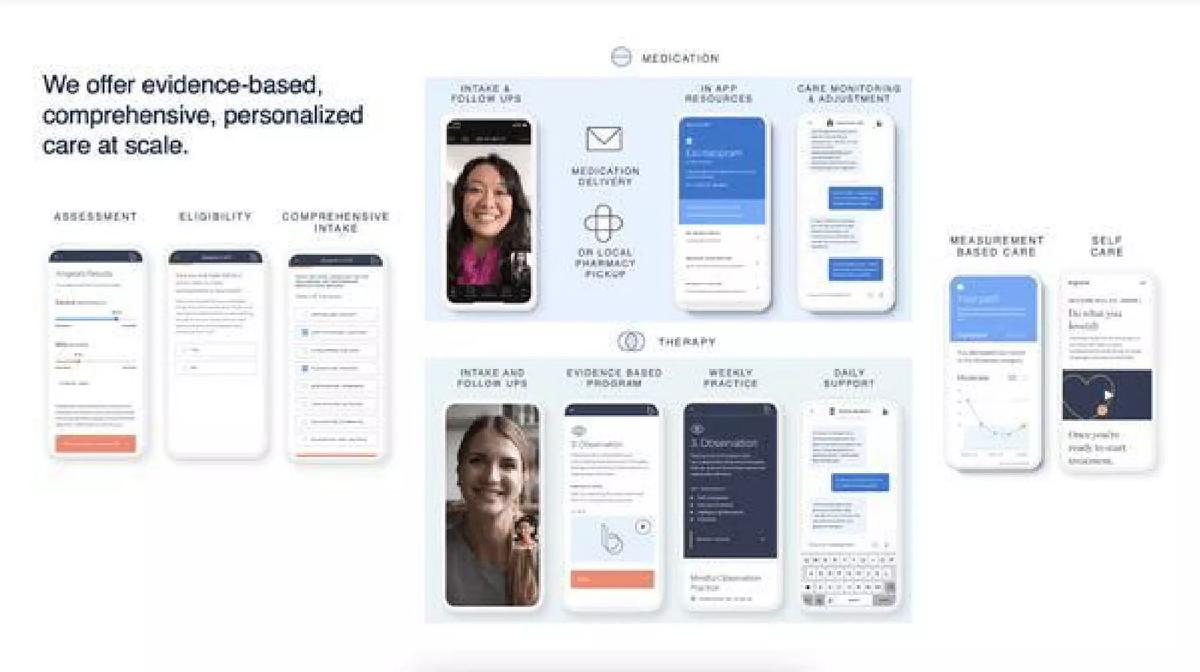
This slide provides a visual overview of the app. It shows the journey from Assessment and Eligibility to Comprehensive Intake . It highlights two distinct paths: Medication (with in-app resources and care monitoring) and Therapy (with evidence-based programs and daily support). The UI is clean and clinical, reinforcing the 'Financial Care' and 'Financial Health' category mentioned in the company's self-description, though the deck itself focuses entirely on mental health.
Slide 7: The Closed-Loop System
Slide 7 explains the 'how' behind their precision. They use 'phenotypic data' to identify symptom clusters and suggest medications. This is followed by 'Closed Loop Treatment Monitoring,' where frequent measurement triggers timely interventions. The circular diagram (Review trigger -> Case review -> Treatment adjustment -> Symptom monitoring) illustrates a proactive rather than reactive care model. This is the 'moat'—a proprietary data loop that theoretically improves with every patient treated.
Slide 8: Clinical Outcomes (The Climax)
The final slide is the most important for a Series A health-tech company. It presents hard data. '80% of members get better within 12 weeks' and '58% achieve remission levels.' The slide includes several charts showing the decline in PHQ-9 scores (a standard depression scale) across different cohorts: severe depression, suicidal ideation, and chronic health conditions. Specifically, it notes that suicidal ideation drops from 49% at baseline to 17% at 12 weeks . This level of clinical proof is rare in early-stage decks and likely served as the primary catalyst for their successful $72.2M funding history.
What Works in the Brightside Deck
Clinical Credibility: By using the PHQ-9 scale and showing remission rates, Brightside speaks the language of doctors and insurance payers, not just VCs. This builds immense trust.
The Retail Analogy: Comparing healthcare to the evolution of DTC retail (Macy's to Shopify to Away) is a brilliant way to simplify a complex market shift for investors who may not be healthcare experts.
Team-Market Fit: The team slide is exceptionally strong. Citing Ginger and Lyra—two of the biggest names in the space—proves that the founders have seen 'what good looks like' and are ready to iterate on it.
What is Missing from the Brightside Deck
Financials and Traction: There is no mention of MRR, ARR, number of active users, or customer acquisition cost (CAC). While clinical outcomes are a form of traction, the lack of business metrics is a notable omission.
The Business Model: The deck mentions 'Success Based Reimbursement' but doesn't explain the actual pricing. Is it a B2B2C model through employers? Direct to consumer? A per-member-per-month (PMPM) fee? The catalogue facts mention they focus on employers, but the deck is vague on this point.
The Ask: There is no slide detailing how much money they are raising or what they intend to do with the funds. This suggests this deck was either a teaser or part of a larger presentation where the 'Ask' was handled verbally or in a separate document.
What a Founder Should Copy
The 'Big Insight' Slide: Instead of a generic 'Problem' slide, use an 'Insight' slide. It shows that you have a unique perspective on the market that others are missing.
Outcome-Oriented Messaging: If you are in a crowded space (like telehealth), don't pitch 'features.' Pitch 'results.' Brightside’s focus on the 12-week remission rate is far more compelling than a list of app features.
Visualizing the 'Loop': If your product uses data to improve over time, use a closed-loop diagram like Slide 7. It visually demonstrates your 'flywheel' and makes the technical process of 'precision prescribing' easy to understand.
The Pedigree Anchor: If your team has worked at 'category kings' in your industry, put their logos next to their names. It transfers the credibility of those billion-dollar companies to your startup instantly.
Frequently asked questions
- How does Brightside differentiate itself from other telehealth platforms?
- Brightside differentiates through specialization and clinical rigor. Slide 3 explicitly states that '1.0 was primary and urgent care' while '2.0 will be specialized solutions for chronic conditions.' They focus on 'high complexity and high severity' cases rather than low-acuity wellness, using a data-driven 'closed-loop' system to adjust treatments based on frequent measurement rather than the 'guess and check' method of traditional generalists.
- What is the significance of the retail comparison on Slide 3?
- The deck uses a 'just like' analogy to explain market evolution. It compares the shift in healthcare to the shift in retail: from department stores (Macy's/Local Health Systems) to platform enablement (Shopify/Telemedicine) to specialized vertical brands (Allbirds, Away/Brightside). This helps investors understand that Brightside isn't just a platform, but a specialized 'Direct-to-Consumer' healthcare brand focused on quality and specific customer needs.
- Is there any financial information or a 'The Ask' slide in this deck?
- No. The 8 slides provided contain zero financial metrics, revenue figures, or a specific funding request. This is common in 'teaser' decks or decks for founders with extreme pedigree where the clinical data and team background are the primary selling points. According to catalogue facts, the company eventually raised over $72M, but those terms were likely negotiated via a separate data room rather than this specific slide deck.
- What specific clinical metrics does Brightside use to prove its efficacy?
- On Slide 8, Brightside uses the PHQ-9 (Patient Health Questionnaire) as its primary metric. They show a baseline average PHQ-9 score of 18 (moderately severe) dropping to 9 (mild) over 12 weeks. They also highlight that 80% of members get better within 12 weeks and 58% achieve remission levels. These are standard clinical benchmarks that resonate with healthcare-focused VCs and insurance payers.
- Who are the key people behind Brightside according to the deck?
- The team is led by CEO Brad Kittredge (formerly of 23andMe) and CMO Dr. Mimi Winsberg (formerly of Ginger and Lyra). Other key leaders come from high-growth startups and established institutions like ThirdLove, WellnessFX, Stanford Health Care, and Walgreens. This 'veteran' status is highlighted on Slide 2 to immediately establish credibility in the complex regulated space of digital health.