The Bridge US seed deck is a high-signal, low-noise presentation that prioritizes financial performance over theoretical market sizing. By placing a 'Key Metrics' slide immediately after the title, the founders established instant credibility, reporting a $1M revenue run rate and 70% gross margins just one year after their Q1 2015 launch. The deck effectively bridges the gap between traditional legal services and scalable SaaS by showcasing a roster of 100+ corporate customers, including high-profile names like Gusto and Rent the Runway. While the deck lacks a specific 'Ask' slide or detailed…
Key takeaways
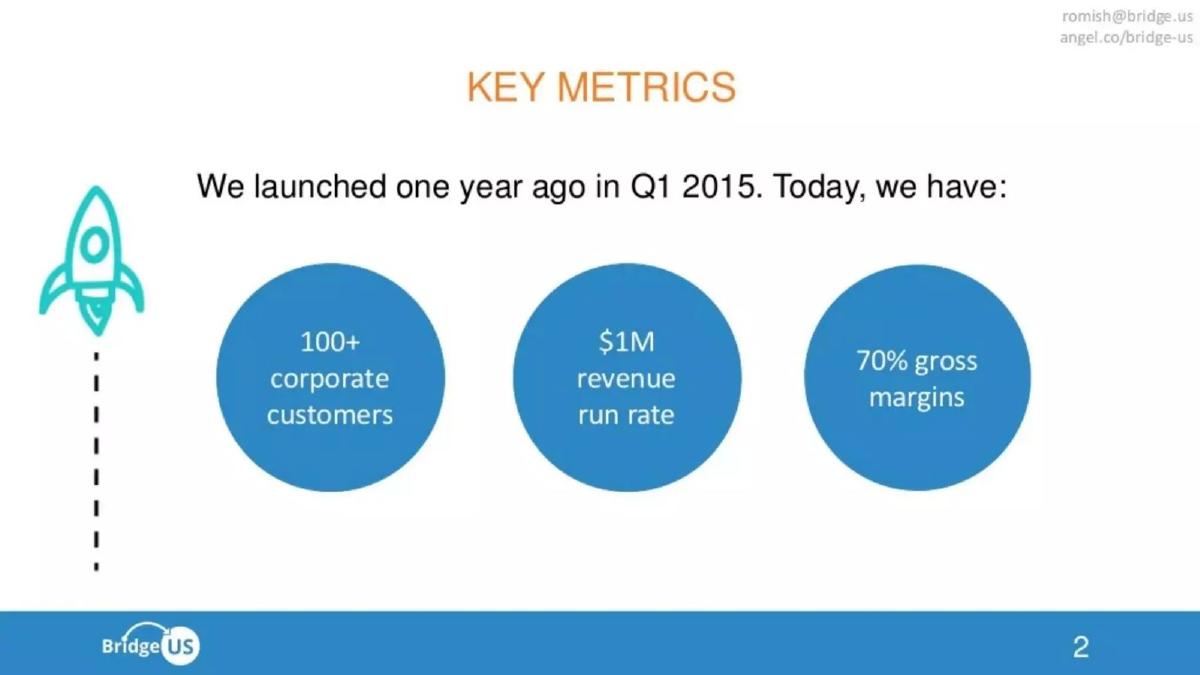
- The deck leads with traction, showing a $1M revenue run rate and 70% gross margins on slide 2.
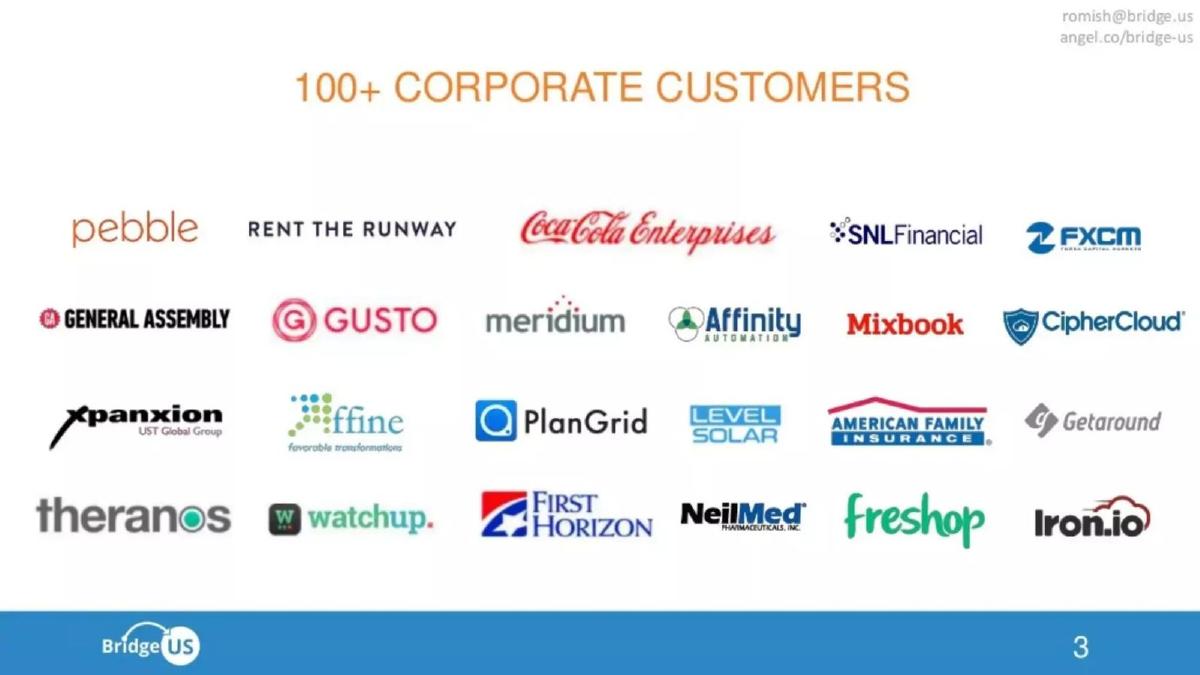
- Social proof is established early with a logo wall of 100+ corporate customers on slide 3.
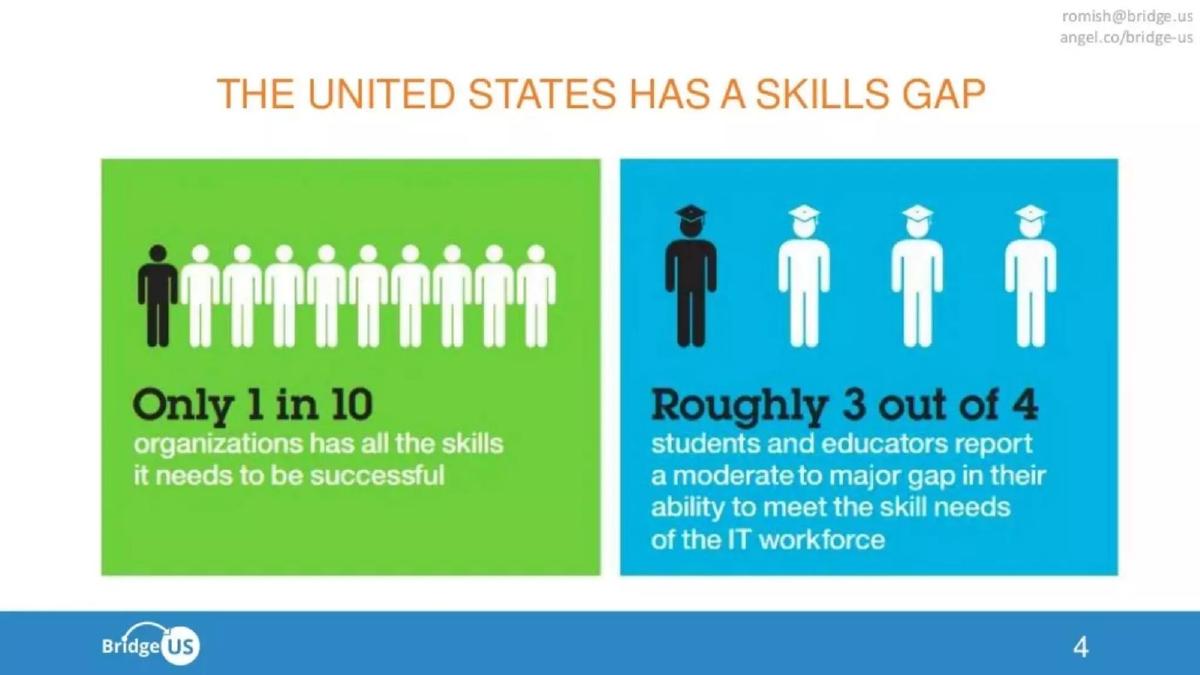
- The problem is framed as a macro-economic 'skills gap' where only 1 in 10 organizations has the necessary skills to succeed, according to slide 4.
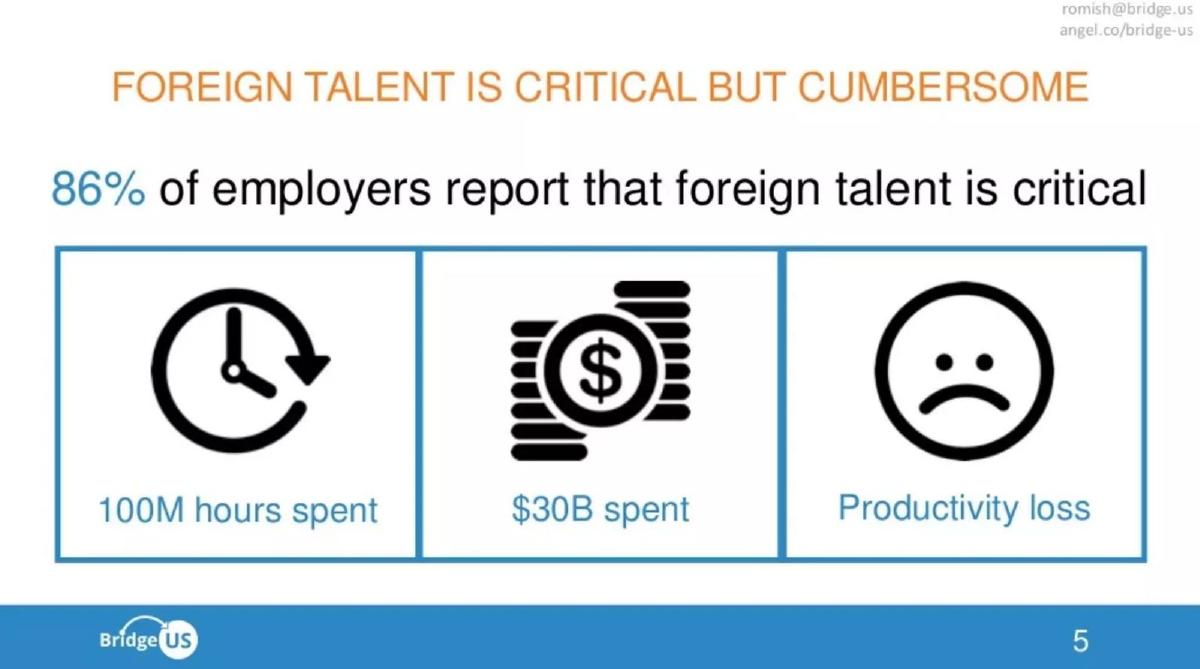
- Market inefficiency is quantified by $30B spent and 100M hours lost to cumbersome immigration processes on slide 5.
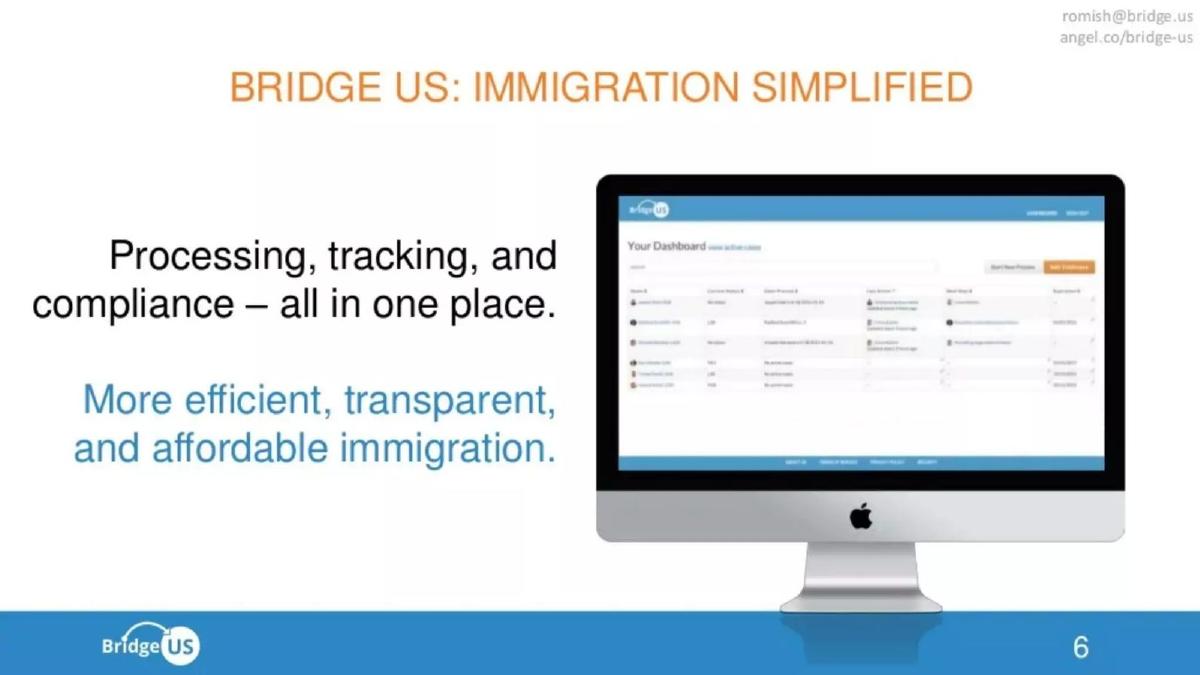
- The product is positioned as a centralized dashboard for processing, tracking, and compliance on slide 6.
- The team slide highlights a mix of tech pedigree (Google) and legal expertise (Serotte Law) on slide 7.
- The deck projects a 50% growth in global mobility by 2020 on slide 8.
- There is no slide detailing the specific investment amount requested or the planned use of funds.
The Power of Traction-First Storytelling
The Bridge US pitch deck is a lean, 9-slide presentation that serves as a masterclass in establishing immediate credibility. In an era where many seed decks spend five slides defining a problem, Bridge US spends exactly one slide on the title before hitting the investor with hard financial data. This teardown examines how a company in the 'Other' (Legal Tech) sector used a $1M revenue run rate to bypass the skepticism usually reserved for service-heavy industries.
Slide 1: Title and Tagline
The deck opens with a clean blue background and the logo for Bridge US. The tagline, "IMMIGRATION SIMPLIFIED," is positioned directly under the logo. It is a functional, no-nonsense start that clearly defines the industry vertical without requiring further explanation.
Slide 2: The Hook – Key Metrics
This is the most important slide in the deck. Bridge US breaks the standard deck flow by placing Key Metrics on slide 2. They state, "We launched one year ago in Q1 2015. Today, we have:" followed by three circles: "100+ corporate customers," "$1M revenue run rate," and "70% gross margins." By leading with these figures, the founders establish that they have found product-market fit and have a scalable cost structure. The 70% margin is particularly important for a legal-tech company, as it suggests software automation rather than just billable hours.
Slide 3: Social Proof – 100+ Corporate Customers
Slide 3 reinforces the first metric from the previous slide. It features a dense logo wall of 24 recognizable companies, including Pebble, Rent the Runway, Coca-Cola Enterprises, Gusto, PlanGrid, and American Family Insurance. Notably, it also includes Theranos , which was a high-profile name at the time of this deck's creation. This slide proves that the $1M run rate is diversified across various industries, from consumer tech to traditional insurance and manufacturing.
Slide 4: The Macro Problem – The Skills Gap
Having proven the business works, the deck moves to the "Why now?" argument. Slide 4, titled "THE UNITED STATES HAS A SKILLS GAP," uses two infographics. The first claims "Only 1 in 10 organizations has all the skills it needs to be successful." The second states "Roughly 3 out of 4 students and educators report a moderate to major gap in their ability to meet the skill needs of the IT workforce." This frames immigration not just as a legal hurdle, but as a solution to a national economic crisis.
Slide 5: The Micro Problem – Inefficiency
Slide 5 pivots from the macro economy to the specific pain points of the employer. Titled "FOREIGN TALENT IS CRITICAL BUT CUMBERSOME," it notes that "86% of employers report that foreign talent is critical." It then quantifies the pain: "100M hours spent," "$30B spent," and "Productivity loss." This slide successfully translates a legal process into a financial and operational burden that a CEO or CFO would care about.
Slide 6: The Solution – Bridge US Dashboard
The solution slide is minimalist. It features a screenshot of a web application on an iMac with the text: "Processing, tracking, and compliance – all in one place." It promises "More efficient, transparent, and affordable immigration." By showing a dashboard, the deck emphasizes the "software" side of their "software-enabled service," justifying the high margins mentioned on slide 2.
Slide 7: The Team
Slide 7, titled "INCREDIBLE TEAM," introduces three key figures. Romish Badani (Co-Founder & CEO) is linked to Harvard Business School and ZocDoc . Forrest Blount (Co-Founder & CTO) brings pedigree from Google and ITA Software . Michael Serotte (Lead Attorney Partner) provides the necessary domain expertise through Serotte Law and Unshackled . This combination of top-tier business education, big-tech engineering, and specialized legal practice covers all the necessary bases for a legal-tech startup.
Slide 8: The Vision – Global Mobility
Slide 8, "POWERING GLOBAL MOBILITY," shows a world map with red arrows indicating migration flows. A callout bubble predicts "50% growth by 2020." This slide serves as the "Market Opportunity" or "Vision" slide, suggesting that while they are currently focused on the US, the platform is built for a world where labor is increasingly mobile.
Slide 9: Contact Information
The final slide repeats the logo and provides the CEO's email and AngelList profile link. There is no call to action, no mention of the round size, and no summary of the investment opportunity.
What Works in the Bridge US Deck
The primary strength of this deck is its brevity and confidence . By keeping the deck to 9 slides, the founders ensure that every slide carries significant weight. The decision to lead with traction (Slide 2) is a brilliant tactical move for a seed-stage company that already has revenue. It immediately answers the investor's biggest question: "Does anyone want this?"
The logo wall (Slide 3) is also exceptionally strong. For a B2B startup, showing that you can sell to both a startup like Gusto and a giant like Coca-Cola Enterprises demonstrates a versatile sales motion. Finally, the team slide (Slide 7) perfectly balances technical ability with industry-specific legal authority, which is often the missing piece in legal-tech pitches.
What is Missing from the Bridge US Deck
Despite its success, the deck has several notable omissions. First, there is no 'Ask' slide . The deck never specifies how much money is being raised or what the milestones for the next 18 months look like. According to the catalogue facts, they raised $800,000, but an investor looking at this deck in isolation wouldn't know if they were looking for $500k or $5M.
Second, there is no competition slide . The immigration space has incumbent law firms and other emerging tech players. Failing to address how Bridge US differs from a traditional firm (other than "transparency") or other software competitors leaves a gap in the narrative. Lastly, there is no detailed financial projection . While the $1M run rate is impressive, investors typically want to see a basic roadmap of how that $1M becomes $10M or $100M.
What a Founder Should Copy
Founders should emulate the "Traction First" structure if their numbers are strong. If you have a $1M run rate at the seed stage, do not hide it on slide 12; put it on slide 2. It changes the entire tone of the meeting from a defensive "please believe in my idea" to an offensive "look at this machine I've built."
Additionally, the quantification of the problem on Slide 5 is excellent. Instead of saying "immigration is slow," they said "100M hours spent." Quantifying pain points in terms of time and money makes the ROI of the solution self-evident. Finally, the clean, uncluttered design is a great example of how to use white space to make data points pop. Each slide has one clear message, making the deck easy to digest in under three minutes.
Final Analysis
The Bridge US deck is a high-conviction document. It relies on the sheer force of its existing business performance to carry the pitch. While it skips several "standard" slides, the quality of the metrics and the pedigree of the team provided a sufficient foundation for their $800,000 seed round. It serves as a reminder that for investors, traction is the ultimate de-risking mechanism , and when you have it, you should lead with it.
Frequently asked questions
- Why did Bridge US put their metrics on slide 2 instead of the end?
- Leading with metrics is a 'power move' for startups with strong numbers. By showing a $1M run rate and 70% margins immediately (Slide 2), Bridge US neutralized the risk often associated with seed-stage legal tech. It forced investors to view the subsequent problem and solution slides through the lens of a proven, working business model rather than a speculative idea.
- How does the deck handle the complexity of immigration law?
- It simplifies it significantly. Instead of explaining legal nuances, Slide 6 focuses on the user interface—a dashboard for 'processing, tracking, and compliance.' By framing the solution as 'Immigration Simplified,' they position the company as a software-enabled service that removes the friction described on Slide 5 ($30B spent and 100M hours lost).
- Is the lack of an 'Ask' slide a mistake?
- In a formal pitch, yes, but in a deck used for securing first meetings, it can be intentional. By omitting the 'Ask,' the founders keep the focus on the business's performance. However, according to catalogue facts, they successfully raised $800,000, suggesting the specific terms were handled in follow-up conversations or a separate deal sheet.
- What does the 70% gross margin tell us about their business model?
- A 70% gross margin (Slide 2) is exceptionally high for a service-based industry like law. This metric signals to investors that Bridge US is not just a law firm; it is a technology company using automation to handle the '100M hours' of manual work mentioned on Slide 5, allowing them to scale without a linear increase in headcount.
- How important was the logo wall on slide 3?
- Critical. For a seed-stage company, having 100+ customers including Coca-Cola Enterprises, Gusto, and Rent the Runway provides massive validation. It proves that both legacy enterprises and fast-growing tech startups find value in their platform, suggesting a wide Total Addressable Market (TAM) without needing a dedicated market-size slide.