Backstartup's 11-slide seed deck presents a compelling case for modernizing back-office functions in Latin America. By positioning themselves as a 'Software-with-a-Service' (SwaS) provider, they address the specific needs of 1.9 million startups and SMEs in the region. The deck effectively uses traction metrics, showing a jump from $10k to over $40k in monthly revenue over two years, and a low 2% churn rate. While the deck lacks a formal 'Ask' slide and detailed unit economics, it successfully leverages the success of international peers like Bench and inDinero to validate their business mode…
Key takeaways
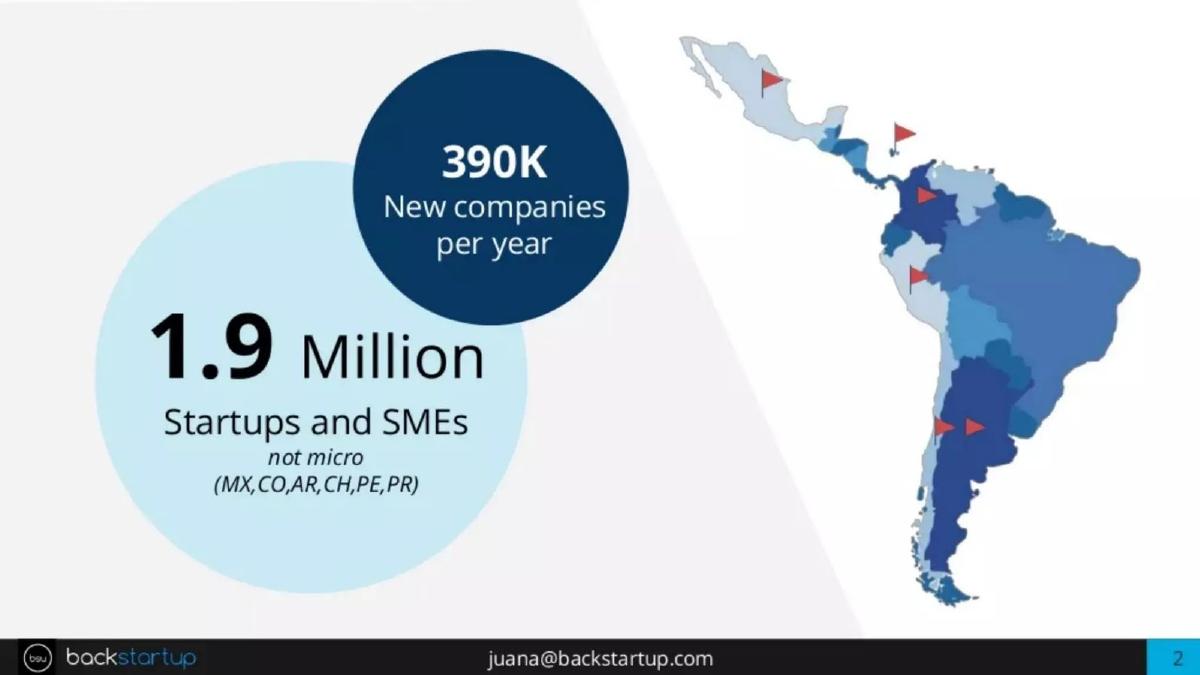
- The company identifies a target market of 1.9 million non-micro startups and SMEs across Mexico, Colombia, Argentina, Chile, Peru, and Puerto Rico (Slide 2).
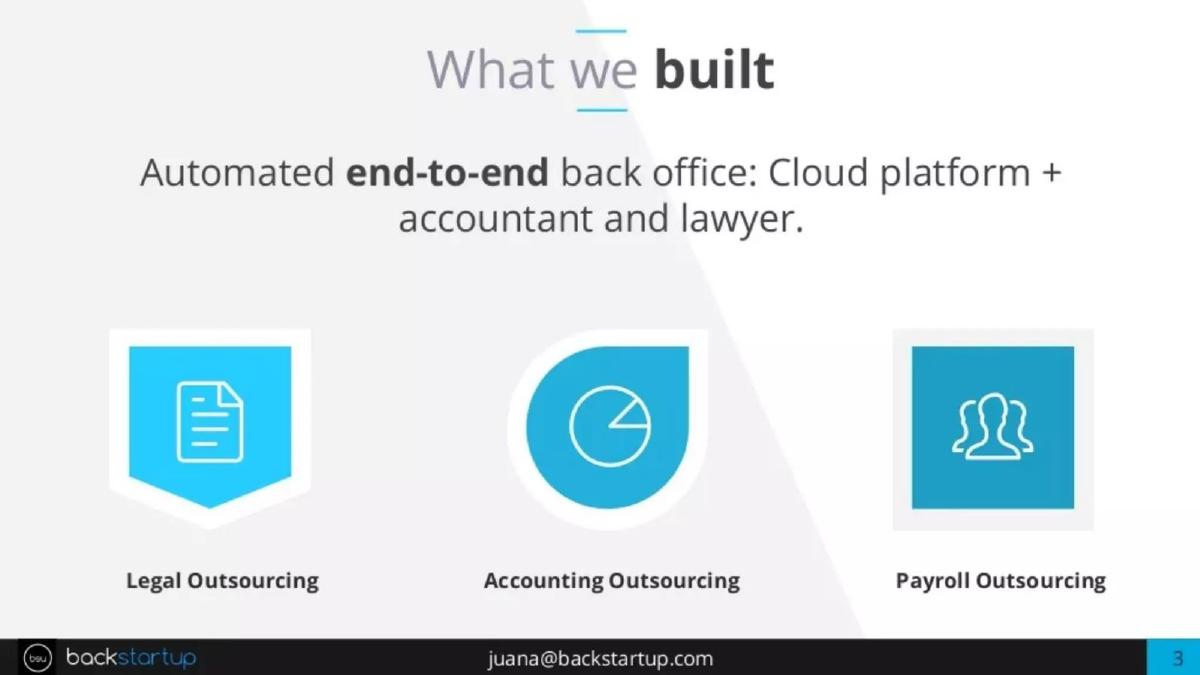
- Backstartup defines its model as 'Software-with-a-Service,' combining cloud platforms with human accountants and lawyers (Slide 3).
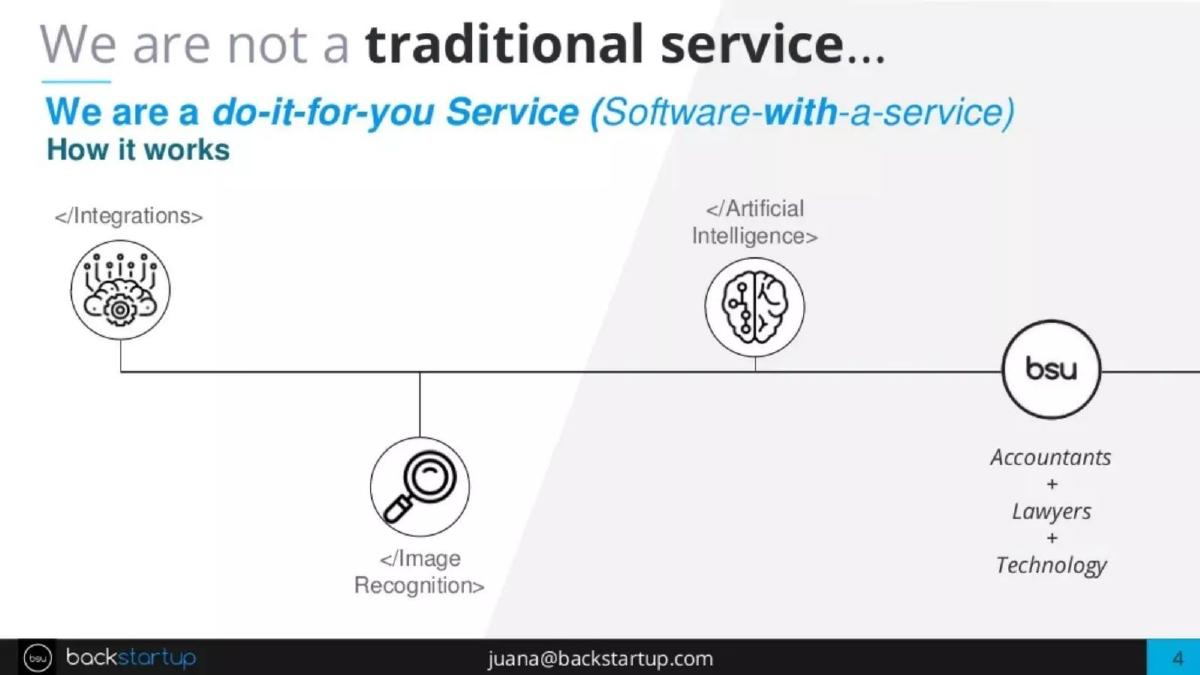
- The technical workflow utilizes integrations, image recognition, and artificial intelligence to automate manual tasks (Slide 4).
- Monthly revenue grew from approximately $10,000 in early 2016 to $42,000 by February 2018 (Slide 7).
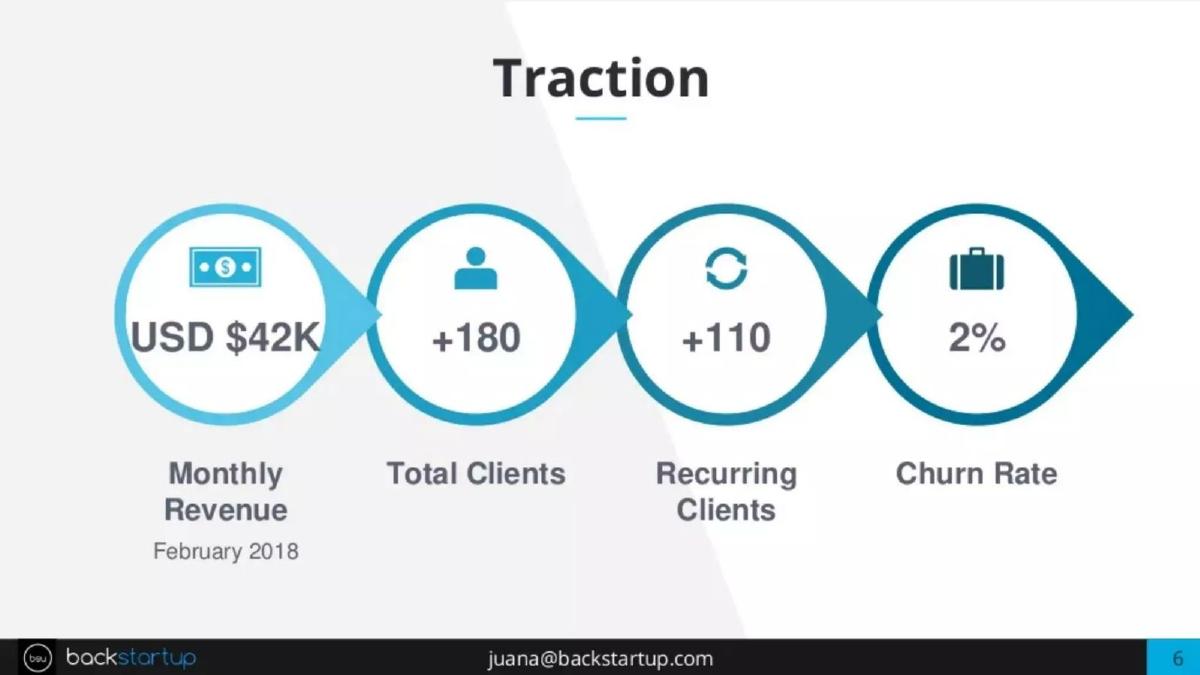
- The platform maintained a low churn rate of 2% while serving over 180 total clients (Slide 6).
- Future projections target $10 million in annual income by 2022 with a presence in at least five countries (Slide 8).
- The leadership team boasts over 40 years of combined professional experience across CEO, CTO, COO, and CRO roles (Slide 9).
- The deck uses 'Main References' to show successful global comparables like Bench ($32.85M raised) and inDinero ($9.9M raised) to validate the model (Slide 11).
Backstartup: Automating the LatAm Back Office
Backstartup presents an 11-slide pitch deck designed to secure seed funding for its automated accounting and legal platform. The company targets the Latin American market, specifically focusing on SMEs and startups that are traditionally underserved by modern financial tools. By positioning themselves as a 'Software-with-a-Service' (SwaS) provider, they aim to bridge the gap between pure software solutions and traditional, labor-intensive professional services.
The Market Opportunity and Vision
Slide 1: Title Slide The deck opens with a clean, professional title slide. The tagline, "New generation of accounting, legal and payroll outsourcing for SMEs," immediately establishes the company's three core pillars. The branding is minimalist, using the 'bsu' shorthand logo.
Slide 2: Market Size Backstartup identifies a massive regional opportunity. They cite 1.9 million startups and SMEs (excluding micro-businesses) across six key markets: Mexico (MX), Colombia (CO), Argentina (AR), Chile (CH), Peru (PE), and Puerto Rico (PR). They also note that 390,000 new companies are formed per year in this region. This slide effectively uses a map and large typography to emphasize the scale of the addressable market.
The Product and Methodology
Slide 3: What we built This slide defines the product as an "Automated end-to-end back office." It reiterates the three service lines: Legal Outsourcing, Accounting Outsourcing, and Payroll Outsourcing. The description "Cloud platform + accountant and lawyer" is a crucial distinction, signaling that they are not just a software tool but a comprehensive service replacement.
Slide 4: How it works (Input) Backstartup introduces the concept of "Software-with-a-service." The slide uses a technical flowchart to show how they use </Integrations>, </Image Recognition>, and </Artificial Intelligence> to feed data into the 'bsu' hub, which is staffed by accountants, lawyers, and technology. This visualizes the automation of the data entry phase of accounting.
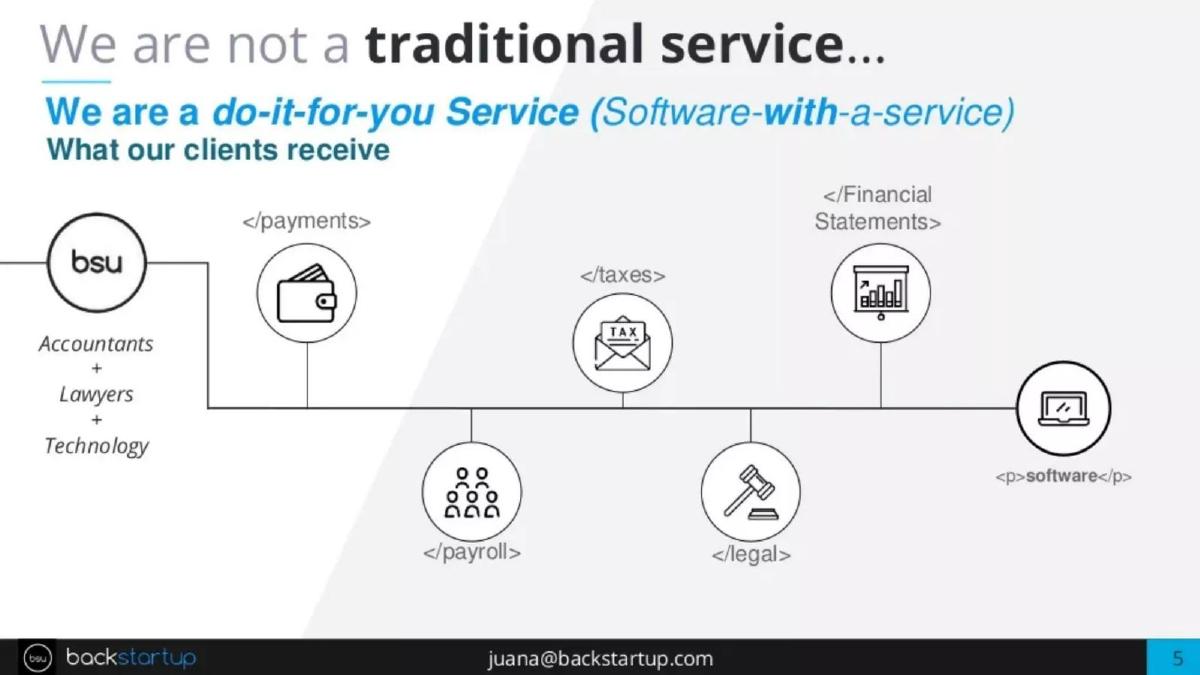
Slide 5: What our clients receive (Output) Following the 'how it works' slide, this page details the deliverables. Clients receive </payments>, </payroll>, </taxes>, </legal>, and </Financial Statements> through the <p>software</p>. The use of pseudo-code tags throughout these slides emphasizes the tech-forward nature of the business.
Traction and Growth Metrics
Slide 6: Traction Overview This is a high-impact slide showing four key KPIs as of February 2018: $42,000 in Monthly Revenue, 180+ Total Clients, 110+ Recurring Clients, and a 2% Churn Rate. The low churn rate is particularly significant for a service-based business, indicating high customer satisfaction and 'stickiness.'
Slide 7: Revenue Growth Chart The deck provides a month-by-month revenue chart covering 2016 and 2017. It shows a clear growth trend, starting around $10,000 and ending the period at $42,000. The slide also highlights a total 2017 revenue of $334,000. The visual representation of the 'hockey stick' growth curve is a standard but effective tool for seed-stage decks.
Slide 8: Future Projections Titled "¿Where are we going?", this slide outlines the roadmap. For 2018, the goal was $1 million in annual income and reaching breakeven by Q4. By 2022, they projected $10 million in annual income and expansion into at least five countries. The slide also features logos of partners like Nexo Banregio and Bancolombia, suggesting strong B2B distribution channels.
Team and Validation
Slide 9: Our Team The leadership team is presented with their years of experience: Juana Barco (CEO, 10 years), Diego Peñuela (CTO, 10 years), Adriana Villamizar (COO, 11 years), and Cristian Villamizar (CRO, 10 years). The right side of the slide highlights their backing from 500 Startups and mentions other mentors, providing necessary institutional validation.
Slide 10: Contact Slide A simple repetition of the logo and the CEO's email address.
Slide 11: Main References (Appendix) This final slide is a strategic move to validate the business model by proxy. It maps out global competitors/references: Bench ($32.85M raised), inDinero ($9.9M raised), HireAthena ($8.65M raised), and SMACC (€3.8M raised). The text "We are building the future of this industry in Latin America" positions Backstartup as the logical regional equivalent to these successful international firms.
What Works in the Backstartup Deck
The deck excels at defining a clear, regional niche. By focusing specifically on Latin America and the 'Software-with-a-Service' model, Backstartup avoids being seen as just another accounting software. The traction slides (6 and 7) are the strongest part of the deck, providing hard evidence of growth and customer retention. The inclusion of global references on Slide 11 is a clever way to answer the "why now" and "does this work" questions without needing a complex competitive analysis.
What is Missing from the Backstartup Deck
The most glaring omission is the 'Ask.' There is no information regarding how much capital the company is seeking or how those funds will be allocated (e.g., hiring, marketing, R&D). Furthermore, while the deck mentions 'legal' services, it doesn't explain how these are automated or what specific legal tasks are covered. Detailed unit economics, such as Customer Acquisition Cost (CAC) and Lifetime Value (LTV), are also absent, which are usually expected in a seed-stage deck showing this level of revenue.
What a Founder Should Copy
Founders should emulate the way Backstartup uses pseudo-code tags to reinforce their identity as a technology company, even when providing professional services. The 'Main References' slide is also a brilliant tactic for startups in emerging markets—it allows you to ride the coattails of successful models in developed markets to prove your own viability. Lastly, the clear separation between 'how it works' (inputs) and 'what the client gets' (outputs) is an excellent way to explain a complex service offering simply.
Frequently asked questions
- What is the core problem Backstartup is solving?
- Backstartup addresses the inefficiency and high cost of traditional accounting and legal services for SMEs in Latin America. By replacing manual, paper-based processes with an automated 'Software-with-a-Service' platform, they provide monthly financial statements, tax filings, and payroll management with higher accuracy and lower overhead than traditional offline accountants.
- How does Backstartup's 'Software-with-a-Service' model work?
- As shown on slides 4 and 5, the model uses a tech stack including AI, image recognition, and bank integrations to ingest data. This technology is then layered with human expertise—accountants and lawyers—to deliver final outputs like tax returns and legal documents. This hybrid approach ensures compliance in complex regulatory environments while maintaining the efficiency of a SaaS product.
- What does the traction look like for this seed round?
- The deck shows significant growth, reaching $42,000 in monthly revenue by February 2018. The revenue chart on slide 7 indicates a steady upward trajectory from 2016, with total 2017 revenue hitting $334,000. With 180 total clients and 110 recurring clients, the 2% churn rate suggests high product-market fit and customer retention.
- Who are the key competitors or references mentioned?
- Instead of a traditional competitive matrix, Backstartup uses a 'Main References' slide (Slide 11). They point to successful international companies like Bench (USA/Canada), inDinero (USA), HireAthena (USA), and SMACC (Germany). By highlighting the millions of dollars these companies have raised, Backstartup positions itself as the regional winner for the same proven model in Latin America.
- What information is missing from the Backstartup pitch deck?
- The most notable omission is a specific 'Ask' slide detailing how much money they are raising and how it will be spent. Additionally, the deck lacks detailed unit economics (CAC, LTV) and a breakdown of the competitive landscape within the Latin American market specifically. A more detailed slide on the 'legal' component of their service would also clarify that specific offering.