The Back Office pitch deck is an anomaly in the world of venture capital for its extreme brevity and lack of explanatory text. Spanning only 9 slides, the deck relies almost entirely on high-impact numbers and logos rather than narrative persuasion. Founded in 2018, the company—now rebranded as Finally—used this deck to highlight a $1M ARR and a staggering 40% month-over-month growth rate. By stripping away the traditional 'problem-solution' verbosity, the founders forced investors to focus on three core strengths: explosive growth, high retention, and a team with a track record of exits. Thi…
Key takeaways
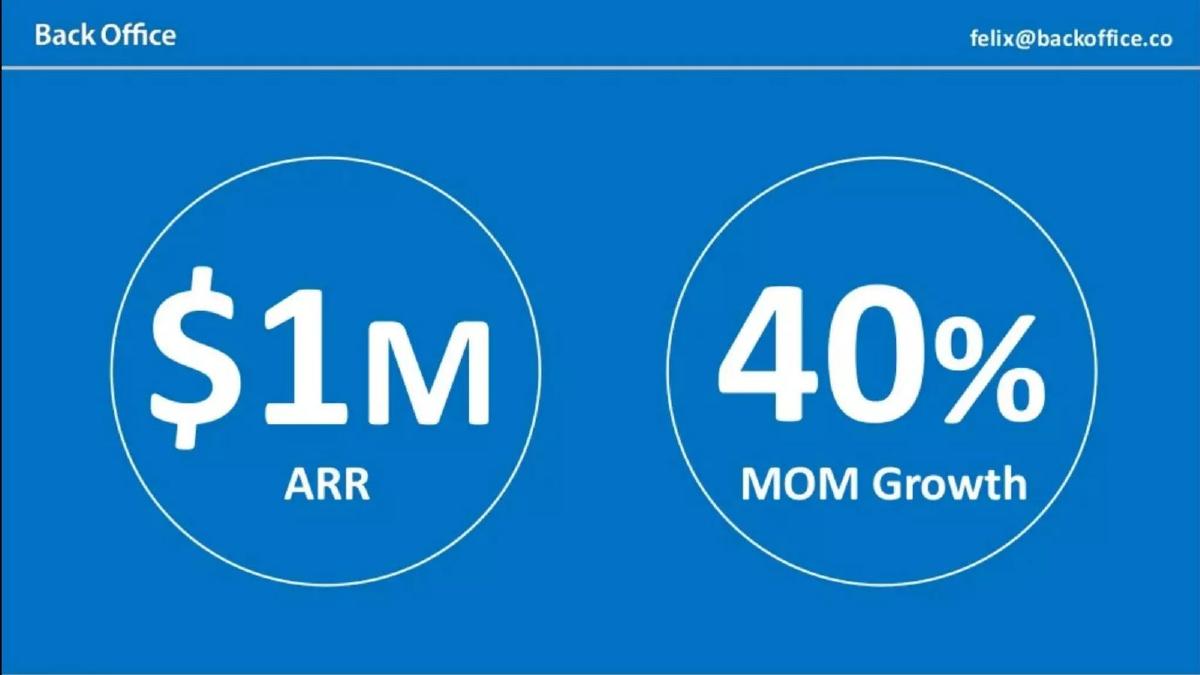
- The deck leads immediately with traction, citing $1M ARR and 40% MOM Growth on slide 2.
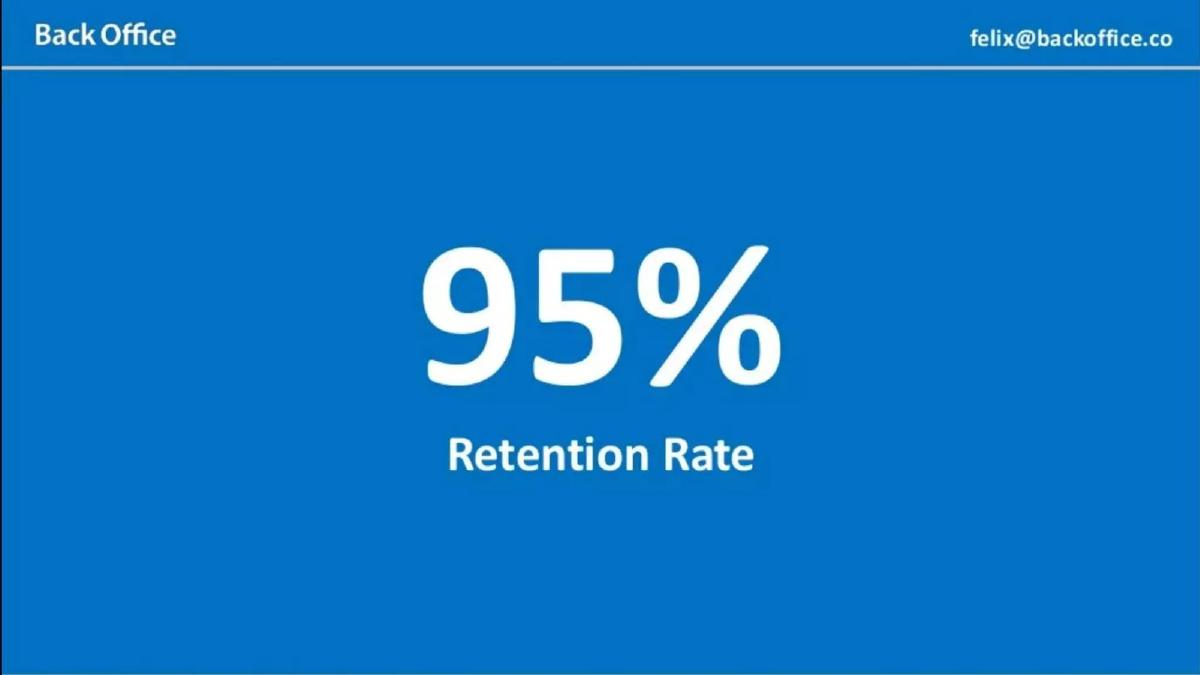
- Retention is positioned as a primary validator, showing a 95% Retention Rate on slide 6.
- The team slide (slide 8) emphasizes experience over pedigree, claiming 3 Successful Exits among the three founders.
- Market size is presented as a single, massive figure of $180Bn on slide 7 without further segmentation.
- The deck completely omits a formal 'Ask' slide, leaving the funding requirements to verbal discussion.
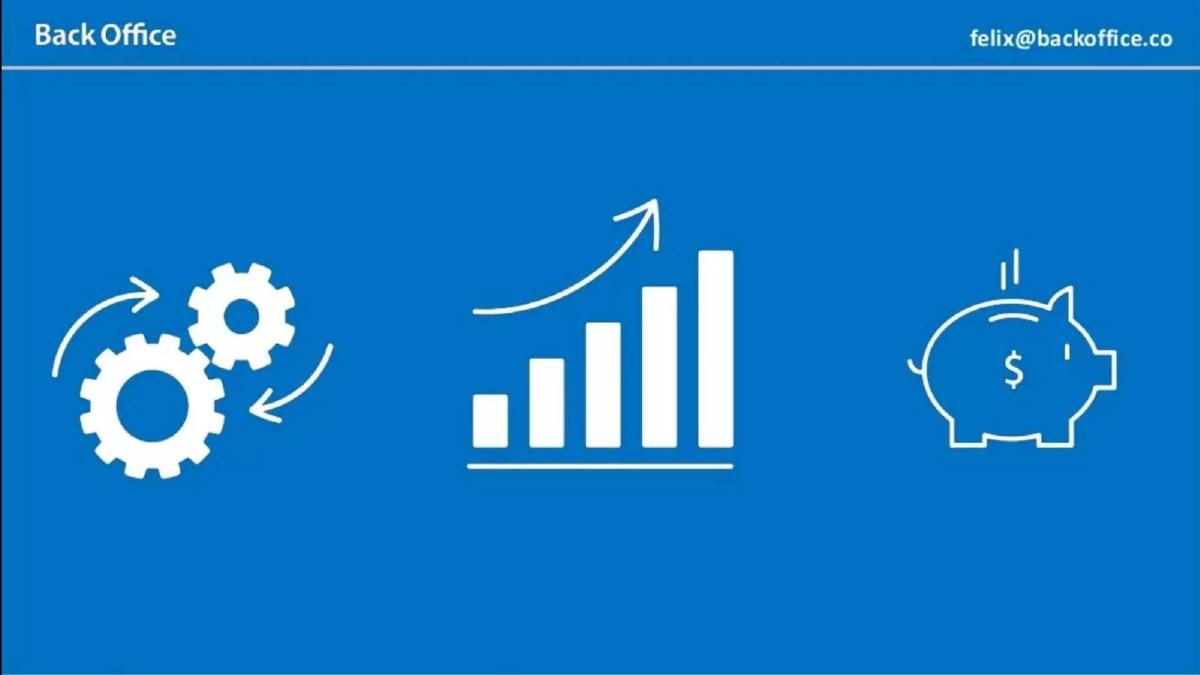
- Visual communication is prioritized over text, using icons on slide 4 to represent automation, growth, and savings.
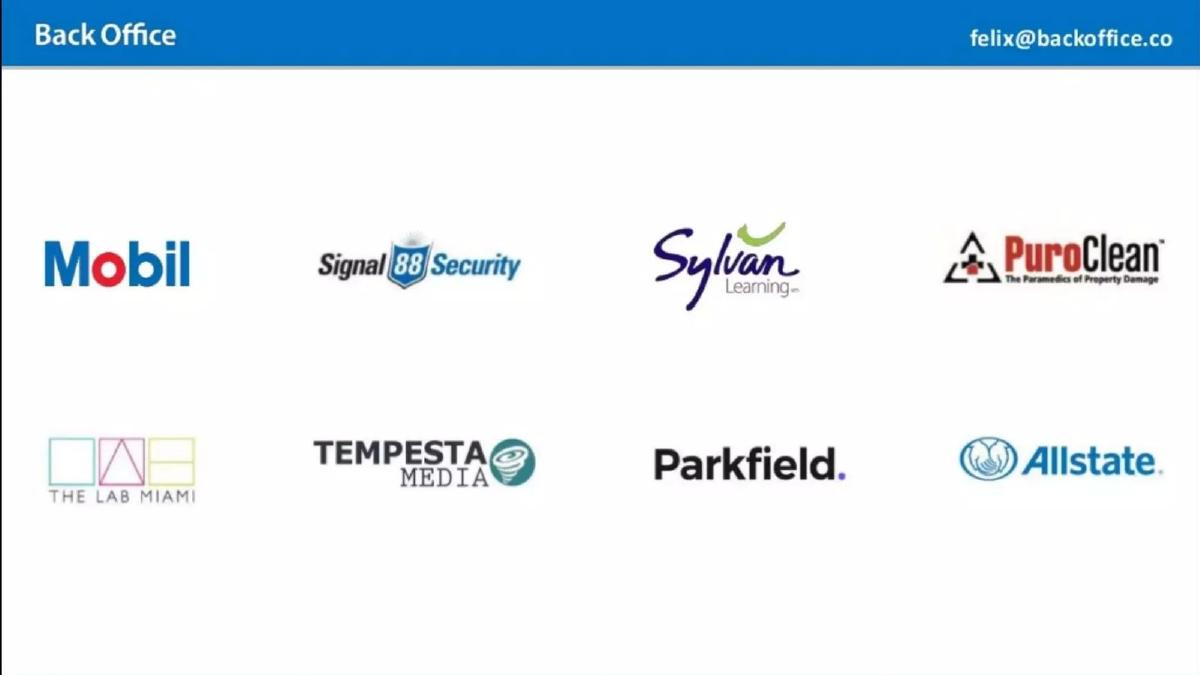
- Customer validation is handled through a logo wall on slide 5, featuring brands like Mobil and Allstate.
- The deck lacks any mention of competitors or a specific product roadmap.
The Power of Minimalist Traction
The Back Office pitch deck is a rare example of a 'less is more' philosophy in startup fundraising. In an industry where decks often bloat to 20 or 30 slides filled with complex market maps and technical diagrams, Back Office (now Finally) opted for a 9-slide presentation that is almost entirely devoid of sentences. This deck was used in 2018, a period of high fintech activity, and it successfully paved the way for the company to eventually raise nearly $100 million across its lifecycle.
The strategy here is clear: let the growth curve do the heavy lifting. By leading with revenue and growth, the founders immediately qualify themselves as a top-tier investment opportunity, allowing them to skip the basic education of the investor and move straight to the terms of the deal.
Slides 1-2: The Hook and The Headline Metrics
Slide 1 is a standard title slide, establishing the brand and the core value proposition: "Automated Accounting for Small Businesses." It is clean, professional, and uses a high-contrast blue and white color palette that persists throughout the deck.
Slide 2 is where the deck makes its most aggressive move. Instead of building up to a 'big reveal,' the founders put their two most important numbers front and center: $1M ARR and 40% MOM Growth . In the world of SaaS and Fintech, reaching $1M in Annual Recurring Revenue is a major milestone, but doing so while growing at 40% month-over-month is exceptional. By placing this on the second slide, the founders ensure that every subsequent slide is viewed through the lens of a winning business.
Slides 3-4: The Abstract Problem and Solution
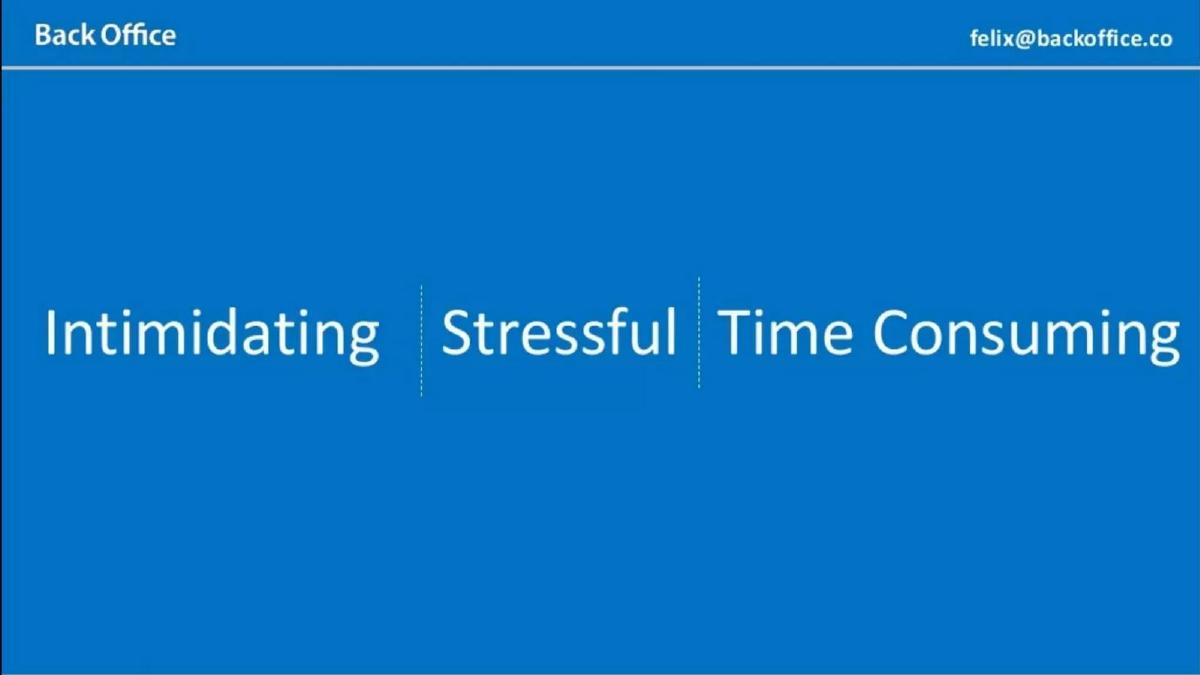
Slide 3 addresses the 'Problem' using only three words: "Intimidating | Stressful | Time Consuming." This is a psychological appeal rather than a technical one. It assumes the investor is aware that small business owners hate doing their own books. It doesn't waste time explaining why accounting is hard; it simply acknowledges the emotional state of the target customer.
Slide 4 follows this pattern for the 'Solution.' There are no screenshots of the software, no feature lists, and no technical architecture diagrams. Instead, there are three white icons: gears (automation), a growth chart (scalability), and a piggy bank (cost savings). This is perhaps the most controversial part of the deck. While it maintains the minimalist aesthetic, it leaves the investor with no understanding of how the product actually works or what the user experience looks like. This suggests the deck was likely used as a visual aid for a live presentation rather than a standalone 'send-ahead' deck.
Slides 5-6: Validation and Stickiness
Slide 5 provides social proof through a logo wall. The logos included are diverse, ranging from global brands like Mobil and Allstate to franchise-heavy businesses like Sylvan Learning and PuroClean . The inclusion of The Lab Miami suggests a strong local presence in their home market. This slide proves that the $1M ARR isn't coming from a single large contract, but from a broad base of recognizable clients.
Slide 6 introduces the 'Retention Rate' at 95% . For a business targeting small and medium-sized businesses (SMBs)—a segment known for high churn—a 95% retention rate is a powerful indicator of product-market fit. It tells investors that once a customer starts using Back Office, they almost never leave. This metric is the 'glue' that makes the 40% growth rate sustainable.
Slides 7-9: Market Size, Team, and The Close
Slide 7 presents the market size as $180Bn . There is no breakdown of TAM (Total Addressable Market), SAM (Serviceable Addressable Market), or SOM (Serviceable Obtainable Market). It is a 'big number' slide intended to show that the ceiling for this business is incredibly high. While light on detail, it serves its purpose in a minimalist deck by checking the 'large market' box.
Slide 8 introduces the founders: Felix Rodriguez, Glennys Rodriguez, and Edwin Mejia. The headline for this slide is "3 Successful Exits." This is the ultimate de-risking mechanism for an investor. It signals that this isn't the team's first rodeo and that they have a history of returning capital to shareholders. The lack of individual bios or specific company names from their past exits is consistent with the rest of the deck's brevity.
Slide 9 is a near-duplicate of the second slide, restating the $1M ARR and 40% MOM Growth . This reinforces the core message one last time. Notably, there is no 'Ask' slide. There is no mention of how much money they are raising, the valuation they are seeking, or what the funds will be used for. This information was likely kept for the verbal pitch or a separate term sheet, which can be a strategic move to maintain leverage during negotiations.
What Works in This Deck
The primary strength of this deck is its unwavering focus on traction . By stripping away everything else, the founders force the investor to engage with the reality of the business's success. It is very difficult for an investor to argue with $1M ARR and 40% growth. The minimalist design also creates an air of confidence; it suggests the founders are too busy growing the company to spend weeks on a 40-page PowerPoint.
The retention metric on slide 6 is also a masterstroke. In the SMB fintech space, churn is the silent killer. By highlighting a 95% retention rate, Back Office preemptively answers the most common objection investors have regarding small business tools.
What Is Missing
The most glaring omission is product substance . There is not a single image of the platform, no explanation of the AI or automation engine, and no detail on how they integrate with existing banks or accounting software. An investor looking at this deck in isolation would have no idea if Back Office is a software-only play, a tech-enabled service, or a marketplace.
Additionally, the competitive landscape is entirely ignored. The accounting space is crowded with giants like Intuit and newcomers like Pilot or Bench. Failing to mention how Back Office wins against these players is a significant gap that would have to be addressed in the Q&A session. Finally, the lack of a financial 'Ask' means the deck doesn't actually 'close' the deal; it merely starts a conversation.
What a Founder Should Copy
Founders should emulate the metric-forward approach of Slide 2. If you have great numbers, do not hide them on slide 12. Put them at the beginning to set the tone for the entire meeting. The use of social proof through a clean logo wall is also a best practice that every founder should follow.
However, founders should be cautious about being this minimalist unless their metrics are equally spectacular. For most startups, a middle ground is better: lead with the traction, but provide enough product and market context so the investor doesn't have to guess how the business works. Back Office's deck is a high-stakes gamble that paid off because the underlying business was a high-performer, not just because the slides were pretty.
Frequently asked questions
- Why is this deck so short compared to typical seed or Series A decks?
- Back Office utilized a 'Traction-First' strategy. When a company hits $1M ARR with 40% month-over-month growth, the metrics often speak louder than any narrative. The brevity is intentional; it signals that the business is a 'rocket ship' where the numbers are the primary story, reducing the need for lengthy explanations of the problem space.
- Is it risky to omit a competitor slide?
- Generally, yes. Most investors want to see how a startup differentiates itself from incumbents like QuickBooks or Xero. However, in this specific case, the 95% retention rate (slide 6) serves as a proxy for competitive advantage. It suggests that despite competition, customers are not leaving, which can sometimes satisfy early-stage investors more than a feature-comparison grid.
- How does the deck handle the 'Problem' and 'Solution' sections?
- It uses extreme abstraction. Slide 3 lists three adjectives—Intimidating, Stressful, Time Consuming—to define the problem, and slide 4 uses three icons to represent the solution. This assumes the investor already understands the pain points of SMB accounting and moves quickly to the evidence that Back Office has solved it.
- What is the significance of the '3 Successful Exits' on the team slide?
- For a minimalist deck, this is a crucial trust signal. Since the deck provides very little detail on 'how' the technology works, the founders are leaning on their history of execution. It tells investors that the team knows how to build, scale, and exit a company, which de-risks the investment significantly.
- Can a founder today copy this minimalist style?
- Only if they have the metrics to back it up. A 9-slide deck with no text will fail if the ARR is low or growth is stagnant. This style is a 'power move' reserved for companies with exceptional traction. For most startups, more context on product defensibility and market GTM is required.