Azumi's pitch deck, originating from 2016, positions the company as a 'Culture’s Playground' designed to solve the monetization gap for independent artists. The deck identifies a clear market shift toward direct-to-fan models, citing the platform Bandpage as a pioneer in selling experiences rather than just merchandise. Azumi proposes a 'Tribes' model where fans subscribe for early access to music and exclusive interactions. While the deck provides a high-level product mockup and a customer acquisition strategy involving festival giveaways and alpha tests with 10 artists, it is structurally i…
Key takeaways
- The platform centers on 'Tribes,' a subscription model where fans pay for early access and exclusive perks (Slide 4).
- Azumi identifies the core problem as artists being 'unable to monetize the content they publish on social media' (Slide 3).
- The customer acquisition strategy relies on a private alpha with 10 artists and 500 test users (Slide 6).
- The roadmap planned for a Winter 2016 launch with a long-term goal to expand to athletes and YouTube stars by 2021 (Slide 7).
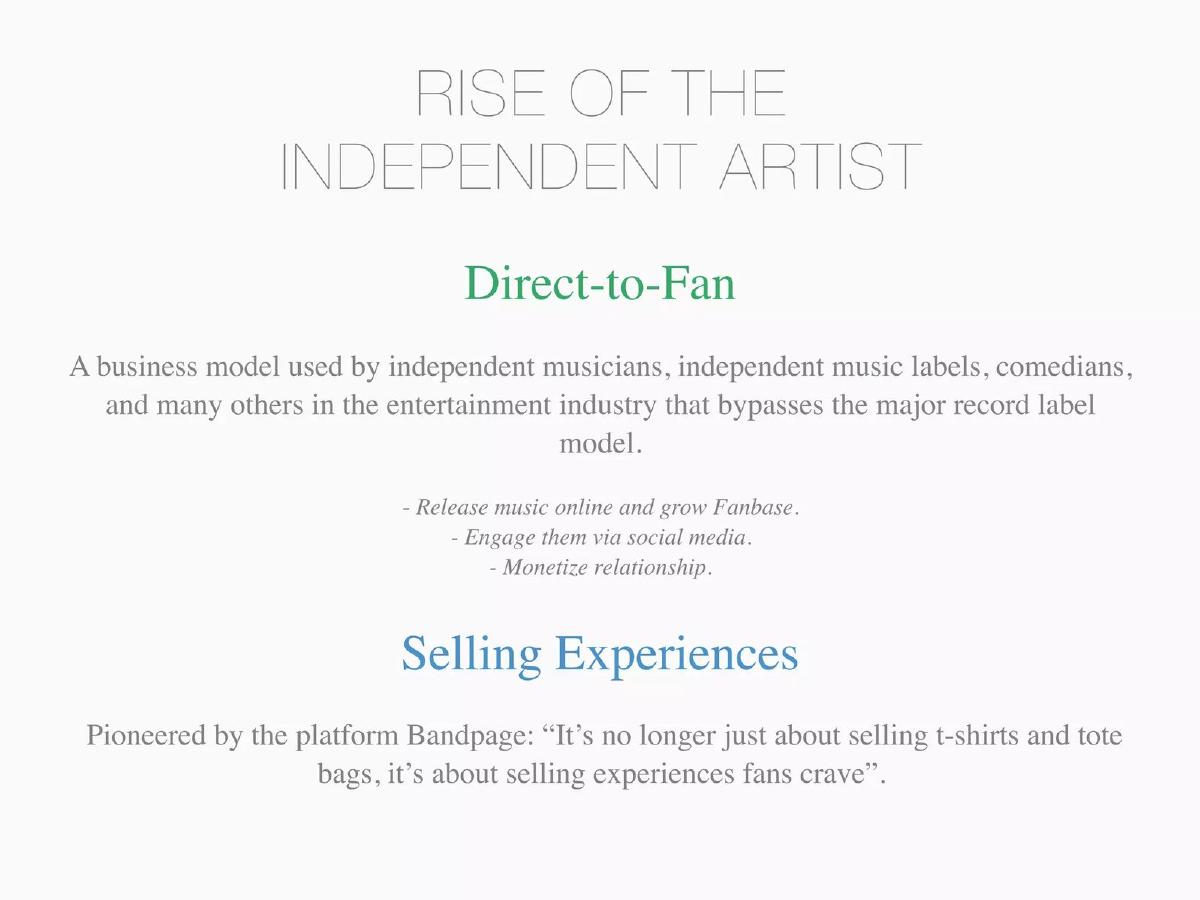
- The deck cites the 'Direct-to-Fan' model as a way to bypass major record labels (Slide 2).
- A product mockup shows a tile-based UI with sections for 'Tribes,' 'Playground,' and 'Events' (Slide 9).
- There is no mention of the founding team's background or previous successes in the provided slides.
- The deck lacks a specific financial 'Ask' or valuation, ending instead with a general call for mentorship and investment (Slide 8).
Azumi Pitch Deck Analysis: The Direct-to-Fan Vision
The Azumi deck, dated from 2016, represents a specific era in the music tech landscape where the 'Direct-to-Fan' (D2F) movement was gaining significant traction. The deck is minimalist, focusing on the philosophical shift in how artists interact with their audience rather than heavy data or financial modeling. It positions itself as a 'Culture’s Playground,' a social network designed to bridge the gap between social engagement and monetization.
Slide 1: Title Slide
The opening slide introduces the brand name, AZUMI , with the tagline CULTURE’S PLAYGROUND . It features a simple wave logo inside a circle. The text 'Music needed a new home. We built it.' establishes a bold, albeit vague, value proposition. The contact information for Max Lawrence is provided in the bottom right corner. This slide is standard but lacks a clear one-sentence description of what the product actually is (e.g., 'A subscription social network for musicians').
Slide 2: The Macro Trend
Titled RISE OF THE INDEPENDENT ARTIST , this slide defines the 'Direct-to-Fan' model. It explicitly states that this model 'bypasses the major record label model.' It breaks the process down into three steps: release music online, engage via social media, and monetize the relationship. It also quotes the platform Bandpage, emphasizing a shift from selling physical goods (t-shirts) to 'selling experiences fans crave.' This slide does a good job of setting the stage and showing that the founders understand the industry's direction.
Slide 3: Pain Points
The deck identifies two primary PAIN POINTS: MONETIZATION & EXCLUSIVITY . For artists, the problem is the inability to monetize content published on traditional social media. For fans, the problem is a lack of 'in depth access' to their favorite icons. By splitting the pain points between the two sides of the marketplace, Azumi demonstrates a dual-sided value proposition, which is essential for any social network pitch.
Slide 4: The Azumi Solution
This slide introduces three pillars of the solution: Social Network of Exclusive Content , Flexible Commerce Model , and Connecting Culture . It introduces the concept of 'Tribes,' where members receive early access and exclusive interactions. Crucially, it notes that artists are in 'complete control of price, perks, and brand sponsorships.' This autonomy is a key selling point for independent creators who feel restricted by traditional platforms.
Slide 5: Reasons to Join (Fans)
This slide focuses on the fan experience, highlighting Exclusive Content and Convenience . It lists specific perks like concert presales and behind-the-scenes videos. The 'Convenience' factor is described as having 'access to musicians all in one platform,' which suggests Azumi aims to be a central hub rather than just another social media profile.
Slide 6: Customer Acquisition
The CUSTOMER ACQUISITION slide provides the most concrete details in the deck. It outlines a Private Alpha Launch with 10 Artists and 500 Test Users . It also mentions Festival Partnerships , specifically naming Outside Lands, Snowglobe, and Lightning in a Bottle as targets for ticket giveaways. Finally, it mentions leveraging 'Music Industry 2.0 Platforms' like Product Hunt and Reddit. This shows a tactical understanding of how to build early momentum without a massive marketing budget.
Slide 7: Status & Goals
This roadmap slide shows the progression from an Alpha Prototype (referencing the azumi.io domain) to a Launch in Winter 2016 . The long-term goal (2016-2021) is to 'Hit Critical Mass, Raise Seed, Earn Revenue,' and expand into other categories like athletes and YouTube stars. While the timeline is clear, the goals are quite broad and lack specific KPIs (e.g., user count or revenue targets).
Slide 8: The Call to Action
The penultimate slide is a CONTACT US page. It lists four reasons to reach out: Artist Inquiries, Mentorship/Investment, Employment Opportunities, and 'To Say Hello!' This is a very soft close. In a formal fundraising environment, this slide should be replaced with a specific 'Ask'—how much money is being raised, the terms, and the specific milestones that capital will fund.
Slide 9: Product Mockup
The final slide provided is a visual mockup of the platform. It shows a tile-based interface featuring various artists and events (e.g., SXSW, Coachella). The sidebar includes navigation for 'Tribes,' 'Playground,' and 'Events.' Interestingly, the chat interface on the right shows a conversation with 'HAL-9000,' which might be a placeholder or a hint at an AI assistant. The UI feels very much of its time (2016), emphasizing visual discovery over a linear feed.
What Works in This Deck
Clear Problem/Solution Fit: The deck does an excellent job of identifying why current social media platforms (at the time) were failing artists. The focus on 'monetization' vs. 'engagement' is a powerful hook for investors looking at the creator economy.
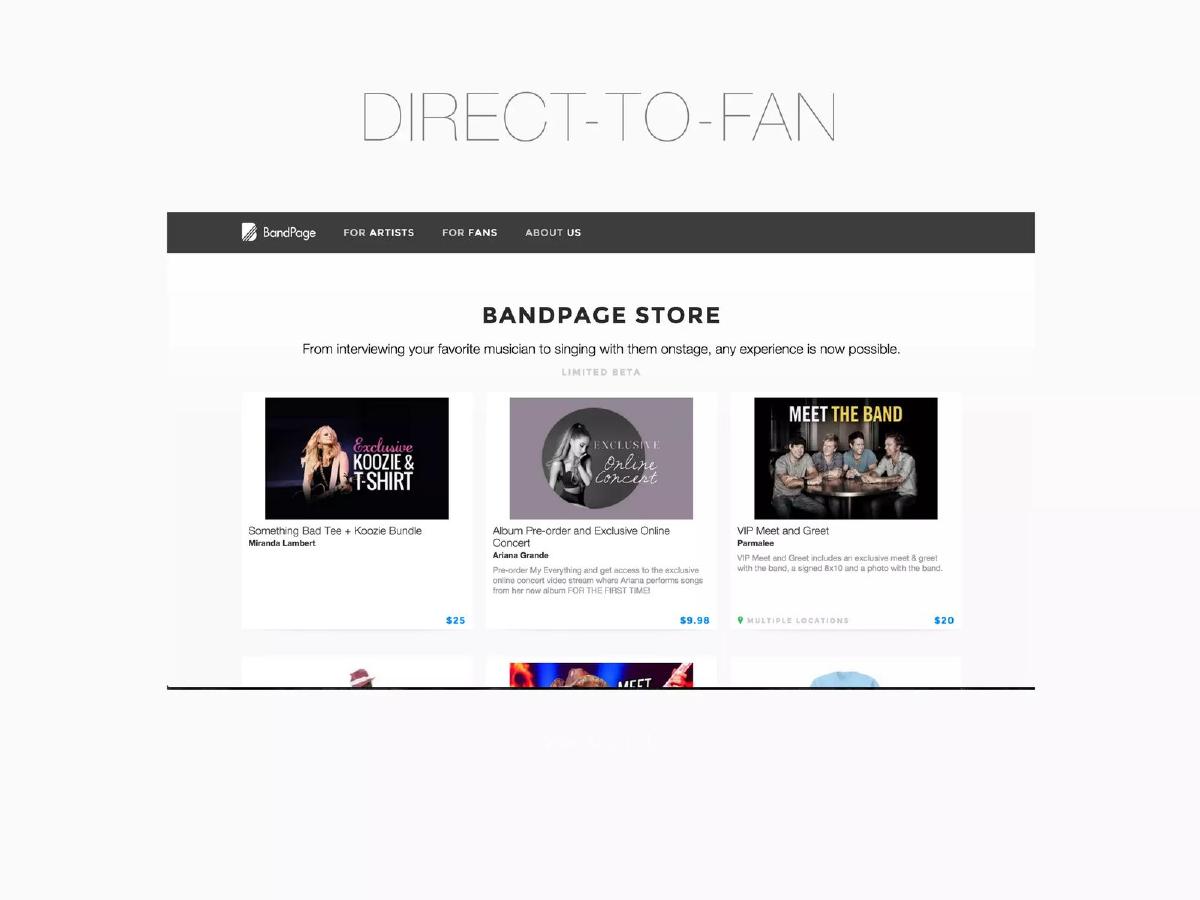
Market Context: By referencing Bandpage and the 'Direct-to-Fan' movement, the founders show they are not operating in a vacuum. They are positioning Azumi as the next logical step in an existing industry trend.
Tactical GTM: The customer acquisition slide is realistic. Starting with 10 artists and 500 users is a manageable way to prove the concept before scaling. The mention of specific festivals gives the plan a sense of groundedness.
What Is Missing
The Team: This is the most significant omission. In early-stage investing, the 'who' is often more important than the 'what.' There is no information about the founders' backgrounds, technical expertise, or industry connections.
Market Size (TAM): There is no data on how large the independent music market is, how much fans spend on exclusive content, or the potential revenue from the expanded categories (athletes, YouTubers). Investors need to see the 'billion-dollar' potential.
Business Model Specifics: While it mentions a 'Flexible Commerce Model,' it doesn't specify Azumi's take. Does the platform take a 10% cut? 30%? Without unit economics, it’s impossible to evaluate the business's viability.
Competitive Landscape: In 2016, Patreon was already growing, and platforms like Bandcamp were established. The deck fails to explain how Azumi differs from these existing solutions.
The Ask: A pitch deck is a tool to get a check. By not stating the amount they are looking to raise, the founders miss the opportunity to anchor the conversation around a specific valuation or milestone.
Founder's Guide: What to Copy
Use a 'Macro Trend' Slide: Slide 2 is a great example of how to use industry shifts to justify your existence. If you can show that the world is moving in your direction, your solution feels inevitable rather than speculative.
Dual-Sided Pain Points: If you are building a marketplace or a social network, always address the pain points for both sides (Slide 3). It shows you understand the incentives required to make the ecosystem work.
Visual Mockups: Even if the product isn't fully built, a high-fidelity mockup (Slide 9) helps investors visualize the user experience. It moves the conversation from abstract ideas to a tangible product.
Final Verdict
The Azumi deck is a strong product vision document but a weak investment deck . It captures the spirit of the 2016 creator economy but fails to provide the structural data points—team, market size, and financials—that professional investors require. For a founder today, this deck serves as a reminder that while a compelling 'why' is necessary to start the conversation, a detailed 'how' is required to close the deal.
Frequently asked questions
- What is the primary business model for Azumi?
- Azumi utilizes a 'Flexible Commerce Model' based on subscriptions. Fans join 'Tribes' for free but can pay for exclusive content, merchandise, and concert tickets. Artists maintain control over pricing and perks. The deck also mentions brand sponsorships as a potential revenue stream for artists within the platform.
- How does Azumi plan to acquire its first users?
- The strategy is three-pronged: partnering with 10 artists for a private alpha to reach 500 test users via social media, sponsoring festival ticket giveaways (specifically mentioning Outside Lands and Snowglobe) to drive sign-ups, and leveraging 'Music Industry 2.0' platforms like Product Hunt and Reddit.
- Who are the target creators for this platform?
- Initially, the platform targets independent musicians and labels. However, the 'Status & Goals' slide indicates a plan to expand into other verticals including comedians, athletes, and YouTube stars between 2016 and 2021, suggesting a broad creator-economy play.
- What are the biggest omissions in the Azumi deck?
- The deck lacks a Team slide, which is critical for early-stage investing. It also fails to provide a Market Size slide (TAM), a Competitor Matrix, or any financial projections. Most notably, there is no 'Ask' slide detailing how much money is being raised or how it will be spent.
- What does the product interface look like?
- Based on the mockup in Slide 9, the interface is a grid-based social feed. It includes a sidebar for navigation (Tribes, Playground, Events), a music player at the top right, and a real-time chat or activity feed on the right side, featuring a 'HAL-9000' chat interaction.