Axelar’s 2022 pitch deck is a focused, technical presentation designed for sophisticated investors in the blockchain space. Raising $25M in a Series B round, the company bypasses traditional marketing fluff to address the core problem of 'Fragmentation' across applications, assets, and users. The deck relies heavily on architectural diagrams and a three-phase roadmap to demonstrate how its 'Blockchain Overlay Network' creates a universal connection layer. By using a high-level analogy to Akamai, Axelar bridges the gap between complex multi-party cryptography and the practical need for global…
Key takeaways
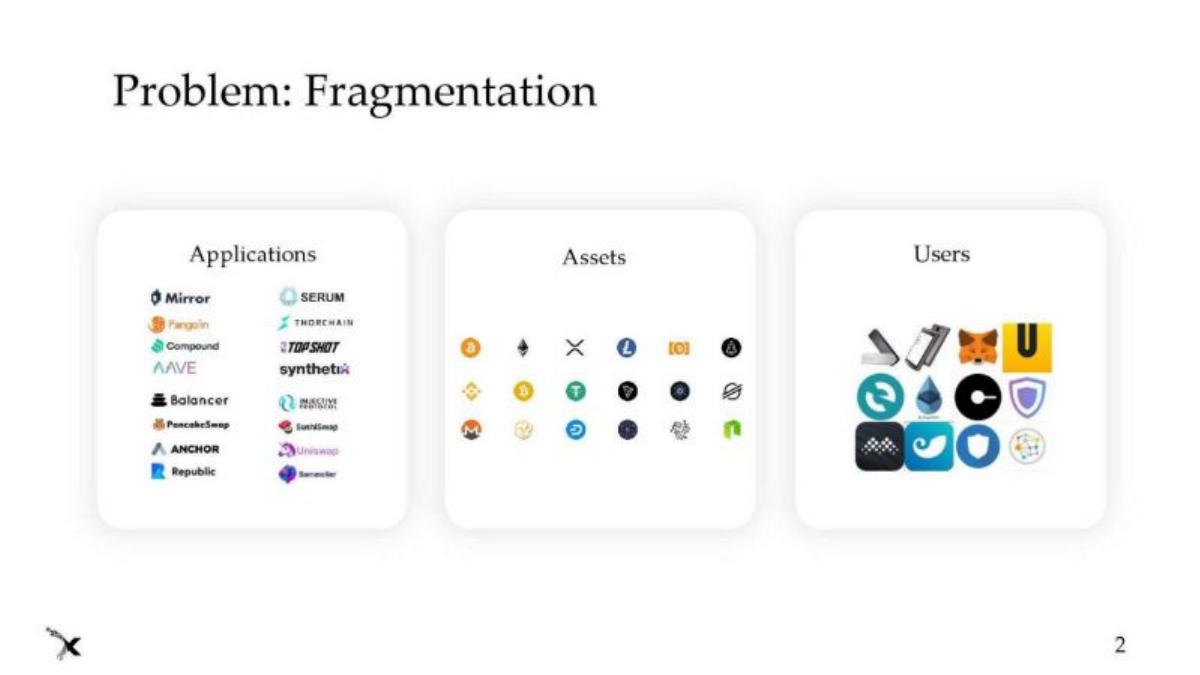
- The deck identifies 'Fragmentation' as the primary market pain point across three verticals: Applications, Assets, and Users (Slide 2).
- Axelar uses a strategic analogy, comparing its routing capabilities to Akamai's role in traditional internet infrastructure (Slide 6).
- The total addressable market is framed through a liquidity lens, citing over '$2 Trillion of assets' that could participate in DeFi (Slide 7).
- The company presents a clear '3-Phase Approach,' starting with cross-chain connections and moving toward app-level interoperability protocols (Slide 11).
- The technical stack is built on four 'Key Ingredients': Tendermint consensus, programmability, finality gadgets, and multi-party crypto (Slide 12).
- The team slide leverages massive institutional credibility, featuring 16 members and logos from MIT, Google, and Consensys (Slide 9).
- The deck is entirely devoid of financial projections, unit economics, or a specific 'Ask' slide, typical of high-conviction infrastructure rounds.
- Network functions are simplified into four core tasks, emphasizing the ability to 'Read' and 'Write' across chains like Bitcoin, Ethereum, and Avalanche (Slide 14).
The Architecture of Interoperability
Axelar's Series B deck is a clinical, technical document that reflects the state of the blockchain infrastructure market in 2022. Rather than focusing on user growth or revenue multiples, the deck sells a vision of a unified Web3. It treats the current state of crypto as a broken, fragmented landscape and proposes a sophisticated technical solution. With 17 slides, the presentation moves from the macro problem of ecosystem silos to the micro details of multi-party cryptography.
Slide 1: The Multi-Chain Ecosystem
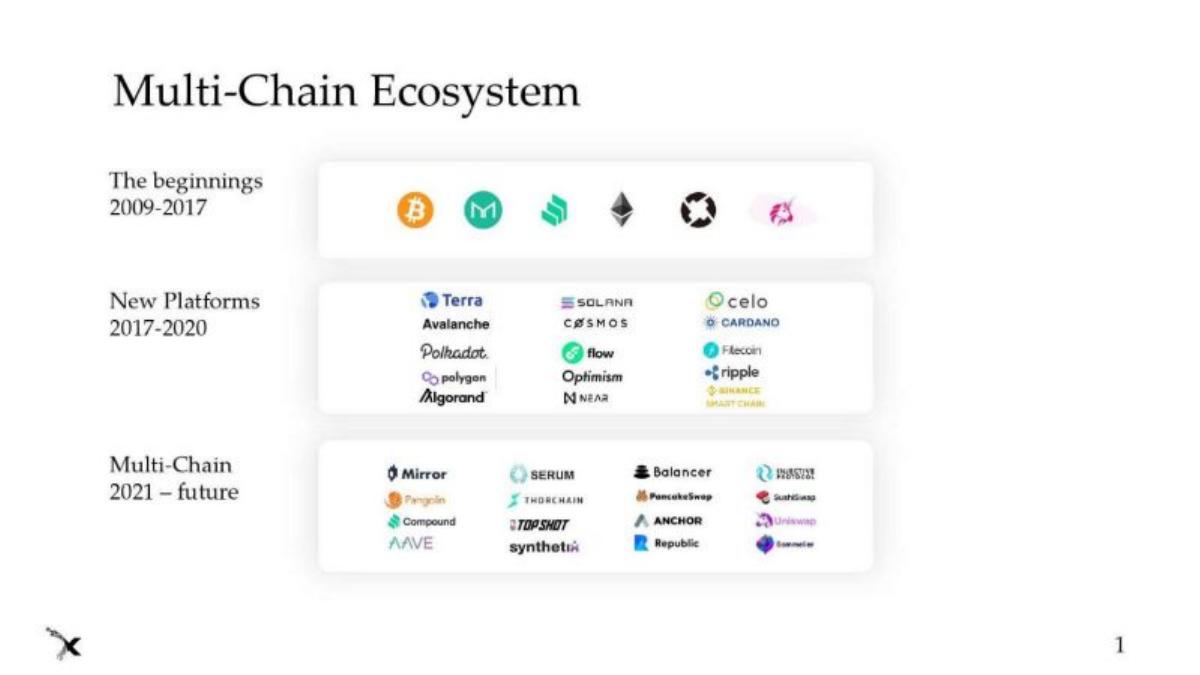
The deck opens with a historical context of the blockchain space. It categorizes the industry into three eras: 'The beginnings' (2009-2017) featuring Bitcoin and Ethereum; 'New Platforms' (2017-2020) including Solana, Polkadot, and Avalanche; and the current 'Multi-Chain' era (2021-future). This slide establishes that the world is no longer dominated by a single chain, creating a market need for a connector.
Slide 2: Problem: Fragmentation
Slide 2 identifies the core pain point. It visually represents fragmentation across three pillars: Applications (Mirror, Compound, Aave), Assets (BTC, ETH, Stablecoins), and Users (represented by various wallet icons). The implication is that these three groups cannot currently communicate or move value between each other seamlessly.
Slide 3 & 4: The Solution and The Network
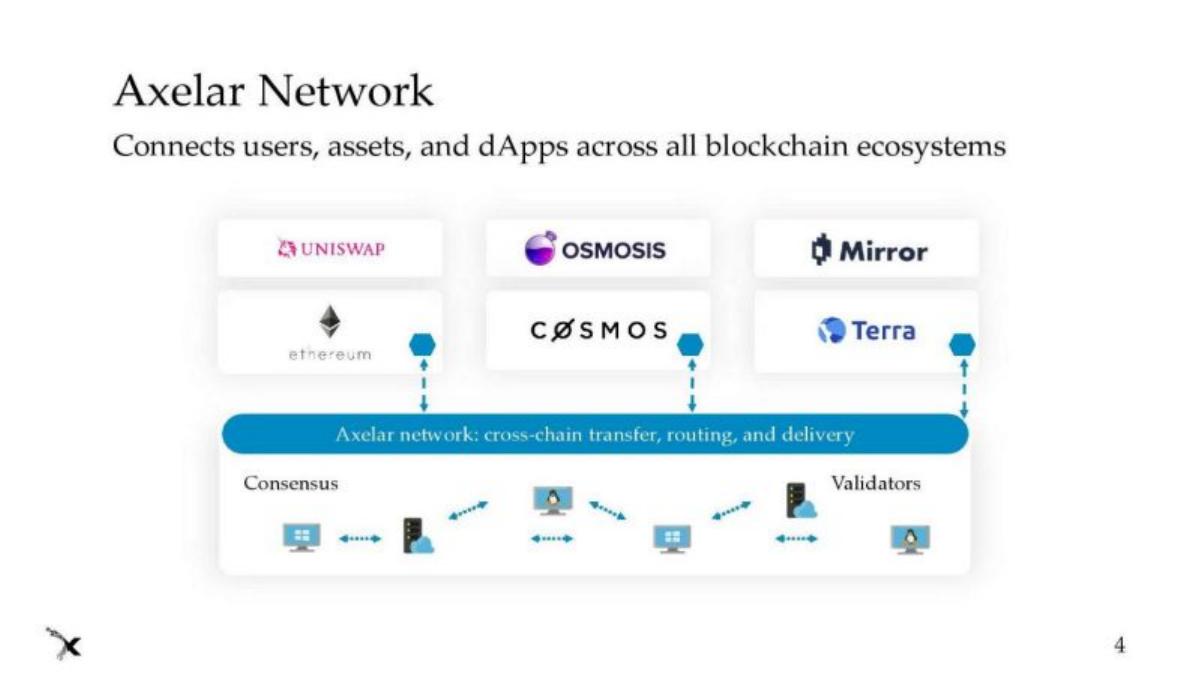
Slide 3 poses a rhetorical question: "Can we allow all users to simply and securely use any asset in any application on any platform?" Slide 4 answers this by introducing the Axelar Network . The diagram shows Axelar as a horizontal layer sitting between various dApps (Uniswap, Osmosis) and base chains (Ethereum, Cosmos, Terra). It highlights the role of validators and consensus in the cross-chain transfer process.
Slide 5: Advantages by Stakeholder
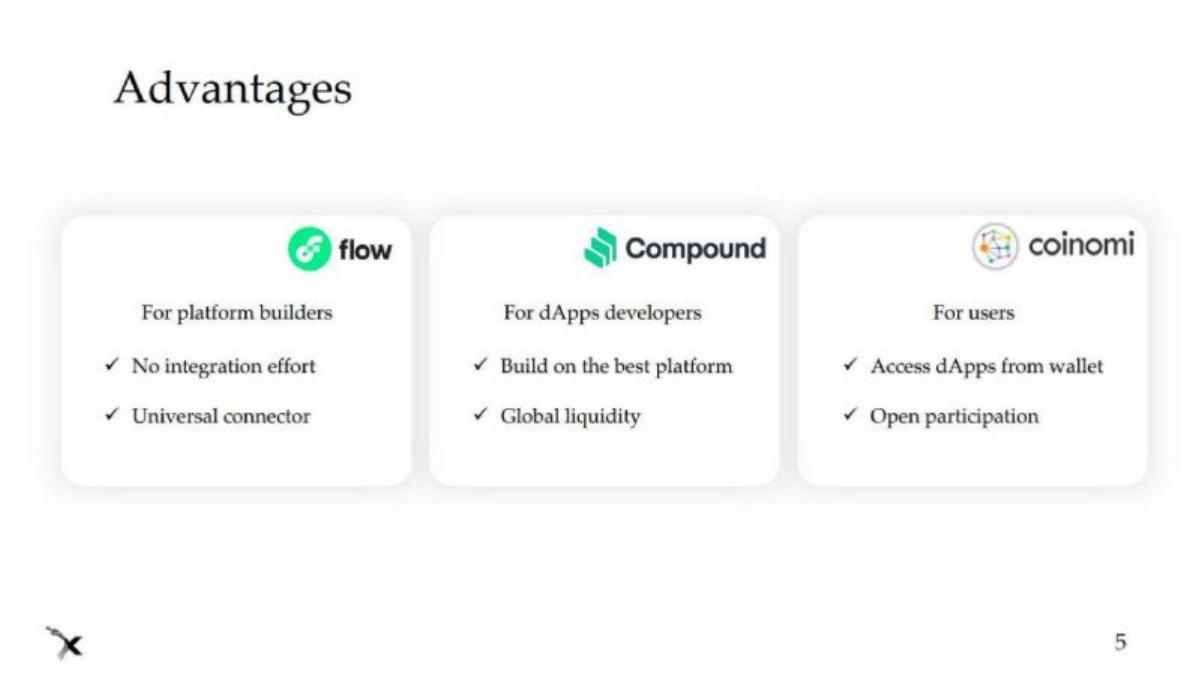
This slide breaks down the value proposition for three distinct groups:
Platform builders: No integration effort, universal connector. · dApps developers: Build on the best platform, global liquidity. · Users: Access dApps from wallet, open participation.
By using logos like Flow, Compound, and Coinomi, Axelar anchors these benefits in real-world entities.
Slide 6: The Akamai Analogy
In one of the most effective slides in the deck, Axelar compares itself to Akamai . Just as Akamai routes content across the traditional internet to optimize delivery, Axelar routes assets, transactions, and state across blockchains. This helps non-technical investors grasp the scale and necessity of the product.
Slide 7 & 8: Use-Cases
Slide 7 focuses on 'Unlocking Liquidity,' stating that over $2 Trillion of assets could participate in DeFi if friction were removed. Slide 8 introduces the 'Universal Wallet' concept, where a single interface could interact with any dApp on any chain (Flow, Bitcoin, Avalanche, Terra) via Axelar's cross-chain transfer protocols.
Slide 9: Our Team
The team slide is a heavy-hitter. It features 16 headshots, led by Sergey Gorbunov and Georgios Vlachos. The bottom of the slide is a 'who's who' of institutional credibility, featuring logos from MIT, Google, Algorand, Consensys, IBM, and the University of Waterloo . For a Series B infrastructure play, this pedigree is the most important slide for de-risking the investment.
Slide 10, 11 & 12: Technical Approach
Slide 11 outlines a 3-Phase Approach . Step 1 (the current focus) is making it easy to set up connections across chains. Step 12 lists the 'Key Ingredients' of the tech stack: Tendermint Consensus, Programmability (API), Finality gadgets, and Multi-party crypto. This confirms the project's reliance on proven cryptographic primitives and the Cosmos ecosystem (via Tendermint).
Slide 13 & 14: System Components and Functions
These slides provide a deep dive into the 'Cross-Chain Gateway Protocol (CGP).' Slide 13 shows the validator stack, including broadcaster processes and RPC connections to external chains like Bitcoin and Ethereum. Slide 14 lists the four primary network functions, including managing keys for external gateways and authorizing 'write' and 'read' requests across chains.
Slide 15, 16 & 17: Closing
The deck concludes with a simple logo slide and a placeholder for the BestPitchDeck.com library. There is no 'Ask' slide, no contact information for the founders, and no summary of the round's terms.
What Axelar Does Well
Axelar excels at positioning . By framing the problem as 'Fragmentation' and the solution as an 'Overlay Network,' they move the conversation away from 'yet another bridge' to 'essential infrastructure.' The use of the Akamai analogy is a masterstroke in simplifying a product that relies on threshold signatures and consensus logic. Furthermore, the team slide is exceptionally strong, providing the necessary academic and professional validation required for a $25M round in a highly technical sector.
What is Missing from the Deck
The most glaring omission is traction data . While the deck mentions the potential for $2 Trillion in liquidity, it does not state how much volume has actually moved through Axelar, how many active validators are on the network, or the number of developers currently using the SDK. Additionally, there is no Business Model slide. It is unclear how the network captures value—whether through transaction fees, token inflation, or subscription models. Finally, the lack of a Competitor Analysis is notable; in 2022, the interoperability space was crowded with players like LayerZero, Wormhole, and Multichain, yet none are mentioned.
What Other Founders Should Copy
Founders building complex, 'invisible' infrastructure should copy Axelar's Analogy Slide . Finding a Web2 equivalent (like Akamai) helps investors categorize the startup's potential market cap and utility instantly. Founders should also emulate the Stakeholder Benefit layout on Slide 5, which clearly explains why different segments of the market should care about the product. Lastly, the 3-Phase Approach on Slide 11 is an excellent way to show a long-term vision while remaining grounded in the immediate 'Step 1' tasks that the current funding round will support.
Frequently asked questions
- What is Axelar's core value proposition?
- Axelar positions itself as a 'Blockchain Overlay Network' that connects users, assets, and dApps across all blockchain ecosystems. Its primary goal is to eliminate the friction of fragmentation, allowing any user to use any asset on any application regardless of the underlying platform. It achieves this through a decentralized network of validators and cross-chain gateway protocols.
- How does Axelar explain its complex technology to investors?
- The deck uses a mix of high-level analogies and detailed system architecture. The most effective slide is the comparison to Akamai, which helps investors understand Axelar as a routing and delivery layer for the decentralized web. This is followed by 'Use-Case' slides that translate technical features into business outcomes like 'Unlocking Liquidity' and 'Universal Wallets.'
- Who is the target audience for this pitch deck?
- This is a Series B deck intended for technical VCs and institutional investors who already understand the blockchain landscape. The inclusion of terms like 'Tendermint Consensus,' 'Finality gadgets,' and 'Multi-party crypto' suggests that the founders are not looking to educate beginners, but rather to prove technical superiority to experts.
- What are the notable omissions in the Axelar deck?
- The deck lacks a traditional business model slide, revenue figures, customer acquisition costs, and a formal 'The Ask' slide. In the context of a $25M Series B for a core infrastructure protocol, these are often replaced by metrics related to network security, validator count, and ecosystem integrations, though those are also largely absent here.
- How does the deck demonstrate market traction?
- Traction is shown through ecosystem logos rather than revenue. Slide 1 and Slide 5 feature prominent industry names like Flow, Compound, Uniswap, and Terra. By showing that these major players either need or are already compatible with Axelar, the company demonstrates its central position in the 'Multi-Chain Ecosystem.'