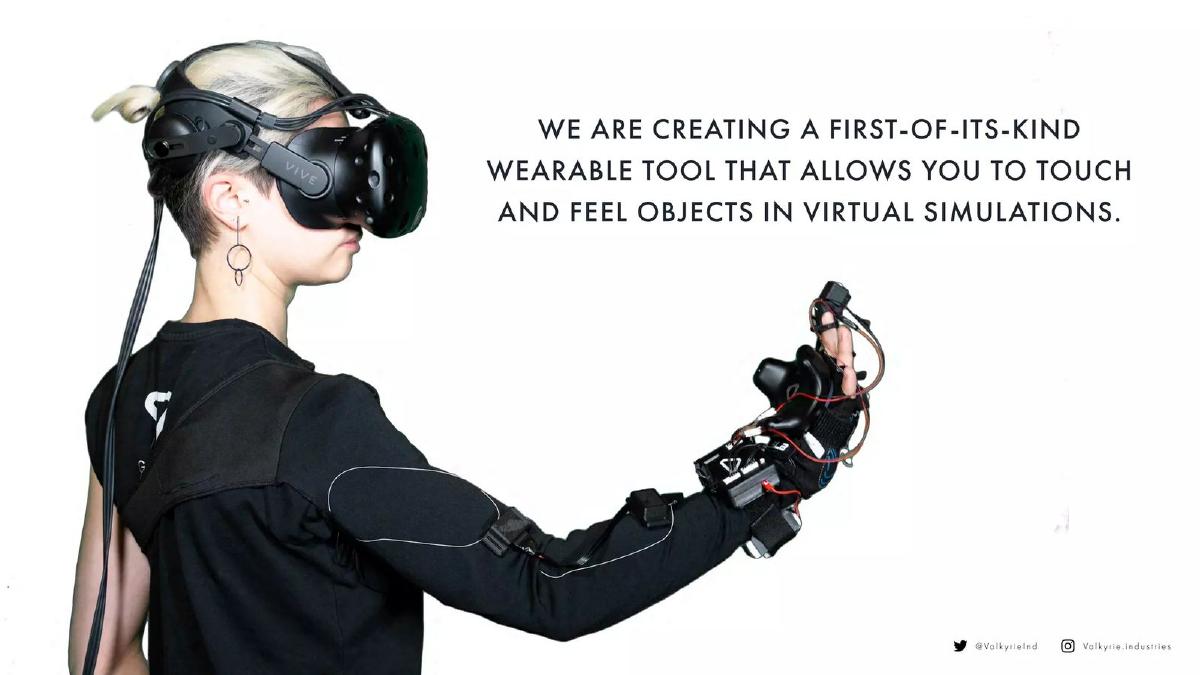
Valkyrie Industries is developing a wearable, modular haptic interface designed to provide tactile and force feedback in virtual reality environments. The deck identifies a gap in current VR technology, specifically that existing interfaces are insufficient for high-stakes industries like medicine and engineering. By offering sensations of texture and weight, Valkyrie aims to enable more realistic simulations for trainee doctors, heavy industry engineers, and physical rehabilitation. The company projects breaking even in three years, supported by a team with strong ties to Imperial College Lo…
Key takeaways
- The company identifies a specific problem: current VR interfaces are inadequate for meaningful adoption in medical, engineering, and retail sectors (Slide 2).
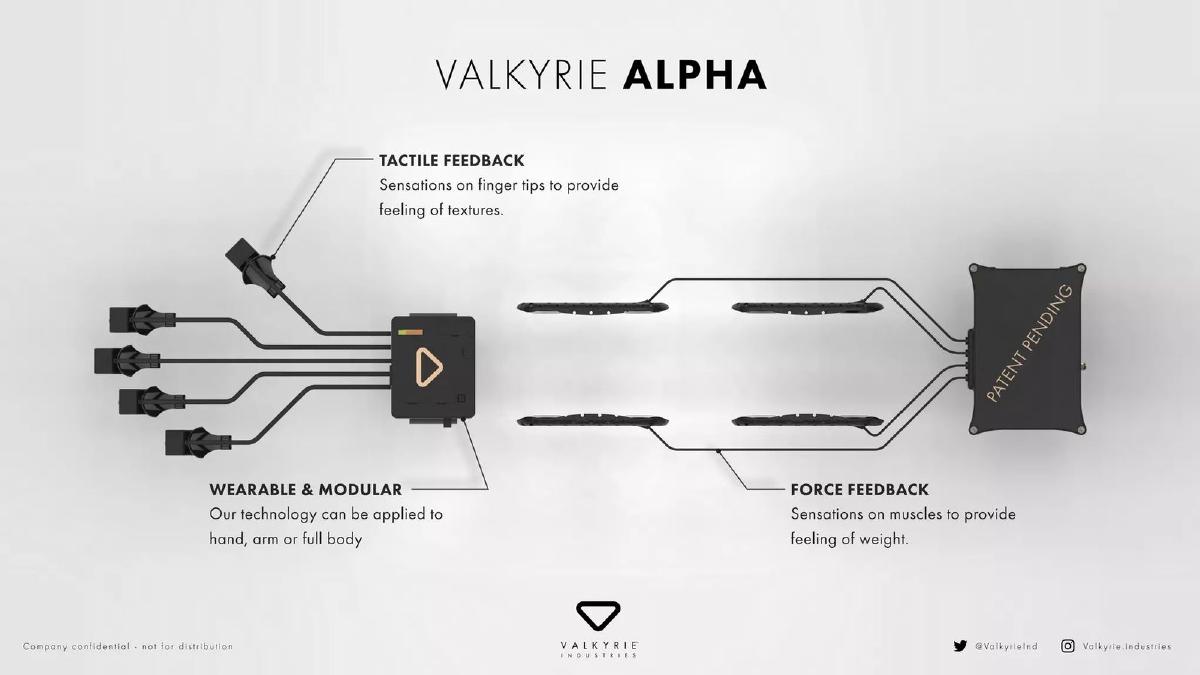
- The Valkyrie Alpha product features tactile feedback for textures and force feedback for weight, using a wearable and modular design (Slide 3).
- Market growth is estimated at $9.1B for VR revenue in 2018, with a 250% increase from the previous year (Slide 4).
- The business vision spans four key areas: medical diagnostics, hazardous scenario simulation, heavy industry training, and rehabilitation (Slide 5).
- A competitive matrix claims Valkyrie is the only player offering a combination of tactile, force feedback, finger tracking, and low cost (Slide 6).
- Financial projections forecast a jump from £100,000 in revenue in 2019 to over £4.4M by 2022 (Slide 8).
- The company has a history of funding from Innovate UK, Deep Science Ventures, and the European Union (Slide 8).
- The team is anchored by founders from Imperial College London and UCL, supported by an advisory board including the VP of HTC VIVE (Slide 9).
Valkyrie Industries: Bridging the Haptic Gap in VR
Valkyrie Industries enters the market with a clear thesis: virtual reality is currently limited by its input methods. While visual and auditory immersion have advanced rapidly, the physical sensation of interacting with objects—haptics—remains a significant barrier to professional adoption. This deck, labeled as the 'Seed Edition' from September 2018, outlines a path toward modular, wearable haptics for industrial and medical applications.
Slide 1: Title and Partnerships
The cover slide establishes immediate credibility through a dense list of partners and funders at the bottom. It notes the company is 'Stage 1 Funded' by Innovate UK and lists technical partners including Imperial College London, University of Southampton, and London South Bank University. The presence of 'Augmentor' and 'Eagle Labs' as collaboration partners suggests the company has been through accelerator or incubator programs. The 'Seed Edition' branding indicates this deck is intended for early-stage equity investors.
Slide 2: The Problem Statement
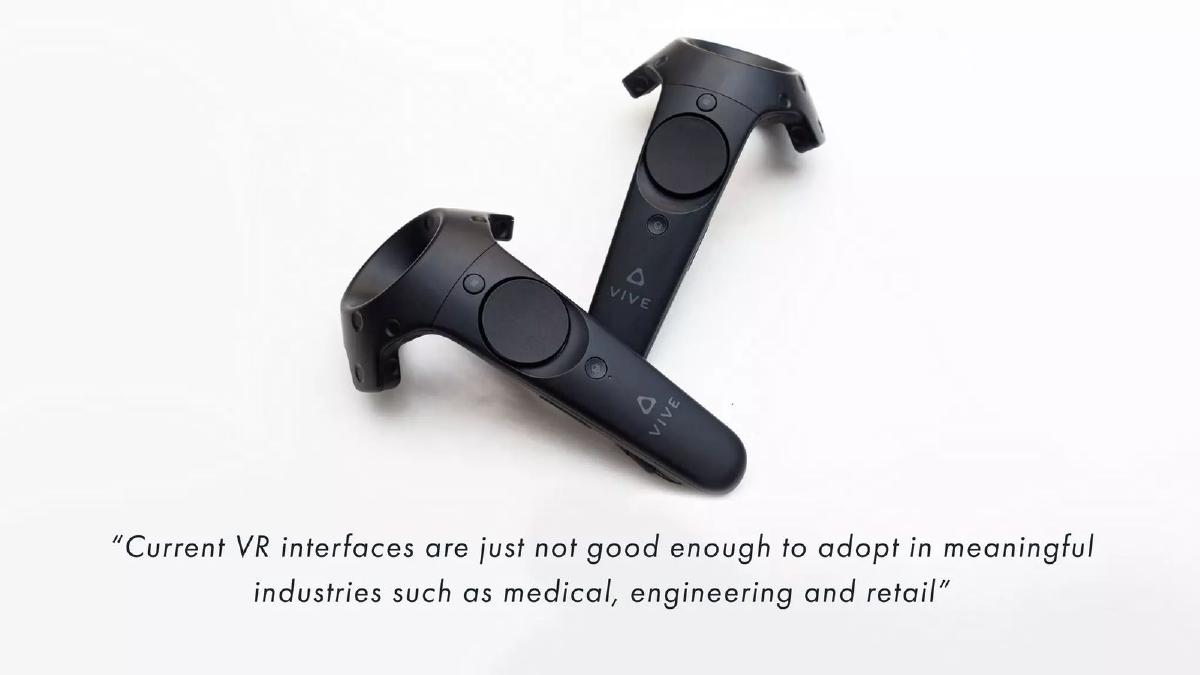
Slide 2 uses a minimalist approach to define the problem. It features an image of standard HTC VIVE controllers with the quote: "Current VR interfaces are just not good enough to adopt in meaningful industries such as medical, engineering and retail." This positions the company not as a competitor to VR headset manufacturers, but as an essential peripheral provider that unlocks the 'meaningful' (high-value) use cases that standard controllers cannot handle.
Slide 3: The Valkyrie Alpha Product
This slide introduces the hardware, labeled 'Valkyrie Alpha.' It shows a schematic of a wearable device with several key callouts. Tactile Feedback is described as sensations on fingertips to provide the feeling of textures. Force Feedback is described as sensations on muscles to provide the feeling of weight. The slide also notes the technology is 'Wearable & Modular,' capable of being applied to the hand, arm, or full body. A 'Patent Pending' stamp is prominently displayed on the main control unit, signaling intellectual property protection.
Slide 4: Market Opportunity and Growth
Slide 4, titled 'Immersive Growth,' provides market sizing. It estimates 2018 VR revenue at $9.1B , representing a 250% increase over 2017. It breaks down the market by sector: Entertainment ($18.9B), Health & Education ($5.8B), Engineering ($4.7B), Retail ($4.2B), and Military ($1.4B). Note that the total of these sub-sectors exceeds the $9.1B figure, suggesting these are long-term projections or addressable market caps rather than current revenue. The slide also cites a 2015 figure of 125 million active Steam users to illustrate the potential scale of the gaming/entertainment side of the market.
Slide 5: Business Vision
This slide moves from abstract market sizes to specific use cases. It lists four primary visions:
Trainee doctors practicing diagnostics without liability conflicts. · Simulating hazardous scenarios by feeling inertia and G-force. · Heavy industry training, such as for unbuilt windfarms. · Cognitive dextrous skill regeneration for rehabilitation.
The inclusion of rehabilitation and medical diagnostics suggests a high-margin, specialized focus beyond simple gaming.
Slide 6: The Competitive Landscape
Valkyrie uses a feature-comparison matrix to position itself against competitors like Dexmo, HaptX, and Teslasuit. The matrix tracks seven variables: Tactile, Force Feedback, Spatially Free, Finger Tracking, AI, Low Cost, and Realistic Haptics. According to the chart, Valkyrie is the only company that checks every box. Most competitors are marked as lacking 'Low Cost' and 'Realistic Haptics,' which Valkyrie identifies as its primary competitive advantages.
Slide 7: Customer Focus
Slide 7 reinforces the 'Heavy Industries' focus with a collage of images showing users in various industrial settings—operating valves, inspecting 3D models, and sitting in vehicle simulators. This slide is intended to prove that the product has a clear home in the enterprise sector, specifically in training environments where physical muscle memory is critical.
Slide 8: Financial Projections and Funding History
The financial slide is detailed, showing a five-year forecast. The company projects breaking even in 3 years . The 'Financial Forecast' table shows revenue growing from £0 in 2018 to £100,000 in 2019, then scaling to £4,473,000 by 2022 . Net income is projected to turn positive in 2022 at £538,586. The bottom of the slide lists a robust funding history for an early-stage startup, including Innovate UK, Deep Science Ventures, and the European Regional Development Fund in 2017 and 2018.
Slide 9: The Team and Advisory Board
The team slide highlights three founders: Kourosh Atefipour (CEO), Dr. Ivan Isakov (CTO), and Oliver Cleveley-Jones (Lead Developer). Their credentials include Imperial College London, UCL, and the Royal College of Art. The advisory board is particularly strong, featuring Raymond Pao, VP of HTC VIVE , alongside serial entrepreneurs and academics from Imperial and London South Bank University. This suggests strong industry ties to the hardware ecosystem they are building for.
Slide 10: Contact and Closing
The final slide provides contact information, including a London address at 101 Euston Road. It repeats the partner logos from the first slide, reinforcing the institutional support the company has gathered.
What Works in the Valkyrie Industries Deck
The deck excels at credibility through association . By listing numerous technical partners, universities, and a VP from HTC VIVE on the advisory board, the founders mitigate the perceived risk of a hardware startup. The problem statement is also highly effective; it doesn't just say 'VR is cool,' it identifies a specific technical bottleneck (lack of haptics) that prevents VR from being used in high-value industries like medicine and heavy engineering. The distinction between tactile feedback (texture) and force feedback (weight) is a crucial technical detail that shows the founders understand the nuances of their field.
What is Missing from the Valkyrie Industries Deck
The most glaring omission is a specific funding ask . While the deck is labeled 'Seed Edition,' it does not state how much money is being raised, the valuation, or how the funds will be spent (e.g., R&D vs. manufacturing vs. sales). Furthermore, for a hardware company, there is a lack of unit economics . Investors would want to know the estimated cost to manufacture one unit versus the intended retail or enterprise lease price. The 'Low Cost' claim on the competition slide is not backed up by specific price points. Finally, the 'Go-to-Market' strategy is implied through use cases but lacks a concrete plan for how they will acquire their first ten enterprise customers.
Founder Takeaways: What to Copy
Founders building in deep tech or hardware should emulate Valkyrie's competitive matrix (Slide 6). Instead of just listing names, they categorized competitors by specific technical capabilities, making it easy for an investor to see where the market gap lies. Additionally, the Business Vision slide (Slide 5) is an excellent example of how to translate complex technology into real-world utility. By showing a doctor, a driver, and an engineer, they make the 'why' of the product immediately clear. Finally, the use of institutional logos (Slide 1 and 8) is a masterclass in building early-stage 'social proof' before the company has significant commercial traction.
Frequently asked questions
- What is the primary technical differentiator for Valkyrie Industries?
- According to Slide 3, the differentiator is the combination of tactile feedback (sensations on fingertips for textures) and force feedback (sensations on muscles for weight). The deck emphasizes that this technology is 'wearable and modular,' allowing it to be applied to the hand, arm, or full body, which distinguishes it from stationary or bulky haptic systems.
- Which industries is Valkyrie targeting for its initial rollout?
- Slide 5 and Slide 7 highlight 'Heavy Industries' and 'Immersive Training' as the primary focus. Specific use cases mentioned include trainee doctors practicing diagnostics, simulating G-forces in hazardous driving scenarios, training engineers for unbuilt windfarms, and cognitive dextrous skill regeneration for rehabilitation.
- How does Valkyrie view its competition in the haptics space?
- Slide 6 provides a competitive matrix against eight companies, including HaptX, Teslasuit, and UltraHaptics. Valkyrie claims to be the only solution that satisfies all seven criteria: Tactile, Force Feedback, Spatially Free, Finger Tracking, AI, Low Cost, and Realistic Haptics. Most competitors are shown lacking in 'Low Cost' and 'Realistic Haptics'.
- What are the company's financial expectations for the next few years?
- Slide 8 projects a break-even point in 2021. The forecast shows revenue growing from £0 in 2018 to £4,473,000 in 2022. During this same period, costs are expected to rise from £126,330 to £3,714,478, resulting in a projected net income of £538,586 by year five.
- What is missing from this pitch deck that an investor might need?
- The deck lacks a specific 'Ask' slide detailing how much capital is being raised and how it will be allocated. Additionally, there is no mention of unit economics (COGS, per-unit price) or a detailed go-to-market strategy beyond general industry categories. The 'Seed Edition' tag on the cover suggests an early-stage raise, but the specific terms are omitted.