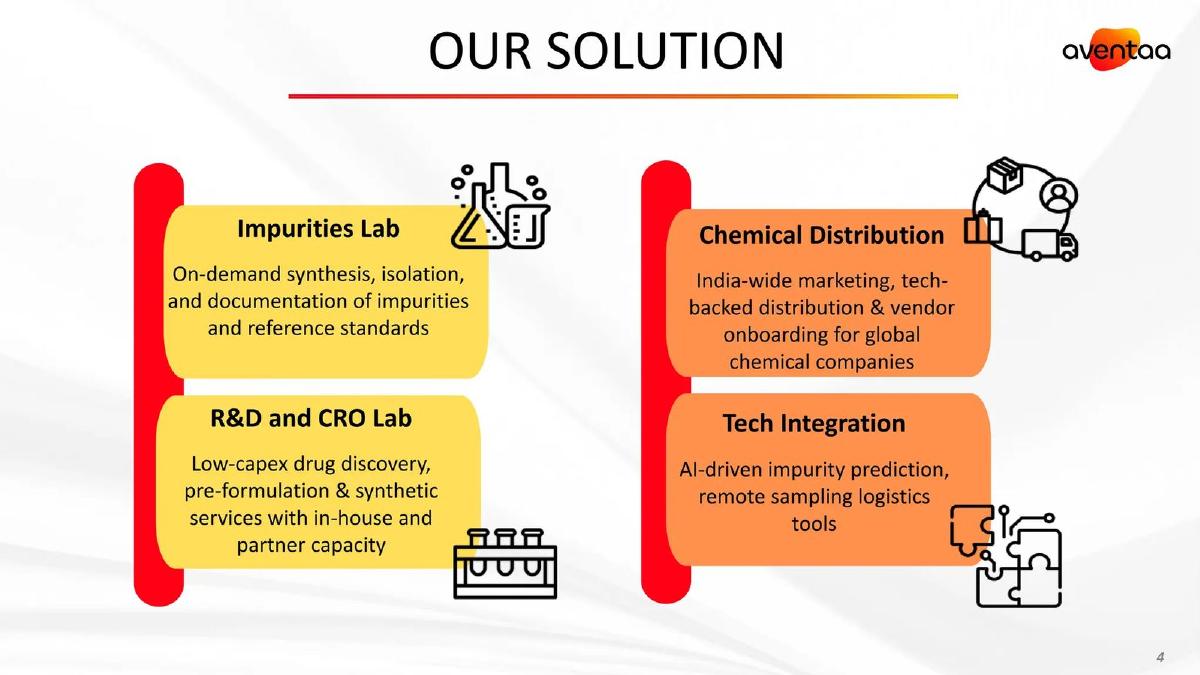
Aventaa Research Private Limited operates at the intersection of pharmaceutical R&D and chemical supply chains. Their deck outlines a diversified revenue strategy that includes high-margin impurity synthesis, commission-based chemical distribution, and a future roadmap for SaaS-based impurity prediction. By leveraging Tier-2 city cost efficiencies in India, the company claims a 3x speed advantage over larger CROs. The financials show a path from initial losses to a projected 2.32% Profit After Tax (PAT) by Year 3, driven by a significant revenue jump from 6.25 Cr to 44.67 Cr. While the deck h…
Key takeaways
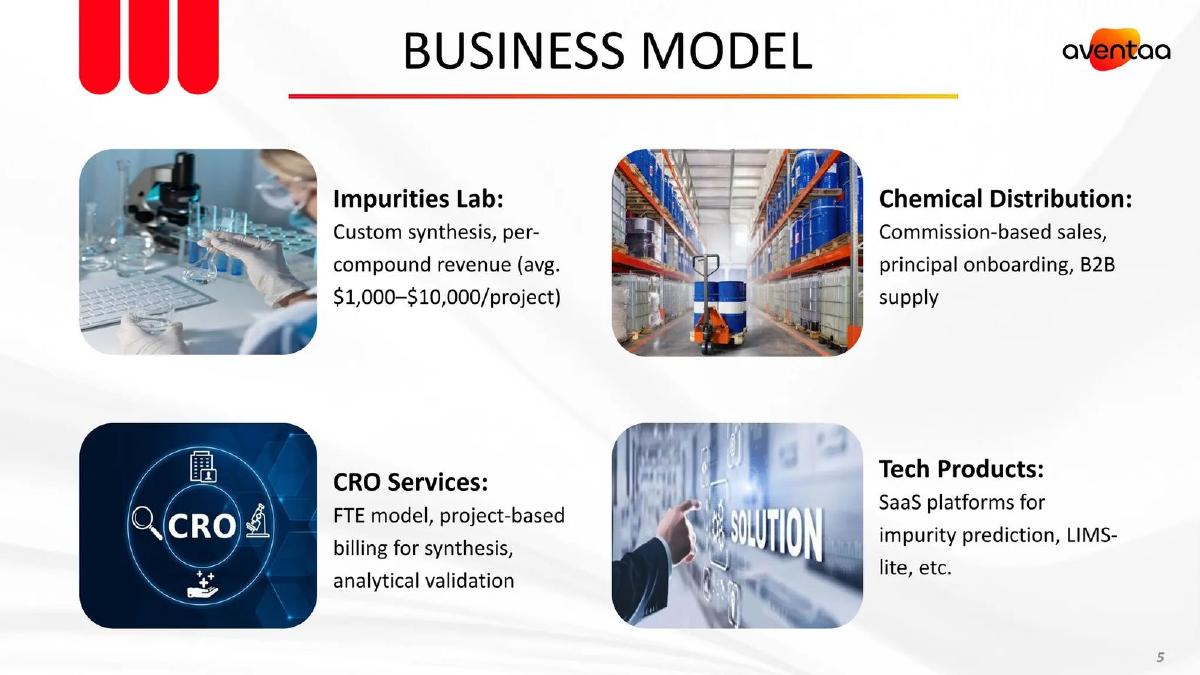
- The business model is split into four distinct pillars: Impurities Lab, Chemical Distribution, CRO Services, and Tech Products (Slide 5).
- Aventaa targets a 3x faster turnaround time for impurity projects compared to large-scale CRO competitors (Slide 9).
- Revenue is projected to grow from 6.25 Cr in Year 1 to 44.67 Cr by Year 3, representing a 7x increase (Slide 11).
- The company utilizes a Tier-2 city operational model to maintain competitive pricing without compromising quality (Slide 9).
- Tech integration plans include the early adoption of AI, Blockchain, and Remote Quality Control (Slide 9).
- The Impurities Lab generates an average revenue of $1,000–$10,000 per project through custom synthesis (Slide 5).
- Regulatory goals include applying for DSIR, NABL, and GLP certifications to meet global pharmaceutical standards (Slide 9).
- The Go-To-Market strategy involves partnering with global CDMOs and exhibiting at major industry events like CPHI and BioAsia (Slide 7).
Slide-by-Slide Analysis
Slide 1: Title Slide
The deck opens with the company name, Aventaa Research Private Limited , and the tagline "Innovation Through Integrity – From Impurities to Innovation." The branding is professional, featuring a red and orange logo. It clearly identifies the entity as a private limited company, suggesting a formal corporate structure in the Indian market.
Slide 3: Problem Statement
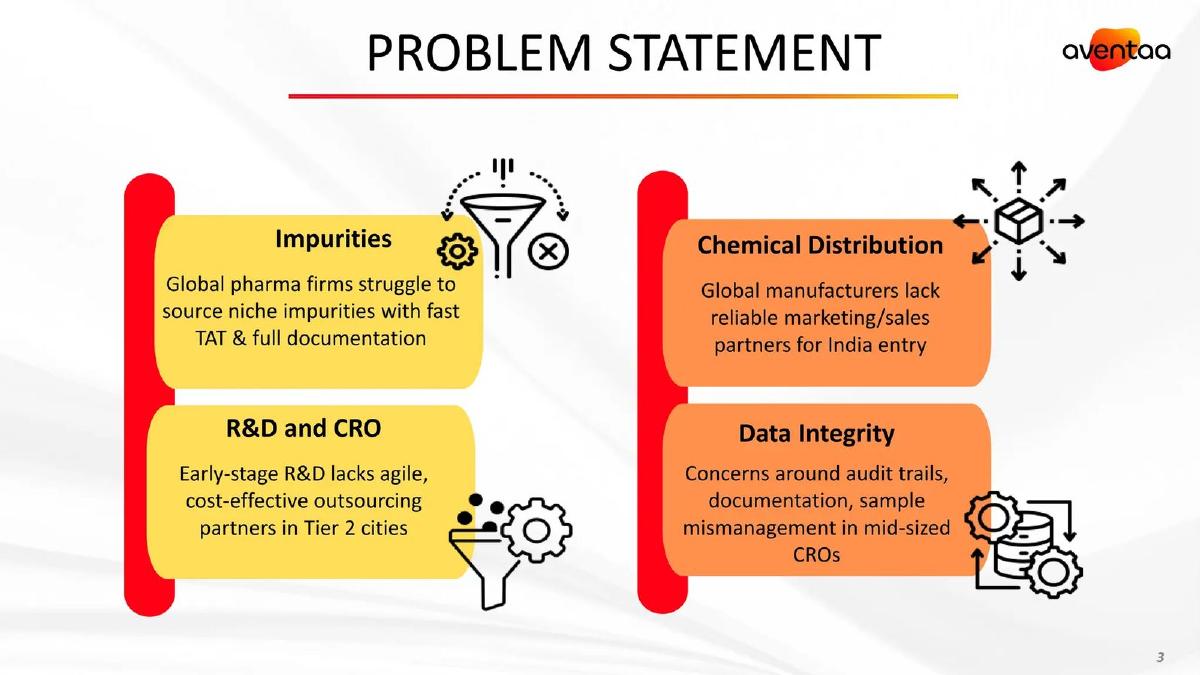
This slide breaks the industry pain points into four quadrants. Under Impurities , it notes that global pharma firms struggle to source niche impurities with fast turnaround times (TAT) and full documentation. The Chemical Distribution section highlights a lack of reliable marketing and sales partners for global manufacturers entering the Indian market. For R&D and CRO , the problem is a lack of agile, cost-effective outsourcing partners in Tier 2 cities. Finally, Data Integrity concerns regarding audit trails and sample mismanagement in mid-sized CROs are identified as a major hurdle.
Slide 5: Business Model
Aventaa presents a four-pillar revenue model. Impurities Lab focuses on custom synthesis with an average revenue of $1,000–$10,000 per project . Chemical Distribution operates on commission-based sales and B2B supply. CRO Services utilize an FTE (Full-Time Equivalent) model and project-based billing for analytical validation. The fourth pillar, Tech Products , introduces a future SaaS component for impurity prediction and "LIMS-lite" (Laboratory Information Management System) software.
Slide 7: Go-To-Market Strategy
The GTM strategy is segmented by business line. For Impurities/CRO, the plan is to partner with global CDMOs and generic pharma companies while exhibiting at industry events like CPHI, BioAsia, and Chemspec . The Distribution arm aims to tie up with global raw material manufacturers (excipients and actives) and target Indian R&D heads. The Tech Solution strategy involves launching beta products for in-house lab use before piloting with other local CROs and small pharma players.
Slide 9: Competitive Advantage
Aventaa lists five key advantages. Their Technical Team consists of PhDs and consultants with drug discovery expertise. They claim a Fast Turnaround Time that is up to 3x faster than large CROs. Cost Efficiency is driven by "Lean, Tier-2 city operations." Regulatory Preparedness involves applying for DSIR, NABL, and GLP certifications. Lastly, Tech Integration mentions a roadmap for AI, Blockchain, and Remote QC, though no specific details on these implementations are provided on the slide.
Slide 11: Financials
The financial table provides a three-year projection. Year 1 shows revenue of 6.25 Cr with a Gross Margin of 16.00% and a PAT (Profit After Tax) of -6.29% . Year 2 sees revenue climb to 22.25 Cr , with the company reaching a positive EBITDA of 2.75%, though still maintaining a negative PAT of -1.69%. By Year 3 , revenue is projected at 44.67 Cr with a Gross Margin of 16.66% and a positive PAT of 2.32% . The margins remain relatively consistent across the three years, suggesting a volume-driven growth strategy rather than margin expansion.
Slide 13: Contact Information
The final slide provides the company's website (aventaa.com), a contact phone number, an email address, and a LinkedIn profile link. It serves as a standard call to action for interested parties to reach out for further discussion.
What Works in This Deck
Clear Market Segmentation: The deck does a good job of explaining how the company intends to play in different parts of the value chain. By separating the lab services from the distribution and tech products, they show a diversified approach that could mitigate the risks associated with a single-service CRO model.
Quantified Speed Advantage: Claiming a "3x faster" turnaround time (Slide 9) is a specific, measurable value proposition that resonates well with pharmaceutical companies where time-to-market is a critical financial driver.
Geographic Arbitrage: Explicitly mentioning Tier-2 city operations (Slide 9) provides a logical explanation for how they can maintain lower costs than larger, urban-based competitors without necessarily sacrificing the quality of their technical talent.
What Is Missing
The Funding Ask: The most significant omission is the lack of a slide detailing how much capital the company is seeking, the valuation, or how the funds will be allocated. Without this, the deck feels more like a corporate brochure than a fundraising tool.
Team Biographies: While the deck mentions "PhDs & Consultants" (Slide 9), it does not name the founders or key leadership. In the CRO and chemical space, the specific pedigree and past track record of the scientists are often the primary factors in establishing trust with investors and clients.
Unit Economics: While the business model slide mentions project averages of $1,000–$10,000, there is no detail on the cost of acquisition (CAC) or the lifetime value (LTV) of a pharma client. Given the low net profit margins projected in Year 3 (2.32%), understanding the underlying unit economics is vital.
Competitive Landscape: The deck mentions "large CROs" as a general competitor but does not name specific companies or provide a comparison matrix. Investors would want to see how Aventaa stacks up against specific mid-tier and top-tier players in the Indian and global markets.
Founder's Guide: What to Copy
The Quadrant Problem Statement: Slide 3 is a strong example of how to categorize complex industry problems. By breaking the issues into Impurities, Distribution, R&D, and Data Integrity, the founders make a complicated technical field accessible to a generalist investor.
Diversified Revenue Streams: The way Slide 5 presents different billing models (FTE, project-based, commission, and SaaS) is a good template for companies that have both service and product components. It shows a sophisticated understanding of how to capture value at different points of the customer relationship.
Regulatory Roadmap: Including specific certifications like DSIR, NABL, and GLP (Slide 9) is essential for any life sciences startup. It demonstrates that the founders understand the compliance hurdles required to scale and are proactively addressing them.
Final Thoughts
Aventaa Research Private Limited presents a pragmatic, service-heavy business model that leverages India's cost advantages to serve the global pharmaceutical market. The deck is strongest when discussing operational efficiencies and market needs but weakens when it comes to the specifics of the investment opportunity. For this deck to be effective in a venture capital context, it would require the addition of a clear team slide, a detailed breakdown of the funding requirement, and a more robust explanation of how their thin profit margins (2.32% in Year 3) will eventually lead to significant investor returns.
Frequently asked questions
- What is Aventaa's primary value proposition in the CRO space?
- Aventaa focuses on speed and cost-efficiency. According to slide 9, they claim to be up to 3x faster than large CROs for impurity projects. They achieve cost-effectiveness by operating out of Tier-2 cities in India, allowing them to offer competitive pricing to global pharma firms that struggle with niche impurity sourcing and long turnaround times.
- How does the company plan to generate revenue?
- As shown on slide 5, the revenue model is diversified. It includes per-compound revenue from custom synthesis ($1k-$10k per project), commission-based sales from chemical distribution, and project-based or FTE (Full-Time Equivalent) billing for CRO services. They also plan to launch SaaS platforms for impurity prediction and laboratory information management (LIMS-lite).
- What are the projected financial outcomes for the company?
- Slide 11 outlines a three-year forecast. Revenue is expected to start at 6.25 Cr with a net loss (PAT of -6.29%). By Year 2, revenue grows to 22.25 Cr with a positive EBITDA of 2.75%. By Year 3, the company projects 44.67 Cr in revenue and a slim net profit (PAT) of 2.32%.
- What technical certifications is Aventaa pursuing?
- To compete globally, Aventaa is applying for several key regulatory certifications. Slide 9 specifically mentions DSIR (Department of Scientific and Industrial Research), NABL (National Accreditation Board for Testing and Calibration Laboratories), and GLP (Good Laboratory Practice) to ensure their data integrity and laboratory standards meet international requirements.
- Is there a specific investment ask in this deck?
- No. The provided slides do not include a 'Use of Funds' or 'Investment Ask' slide. While the deck is labeled as a 'Pitch Deck' on slide 1, it functions more as a capabilities and business overview rather than a specific request for capital with defined terms or milestones.