Avatr, operated by Inavya Ventures Ltd., presented this investor pack in April 2019 to support a £300,000 crowdfunding campaign on Seedrs. The company positions itself as an 'augmented intelligence' bridge between patients and physicians, utilizing a conversational interface to surface actionable health data. The deck emphasizes significant regulatory and grant-based traction, including a CE Mark and Innovate UK grants dating back to 2015. While the technology is framed as 'ready for pre-commercial launch,' the deck focuses heavily on a phased global expansion plan starting in Singapore and m…
Key takeaways
- The company sought a total investment of £300,000 to validate its commercial model in Singapore and expand globally (Slide 3).
- Avatr achieved CE Class 1 Medical Device registration in October 2018, a critical regulatory milestone for health-tech startups (Slide 6).
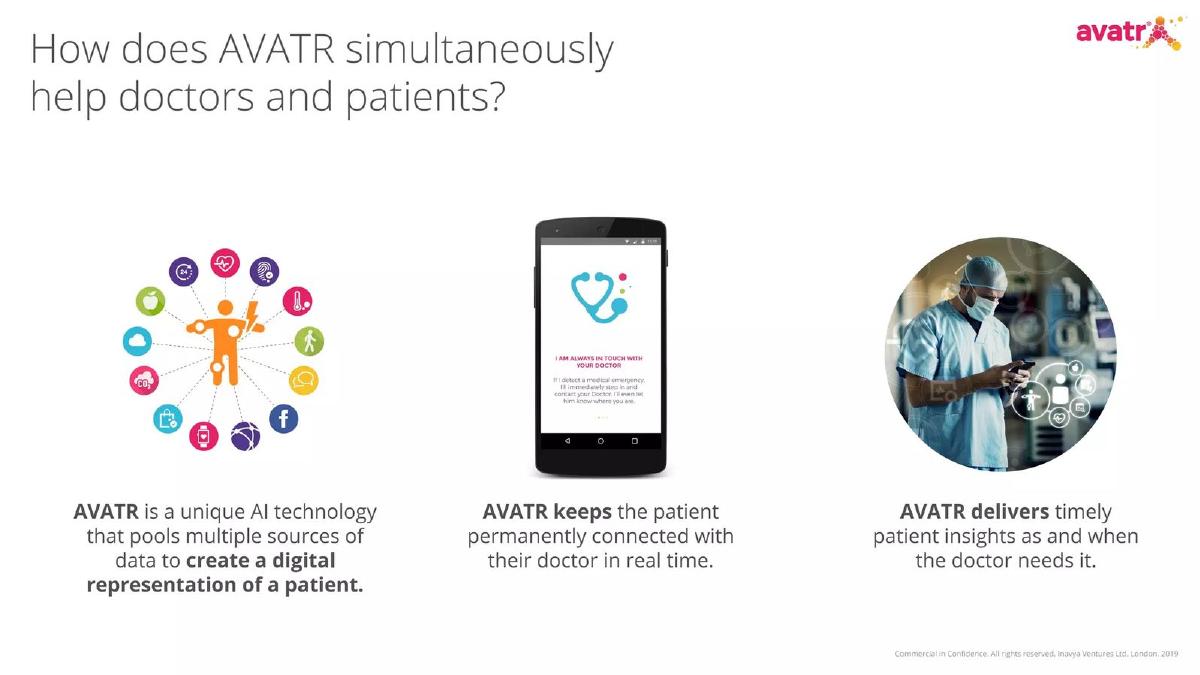
- The product uses a conversational interface (chatbot) to collect patient data, which is then prioritized by machine learning for physician review (Slide 5).
- A significant portion of the funding (£140,000) was allocated to covering the 'Operating Cash Flow Gap' in Year 1 (Slide 3).
- The business plan targets 500 private patients in Singapore by December 2019 to validate price points (Slide 7).
- Long-term projections aim for 30,000 to 50,000 private users by the end of 2021 across five key global locations (Slide 7).
- The technology has been supported by non-dilutive funding, including an Innovate UK R&D grant in 2015 and a Newton Fund grant in 2017 (Slide 6).
- The final business breakthrough phase (2022-2023) intends to transition the company into a B2B SaaS model for hospitals and insurers (Slide 7).
Slide-by-Slide Analysis
Slide 1: Title Page
The cover slide introduces Avatr as an 'Investor Pack' dated April 2019. It identifies the parent company as Inavya Ventures Ltd., based in London. The visual branding is clean, using a multi-colored bubble motif that persists throughout the deck. A small icon in the bottom right featuring a pound sign and a bar chart suggests the deck is geared toward a financial raise.
Slide 2: Pre-commercial Launch Readiness
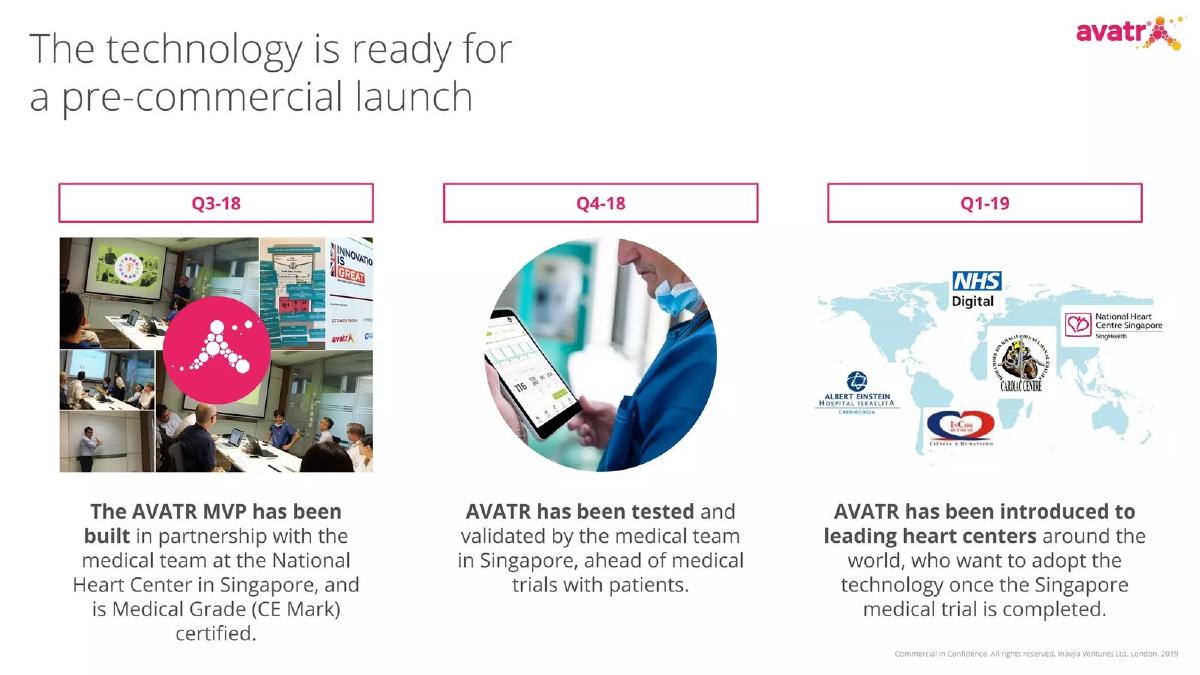
This slide focuses on the technical and clinical validation of the product. It breaks down progress into three quarters: Q3-18 (MVP built and CE Mark certified), Q4-18 (Testing and validation by the medical team in Singapore), and Q1-19 (Introduction to global heart centers). The slide lists several logos, including NHS Digital, National Heart Centre Singapore, and Albert Einstein Hospital Israelita, signaling that the product has moved beyond the theoretical stage into clinical environments.
Slide 3: The Investment Ask
Avatr explicitly states a need for £300k . The table provides a granular breakdown of how this capital will be deployed. Notably, £140k is earmarked for 'Operating Cash Flow Gap Yr1,' which suggests the company is not yet revenue-generating or self-sustaining. Other allocations include £60k for technology (AI and physician dashboards), £50k for legal/accounting (international patents), £30k for sales, and £20k for communication. The slide also includes a direct link to a live Seedrs crowdfunding campaign, indicating that this deck was likely used as supplemental material for retail and angel investors on that platform.
Slide 4: Contact and Team
This slide serves as a 'Thank You' and contact page for Aymeric Teulon, identified as lead for Finance and Business Development. It provides an email address and the company website (avatr.ai). It is important to note that in the provided 8-slide sequence, there is no comprehensive team slide detailing the founders' backgrounds, technical expertise, or clinical advisors, though the full 23-slide deck likely contains this information.
Slide 5: Product Workflow
Titled 'Connecting patient & physician,' this slide explains the user experience. It describes a 'highly personalised Conversational Interface (CI)' where the patient engages a chatbot. The 'augmented intelligence' core of Avatr facilitates the conversation by using machine learning to prioritize data. The physician then monitors the patient remotely, receiving 'timely and contextual data' to make informed decisions. The visual shows a two-way flow of information, emphasizing that the AI acts as a filter between the raw patient input and the doctor's dashboard.
Slide 6: Traction Timeline
This is a comprehensive timeline dating back to July 2015. Key milestones include:
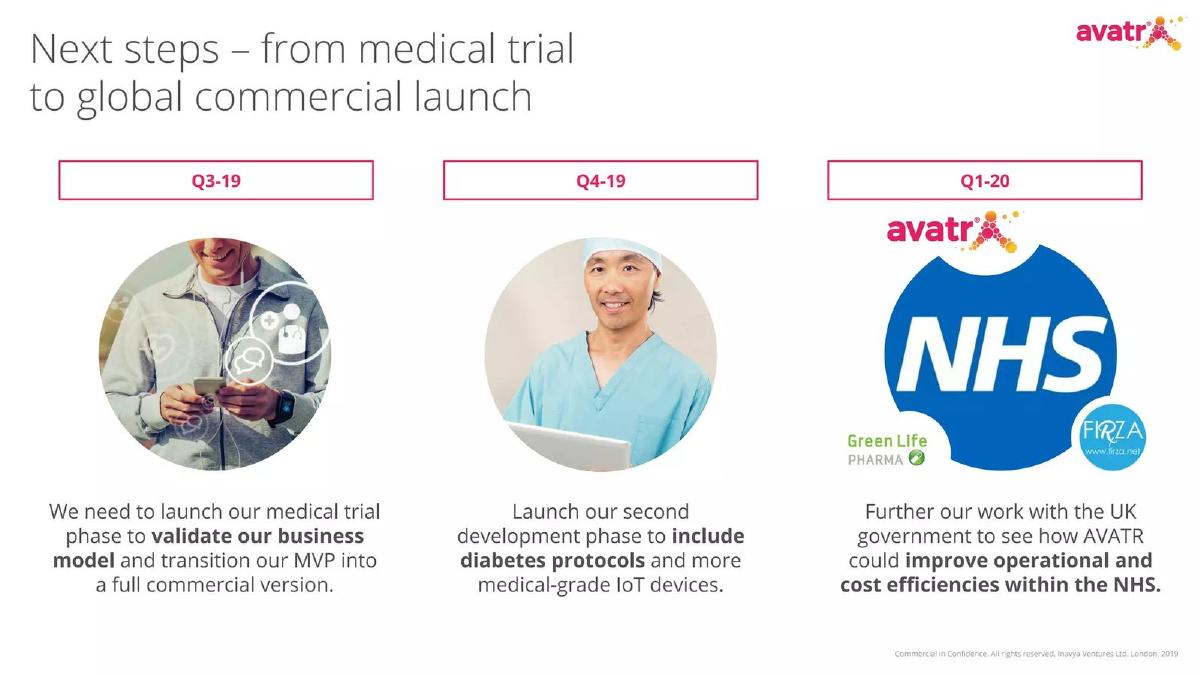
Jul 2015: Innovate UK R&D grant for 'quantified self' technology. · Dec 2016: Achieving Technology Readiness Level 7. · Aug 2017: Newton Fund R&D grant. · Mar 2018: First press coverage in Forbes. · Oct 2018: CE Class 1 Medical Device registration. · Apr 2019: Selection by the Office for Life Science to demonstrate cost efficiencies in the NHS.
This timeline is effective because it shows a long history of institutional support and non-dilutive funding, which de-risks the investment for angels.
Slide 7: Business Plan and Growth Forecast
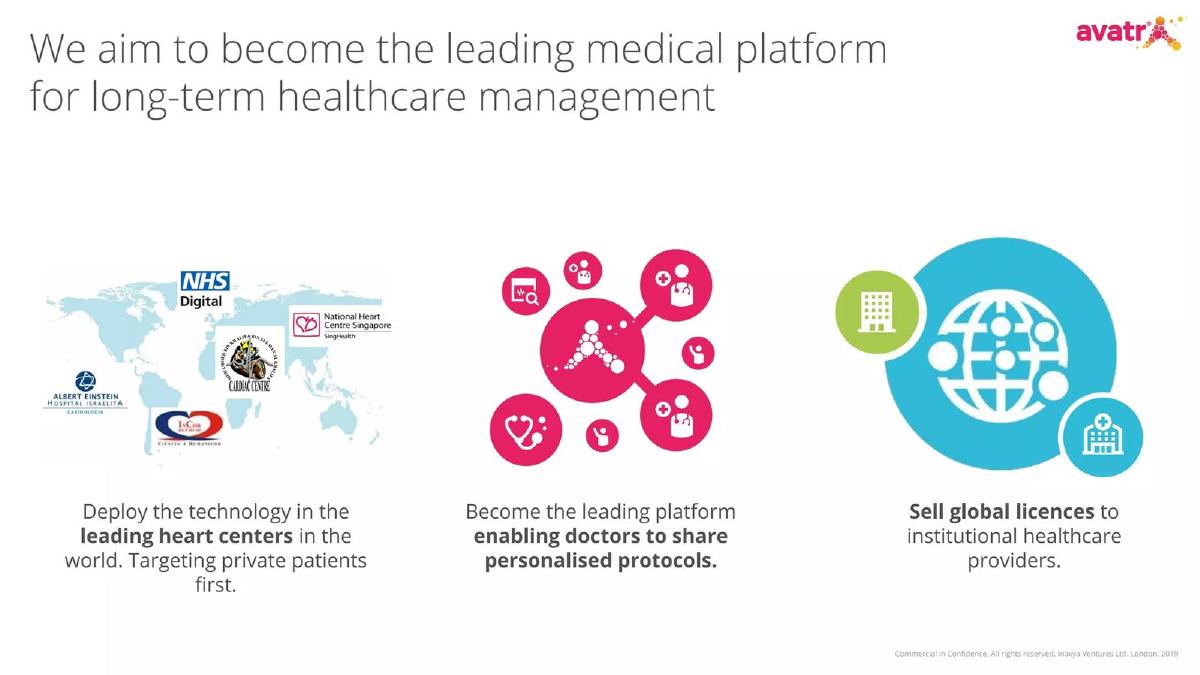
The roadmap is divided into 'Three major breakthroughs.' The first (ending Dec 2019) targets 500 private patients in Singapore via subscription. The second (2020-2021) aims for 30,000 to 50,000 users across five locations. The third (2022-2023) moves to a B2B SaaS model for hospitals and insurers. A bar chart shows projected user growth across APAC, UK, EMEA, and the Americas, with a steep 'Licenses' curve beginning in 2021. The chart suggests a goal of roughly 30,000 total users by late 2023.
Slide 8: Augmented Intelligence Capabilities
This slide provides a technical overview of the 'Basic principles.' It illustrates how the 'Patient ledger' feeds into the 'augmented intelligence' engine, which then processes data through 'Physician designed protocols.' The output is categorized into Red, Amber, and Green status alerts. This 'traffic light' system is a common medical triage UI pattern. The slide lists specific benefits for the physician: saving time, reducing bureaucracy, managing patient demand, and providing real-time data. It clarifies that the AI is not replacing the doctor but rather surfacing the most critical cases for 'Actionable Decisions.'
What Avatr Does Well
The deck excels at demonstrating regulatory and institutional validation . By highlighting the CE Mark and multiple government grants (Innovate UK, Newton Fund), Avatr proves that their technology has been vetted by experts long before they asked for private capital. This is a crucial strategy for health-tech startups where the 'black box' of AI can often be a source of skepticism for investors. Furthermore, the phased business plan (Slide 7) shows a realistic progression from a small-scale B2C validation phase to a large-scale B2B SaaS model, acknowledging that healthcare sales cycles are long and require evidence of cost savings before institutional adoption.
What is Missing from the Deck
In the 8 slides provided, there are several notable omissions:
Detailed Team Slide: While Aymeric Teulon is mentioned, the deck lacks a slide showing the full founding team, their medical credentials, or their technical history in AI/ML. · Competitor Analysis: There is no mention of other remote patient monitoring (RPM) platforms or how Avatr differentiates itself from established players or other health-chatbots. · Unit Economics: While Slide 7 mentions 'validating price points,' the deck does not state what the current or expected Customer Acquisition Cost (CAC) or Lifetime Value (LTV) might be. · Financial Projections: The deck shows user growth but lacks a corresponding revenue or EBITDA forecast to show when the company expects to reach profitability.
Founder Takeaways
Use non-dilutive funding as a signal: Avatr's timeline (Slide 6) is a masterclass in building a 'pedigree' for a startup. If you have won grants or been part of government-backed programs, feature them prominently to show that you have passed rigorous due diligence processes before. Quantify your milestones: Instead of vague goals, Avatr sets specific targets (e.g., 500 patients by Dec 2019). This gives investors a clear metric to judge success in the following 12 months. Explain the AI's role clearly: Many founders fail to explain how their AI actually helps the end-user. Avatr's 'traffic light' diagram (Slide 8) makes it immediately obvious that the AI's job is triage and prioritization, which is a tangible benefit for overworked physicians.
Frequently asked questions
- What is the specific problem Avatr is solving?
- While the slides do not have a dedicated 'Problem' slide, the 'Basic Principles' and 'Product' slides imply the problem is the inefficiency of patient-physician communication. It aims to reduce physician bureaucracy and manage growing patient demands by using AI to filter and prioritize data, ensuring doctors only see the most critical 'Red' or 'Amber' alerts rather than a constant stream of raw data.
- How does Avatr plan to generate revenue?
- The deck outlines a two-stage revenue strategy. Initially, it targets a monthly subscription model for private patients in Singapore to validate price points. By 2022, the plan shifts to a B2B SaaS model, selling the platform to large-scale healthcare players, including hospitals, insurance providers, and local health authorities, based on demonstrated cost savings.
- What is the current regulatory status of the technology?
- According to Slide 2 and Slide 6, the technology is 'Medical Grade' and received its CE Mark (Class 1 Medical Device registration) in October 2018. This allows the company to market the device within the European Economic Area and other regions recognizing the mark, providing a significant barrier to entry against non-certified competitors.
- Who are the key partners mentioned in the deck?
- Avatr lists several high-profile clinical and governmental partners, including the National Heart Centre Singapore, NHS Digital, and the Office for Life Science in the UK. They also mention collaborations for deployment in UK pharmacies and trials with the Albert Einstein Hospital Israelita in Brazil.
- What is the primary use of the £300k investment?
- The largest share (£140k) is for operating cash flow. The remainder is split between technology enhancements (£60k) such as AI personalization, legal and accounting (£50k) for international patents and registrations, sales (£30k) for conference presence, and communication (£20k) for digital marketing and website refreshes.