Automation Workz Institute addresses the disproportionate impact of automation on the African American economy, citing that over 60 percent of automation risk for this demographic is concentrated in five occupation categories (Slide 3). The company proposes a solution through high-tech training funded by Income Sharing Agreements (ISAs), where students pay no upfront tuition and instead share 7% of their income over 5 years once earning at least $30,000 (Slide 7). The deck targets ten specific urban markets, including Detroit, Chicago, and Atlanta, identifying Black women as the primary initi…
Key takeaways
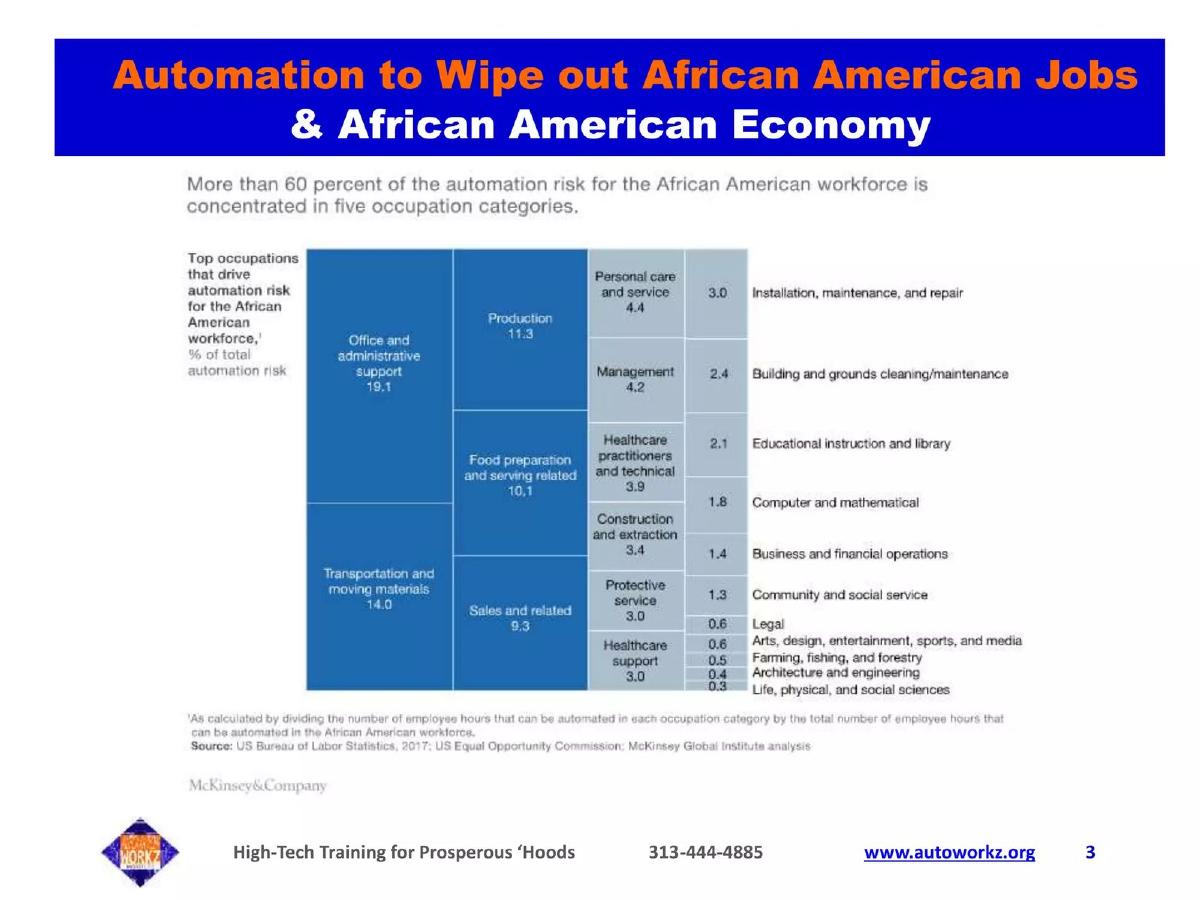
- Automation risk is concentrated in five categories for the African American workforce, with office and administrative support accounting for 19.1% of total risk (Slide 3).
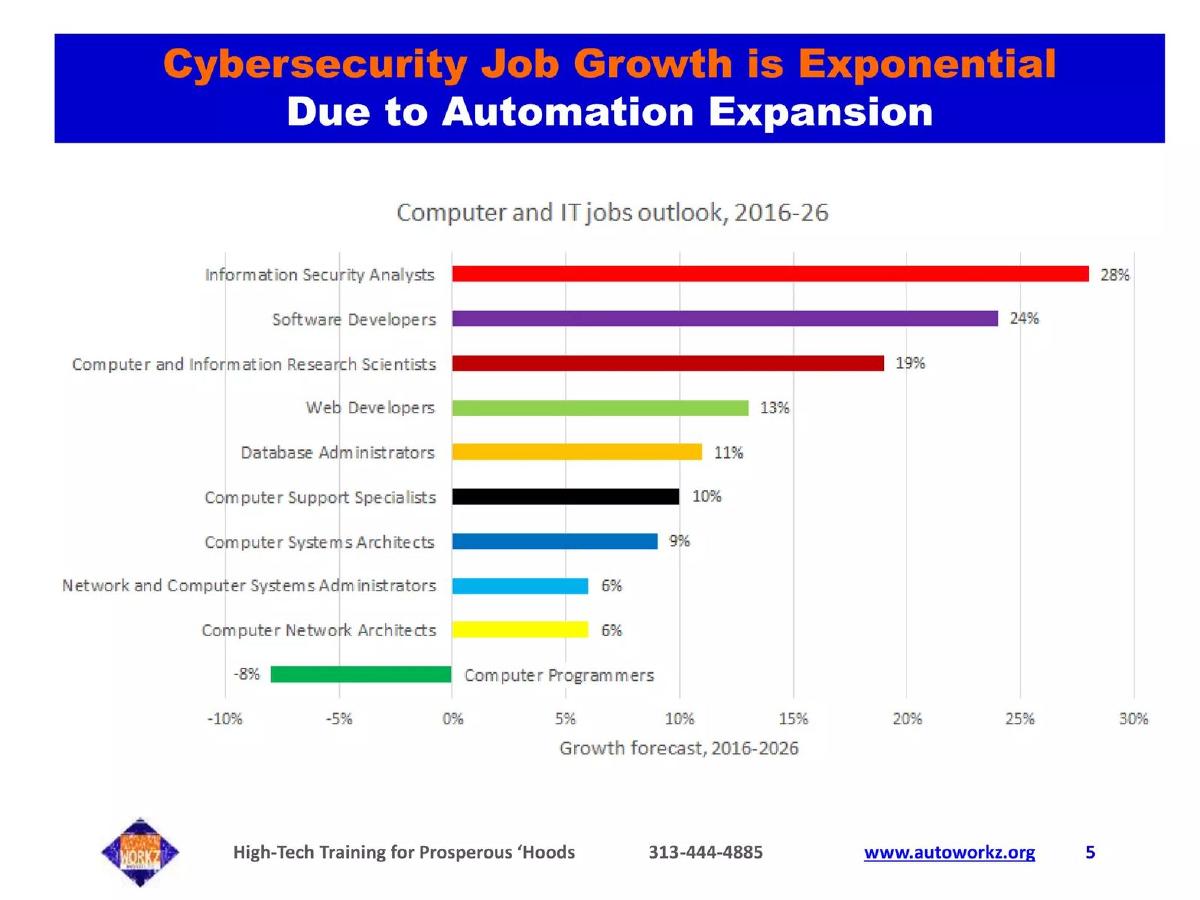
- The institute focuses on cybersecurity and IT roles, noting that Information Security Analyst positions are forecast to grow by 28% between 2016 and 2026 (Slide 5).
- The business model relies on Income Sharing Agreements (ISAs) with no upfront tuition, requiring a 7% income share for 5 years after the student secures a high-paying job (Slide 7).
- The primary target market is Black women in 10 major U.S. metro areas, with the largest populations in New York (1,994,836) and Atlanta (1,074,373) (Slide 9).
- Automation Workz positions itself as more economical than competitors like Focus: HOPE ($16,000 tuition) and Grand Circus ($9,720 tuition) by removing upfront costs (Slide 11).
- The management team includes CEO Ida Byrd-Hill, who previously grew a financial advisory firm to $353 million in assets (Slide 13).
- The exit strategy identifies Strayer University, DeVry University, and Lambda School as potential acquirers based on their student demographics and ISA models (Slide 15).
- The deck omits a specific capital request, use of funds, and historical revenue or placement data.
Automation Workz Institute: Slide-by-Slide Analysis
Slide 1: Title Slide
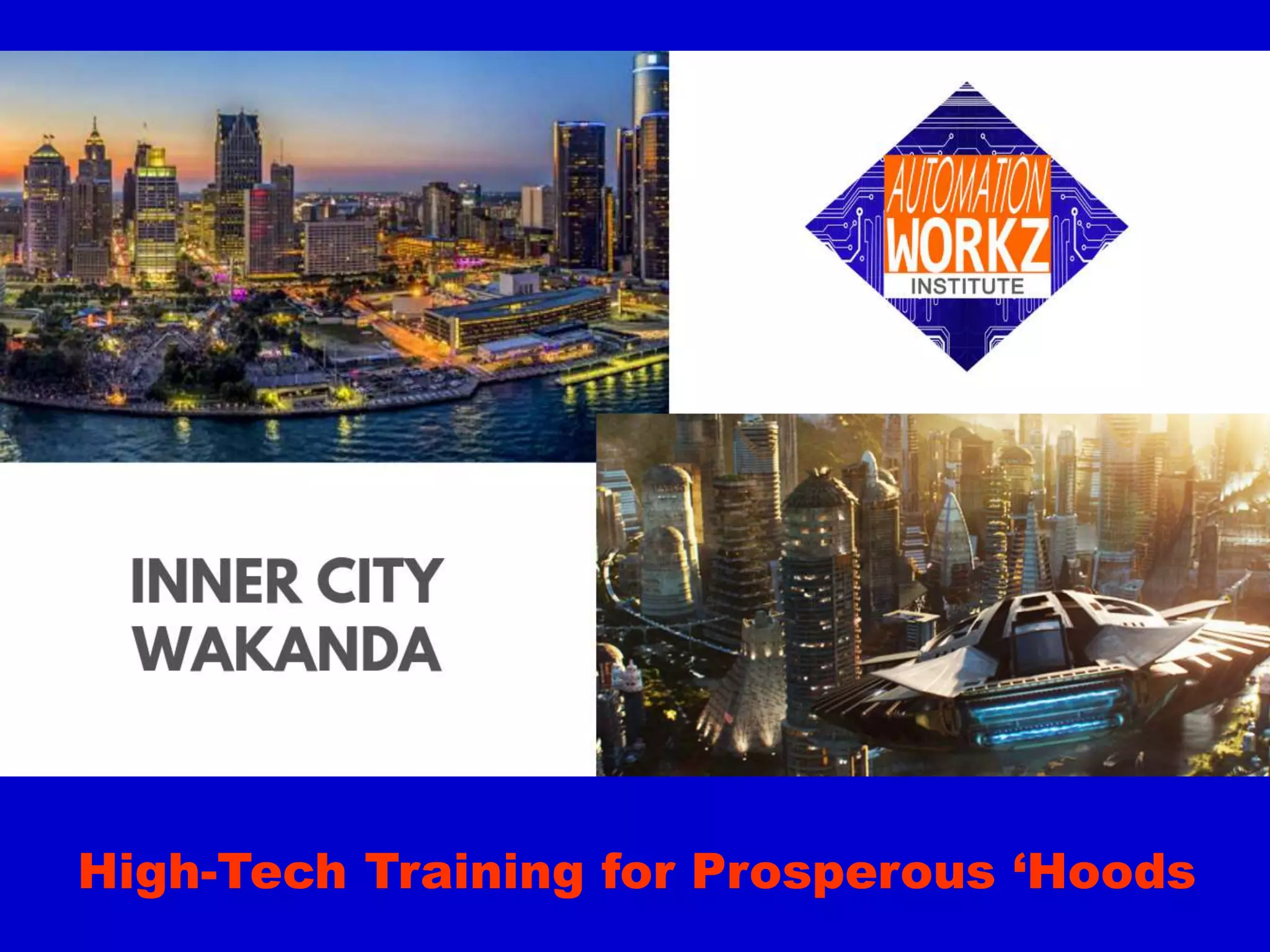
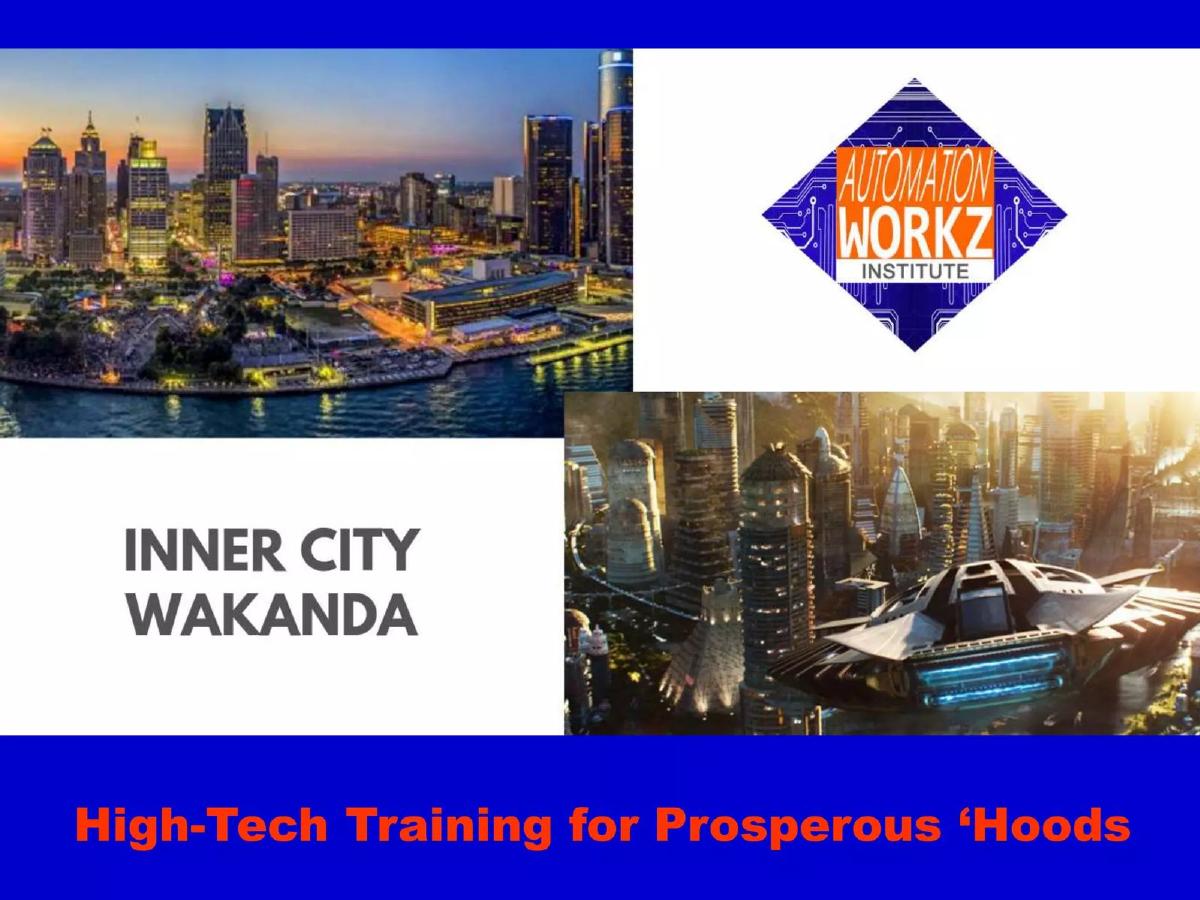
The title slide introduces the company name, Automation Workz Institute, alongside the tagline "High-Tech Training for Prosperous 'Hoods." The visual elements include a skyline of Detroit and a futuristic depiction labeled "Inner City Wakanda." This sets a clear tone regarding the company's mission to bring advanced technology and economic prosperity to urban environments.
Slide 3: The Problem - Automation Risk
This slide uses data from McKinsey & Company and the US Bureau of Labor Statistics to quantify the threat of automation. It states that over 60 percent of automation risk for the African American workforce is concentrated in five occupation categories. The largest risk areas identified are Office and Administrative Support (19.1%), Transportation and Moving Materials (14.0%), and Production (11.3%). This slide establishes the urgency for retraining in these specific communities.
Slide 5: The Opportunity - IT Job Growth
To contrast the risk of automation, Slide 5 presents the "Computer and IT jobs outlook, 2016-26." It highlights that Information Security Analysts are expected to see 28% growth, followed by Software Developers at 24%. Conversely, it shows that Computer Programmers are expected to see a decline of 8%. This data justifies the institute's focus on cybersecurity and specialized IT roles rather than general programming.
Slide 7: The Solution - Income Sharing Agreements (ISA)
This slide details the financial model. It describes the ISA as a "BET on Exponential Tech Training Growth." Key terms include: no upfront tuition, a requirement that the student earns $30,000+ before paying, and a 7% income share over 5 years. It explicitly states that if a student loses their job, payments stop, framing the model as a shared risk between the institute and the student.
Slide 9: Market Segmentation and Geography
The deck identifies Black women and people of color as the "Initial Market." It provides a map of the U.S. highlighting 10 urban cities with the largest Black female populations. New York Metro leads with 1,994,836, followed by Atlanta Metro with 1,074,373 and Chicago Metro with 916,127. The slide suggests that the same 10 urban cities will serve both the initial and follow-on mainstream markets.
Slide 11: Competitive Landscape
Automation Workz compares itself to three competitors: Focus: HOPE, Grand Circus, and New Horizons. The slide points out that Focus: HOPE charges $16,000 and relies on workforce development funds or private loans. Grand Circus charges $9,720 and requires high credit scores for private loans. Automation Workz positions its ISA model as a "Better & More Economical Product" because it removes the credit score and upfront cost barriers.
Slide 13: Management Team
The team slide lists six key members. CEO Ida Byrd-Hill is highlighted for growing a financial advisory firm to $353 million in assets and managing the AWI pilot. COO D. Benjamin Estill is credited with managing multi-million dollar budgets for school districts. Other roles include VP of Academics, Innovation, Marketing, and Partners, with backgrounds ranging from game design to regional economic development. The slide emphasizes "Management Team Execution" as the basis for past and future success.
Slide 15: Exit Strategy
The final slide identifies three potential buyers to provide an exit for investors. Strayer University is listed due to its 56% Black student body and lack of Midwest presence. DeVry University is noted for its history in technology training and lack of Michigan presence. Lambda School is included because it has the largest ISA fund ($48 million in investor funding) and a similar business model. This slide provides a concrete end-game for the investment.
What Works in This Deck
Clear Problem Definition: By using McKinsey data to show exactly which job sectors are at risk within a specific demographic, the deck creates a compelling "why now" argument. It moves beyond generalities about automation to show specific economic vulnerability.
Specific Market Targeting: Rather than claiming to serve everyone, the deck identifies a very specific initial market (Black women in 10 specific metros). This allows for a more focused marketing and recruitment strategy that investors can easily visualize.
Alignment of Incentives: The ISA model is presented not just as a payment plan, but as a way to align the school's success with the student's success. The inclusion of the $30,000 income floor and the 5-year cap provides necessary detail on how the revenue engine actually functions.
What Is Missing from This Deck
The Ask: The most significant omission is a slide detailing how much capital the company is seeking, the valuation, or the specific terms of the investment. Without an "Ask" slide, the deck functions more as a company overview than a fundraising tool.
Traction and Metrics: While the CEO is mentioned as having managed a "pilot," there are no specific results from that pilot. Investors would want to see graduation rates, job placement rates, and the average salary increase for students who have already completed the program.
Financial Projections: The deck explains how they make money (7% of income), but it does not project how many students they expect to enroll or when the company expects to reach profitability. There is no mention of the cost to acquire a student (CAC) versus the lifetime value (LTV) of an ISA.
What a Founder Should Copy
The Exit Strategy Slide: Many early-stage decks neglect the exit strategy. Automation Workz does an excellent job of not just listing names, but explaining why those specific companies would want to buy them (e.g., geographic gaps or demographic alignment). This shows the founder is thinking about the investor's eventual liquidity event.
Visualizing the Competitive Advantage: Slide 11 is a strong example of a competitive matrix that goes beyond checkmarks. By listing specific tuition costs and funding requirements for competitors, the company makes a data-driven case for why their model is more accessible to their target demographic.
Data-Backed Urgency: Using third-party research (McKinsey, BLS) to validate the market need adds significant credibility. Founders should always look for macro-economic trends that support their specific micro-solution, as seen in the automation risk slides.
Frequently asked questions
- What is the core problem Automation Workz Institute aims to solve?
- The institute addresses the threat of automation to the African American economy. According to Slide 3, more than 60 percent of the automation risk for the African American workforce is concentrated in just five occupation categories, including production, transportation, and administrative support. The company aims to transition these workers into high-growth tech roles to prevent economic displacement.
- How does the Income Sharing Agreement (ISA) model work for students?
- As detailed on Slide 7, the institute offers 'No Upfront Tuition.' Students sign an agreement to share 7% of their income for a period of 5 years. This obligation only triggers once the student earns at least $30,000 annually. If a student loses their job, payments stop, and the agreement expires after the fifth year regardless of the total amount paid.
- Who is the target demographic for this training program?
- The deck identifies 'Black Women & People of Color' as the initial market, followed by a broader mainstream market (Slide 9). Geographically, the company focuses on 10 urban centers with high Black populations, specifically highlighting the Detroit, Chicago, New York, and Atlanta metro areas as key hubs for recruitment.
- How does Automation Workz differentiate itself from other tech bootcamps?
- On Slide 11, the company compares itself to local and national competitors. It highlights that while Focus: HOPE and Grand Circus require significant tuition ($16,000 and $9,720 respectively) or rely on high-credit-score private loans, Automation Workz removes the financial barrier via the ISA. It also notes that competitors like New Horizons focus primarily on corporate-paid upskilling rather than individual career transitions.
- What is the proposed exit strategy for investors?
- Slide 15 outlines three potential acquirers: Strayer University, DeVry University, and Lambda School. The rationale for these specific buyers includes their existing focus on working adults, their need for a Midwest presence, or their existing use of ISA models. For example, Lambda is cited for having the largest ISA fund, while Strayer is noted for its high percentage of Black and female students.