How startups show an exit strategy in a pitch deck: named acquirers with a reason each would buy, comparable deals, timelines and valuation claims.
Exit Strategy Slide: Acquirers, Comparable Deals and Timelines
An exit strategy slide tells investors how they might get their money back: who could buy the company, why, and roughly when. Many decks leave it out; the ones that include it range from a list of big-company names to a reasoned case for each buyer backed by past deals. This guide compares nine real exit slides.
TL;DR
If you include an exit slide, name a few likely buyers and give a specific reason each would buy, as Mint does for Google, Yahoo, Intuit and Microsoft. Back it with past deals in your category, with prices where public, as Once Upon a Farm does for baby food. Add a timeline or size range only if you can explain it: Calltree says 18–36 months at under $50 million. A list of famous names with no reason, or a valuation with no earnings shown, adds little.
Exit strategy slides from real pitch decks
Each example shows the slide above its analysis and links to the full teardown. Slides that give reasons or evidence come first. Claims are as shown on the slides; comments are ours.
Mint exit strategy slide — slide 11
Personal finance app, pre-launch deck. Other pages of this deck appear in the competition and NPS guides.
Mint deck, slide 11. Exact stored slide matched to this analysis.
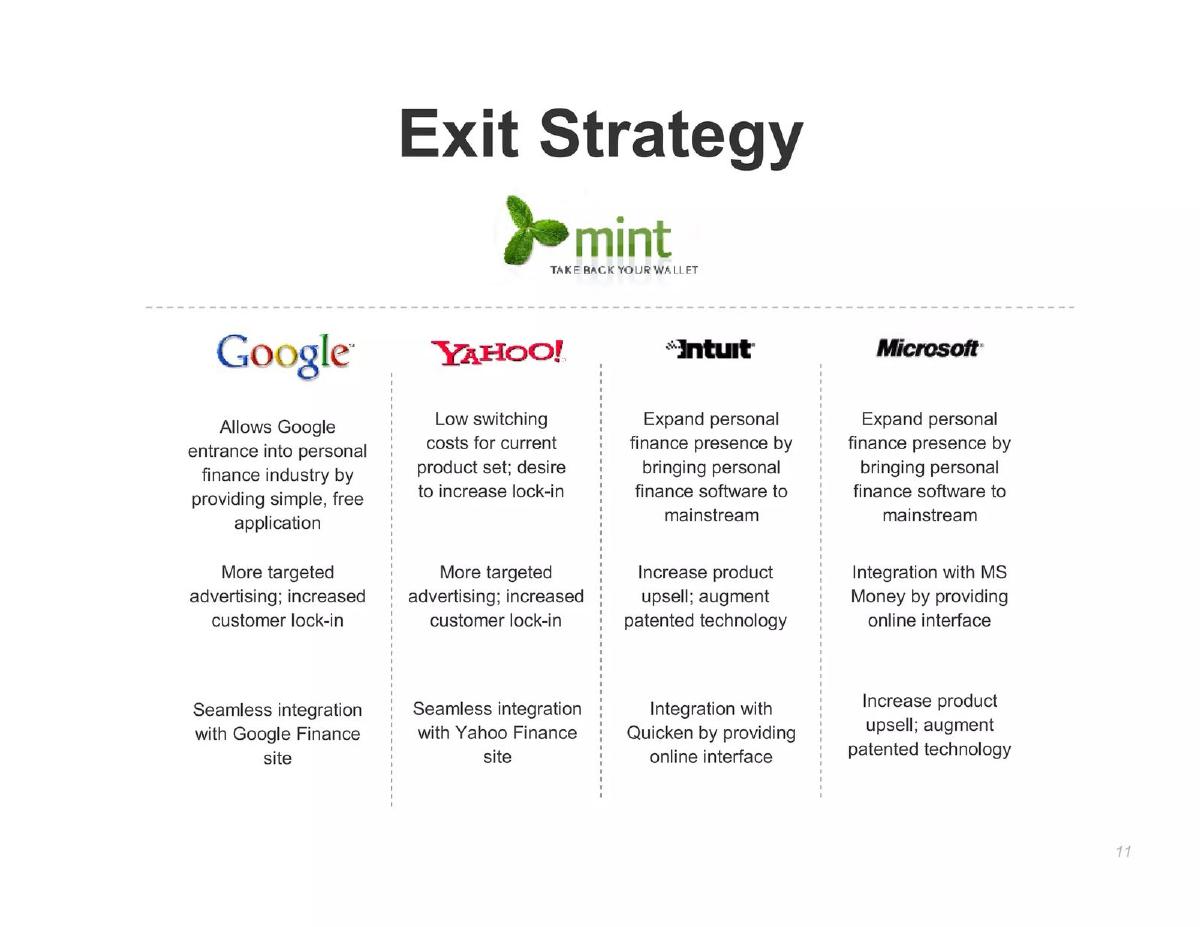
Our analysis: Reasoned buyers, one per column.
Evidence and limitation: Four buyers, three reasons each, tied to each buyer's own product. No timeline, price or past deals. Intuit, one of the four named, later bought Mint.
What a founder can adapt: "[Buyer]: [gap you fill] + [product you'd plug into]" for three or four buyers.
Supporting analysis
What the deck claims: "Exit Strategy." Four columns: Google — "Allows Google entrance into personal finance industry by providing simple, free application", "More targeted advertising; increased customer lock-in", "Seamless integration with Google Finance site". Yahoo! — "Low switching costs for current product set; desire to increase lock-in", targeted advertising, integration with Yahoo Finance. Intuit and Microsoft — "Expand personal finance presence by bringing personal finance software to mainstream", "Increase product upsell; augment patented technology", integration with Quicken and MS Money "by providing online interface".
Presentation choice: Each name comes with why that company would pay.
When it does not fit: Copying the same reasons across two buyers without saying why both apply.
Organic baby food. The page is numbered 16 on the slide; it is page 19 of the deck file.
Once Upon a Farm deck, slide 19. Exact stored slide matched to this analysis.
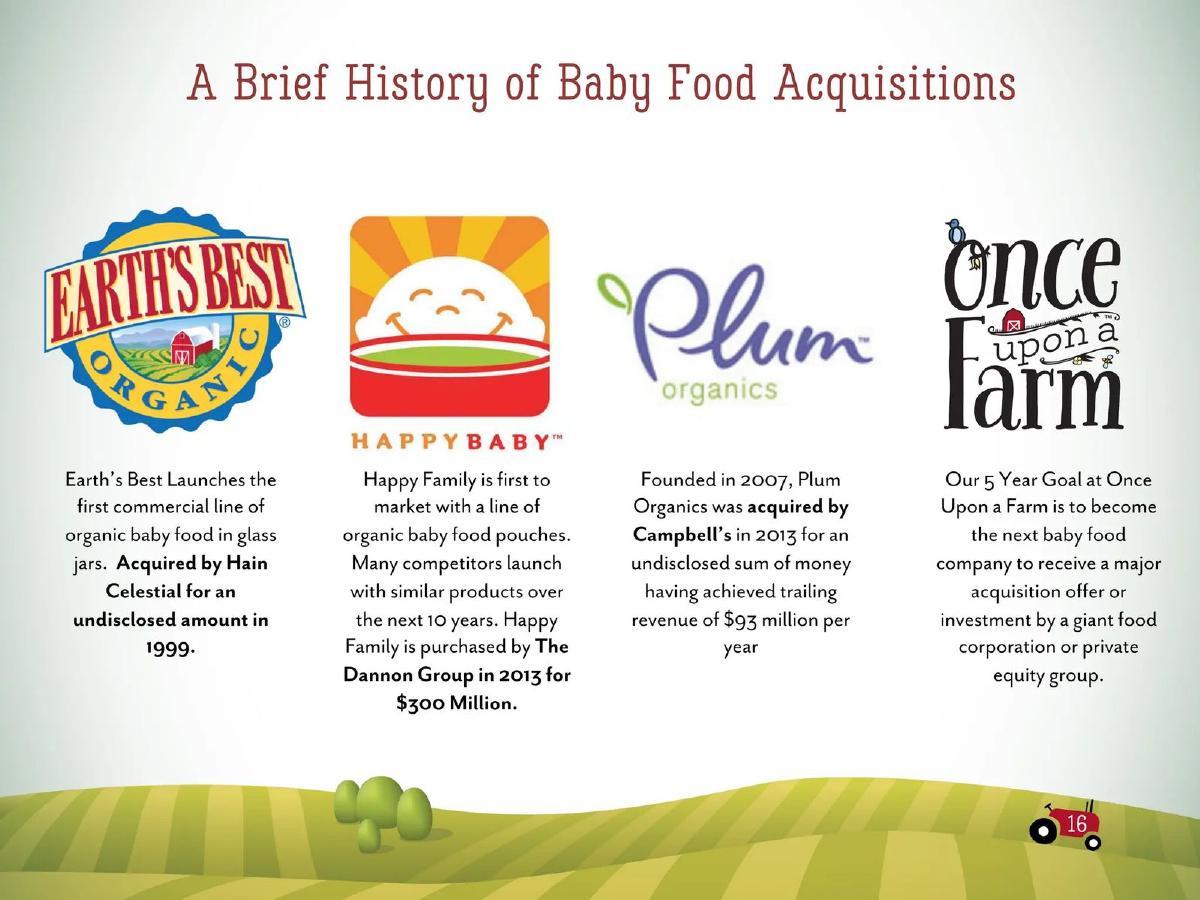
Our analysis: Comparable deals instead of a buyer wish list.
Evidence and limitation: Three dated category deals, with a price for one and trailing revenue for another. We have not verified these figures. The goal is framed as an offer or investment, not a promised sale.
What a founder can adapt: "[Company] bought by [buyer], [year], $[price] at [revenue]" for two or three deals.
Supporting analysis
What the deck claims: "A Brief History of Baby Food Acquisitions." Earth's Best: "Acquired by Hain Celestial for an undisclosed amount in 1999." Happy Family: "purchased by The Dannon Group in 2013 for $300 Million." Plum Organics: "acquired by Campbell's in 2013 for an undisclosed sum of money having achieved trailing revenue of $93 million per year." Once Upon a Farm: "Our 5 Year Goal … is to become the next baby food company to receive a major acquisition offer or investment by a giant food corporation or private equity group."
Presentation choice: Past deals show large food companies do buy brands like this.
When it does not fit: Undisclosed prices presented without saying why the deal is still relevant.
IT incident communication software. The teardown refers to this as slide 9; it is page 17 of the deck file. Another page appears in the competition guide.
Calltree deck, slide 17. Exact stored slide matched to this analysis.
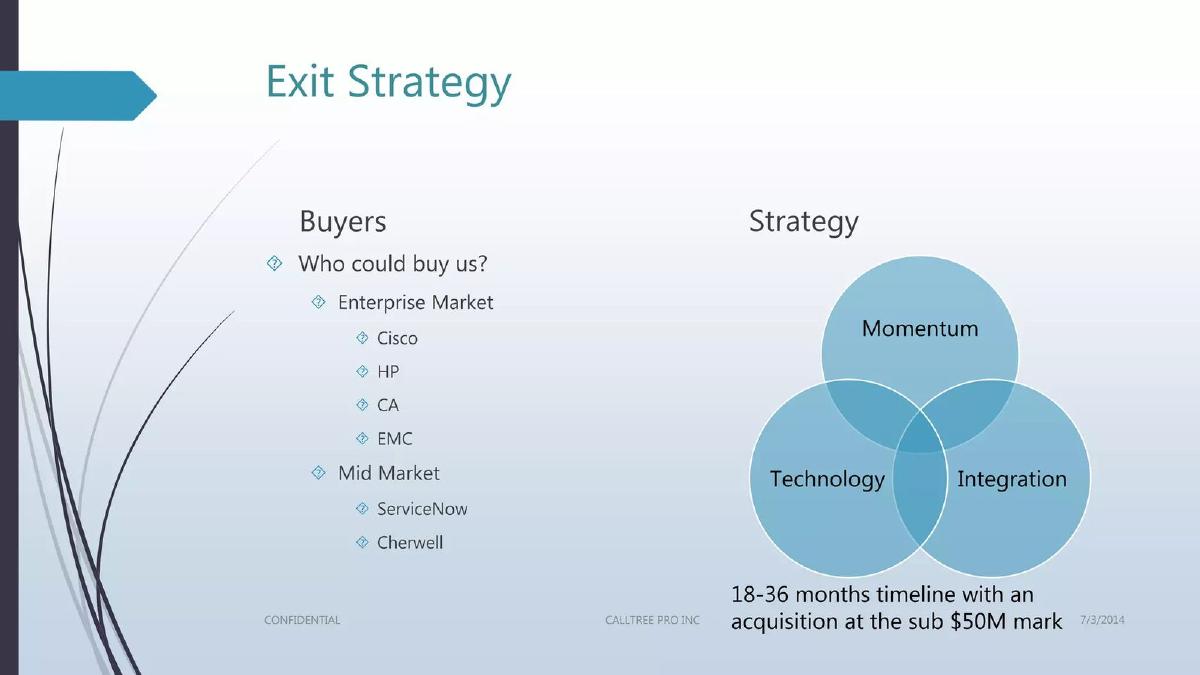
Our analysis: A realistic range, without its basis.
Evidence and limitation: Buyers grouped by market, plus a timeline and price range. Neither the timeline nor the sub-$50 million figure is explained, and the three-circle diagram has no text.
What a founder can adapt: "[18–36] months; sub-$50M, based on [comparable deal or revenue multiple]".
Supporting analysis
What the deck claims: "Exit Strategy." "Buyers — Who could buy us? Enterprise Market: Cisco, HP, CA, EMC. Mid Market: ServiceNow, Cherwell." "Strategy": a diagram of Momentum, Technology, Integration. "18-36 months timeline with an acquisition at the sub $50M mark."
Presentation choice: A modest, specific range is more believable than a large one.
When it does not fit: Diagrams with labels but no content.
Social shopping marketplace. The teardown refers to this as slide 6; it is page 16 of the deck file.
OfferSavvy deck, slide 16. Exact stored slide matched to this analysis.
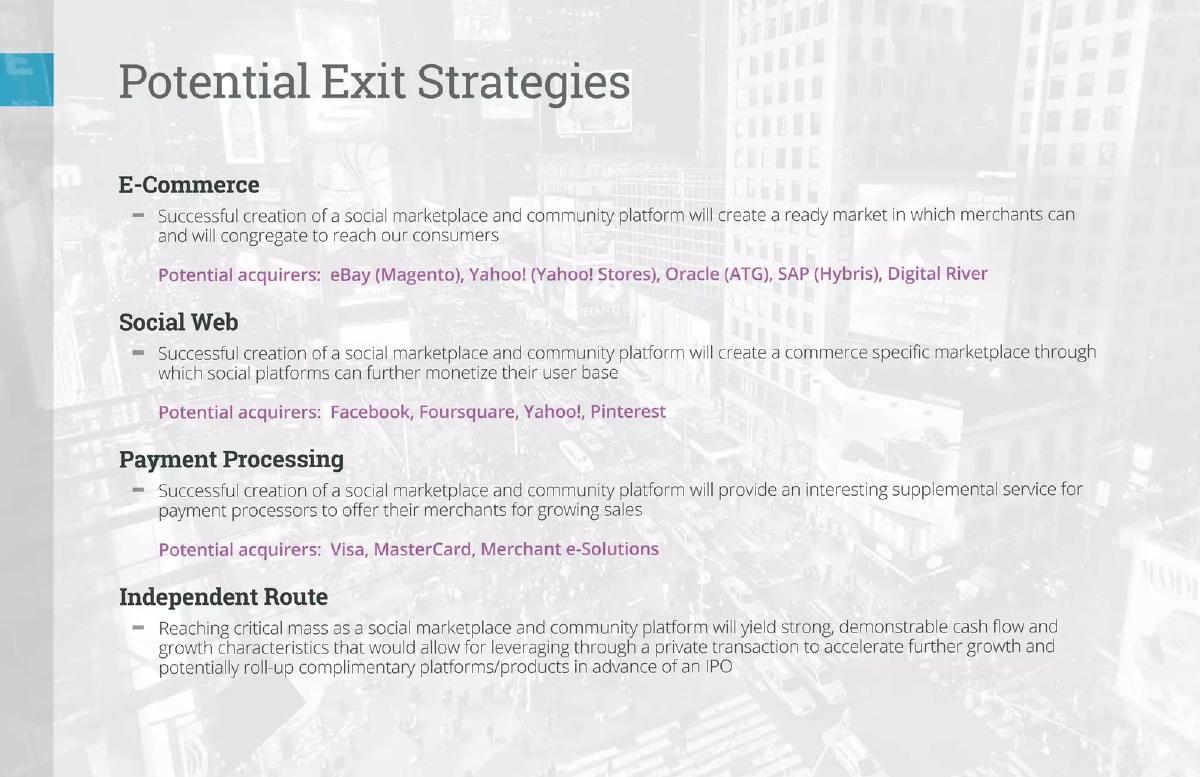
Our analysis: Buyers grouped by why they'd buy.
Evidence and limitation: Buyers grouped by reason, and the e-commerce group names each buyer's own commerce product. Twelve buyers across three groups is a lot; each reason is the same "social marketplace and community platform" sentence.
What a founder can adapt: Keep two or three buyers per group, with a different reason each.
Supporting analysis
What the deck claims: "Potential Exit Strategies." E-Commerce — "Potential acquirers: eBay (Magento), Yahoo! (Yahoo! Stores), Oracle (ATG), SAP (Hybris), Digital River". Social Web — "Facebook, Foursquare, Yahoo!, Pinterest". Payment Processing — "Visa, MasterCard, Merchant e-Solutions". Independent Route — "strong, demonstrable cash flow … a private transaction to accelerate further growth and potentially roll-up complimentary platforms/products in advance of an IPO."
Presentation choice: Grouping by motive shows several separate routes to a sale.
When it does not fit: The same sentence repeated as the reason for every group.
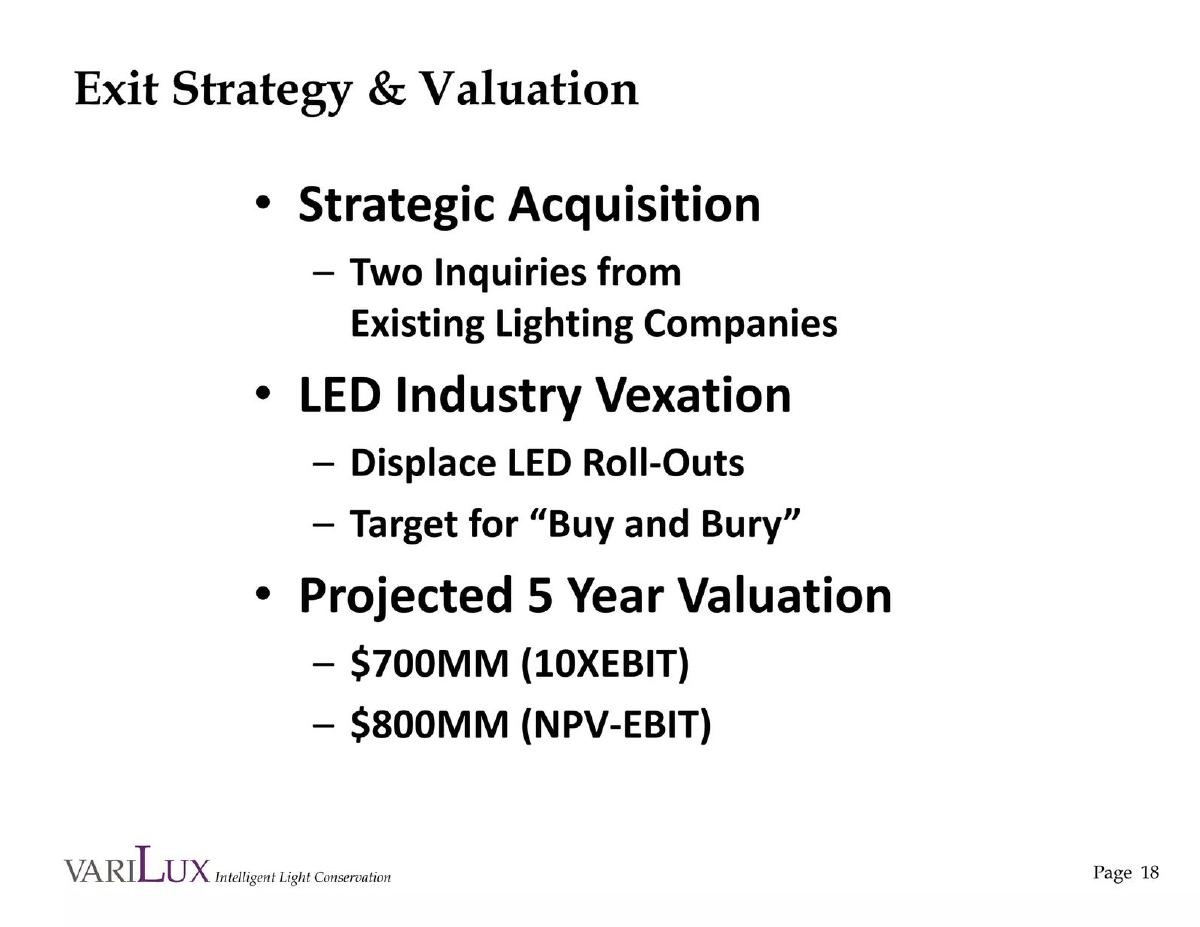
VariLux deck, slide 18. Exact stored slide matched to this analysis.
Our analysis: Real interest, stretched valuation.
Evidence and limitation: Inbound interest is a real signal, though the companies aren't named. $700 million at 10× EBIT implies $70 million EBIT in year five, which isn't shown here. "Buy and bury" suggests a buyer might acquire it to shelve it.
What a founder can adapt: "Two inbound inquiries from [type of company], [dates]"; drop valuation unless year-five EBIT is shown.
Supporting analysis
What the deck claims: "Exit Strategy & Valuation." "Strategic Acquisition — Two Inquiries from Existing Lighting Companies." "LED Industry Vexation — Displace LED Roll-Outs; Target for 'Buy and Bury'." "Projected 5 Year Valuation — $700MM (10XEBIT); $800MM (NPV-EBIT)."
Presentation choice: It shows the difference between evidence (two inquiries) and a projection.
When it does not fit: A valuation multiple on earnings the deck doesn't show.
Procurement software. The teardown refers to this as slide 9; it is page 17 of the deck file.
BidLAN deck, slide 17. Exact stored slide matched to this analysis.
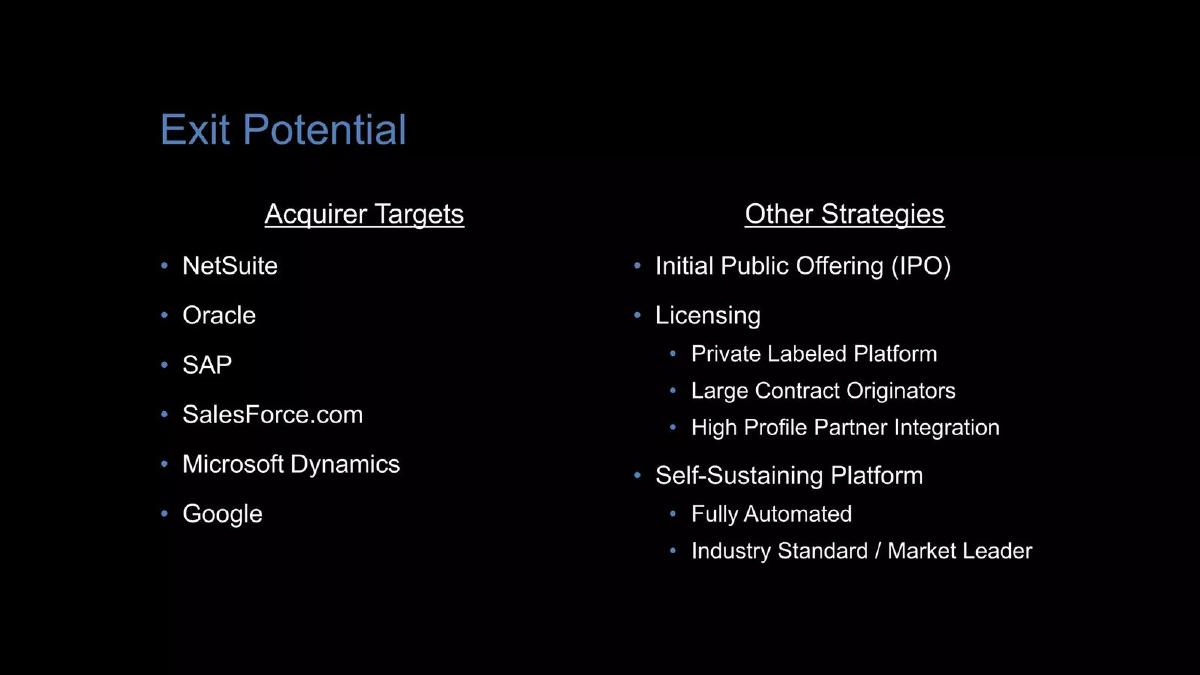
Our analysis: Names and options without reasons.
Evidence and limitation: Six buyers with no reasons, and alternatives beyond a sale. Licensing and a self-sustaining platform are ways to make money, not ways for investors to sell their stake.
What a founder can adapt: Add one line per buyer; keep alternatives that return money to investors.
Supporting analysis
What the deck claims: "Exit Potential." "Acquirer Targets: NetSuite, Oracle, SAP, SalesForce.com, Microsoft Dynamics, Google." "Other Strategies: Initial Public Offering (IPO); Licensing — Private Labeled Platform, Large Contract Originators, High Profile Partner Integration; Self-Sustaining Platform — Fully Automated, Industry Standard / Market Leader."
Presentation choice: Included to show a list that needs the "why" Mint gives.
When it does not fit: Listing business models as exit routes.
Organic Dried Food Store exit strategy slide — slide 15
Online organic food store. The teardown refers to this as slide 8; it is page 15 of the deck file.
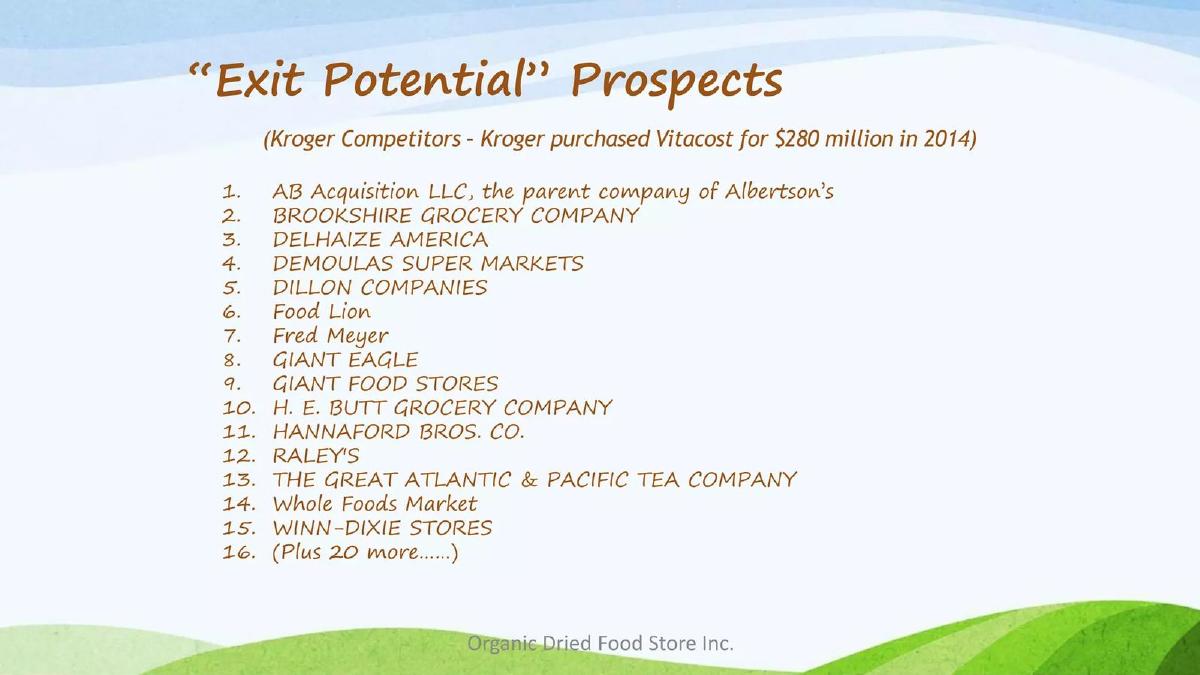
Organic Dried Food Store deck, slide 15. Exact stored slide matched to this analysis.
Our analysis: One good comparable, too many names.
Evidence and limitation: One comparable deal anchors the list; we have not verified the price. The logic is that rivals may follow Kroger. Fifteen names plus "20 more" dilutes it, and no reason is given for any single grocer.
What a founder can adapt: "Kroger bought Vitacost for $[X] in [year]; [2–3 named rivals] lack an online organic offer."
Supporting analysis
What the deck claims: "'Exit Potential' Prospects (Kroger Competitors – Kroger purchased Vitacost for $280 million in 2014)." A numbered list of 15 grocers from "AB Acquisition LLC, the parent company of Albertson's" to "WINN-DIXIE STORES", then "16. (Plus 20 more……)".
Presentation choice: The Vitacost deal does the work; the list doesn't.
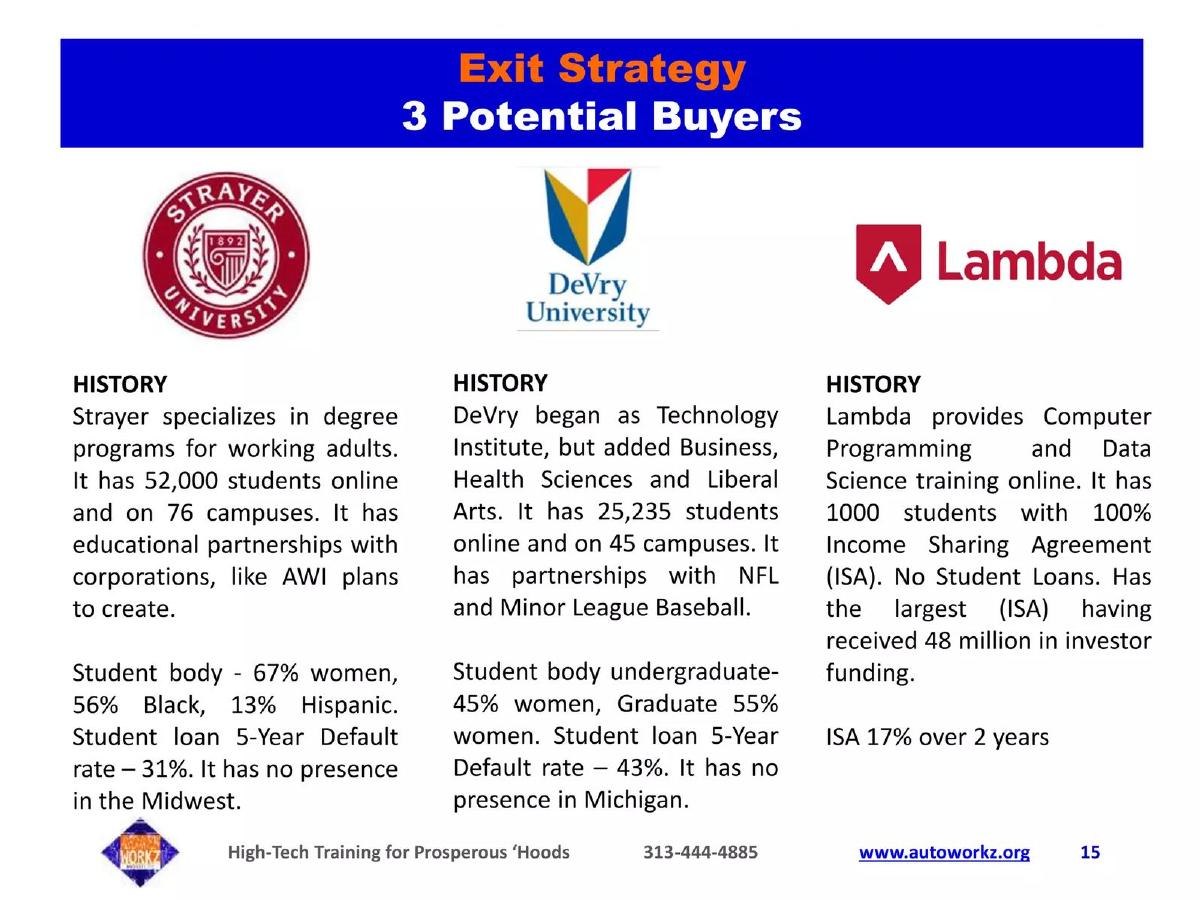
Automation Workz deck, slide 15. Exact stored slide matched to this analysis.
Our analysis: Buyer profiles rather than buyer reasons.
Evidence and limitation: Three buyers with a profile each, and one reason stated (Strayer's corporate partnerships). Demographic and loan-default figures are given without saying why they matter to a sale. We have not checked the figures.
What a founder can adapt: Replace demographics with "[Buyer] would gain [what]".
Supporting analysis
What the deck claims: "Exit Strategy — 3 Potential Buyers." Strayer — "specializes in degree programs for working adults … 52,000 students online and on 76 campuses … educational partnerships with corporations, like AWI plans to create." DeVry — "25,235 students online and on 45 campuses." Lambda — "Computer Programming and Data Science training online … 100% Income Sharing Agreement (ISA) … received 48 million in investor funding." Each column also gives student body mix and loan default rates.
Presentation choice: Shows how research on buyers still needs a line on why they'd buy.
When it does not fit: Facts about the buyer that don't connect to your company.
Coding training for autistic adults. Another page appears in the edtech business model guide.
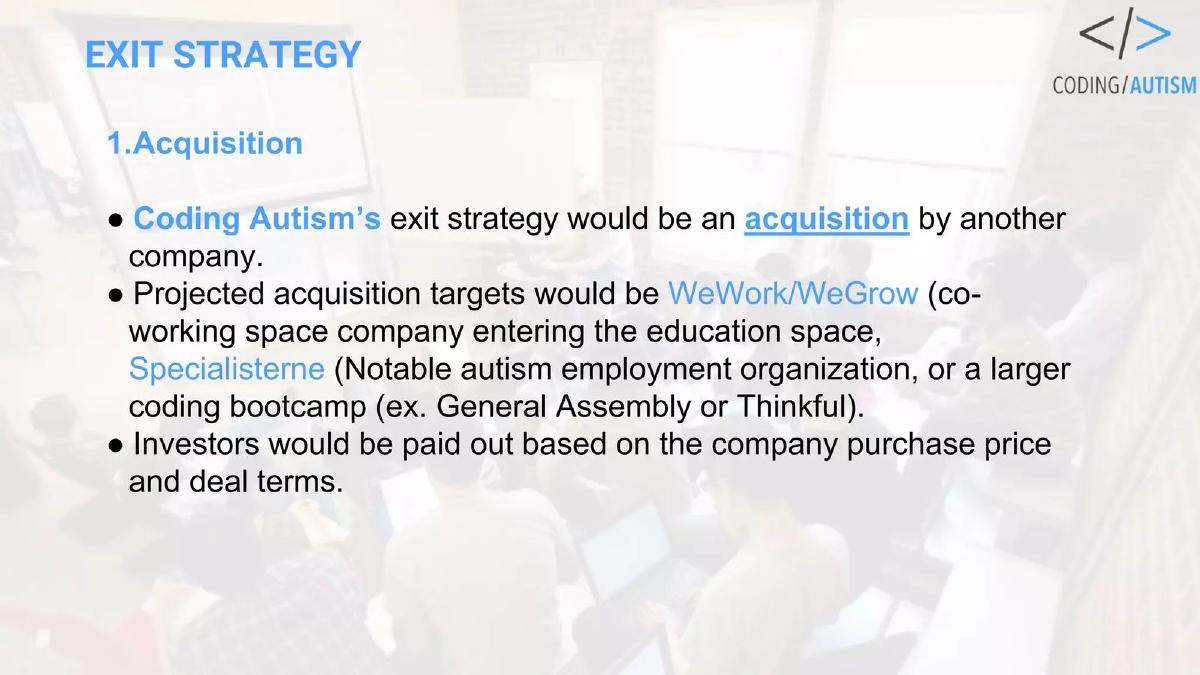
Coding Autism deck, slide 16. Exact stored slide matched to this analysis.
Our analysis: Short and plausible, with filler.
Evidence and limitation: Three types of buyer with a short reason each. The last line states what is true of any acquisition.
What a founder can adapt: Replace the last line with a comparable deal in education or autism employment.
Supporting analysis
What the deck claims: "Exit Strategy. 1. Acquisition." "Coding Autism's exit strategy would be an acquisition by another company." "Projected acquisition targets would be WeWork/WeGrow (co-working space company entering the education space), Specialisterne (Notable autism employment organization, or a larger coding bootcamp (ex. General Assembly or Thinkful)." "Investors would be paid out based on the company purchase price and deal terms."
Presentation choice: Specific buyer types for an unusual niche.
When it does not fit: Explaining how acquisitions pay investors.
What improved: Our illustrative rewrite of BidLAN's list; bracketed text is a placeholder, not company fact.
Do you need an exit slide?
It's optional. Many early-stage decks leave exits to the conversation, and investors form their own view. It helps most when the buyers aren't obvious, or when category deals show a real market for companies like yours. It hurts when it reads as a list of hoped-for buyers with no reasoning.
What investors check
Whether the named buyers have bought similar companies, and why they'd want this one. Whether any comparable deal is real, dated and priced. Whether a stated price or valuation follows from numbers elsewhere in the deck.
How we read each slide
We quote the text on the slide images. We have not checked the acquisition histories named on the slides unless stated. Several page numbers differ from the teardown's numbering; the pages shown are the ones quoted. None of these pages was in our stored image set, so we rendered each from the original deck file in our library.
Common mistakes
Famous names with no reason. Say why each would buy.
Long lists. Three strong buyers beat twenty.
Unsupported valuation. Show the earnings or deal it rests on.
Business models as exits. Licensing isn't a way to sell shares.
Filler lines. Cut statements true of every acquisition.
Diagnostic checklist
Three or four buyers, each with a reason.
At least one dated category deal.
Any price or timeline has a basis.
Unverified deal figures sourced.
Frequently asked questions
Should a pitch deck include an exit strategy slide?
It's optional. If you include one, name a few buyers with a reason each and cite past deals in your category. Mint gives three reasons for each of four buyers; Once Upon a Farm lists three dated baby food acquisitions.
Should I put a valuation on my exit slide?
Only if the deck shows the numbers behind it. VariLux projects $700 million at 10× EBIT, which implies $70 million EBIT the slide doesn't show. A range tied to a comparable deal is easier to defend.
How we chose these examples
Corpus: published pitch deck teardowns on StartupFundraising.com. Founder-uploaded private decks are excluded.
Selection (2026-09-26): we searched teardowns for exit strategy, exit potential and acquirer headings, rendered 12 candidate pages, then the closing pages of six decks whose teardown numbering didn't match the file.
Kept nine. Excluded: KOS (we found no exit page among the pages checked; the page we rendered is a customer-channels slide), Digitzs (the teardown describes an implied exit argument; the page at that number is an advisors slide), Brewstrap (three logos with no reasons; covered by the BidLAN and Organic Dried Food examples).
None of the chosen pages was in our stored image set; we rendered them from the original deck PDFs in our library and stored them with the existing slide-image workflow. All nine decks were confirmed as published teardowns on 2026-09-26.
Acquisition prices and dates are quoted from the slides and not independently verified, except that Intuit's later purchase of Mint is widely reported.
Review: slide images were checked on 2026-09-26 and matched to company, deck and page (editorial model review). No person has yet completed an editorial review of this page. We make no claim that any slide caused a fundraising outcome.