How to write the investment highlights or "why invest" slide: claims an investor can check, a number behind each, and estimates labelled as estimates.
Investment Highlights Slide: Real Examples
Seven investment highlights slides, shown in full, compare how companies list their reasons to invest, and how many of those reasons an investor could actually check.
TL;DR
An investment highlights slide lists the four to six reasons to invest, each backed by a number or fact the rest of the deck supports. It is an argument, not an overview: the executive summary says what the company is; the highlights slide says why it's worth buying. The strongest examples below attach evidence to each reason (Flow's growth rate, Net Promoter Score and B Corp score; KnowBe4's margin and cash-flow date; Playstudios' revenue and players). The weakest are lists of adjectives any company could claim (Otovo, 2VisitUs). Label estimates as estimates: Playstudios' headline figures are 2022 estimates, stated only in a footnote.
Investment highlights slides from real pitch decks
Each example shows the exact stored slide above its analysis and links to the full teardown. Figures are the companies' own claims. Stage and year are given only where the slide states them.
Flow investment highlights slide — slide 3
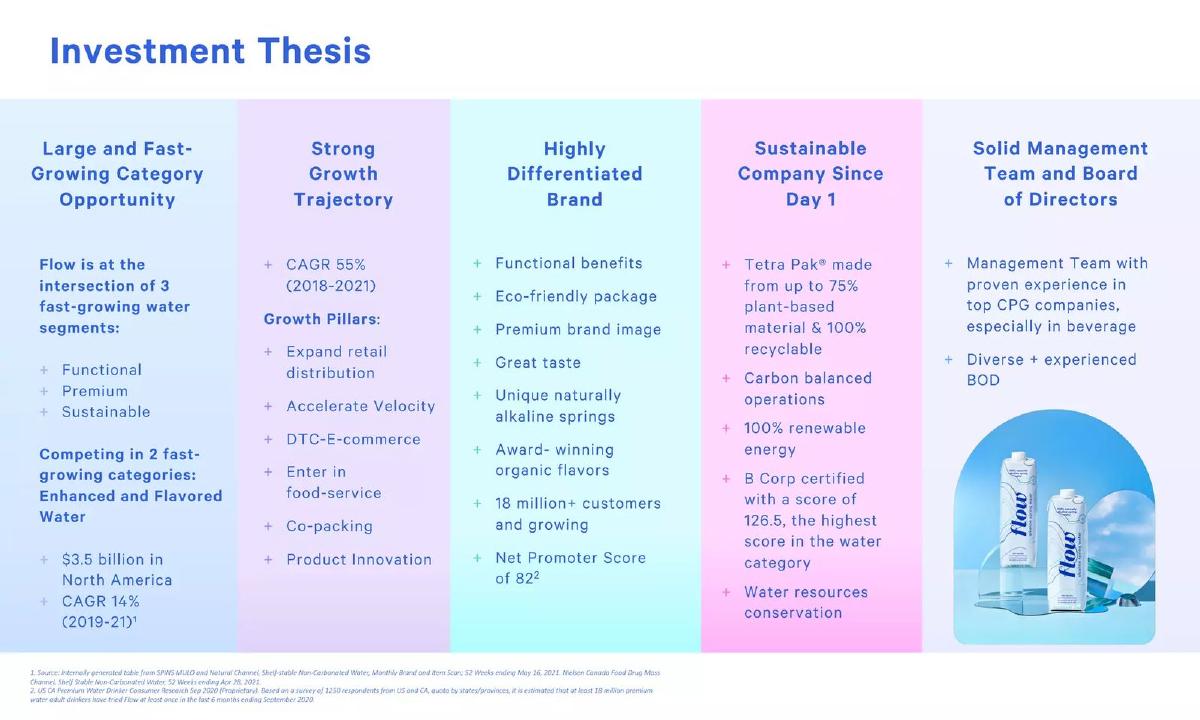
Packaged water brand. The slide cites growth for 2018–2021.
Flow deck, slide 3. Exact stored slide matched to this analysis.
Our analysis: Each reason has its own evidence and the footnotes say where the market and survey figures come from.
Evidence and limitation: The team column has no names or figures. Either add them or drop the column.
What a founder can adapt: Use one column per reason and put the proof under each.
Supporting analysis
What the deck claims: "Investment Thesis" in five columns: large and fast-growing category (functional, premium and sustainable water; $3.5 billion in North America, 14% annual growth 2019–21); strong growth trajectory (55% annual growth 2018–2021; growth pillars such as retail distribution, direct-to-consumer and food service); highly differentiated brand (18 million+ customers, Net Promoter Score of 82); sustainable company (packaging up to 75% plant-based, carbon balanced, B Corp score of 126.5, described as the highest in the water category); and management team and board. Footnotes give sources.
Presentation choice: Each reason has its own evidence and the footnotes say where the market and survey figures come from.
When it does not fit: The team column has no names or figures. Either add them or drop the column.
KnowBe4 deck, slide 4. Exact stored slide matched to this analysis.
Our analysis: It is short and in a sensible order (market, product, ease, growth, economics), and the financial claim has a date. The market figure points to its method.
Evidence and limitation: "Demonstrated scale and durable growth" has no number on the slide. Add revenue or customer count.
What a founder can adapt: Order your reasons market → product → growth → economics, and date the financial one.
Supporting analysis
What the deck claims: "Key Investment Highlights" in five bars: a $23 billion+ global opportunity addressing "the human layer" (a footnote points to how it is calculated); an AI/ML-driven SaaS platform using a proprietary data set; easy to deploy for companies of all sizes; demonstrated scale and durable growth; and "attractive 80%+ margins and positive FCF as of June 30th, 2022".
Presentation choice: It is short and in a sensible order (market, product, ease, growth, economics), and the financial claim has a date. The market figure points to its method.
When it does not fit: "Demonstrated scale and durable growth" has no number on the slide. Add revenue or customer count.
Mobile game developer. The slide's figures refer to 2022.
Playstudios deck, slide 5. Exact stored slide matched to this analysis.
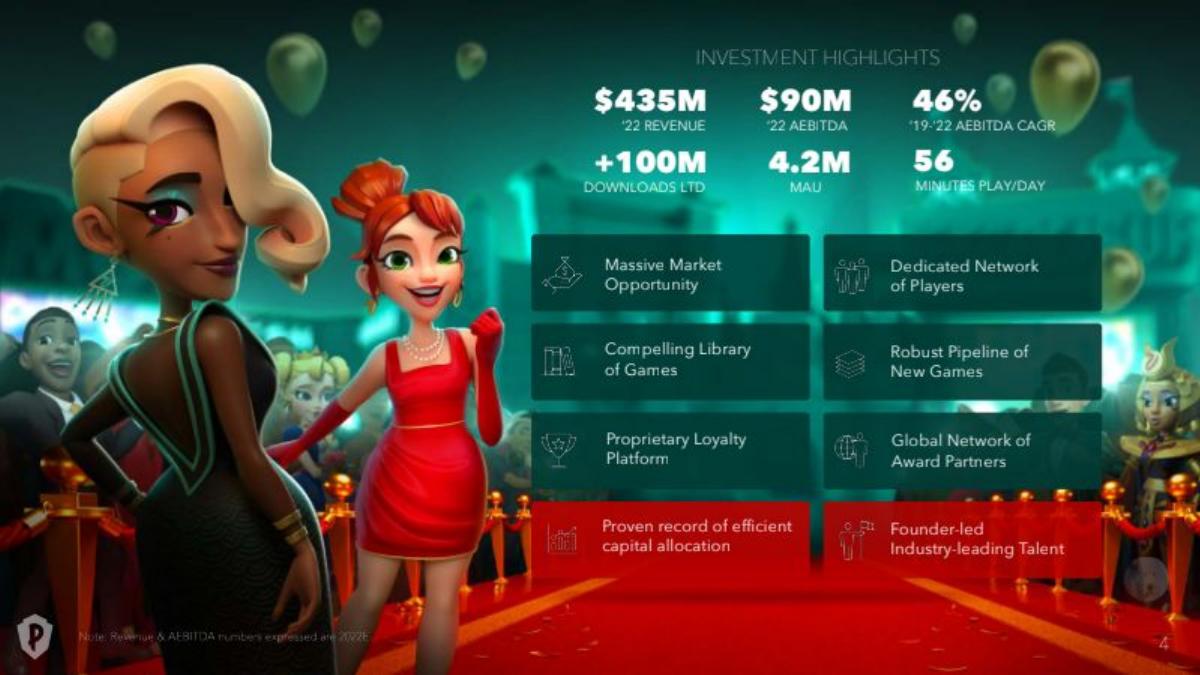
Our analysis: The numbers come first, and they cover scale, profitability and engagement, so the eight tiles read as claims the figures support.
Evidence and limitation: The headline revenue and EBITDA are estimates, disclosed only in small print. Mark estimates next to the figure ("2022E"). Eight tiles is also too many; four would be stronger.
What a founder can adapt: Lead with the four to six numbers that matter most, then the reasons.
Supporting analysis
What the deck claims: "Investment Highlights": six headline figures ($435M '22 revenue, $90M '22 adjusted EBITDA, 46% '19–'22 adjusted EBITDA growth rate, 100M+ downloads, 4.2M monthly active users, 56 minutes play per day) above eight labelled tiles: massive market, dedicated network of players, library of games, pipeline of new games, proprietary loyalty platform, global network of award partners, efficient capital allocation, and founder-led talent. A footnote: revenue and adjusted EBITDA are 2022 estimates.
Presentation choice: The numbers come first, and they cover scale, profitability and engagement, so the eight tiles read as claims the figures support.
When it does not fit: The headline revenue and EBITDA are estimates, disclosed only in small print. Mark estimates next to the figure ("2022E"). Eight tiles is also too many; four would be stronger.
Biotech company developing antibody fragment drug conjugates. The slide cites 2017 deals.
Antikor deck, slide 3. Exact stored slide matched to this analysis.
Our analysis: It points to evidence an investor can check: patent term, a government grant and named comparable deals.
Evidence and limitation: The quote is anonymous and "valuation uplift" is a forecast. Comparable deal values are usually headline totals including future milestones; say so.
What a founder can adapt: If you cite comparable deals, name them, give the value and the year.
Supporting analysis
What the deck claims: "Why invest in Antikor?": a differentiated delivery platform (OptiLink), with a quote from an unnamed ex-CEO in the antibody industry; IP protection to 2034; a recent UK government grant for a gastric cancer product; "significant valuation uplift within 2 years", citing the Crescendo–Takeda ($790m) and Bicycle–AstraZeneca ($1bn) deals and Bicycle's $52m Series B (all 2017); and an experienced, cash-efficient team.
Presentation choice: It points to evidence an investor can check: patent term, a government grant and named comparable deals.
When it does not fit: The quote is anonymous and "valuation uplift" is a forecast. Comparable deal values are usually headline totals including future milestones; say so.
Children's audio player and figurines. Stage and year are not stated on the slide.
Tonies deck, slide 5. Exact stored slide matched to this analysis.
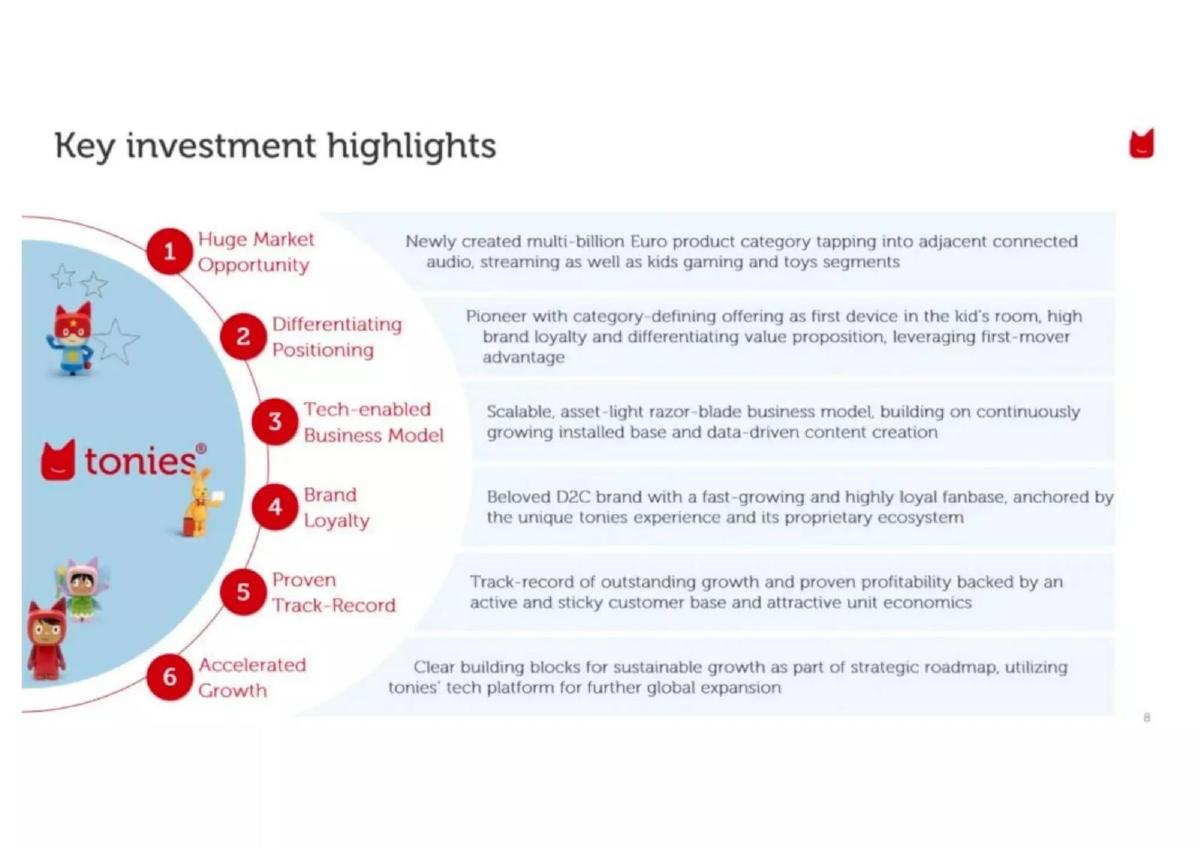
Our analysis: The six points follow a clear logic, and "razor-blade model on a growing installed base" explains how revenue repeats in five words.
Evidence and limitation: There is not one number on the slide. Put the installed base, repeat-purchase rate or revenue next to the relevant point.
What a founder can adapt: Explain your business model in one familiar phrase if one fits.
Supporting analysis
What the deck claims: "Key investment highlights" in six numbered points: huge market opportunity (a newly created multi-billion euro category); differentiating positioning (first device in the kid's room, first-mover advantage); tech-enabled business model (asset-light razor-blade model on a growing installed base); brand loyalty (a fast-growing, loyal fanbase); proven track record (growth and profitability, sticky customers); and accelerated growth (roadmap for global expansion).
Presentation choice: The six points follow a clear logic, and "razor-blade model on a growing installed base" explains how revenue repeats in five words.
When it does not fit: There is not one number on the slide. Put the installed base, repeat-purchase rate or revenue next to the relevant point.
Residential solar marketplace in Europe. Stage and year are not stated on the slide.
Otovo deck, slide 5. Exact stored slide matched to this analysis.
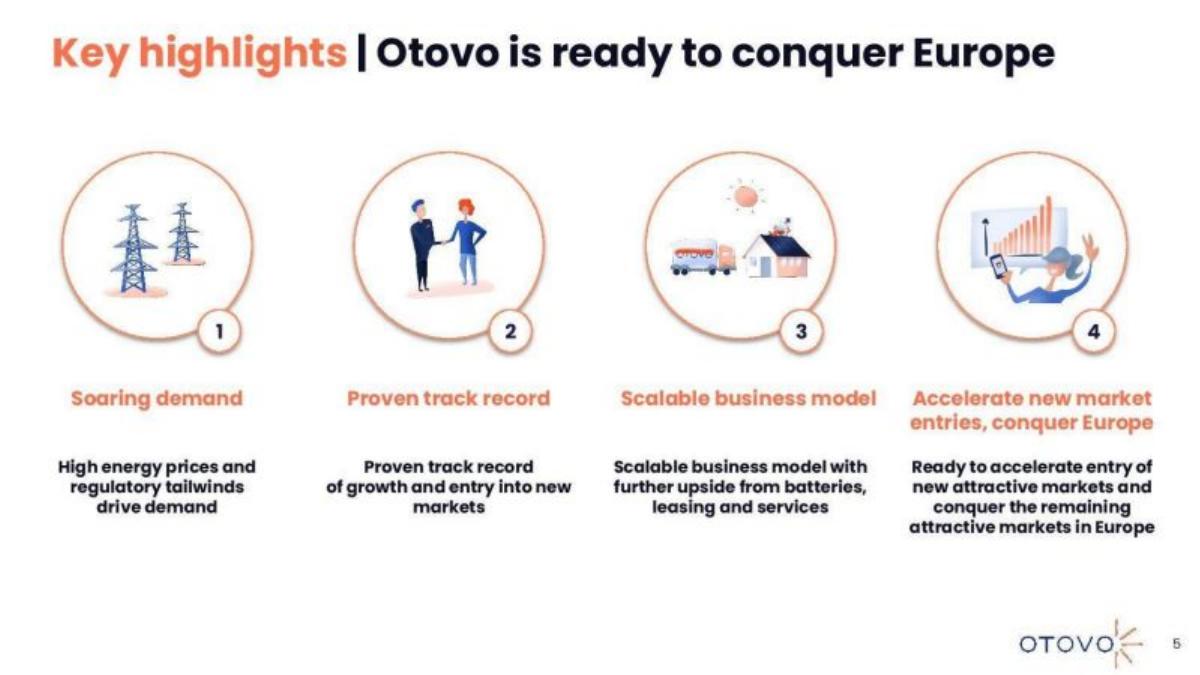
Our analysis: Four points is the right length and the illustrations make it quick to read.
Evidence and limitation: "Proven track record" and "scalable" have no evidence here. Add markets entered, installations or revenue growth.
What a founder can adapt: Treat this as a slide to improve on. Keep four points, and give each one a figure.
Supporting analysis
What the deck claims: "Key highlights | Otovo is ready to conquer Europe": four illustrated points: soaring demand (high energy prices and regulatory tailwinds); proven track record of growth and entry into new markets; scalable business model with upside from batteries, leasing and services; and accelerating entry into new European markets.
Presentation choice: Four points is the right length and the illustrations make it quick to read.
When it does not fit: "Proven track record" and "scalable" have no evidence here. Add markets entered, installations or revenue growth.
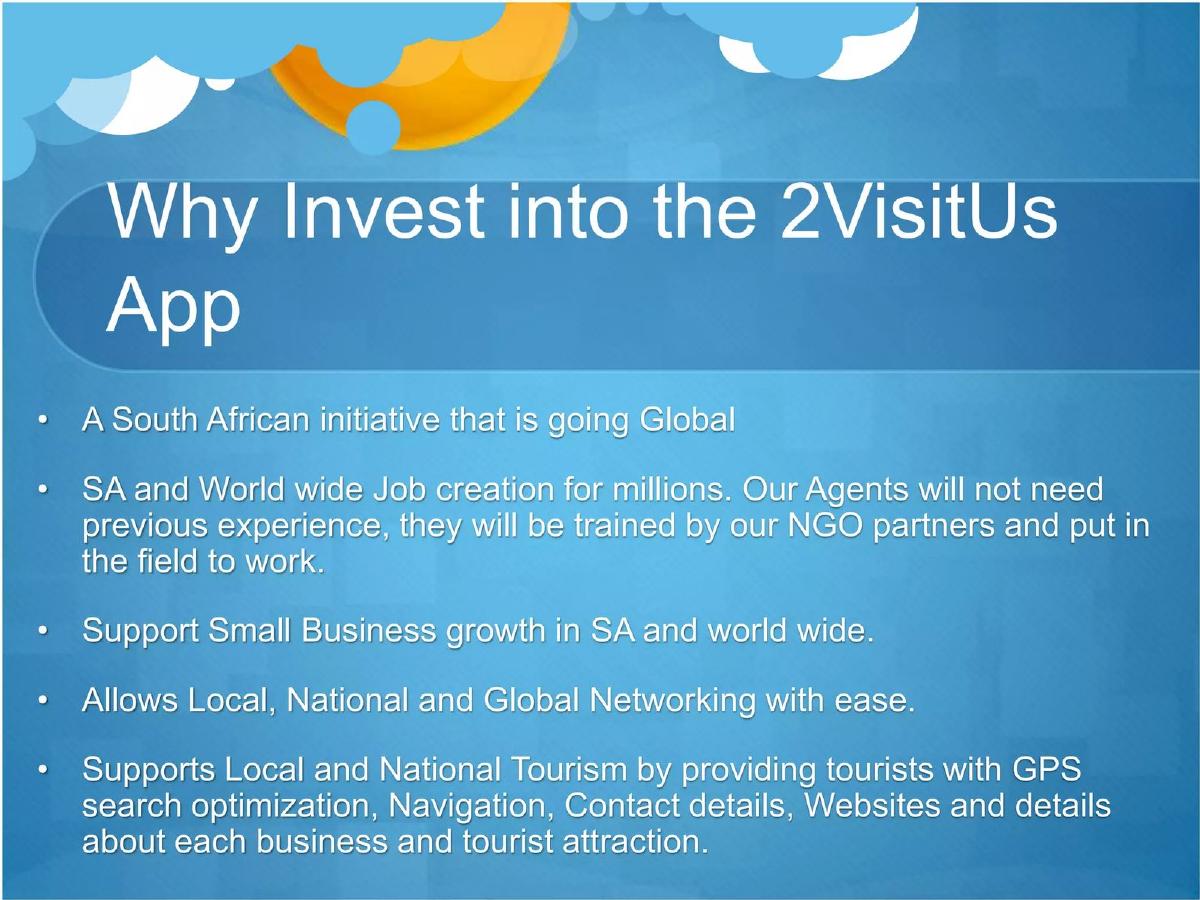
South African local business and tourism app. Stage and year are not stated on the slide.
2VisitUs deck, slide 2. Exact stored slide matched to this analysis.
Our analysis: It states the social benefit the founders care about.
Evidence and limitation: These are product features and social goals, not investment reasons, and "job creation for millions" has no basis on the slide.
What a founder can adapt: Treat this as a slide to improve on. Replace benefits to society with reasons an investor earns a return: market, traction, economics, team.
Supporting analysis
What the deck claims: "Why Invest into the 2VisitUs App": a South African initiative going global; job creation for millions, with agents trained by NGO partners; support for small business growth; local, national and global networking; and support for tourism through GPS, navigation and business details.
Presentation choice: It states the social benefit the founders care about.
When it does not fit: These are product features and social goals, not investment reasons, and "job creation for millions" has no basis on the slide.
Count the highlights that come with a number or a checkable fact.
Example
Highlights
Backed by a number or fact
Estimates marked
Main gap
Flow
5
4 of 5
n/a
Team column
KnowBe4
5
2 of 5
n/a
Growth figure
Playstudios
8 tiles + 6 figures
Figures only
Footnote only
Too many tiles
Antikor
5
3 of 5
Forecast stated as highlight
Anonymous quote
Tonies
6
0 of 6
n/a
No numbers
Otovo
4
0 of 4
n/a
No numbers
2VisitUs
5
0 of 5
n/a
Not investment reasons
Key Takeaways
Give every highlight a number. Flow backs its "strong growth" pillar with a 55% annual growth rate for 2018–2021, and "differentiated brand" with 18 million customers and a Net Promoter Score of 82.
Date your financial claims. KnowBe4 states "80%+ margins and positive free cash flow as of June 30th, 2022", so the reader knows what period is meant.
Mark estimates on the face of the slide. Playstudios' $435 million revenue and $90 million adjusted EBITDA are labelled '22, and the footnote says they are 2022 estimates.
Cite outside proof where you can. Antikor names comparable deals (Crescendo–Takeda, Bicycle–AstraZeneca) and a UK government grant, which an investor can check.
Cut highlights that could describe any company. "Soaring demand", "proven track record" and "scalable business model" (Otovo) say nothing without a figure.
Build your investment highlights slide
Write four to six reasons. If a reason has no number, find one or cut it.
Market. How big, how fast-growing, and according to whom?
Position. Why are you winning? What can an investor check?
Growth. What growth figure, over what period?
Economics. What margin, payback or cash position, as of what date?
Team. What has this team done before that matters here?
Before: Proven track record and scalable business model.
After: Revenue grew from [x] to [y] in [period]; gross margin [z]% as of [date]; entered [n] new markets since [year].
What improved: Our illustrative rewrite, not any company's text. Each claim becomes a dated figure; bracketed values are placeholders.
Investment highlights versus executive summary
Both appear near the front of a deck, and both compress it. The executive summary describes the company: what it sells, to whom, the traction and the round. The investment highlights slide makes the case: the reasons an investor should buy, usually market, position, product, growth, economics and team, in that kind of order.
The format is standard in later-stage, IPO and SPAC decks, where the audience expects it. Early-stage decks use it less, but a short "why invest" slide can work at any stage if every point is backed later in the deck.
Common mistakes
Adjectives instead of evidence. "Massive", "proven" and "scalable" need a number.
Hidden estimates. Mark forecasts next to the figure, not in a footnote.
Too many points. Four to six highlights are easier to remember than ten.
Benefits to society as reasons to invest. Keep impact for an impact slide unless it drives returns.
Highlights the deck doesn't support. Each point should match a later slide.
Diagnostic checklist
Four to six highlights.
Each has a number or checkable fact.
Financial figures are dated.
Estimates are marked on the figure.
Market figures cite a source.
Every highlight is supported later in the deck.
Frequently asked questions
How we chose these examples
Corpus: published pitch deck teardowns on StartupFundraising.com. Founder-uploaded private decks are excluded.
Selection (2026-09-24): we searched extracted text of slides 2–6 for slides titled investment highlights, investment thesis, key highlights or why invest, where a stored slide image exists (about 60 slides, many from public-company decks), and inspected nine candidates. Seven were selected for variety of company type and stage. Kitu Life and Matterport were left out because they already appear in the ask and executive summary guides.
Overlap check: the executive summary guide covers the company overview slide; this guide covers the list of reasons to invest. Pages link to each other.
Review: all seven stored slide images were inspected on 2026-09-24 and matched to company, deck and slide number (editorial model review). No person has yet completed an editorial review of this page.
Figures are the companies' own claims and have not been verified. The note on comparable deal values is general editorial context, not a statement about the specific deals. We make no claim that any slide caused a fundraising outcome.