Antikor’s 2017 investor deck presents a technical case for Antibody Fragment Drug Conjugates (FDCs) as a superior alternative to traditional ADCs in cancer therapy. The company highlights its OptiLink platform, which aims to solve intrinsic ADC problems like slow tumor penetration and off-target toxicity. The deck is data-heavy, showcasing comparative studies in gastric cancer models where Antikor's FDC at 1mg/kg outperformed an ADC at 5mg/kg. While the technical validation is robust, the deck lacks a traditional market size slide, focusing instead on recent high-value M&A activity in the sec…
Key takeaways
- The company positions FDCs as the solution to six intrinsic ADC problems, including bulky conjugates and low therapeutic index (Slide 5).
- Comparative imaging data on Slide 7 shows FDCs achieving rapid, deep uptake into tumors within 2 hours, whereas ADCs show slow and patchy uptake.
- In a human gastric cancer model, Antikor's FDC at 1mg/kg outperformed an equivalent ADC at 5mg/kg (Slide 9).
- Toxicology data on Slide 11 indicates that FDCs are better tolerated by body weight than ADCs, with specific groups terminated early due to ADC toxicity.
- The 'FDC discovery engine' claims the ability to generate multiple leads in less than one month for in-house targets (Slide 13).
- The deck outlines a £1.5M use of funds, with the largest allocation being £500k for R&D staff (Slide 15).
- Antikor cites a potential Series A fundraising of ~£2.5m contingent on meeting four specific milestones (Slide 15).
- The team includes a former SVP of AstraZeneca and a founder from Imperial College, with 90% of current investment from HNW/angels (Slide 17).
Executive Summary and Value Proposition
Slide 1: Title Slide
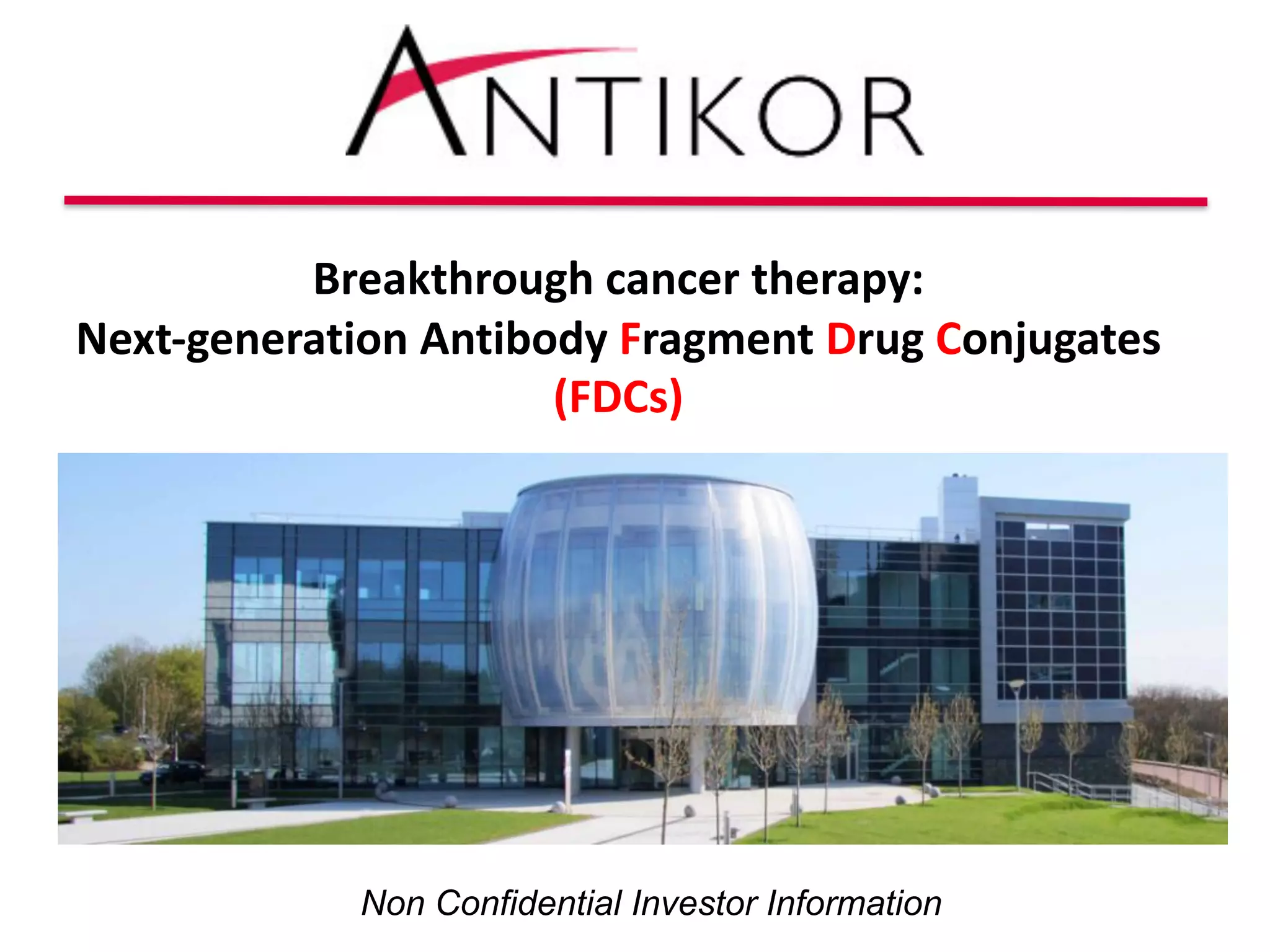
The deck opens with the Antikor logo and the tagline: "Breakthrough cancer therapy: Next-generation Antibody Fragment Drug Conjugates (FDCs)." The slide features a photograph of a modern laboratory facility and explicitly labels the document as "Non Confidential Investor Information." The focus is immediately placed on the specific technology (FDCs) rather than a broad mission statement.
Slide 3: Why Invest in Antikor?
This slide serves as the executive summary. It lists five key pillars for investment: a unique delivery platform called OptiLink, strong IP protection extending to 2034, a UK Government grant for their gastric cancer product, and a dedicated team with over 15 years of experience. Notably, it mentions a "significant valuation uplift within 2 years," citing industry deals like the $1bn Bicycle-Astra-Zeneca deal and the $790m Crescendo-Takeda deal as benchmarks. It also includes a quote from an unnamed "ex-CEO in antibody industry" stating Antikor is "way ahead of Crescendo in applying fragments as ADCs."
The Problem with Current Therapies
Slide 5: Antibody Drug Conjugates (ADCs)
Antikor defines the current landscape by explaining ADCs: antibodies with cytotoxic payloads for direct tumor killing. While acknowledging existing drugs like Adcetris (2011) and Kadcyla (2012), the slide lists "The 6 Intrinsic ADC problems." These include: very bulky conjugates, slow/uneven tumor penetration, long residence time leading to off-target toxicity, poor potency, drug instability, and a low therapeutic index (TI). A diagram of a whole MAb IgG (ADC) is provided to visualize the "bulky" nature of the current standard.
Technical Validation and Comparative Data
Slide 7: FDC Tumor Penetration
This slide provides visual evidence for the company's core claim: FDCs penetrate tumors faster than ADCs. It shows comparative fluorescence imaging at 2, 8, and 48 hours. The FDC row shows rapid and deep uptake as early as 2 hours, whereas the ADC row shows "slow and patchy uptake." The conclusion drawn is that FDCs provide an earlier and more potent 'hit' to the tumor, killing more cells earlier in the treatment cycle.
Slide 9: Performance in Gastric Cancer Models
Focusing on a specific application, this slide shows a graph of tumor volume over 90 days in an NCI-N87 gastric cancer model. The data, attributed to an independent study by CRO Charles River Labs, shows that Antikor's FDC at a dose of 1mg/kg significantly outperformed an ADC at a higher dose of 5mg/kg. The FDC led to near-total tumor suppression, while the ADC only slowed growth compared to the saline vehicle. Key takeaways listed are lower dosing requirements and better tolerability for FDCs.
Slide 11: Toxicology Data
Slide 11 presents "Non-GLP, single-dose toxicology" data in rats. A graph tracks percentage body weight change over 21 days. The data shows that the ADC 30mg/kg group had to be terminated at day 3 due to toxicity. In contrast, FDC2 (1-4mg/kg) was well tolerated, with body weight plots similar to the saline control. The slide asserts that FDCs are better tolerated by body weight and notes that full haematology, liver, and kidney clinical chemistry data are available for these studies.
Platform and Pipeline
Slide 13: FDC Discovery Engine
Antikor moves from a single product to a platform story. The "OptiLink FDC Discovery Engine" is described as an optimized framework using three large libraries. The company claims the ability to generate multiple leads in less than one month for in-house targets. The slide uses a flow diagram to show how the OptiLink framework can be applied to various targets (Target-1, Target-2, Target-3) to create novel products, emphasizing the scalability of the technology.
Execution Plan and Financials
Slide 15: Plan and Use of Funds
This slide provides a detailed roadmap from Q3 2017 through Q4 2019. It tracks the gastric cancer FDC programme (ANT-045), platform development, and future product opportunities. It marks a "1st Bio-pharma licence deal/potential M&A or exit" for late 2019. The bottom of the slide breaks down a £1.5M use of funds: Management (£310k) , R&D staff (£500k) , Materials (£240k) , Out-sourced/contracted (£135k) , Travel & BD (£45k) , and G&A/Patents/Legal (£270k) . It also mentions a future Series A fundraising of ~£2.5m based on meeting four milestones.
Slide 17: The Team
The final slide lists the leadership. Dr. Till Medinger (Chairman) is noted as a former SVP at AstraZeneca. Dr. Mahendra Deonarain (CEO/CSO) is described as an antibody expert from Imperial College. The R&D team consists of 7 doctoral scientists. The slide also discloses the investor base: 90% HNW/angels and 5% Imperial College. It concludes with a note that the company is looking to strengthen management with senior commercial appointments following successful funding.
What Works and What is Missing
What Works
Direct Comparison: The deck does an excellent job of head-to-head comparisons. By showing FDCs at 1mg/kg beating ADCs at 5mg/kg, they make a compelling case for efficacy and cost-efficiency. · Visual Evidence: The tumor penetration images on Slide 7 provide a clear, easy-to-understand visual for a highly technical concept. · Specific Use of Funds: The breakdown on Slide 15 is granular, showing exactly how the £1.5M will be spent across personnel, materials, and overhead. · Clear Milestones: The roadmap ties future fundraising (Series A) to specific technical and business milestones, giving investors a clear sense of the "value-inflection points."
What is Missing
Market Size: There is no slide dedicated to the Total Addressable Market (TAM) for gastric cancer or the broader oncology market. The deck assumes the investor already knows the market is large. · Competitive Landscape: While it mentions Crescendo and Bicycle in the context of deals, it does not provide a feature-by-feature competitive matrix against other emerging fragment technologies. · Commercial Strategy: The deck focuses heavily on R&D and licensing but lacks detail on how they would eventually bring a product to market if an M&A exit does not occur. · Unit Economics: As a pre-clinical biotech, traditional unit economics are absent, but there is also no mention of projected manufacturing costs or "cost to cure" comparisons.
Founder Takeaways
Use comparative data as a weapon. Antikor doesn't just say their tech is better; they show it through independent CRO data and side-by-side toxicology charts. If you are entering a crowded space (like ADCs), your primary job is to prove why the "standard" is broken and how you fix it.
Leverage industry benchmarks for valuation. In sectors where revenue is years away, valuation is often driven by recent M&A. By citing the $1bn AstraZeneca/Bicycle deal, Antikor sets an anchor for what their platform could be worth, making the £1.5M ask seem small in comparison to the potential exit.
Be transparent about the team's evolution. Antikor admits they need to "strengthen management with senior commercial appointments." Founders often try to hide gaps in their team; being upfront about what roles you will hire for next shows maturity and a clear understanding of the company's needs.
Frequently asked questions
- What is the primary technical advantage Antikor claims over competitors?
- Antikor claims its Antibody Fragment Drug Conjugates (FDCs) penetrate tumors much faster and more evenly than traditional Antibody Drug Conjugates (ADCs). According to Slide 7, FDCs show deep uptake within 2 hours, while ADCs remain patchy even at 48 hours. This allows for a more potent 'hit' to the tumor and potentially lower dosing requirements.
- How does Antikor justify its potential valuation to investors?
- Rather than using a bottom-up market sizing, Slide 3 points to recent high-value deals in the sector as comparables. It cites the $790m Crescendo-Takeda deal and the $1bn Bicycle-Astra-Zeneca deal (both 2017) as evidence of a 'significant valuation uplift' possible within two years for companies in the emerging FDC/fragment space.
- What specific cancer indication is the lead program targeting?
- The lead program, designated ANT-045, targets gastric cancer. Slide 9 presents data from an independent study by CRO Charles River Labs showing that their FDC (1mg/kg) significantly reduced tumor volume in an NCI-N87 gastric cancer model compared to both a saline vehicle and a higher-dose ADC (5mg/kg).
- What is the current funding and ownership structure mentioned in the deck?
- As of the 2017 deck, the company was backed primarily by High Net Worth (HNW) individuals and angels, who accounted for approximately 90% of the investment. Imperial College held a 5% stake. Slide 17 also notes that a major holder owns ~41%, making the company eligible for the Enterprise Investment Scheme (EIS) in the UK.
- What are the immediate milestones the company aims to reach with new funding?
- According to the roadmap on Slide 15, the company aims to complete lead optimization and move into pre-clinical stages for the gastric cancer program by 2018. They also planned to establish a first biopharma collaboration by Q4 2017/Q1 2018 and target a potential M&A or exit by late 2019.