The North American Palladium (NAP) investor presentation from September 2011 is a classic example of a capital-intensive industrial pitch. The company positions itself as a critical supplier for the global automotive industry, leveraging tightening emission standards in emerging economies to drive demand for catalytic converters. The deck highlights the Lac des Iles (LDI) mine, noting its status as a rare primary palladium source with a targeted production expansion for Q4 2012. Beyond palladium, NAP showcases a strategic diversification into gold, with a $9.1 million exploration budget for 2…
Key takeaways
- NAP identifies as one of only two primary palladium mines in the world, emphasizing scarcity (Slide 15).
- The company ties its demand growth directly to global emission standards, specifically the Euro IV and V rollouts in China and India (Slide 10).
- A major mine expansion at the LDI site was targeted for production in Q4 2012 via the Offset Zone shaft (Slide 15).
- Development milestones show surface engineering at 90% and construction at 70% completion as of the presentation date (Slide 21).
- Independent reviews from Revelation Geoscience are used to validate exploration potential, claiming the company has 'only scratched the surface' (Slide 25).
- The company diversified into gold with a 70-km land package and a 49,000-meter drilling program (Slide 35).
- Resource estimates for the Vezza Project show 320,900 contained ounces of gold in the Measured & Indicated categories (Slide 45).
- The management team features deep institutional experience, with the CEO and CFO both having backgrounds at Barrick Gold (Slide 40).
Introduction: The Industrial Growth Narrative
The North American Palladium (NAP) investor presentation from September 2011, titled 'Investing for Growth,' is a technical and operational deep dive into a mid-tier mining company. Unlike software decks that focus on user acquisition, this deck focuses on geological certainty, infrastructure milestones, and regulatory tailwinds. The company, led by CEO William J. Biggar, uses this 48-slide deck to justify the capital expenditure required to move from an exhausted open-pit mine to a high-yield underground operation.
Slide 1: Title and Positioning
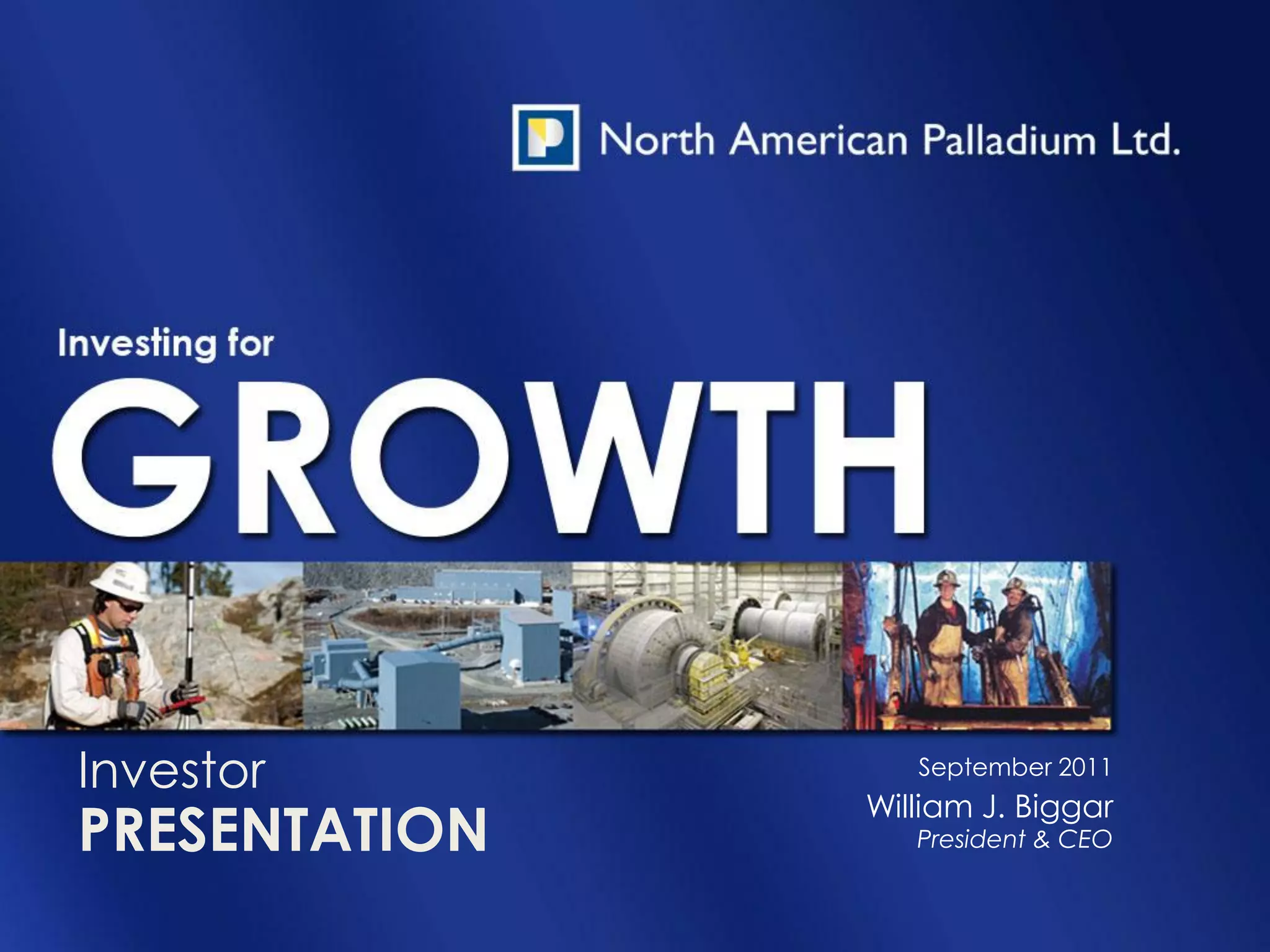
The cover slide establishes the theme: 'Investing for GROWTH.' It features industrial imagery—miners, heavy machinery, and processing facilities—to immediately signal that this is a 'bricks and mortar' investment. The date, September 2011, is crucial as it places the company in a post-recession period where commodity prices were a major focus for hedge funds and institutional investors.
Slide 5 & 10: The Macro Case for Palladium
Slide 5 introduces the 'Investment Case for Palladium' with images of 999.5 pure bullion bars. Slide 10 provides the data to back this up, focusing on the 'Demand' side. The company presents a detailed chart showing the adoption of stricter emission control standards across Europe, China, India, Russia, the USA, Brazil, and Japan. The logic is linear: stricter standards require more catalytic converters, which require more palladium. By highlighting the 'Euro V' and 'Euro VI' standards, NAP positions itself as a beneficiary of global environmental policy.
Slide 15: The Asset - Lac des Iles (LDI)
This is the 'Product' slide for a mining company. NAP describes LDI as a 'World Class Mine.' Key facts include that it is one of only two primary palladium mines in the world. It notes that the open pit, which produced 2.5 million ounces of palladium since 1993, is exhausted, necessitating the shift to the 'Offset Zone.' The slide mentions a 15,000 ton-per-day (tpd) underutilized mill, which represents a significant sunk cost and an opportunity for increased throughput without new infrastructure spending.
Slide 21: Operational Milestones
For an industrial project, the 'Roadmap' is a list of engineering completions. Slide 21 shows that surface engineering is 90% complete and surface construction is 70% complete. This slide is designed to de-risk the investment by showing that the most difficult phases of the expansion are nearing completion. The mention of 'Production shaft sinking' having 'Recently commenced' indicates the company is in the most capital-intensive phase of the project.
Slide 25: Third-Party Validation
Mining is inherently speculative. To counter this, Slide 25 presents an 'Independent Review' by Revelation Geoscience. The slide uses a powerful quote: 'WE HAVE ONLY SCRATCHED THE SURFACE.' By citing experts in PGE (Platinum Group Element) deposits, NAP attempts to move the conversation from 'if' there is more ore to 'how much' more ore there is. This is a classic tactic to support a higher valuation based on 'exploration potential' rather than just 'proven reserves.'
Slide 30 & 35: Diversification into Gold
Slides 30 and 35 detail the company's secondary focus: Gold. Slide 30 explains the economics of the 'Sleeping Giant' mine, showing a cross-section of the 200-meter deepening project. Slide 35 maps out the 2011 Gold Exploration program in the Abitibi region of Quebec. With a $9.1 million budget for 49,000 meters of drilling, NAP is signaling that it is not a one-trick pony. The map shows proximity to other major producers like Agnico-Eagle and Metanor, using 'nearology' to imply the value of their land package.
Slide 40: The Management Team
The 'Senior Management' slide is heavy on institutional pedigree. The team is dominated by former executives from Barrick Gold, the industry leader at the time. CEO William J. Biggar, CFO Jeff Swinoga, and VP Trent Mell all cite Barrick experience. This suggests a 'big company' mindset and operational discipline, which is intended to comfort investors concerned about the execution risks of a major mine expansion.
Slide 45: Mineral Resources Detail
Slide 45 provides the hard data for the Vezza Project. It lists 1,714,000 tonnes of 'Measured & Indicated' resources at a grade of 5.8 grams per tonne of gold. The inclusion of detailed footnotes regarding cut-off grades ($1,200 per ounce gold) and NI 43-101 compliance is a regulatory necessity that also serves to demonstrate the company's transparency and adherence to industry standards.
What Works in This Deck
Regulatory Alignment: The deck does an excellent job of connecting a specific commodity (palladium) to a global, unstoppable trend (emission standards). This makes the investment feel like a 'macro certainty' rather than a geological gamble.
Infrastructure Utilization: Highlighting the 'underutilized mill' is a smart move. It tells investors that the company can grow production without the massive capital outlay usually required to build a new processing plant.
De-risking through Data: The use of independent geological reviews and specific percentage-completion figures for construction provides a level of granularity that builds trust with sophisticated investors.
What Is Missing
The Financial 'Ask': As a public company presentation, this deck lacks a specific 'ask' or 'use of proceeds' slide common in private equity or venture capital. It does not state how much capital they are looking to raise or at what valuation.
Competitor Analysis: While it mentions being one of only two primary palladium mines, it does not name the other one (Stillwater Mining) or discuss the competitive landscape of secondary producers (nickel/platinum miners in Russia and South Africa) who might flood the market.
Unit Economics: While it mentions 'lower cash costs per ounce' on Slide 30, it does not provide a specific projected All-In Sustaining Cost (AISC). In mining, the grade of the ore is meaningless without knowing the cost to extract it.
Founder Takeaways
Use Macro Tailwinds: If your business benefits from a specific regulation (like carbon credits or emission standards), make that a central pillar of your demand story. It makes your growth feel inevitable.
Quantify Progress: Don't just say you are 'building the product.' Use percentages. '70% construction complete' is much more persuasive than 'in progress.'
Leverage Pedigree: If your team comes from the 'Google' or 'Barrick Gold' of your industry, lean into it. In high-risk sectors, investors are buying the team's ability to handle complexity based on their past experience at scale.
Frequently asked questions
- What is the primary value proposition of North American Palladium?
- The primary value proposition is its status as a rare primary producer of palladium. Most palladium is produced as a byproduct of nickel or platinum mining. By operating a primary mine at Lac des Iles, NAP offers investors direct exposure to palladium price movements, driven by the mandatory adoption of catalytic converters in global automotive markets.
- How does the company address the risk of resource depletion?
- The deck addresses depletion by highlighting the transition from the exhausted open pit to underground mining in the Roby Zone and the new Offset Zone expansion. They also use third-party validation from Revelation Geoscience to suggest significant untapped potential in the 'Mine Block Intrusion' area, including the Cowboy and Sheriff zones.
- What is the significance of the gold exploration mentioned in the deck?
- Gold exploration, particularly at the Sleeping Giant and Vezza projects, serves as a strategic hedge and growth lever. By utilizing an underutilized mill and a $9.1 million exploration budget, NAP aimed to transform from a single-commodity miner into a diversified precious metals producer in the stable jurisdiction of Quebec, Canada.
- Who are the key people leading the company?
- The leadership team is composed of mining industry veterans. CEO William J. Biggar and CFO Jeff Swinoga both held senior roles at Barrick Gold, the world's largest gold mining company at the time. COO Greg Struble brought specific experience from Stillwater Mining, which operated the only other primary palladium mines in North America.
- What stage of development was the LDI mine expansion in during this pitch?
- As of September 2011, the expansion was in the late stages of construction. Surface engineering was 90% complete, and surface construction was 70% complete. The company was targeting Q4 2012 for the commencement of production from the new Offset Zone via a production shaft.