Normalyze's 16-slide Series A deck focuses on the 'data explosion' within cloud environments, positioning itself as a unified solution for discovery, classification, and risk prioritization. The narrative moves from the complexity of modern digital enterprises to a specific competitive matrix that highlights gaps in existing tools like CASB and CSPM. By the time the deck reaches its progress timeline, it demonstrates clear execution: growing from 5 to 20 employees and securing 14 pilots within 18 months. The deck successfully raised $22M in 2024, as reported by Business Insider, by leaning in…
Key takeaways
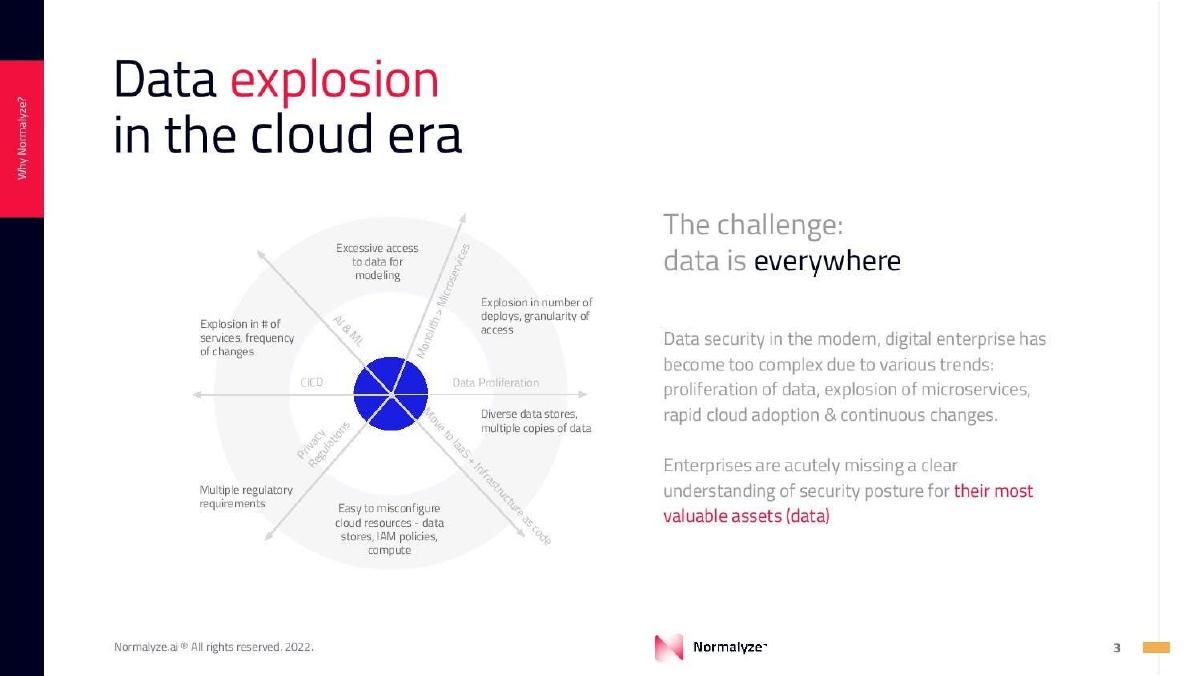
- The deck identifies 'data proliferation' and 'explosion of microservices' as the primary drivers of modern security complexity (Slide 3).
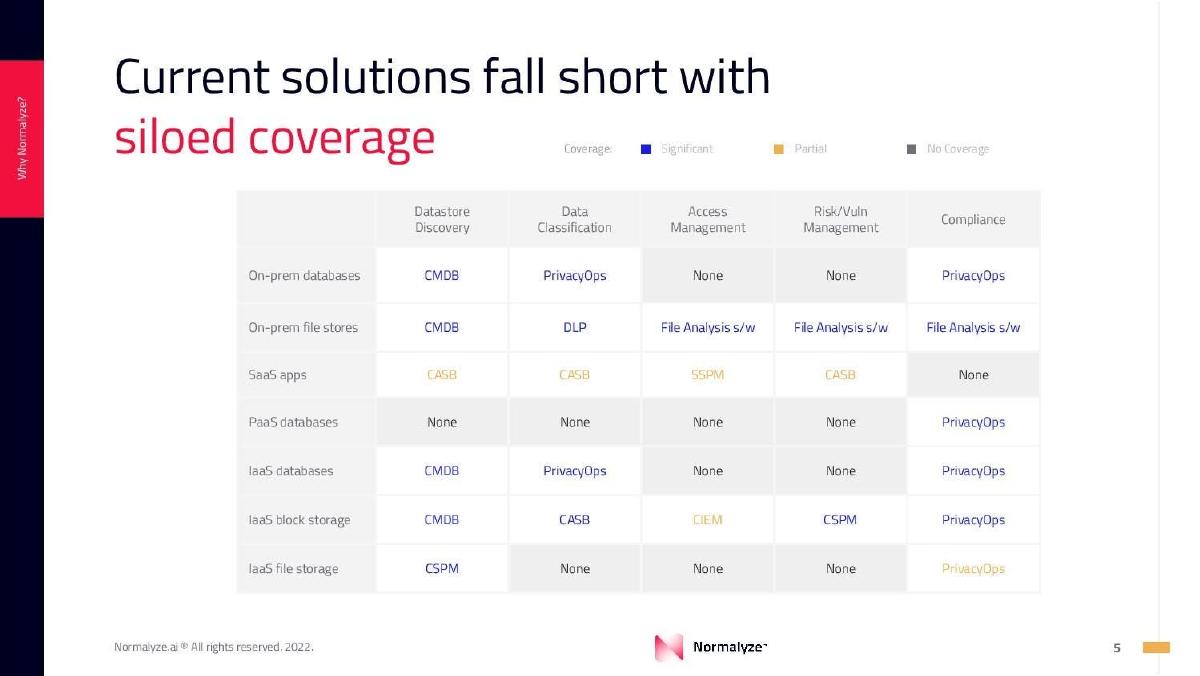
- A detailed competitive matrix explicitly lists where existing solutions like CMDB, DLP, and CASB provide 'None' or only 'Partial' coverage for PaaS and IaaS (Slide 5).
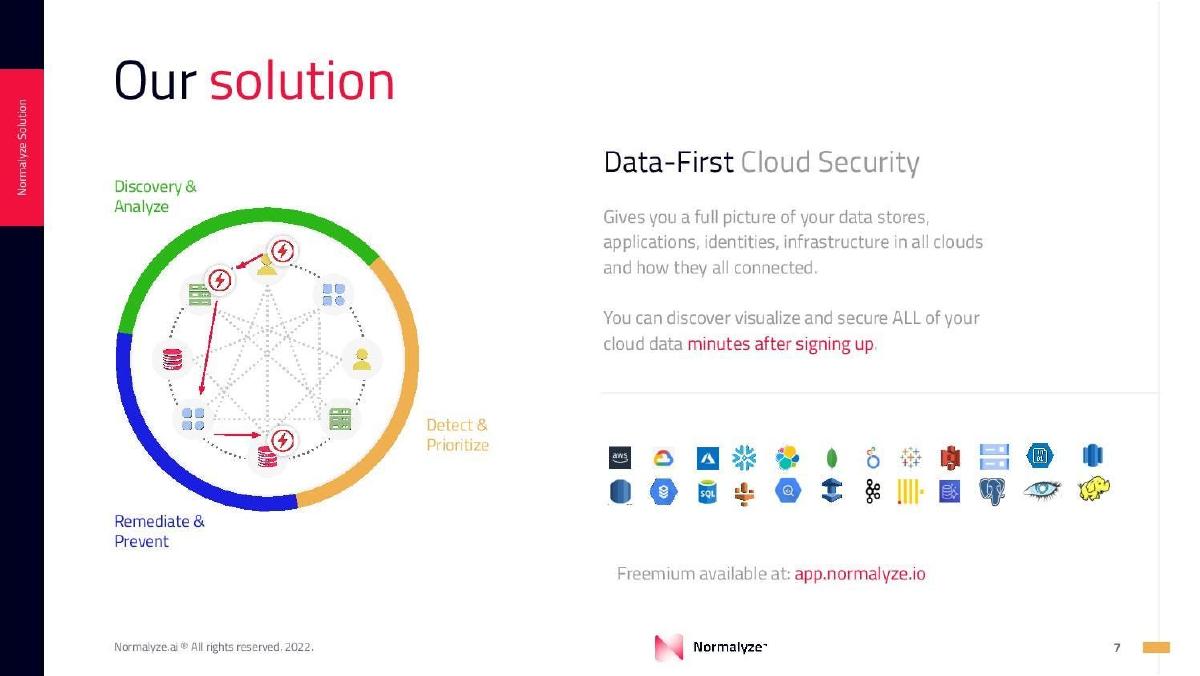
- The platform promises rapid time-to-value, claiming users can secure cloud data 'minutes after signing up' (Slide 7).
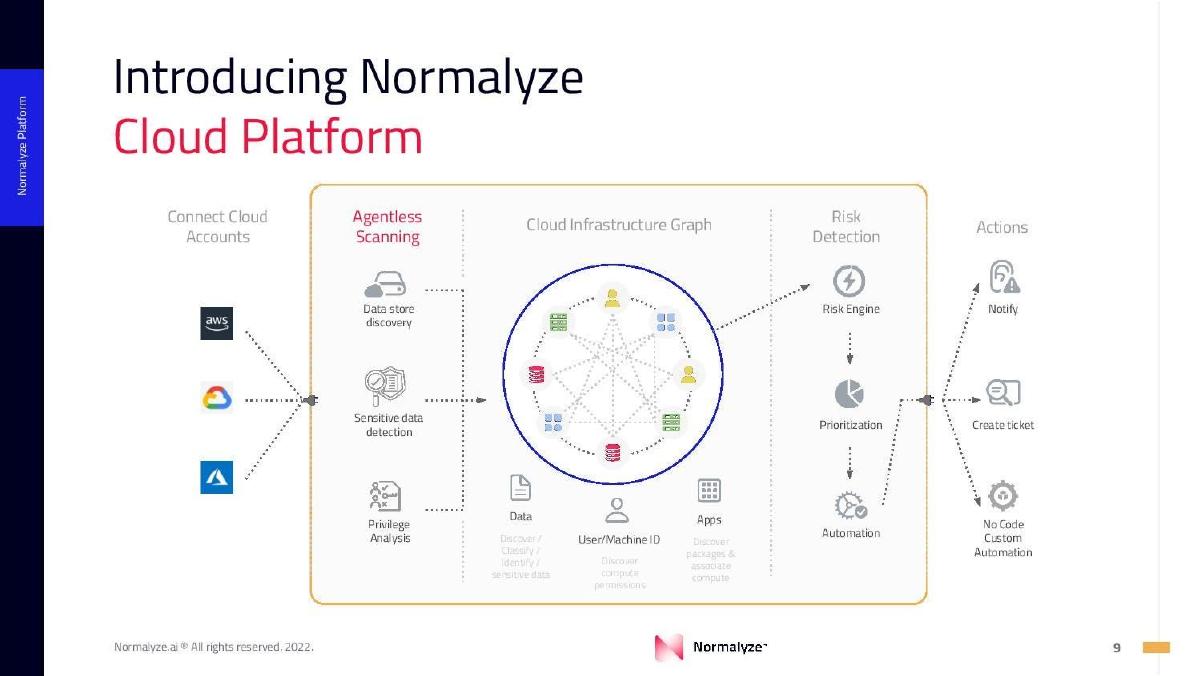
- The technical architecture highlights an 'Agentless Scanning' approach to discover data stores and analyze privileges without disrupting infrastructure (Slide 9).
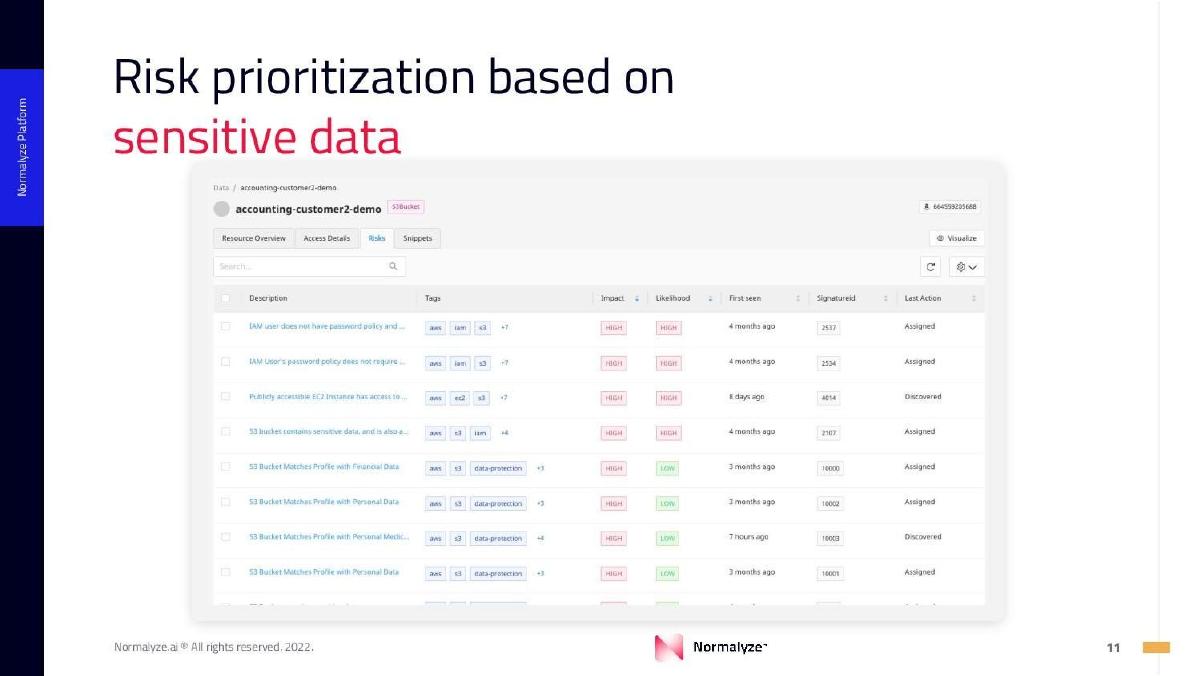
- Risk prioritization is visualized through a product UI showing impact and likelihood scores for specific cloud resources (Slide 11).
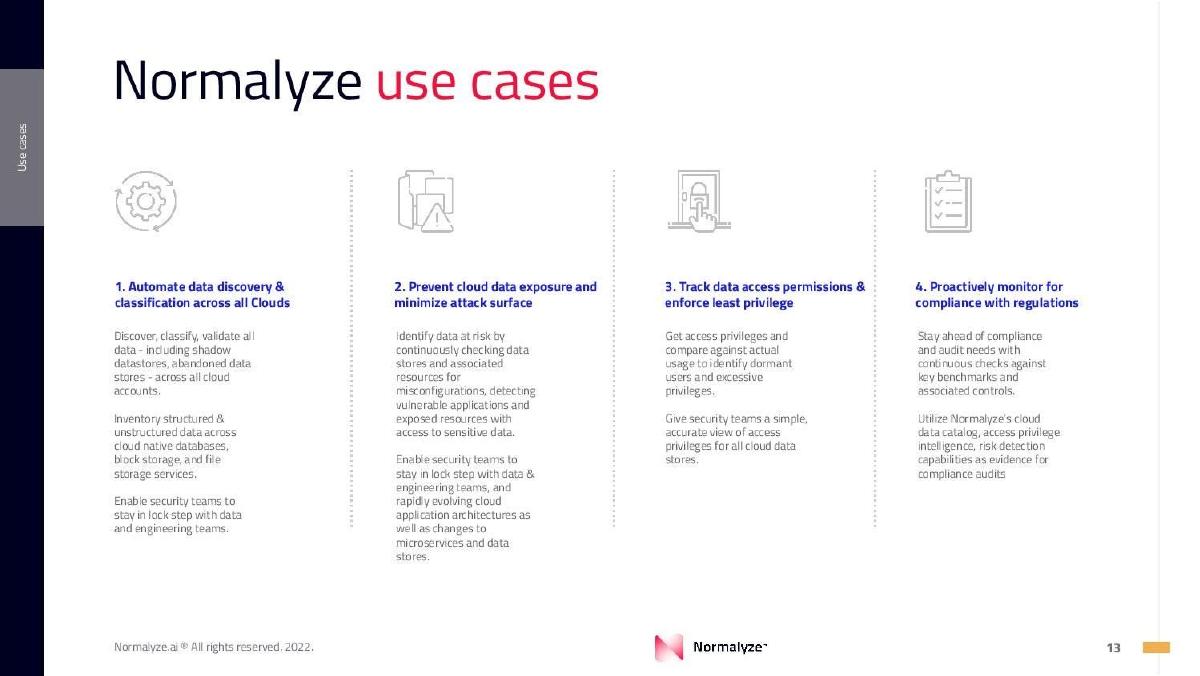
- The deck outlines four distinct use cases: automated discovery, exposure prevention, access tracking, and compliance monitoring (Slide 13).
- Execution is proven through a timeline showing growth from incorporation in Dec 2020 to a $22.2M A-round in May 2022 (Slide 15).
- The company scaled from 0 to 14 pilots and 2 paying customers in the seven months leading up to the round (Slide 15).
The Data-First Security Narrative
Normalyze entered a crowded cybersecurity market by focusing on a specific, high-pain niche: Data Security Posture Management (DSPM). The deck, used to raise a $22M Series A as reported by Business Insider, is a masterclass in identifying a 'coverage gap' in existing enterprise stacks. Rather than claiming to replace the entire security suite, Normalyze uses its slides to show exactly where current tools like CSPM (Cloud Security Posture Management) and DLP (Data Loss Prevention) fail in modern, microservice-heavy cloud environments.
Slide 1-2: Branding and Positioning
The deck opens with a minimalist title slide. The tagline 'data-first cloud security' is the central pillar of the company's identity. By leading with 'Data-First,' they immediately signal a shift away from traditional infrastructure-centric security, which focuses on the 'walls' (firewalls, networks) rather than the 'jewelry' (the data itself).
Slide 3: The Problem of Data Explosion
Slide 3, titled 'Data explosion in the cloud era,' uses a radar-style graphic to visualize the complexity of the modern enterprise. It lists six specific drivers of risk: excessive access for AI/ML modeling, explosion in services/microservices, rapid CI/CD changes, privacy regulations, IaaS/Infrastructure as Code misconfigurations, and diverse data stores. The slide concludes with a strong problem statement: enterprises are missing a clear understanding of the security posture for their 'most valuable assets (data).'
Slide 5: The Competitive Gap Analysis
This is arguably the most important slide for a Series A pitch. It features a grid comparing 'Current solutions' against five categories: Datastore Discovery, Data Classification, Access Management, Risk/Vuln Management, and Compliance. The grid is populated with acronyms like CMDB, DLP, CASB, and CSPM. Crucially, it shows 'None' or 'Partial' coverage for PaaS databases and IaaS block storage. This slide justifies the existence of Normalyze by highlighting the 'siloed coverage' that leaves data exposed.
Slide 7: The Solution Overview
Slide 7 introduces the 'Data-First Cloud Security' solution. It promises a 'full picture' of data stores, applications, identities, and infrastructure. A key value proposition is highlighted in red text: users can secure data 'minutes after signing up.' This addresses a common pain point in enterprise security—long deployment cycles. The slide also mentions a 'Freemium' model, suggesting a bottom-up adoption strategy to complement enterprise sales.
Slide 9: Platform Architecture
For a technical audience, Slide 9 explains how the product actually works. It details an 'Agentless Scanning' process that connects to AWS, Google Cloud, and Azure. The architecture flows from discovery to a 'Cloud Infrastructure Graph' (connecting Data, Users, and Apps) and finally to a 'Risk Engine.' The 'Actions' column shows integrations for notification, ticketing, and 'No Code Custom Automation,' positioning the tool as a workflow enabler rather than just a dashboard.
Slide 11: Product UI and Risk Prioritization
This slide provides a screenshot of the platform in action. It shows a list of risks (e.g., 'IAM user does not have password policy,' 'S3 bucket contains sensitive data') with associated 'Impact' and 'Likelihood' scores. By showing the product, Normalyze proves the software is built and functional, moving the conversation from theory to utility. The UI emphasizes 'High' impact risks, demonstrating how the tool helps security teams cut through the noise.
Slide 13: Use Cases
Slide 13 breaks down the platform's utility into four pillars: 1. Automate discovery, 2. Prevent exposure, 3. Track access permissions, and 4. Monitor for compliance. This slide is designed to speak to different stakeholders—from the security engineer worried about 'shadow data' to the CISO worried about 'compliance audits.' It maps the technical features back to business outcomes.
Slide 15: Execution and Traction
The 'Company progress and timeline' slide is a dense summary of the company's velocity. It tracks employee growth (from 5 to 20) and pilot growth (from 0 to 14) between December 2020 and May 2022. It notes key milestones like the 'Seed round LSVP' in Feb 2021 and the 'A-round 22.2M' in May 2022. This slide provides the 'proof of work' necessary to justify a Series A valuation, showing that the team can hit product and hiring milestones consistently.
What Normalyze Does Well
The deck is exceptionally clear about its 'Why.' By focusing on the 'Data Explosion,' it creates a sense of urgency that infrastructure-only security tools cannot match. The competitive matrix on Slide 5 is a bold and effective way to show investors exactly where the market is underserved. Furthermore, the inclusion of a 'Freemium' link and a rapid 'minutes after signing up' promise suggests a modern, product-led growth mindset that is attractive to venture capitalists.
What is Missing from the Deck
The provided images lack a dedicated 'Team' slide. While the timeline mentions the CEO and Head of Products joining, a Series A deck typically features a slide highlighting the founders' previous exits or deep domain expertise in cybersecurity. Additionally, there is no 'Unit Economics' or 'Financial Projections' slide in the set. While the timeline shows two paying customers, investors at this stage usually want to see the pipeline, ACV (Average Contract Value), and the projected path to $10M+ ARR. Finally, a specific 'Ask' slide detailing how the $22M will be spent (e.g., 50% R&D, 50% GTM) is absent from the provided materials.
Founder Takeaways
Founders should study Slide 5's 'Siloed Coverage' matrix. If you are entering a crowded market, you must be able to articulate not just what you do, but exactly where the incumbents are 'None' or 'Partial.' Another takeaway is the use of a progress timeline (Slide 15) that tracks multiple metrics simultaneously (Employees, Pilots, Milestones). This gives a holistic view of company health and momentum that a simple list of bullets cannot achieve. Lastly, the 'Data-First' branding is a great example of how to own a category through consistent messaging across every slide.
Frequently asked questions
- What is the primary problem Normalyze addresses?
- Normalyze addresses the 'Data explosion in the cloud era,' where data is scattered across diverse stores, microservices, and IaaS/PaaS environments. Slide 3 notes that enterprises lack a clear understanding of the security posture for their most valuable assets, specifically their data, due to rapid cloud adoption and continuous changes.
- How does Normalyze differentiate itself from existing security tools?
- Slide 5 provides a comparison matrix showing that traditional tools like DLP, CASB, and CSPM offer siloed coverage. Normalyze positions itself as a 'Data-First' solution that covers gaps where others have 'None,' particularly in PaaS databases and IaaS file storage discovery and classification.
- What are the technical capabilities of the Normalyze platform?
- As shown on Slide 9, the platform uses agentless scanning to perform data store discovery, sensitive data detection, and privilege analysis. This feeds into a 'Cloud Infrastructure Graph' that connects data, users, and apps to a risk engine for automated prioritization and remediation actions.
- What traction did Normalyze have at the time of the Series A?
- According to the timeline on Slide 15, by May 2022, the company had 20 employees, 14 pilots, and 2 paying customers. They had also completed their SOC2 Type 2 certification and launched a new UX earlier that year.
- Does the deck include a financial 'Ask' slide?
- The provided slide content does not include a specific 'Ask' slide detailing the amount sought or the planned allocation of capital. However, the timeline on Slide 15 marks the 'A-round 22.2M' in May 2022, which aligns with the reported funding amount.