Nonnatech’s 8-slide pitch deck is a study in extreme brevity. Launched in 2010, the New York-based startup sought to solve the high costs of elderly care through passive sensors and machine learning. The deck avoids the traditional 'Problem/Solution' text blocks, instead using large-scale numbers—like a $17 billion market figure on slide 3—and high-impact visuals to tell the story. While it successfully communicates a 10x ROI and a base of over 1,000 users by Q1 2017, the deck is notably missing a formal 'Ask' slide, detailed financial projections, and a competitive landscape analysis. Despit…
Key takeaways
- The deck relies on a minimalist 8-slide structure that prioritizes visual impact over detailed technical documentation.
- Market size is presented as a single, massive figure of $17 Billion on slide 3, though it lacks context on whether this is TAM, SAM, or SOM.
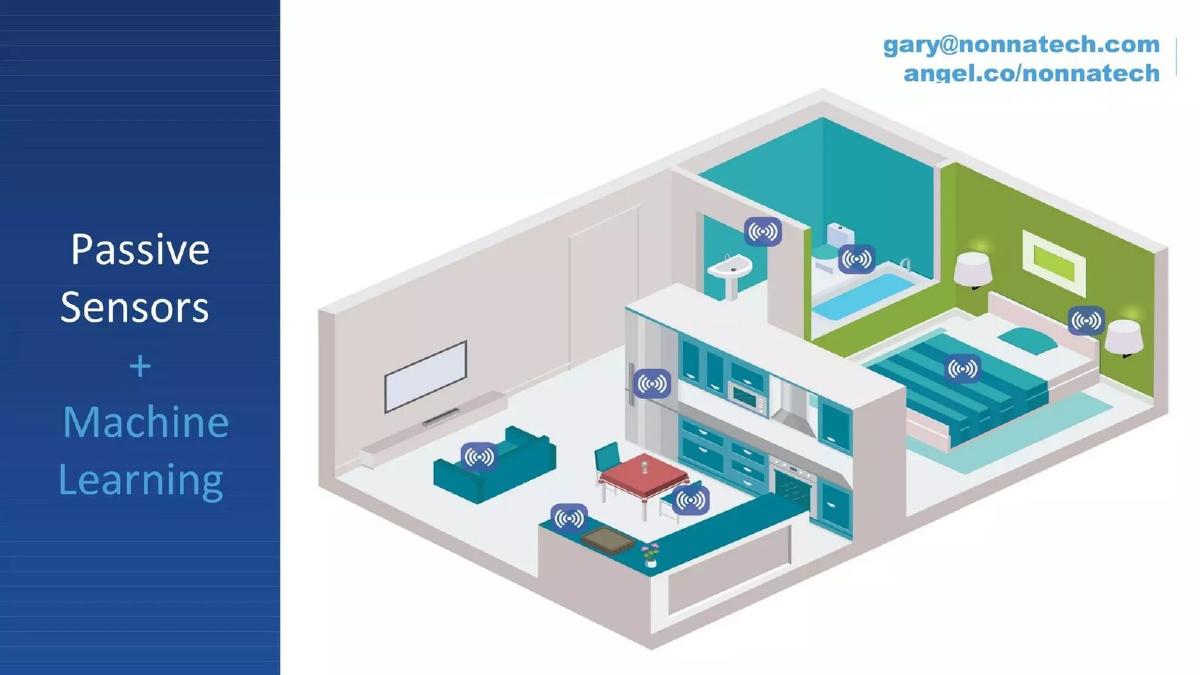
- The product is explained through a single isometric diagram on slide 2, showing passive sensors placed in bathrooms, kitchens, and bedrooms.
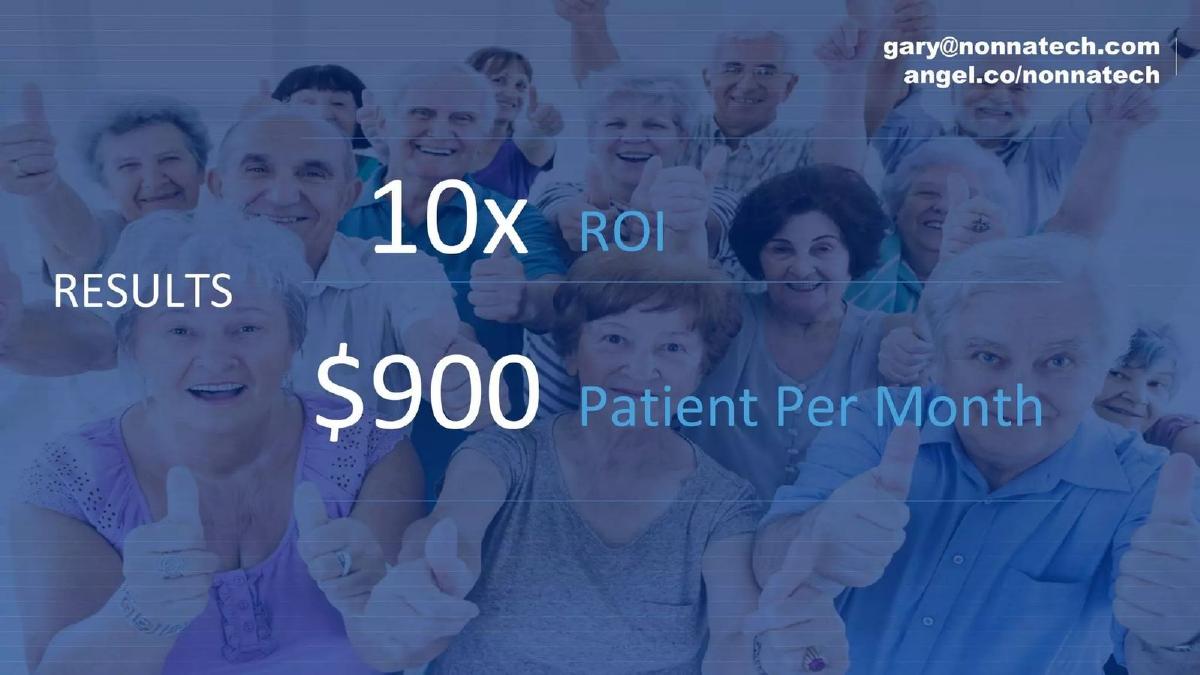
- Financial impact is distilled into two primary metrics on slide 5: a 10x ROI and a $900 value per patient per month.
- Traction is evidenced by a list of prominent healthcare partners including Sprint, Hirslanden, and NYU Langone on slide 6.
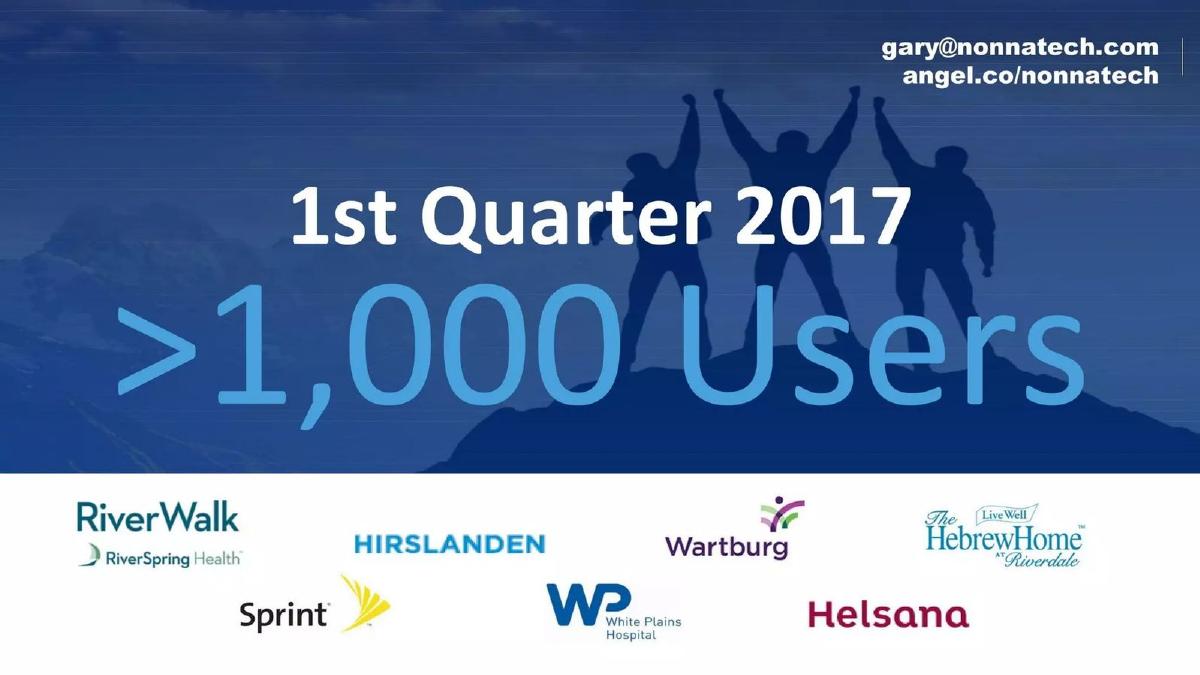
- The company reached a milestone of over 1,000 users by the first quarter of 2017, as stated on slide 6.
- The team slide (slide 7) leverages corporate logos like Medtronic and Ochsner to establish credibility through past experience.
- The deck completely omits a slide detailing the specific funding amount requested or the planned use of proceeds.
The Minimalist Approach to Health-Tech Fundraising
Nonnatech’s pitch deck is an anomaly in the world of venture capital. At only eight slides, it ignores the standard 12-to-15 slide template popularized by firms like Sequoia. Instead, it operates as a high-level visual narrative designed to support a spoken pitch. The deck focuses on three core pillars: the massive financial burden of healthcare, the simplicity of their sensor-based solution, and the impressive pedigree of their team. By the time this deck was circulating in its later stages, the company had already secured $1,000,000 in funding and established a foothold with major healthcare providers.
Slides 1-2: The Vision and the Mechanism
Slide 1: Title Slide The deck opens with a simple branding slide. It features the Nonnatech logo and contact information for CEO Gary German. The background image of a caregiver and an elderly patient immediately establishes the target demographic: geriatric care and remote patient monitoring. The inclusion of an AngelList (angel.co) URL suggests a focus on early-stage tech investors.
Slide 2: Passive Sensors + Machine Learning This is the 'How it Works' slide. Rather than using bullet points to explain their tech stack, Nonnatech uses an isometric floor plan of a home. Icons representing sensors are placed in the bathroom, kitchen, bedroom, and living room. The text is minimal: 'Passive Sensors + Machine Learning.' This slide effectively communicates that the system is non-intrusive; patients do not need to wear a device or press buttons. The sensors collect data, and the machine learning component interprets it to provide predictive analytics.
Slides 3-4: The Market Opportunity and Product Interface
Slide 3: $17 Billion Slide 3 is a classic 'Big Number' slide. Over a background of a stethoscope and US currency, the figure '$17 Billion' is displayed in large type. There is no accompanying text to explain what this number represents. In a live pitch, this likely referred to the annual cost of hospital readmissions or the specific market size for elderly home care. While visually striking, as a standalone slide, it lacks the necessary context to define the Total Addressable Market (TAM).
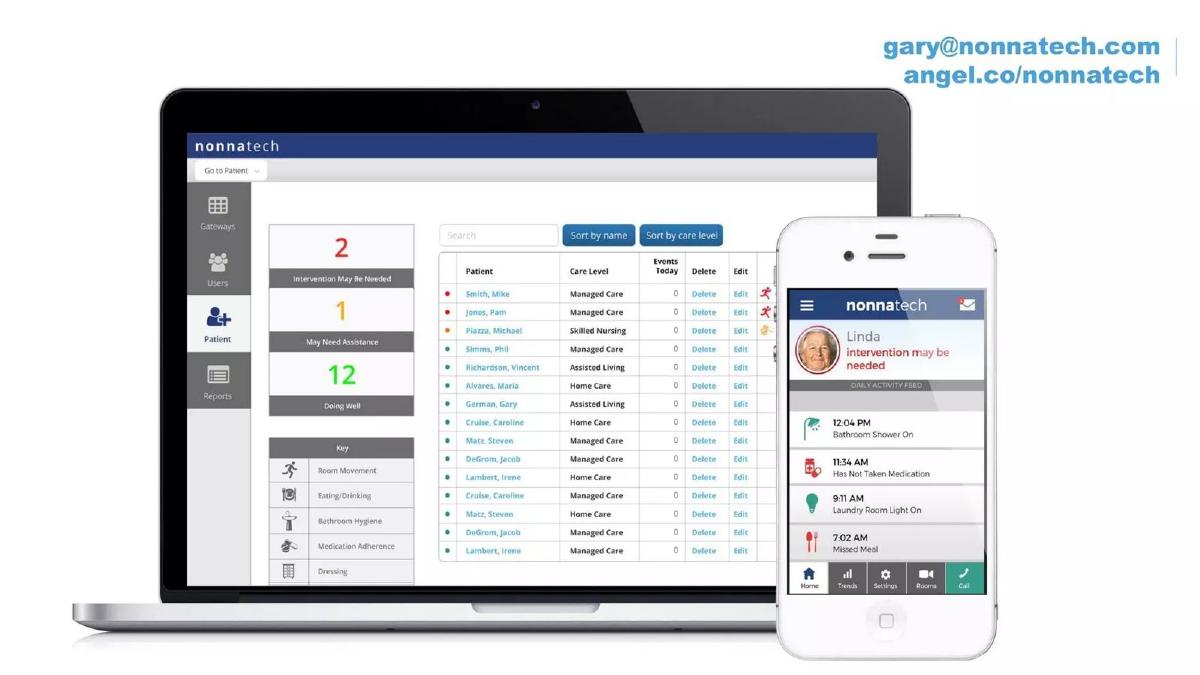
Slide 4: Software Interface This slide provides a look at the actual user interface (UI) for healthcare providers. It shows a desktop dashboard and a mobile app. The dashboard lists patients with color-coded status indicators (e.g., 'Intervention May Be Needed' in red, 'Doing Well' in green). The mobile view shows a feed for a patient named 'Linda,' detailing events like 'Bathroom Shower On' at 12:04 PM and 'Has Not Taken Medication' at 11:34 AM. This slide is crucial because it proves the product is more than a concept; it is a functional platform that translates raw sensor data into actionable insights for clinicians.
Slides 5-6: Results and Traction
Slide 5: Results The 'Results' slide is the strongest argument for the business model. It highlights two key figures: '10x ROI' and '$900 Patient Per Month.' The 10x Return on Investment is a powerful hook for healthcare administrators looking to reduce costs. The $900 figure likely represents the cost savings per patient or the revenue generated per patient, though the slide doesn't specify. The background of smiling elderly individuals reinforces the positive outcome of the technology.
Slide 6: Traction and Partnerships Slide 6 serves as the 'Proof of Life' for the company. It boldly states '>1,000 Users' as of '1st Quarter 2017.' Below this, a 'wall of logos' includes Sprint, Hirslanden, White Plains Hospital, and NYU Langone. For a healthcare startup, these partnerships are the ultimate validation. They signal that the product has passed the rigorous security and HIPAA compliance hurdles required by major medical institutions.
Slides 7-8: The Team and the Mystery Metric
Slide 7: Our Team The team slide features six key members, including CEO Gary German and CTO Bill Lindsey. What makes this slide effective is the column of logos on the right side, representing the team's previous experience: Meridian Health Plan, Ochsner Health System, Medtronic, and NYU Langone. This 'borrowed credibility' is essential in the healthcare space, where domain expertise is often more important than the technology itself.
Slide 8: 480 Million The deck ends on a cryptic note with the number '480 Million' centered over an image of the Earth from space. Like the $17 Billion slide, there is no text to explain this figure. It could represent the global elderly population, the total number of data points collected, or a future market projection. Ending on such an ambiguous note is a risky move that only works if the preceding presentation has been exceptionally clear.
What Works in This Deck
Clarity of Value Proposition: The deck doesn't get bogged down in technical jargon. It clearly states that the product uses sensors to monitor patients and delivers a 10x ROI. For an executive-level pitch, this level of simplification is often preferred over deep technical dives.
Visual Product Demo: Slide 4 does an excellent job of showing the product in action. By showing both the desktop and mobile interfaces, Nonnatech demonstrates that they have considered the workflow of both office-based administrators and on-the-go caregivers.
Credibility via Association: The use of well-known healthcare logos on both the traction slide and the team slide provides an immediate sense of security to a potential investor. It suggests that the 'smart money' and industry experts are already involved.
What is Missing
The Ask: Perhaps the most glaring omission is the lack of a funding slide. There is no mention of how much capital the company is seeking, the valuation, or how the funds will be allocated. This suggests the deck was used for general partnership meetings or as a teaser, rather than a formal 'closing' deck.
Competitive Landscape: The remote patient monitoring (RPM) space is crowded with competitors ranging from wearable makers (like Fitbit) to other sensor-based startups. Nonnatech does not address how it differs from these players or what its 'moat' is.
Financial Projections: While the deck mentions a 10x ROI for the customer, it says nothing about the company’s own financials. There is no mention of Burn Rate, Runway, or Revenue projections for the coming years.
What a Founder Should Copy
The 'Logo Wall' Strategy: If you have partnerships with major brands, follow Nonnatech’s lead and give them their own dedicated space. It is the fastest way to build trust with an investor who may not be an expert in your specific niche.
Minimalist Text: This deck is a great example of 'less is more.' By keeping text to a minimum, the founders ensure that the audience is listening to the presenter rather than reading the slides. This is particularly effective for high-impact metrics like ROI and user counts.
The Use of Isometric Illustrations: For hardware or IoT startups, explaining a physical setup can be difficult. The isometric floor plan on slide 2 is a perfect way to visualize a complex installation in a way that is instantly understandable.
Final Thoughts
Nonnatech's deck is a high-conviction, low-detail presentation. It relies heavily on the strength of its traction and the pedigree of its team to fill in the blanks. While it lacks the rigorous data expected in a Series A or B round, its simplicity was clearly enough to facilitate a $1,000,000 raise. For founders, the lesson here is that if your metrics and partners are strong enough, you don't need a 50-slide deck to prove your worth.
Frequently asked questions
- How much did Nonnatech raise with this deck?
- According to the catalogue facts, Nonnatech raised $1,000,000. Interestingly, the deck itself does not contain a slide specifying the 'Ask' or the amount they were looking to raise at the time of the presentation.
- What is the core technology behind Nonnatech?
- As shown on slide 2, the platform utilizes 'Passive Sensors + Machine Learning.' These sensors are installed in a patient's living environment—such as the kitchen, bathroom, and bedroom—to monitor behavior and health in real-time without requiring active input from the patient.
- Who are the key members of the Nonnatech team?
- The team includes Gary German (CEO), Bill Lindsey (CTO), Jason Oliver (VP of Product), Dr. Robert Frank (Chief Medical Officer), John Williams (VP Strategy and Growth), and Keith Safian (Medical Advisor). Their backgrounds include experience at major institutions like Medtronic and NYU Langone.
- What kind of traction did the company have at the time of this deck?
- Slide 6 indicates significant traction, noting that the company had over 1,000 users by Q1 2017. They also listed several high-profile partners and clients, including Sprint, White Plains Hospital, and the Hebrew Home at Riverdale.
- What are the biggest omissions in the Nonnatech pitch deck?
- The deck is missing several standard components: a detailed 'Problem' slide, a competitive analysis, a roadmap, a specific 'Ask' (funding amount), and a breakdown of unit economics. It functions more as a visual aid for a live presentation than a standalone document.