Nodal’s 8-slide deck is a masterclass in identifying a high-friction, high-value market bottleneck. The company targets the $4+ billion global surrogacy market, which they characterize as an 'antiquated system' where less than 10% of needs are currently met. By positioning themselves as a technology-driven marketplace that handles screening, matching, and community support, Nodal aims to reduce the 12+ month wait times typical of traditional agencies. The deck successfully highlights a growing demand fueled by corporate fertility benefits and shifting demographics, while showcasing a team wit…
Key takeaways
- The global surrogacy market is valued at $4+ billion, yet traditional agencies meet less than 10% of the demand (Slide 2, 3).
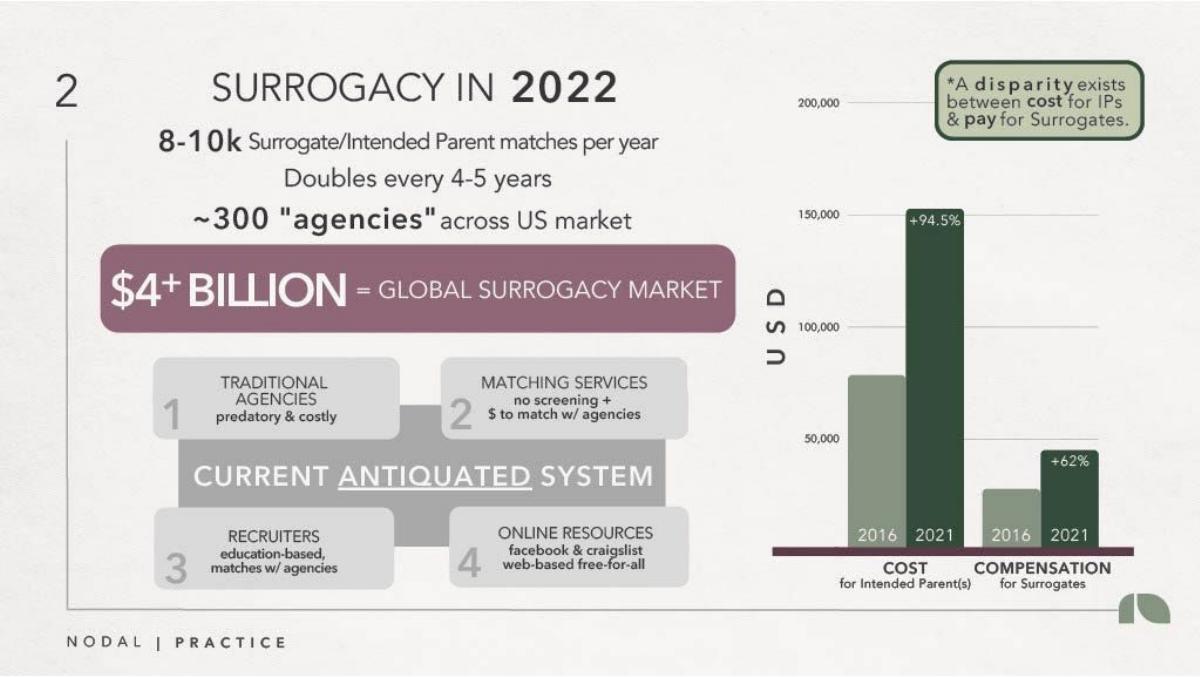
- Surrogacy costs for intended parents rose by 94.5% between 2016 and 2021, while surrogate compensation only increased by 62% (Slide 2).
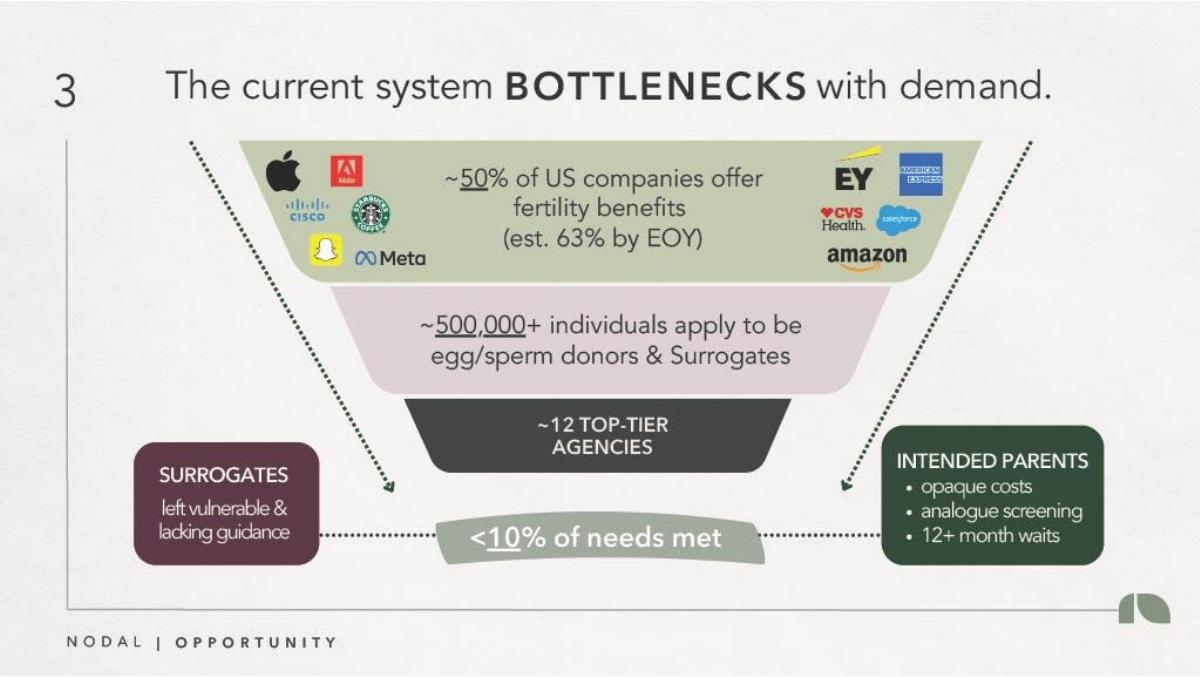
- Corporate adoption of fertility benefits is a major tailwind, with an estimated 63% of US companies offering them by the end of 2022 (Slide 3).
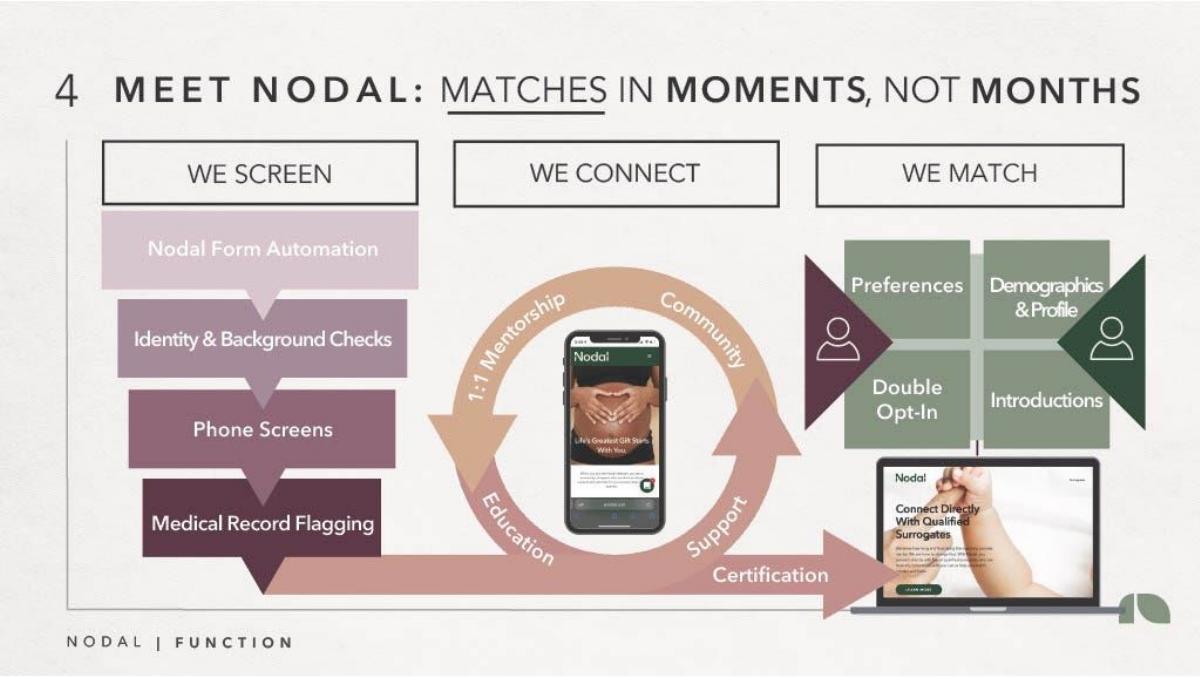
- Nodal replaces manual agency processes with automated form screening, identity checks, and medical record flagging (Slide 4).
- The platform utilizes a 'Double Opt-In' matching system to give surrogates more agency in the selection process (Slide 4).
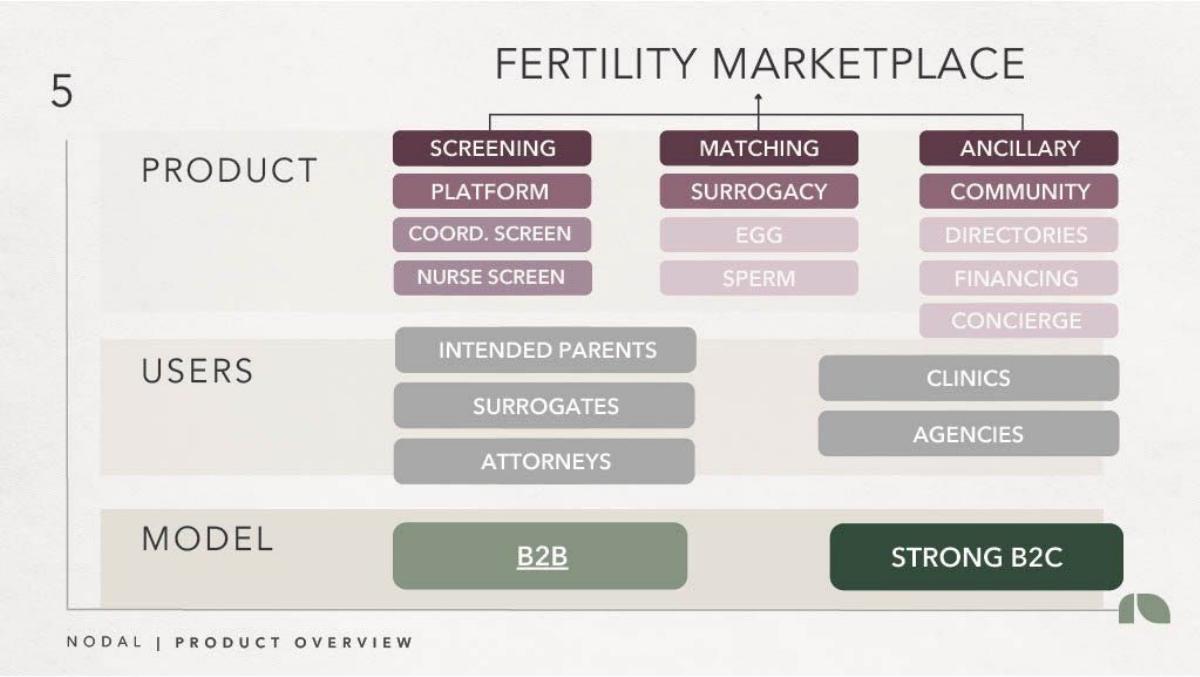
- Nodal's business model is described as a 'Strong B2C' marketplace, though it also includes B2B components for clinics and attorneys (Slide 5).
- The team is led by Dr. Brian Levine, a founding partner at CCRM NY, providing significant clinical credibility to a tech platform (Slide 9).
- The deck omits a specific 'Ask' slide, financial history, and unit economics, focusing instead on the platform's functional workflow (Slides 1-9).
The Surrogacy Bottleneck: A Slide-by-Slide Analysis
Nodal’s pitch deck is a concise, 8-slide presentation (numbered up to 9, though slide 7 and 8 appear to be missing or consolidated) that targets a highly emotional and financially significant sector: fertility and surrogacy. The deck focuses heavily on the macro trends driving demand and the operational inefficiencies of the status quo. By framing the current surrogacy market as a 'bottleneck,' Nodal positions its technology as the essential infrastructure for a modern fertility marketplace.
Slide 1: Title and Vision
The cover slide features the Nodal logo and the tagline 'Surrogacy the way it should be.' The imagery is high-quality and emotive, showing a close-up of a baby and a parent. This sets a professional yet compassionate tone, which is critical in healthcare and family-building sectors. There are no metrics or data points on this slide.
Slide 2: The Global Fertility Crisis
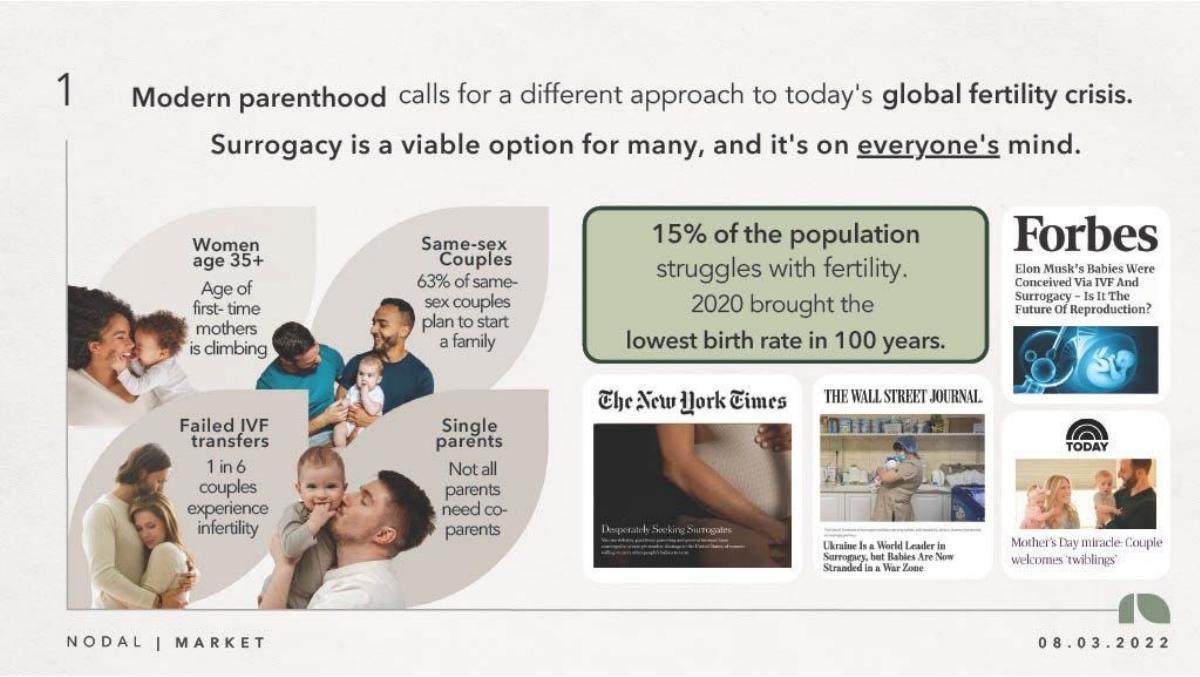
Slide 1 (labeled as such in the top left) establishes the 'Why Now.' It cites that 15% of the population struggles with fertility and that 2020 saw the lowest birth rate in 100 years. The slide uses a 'Market' footer and identifies four key demographics driving demand: women age 35+, same-sex couples (63% of whom plan to start a family), individuals with failed IVF transfers (1 in 6 couples), and single parents. It also includes press clippings from Forbes, The New York Times, and The Wall Street Journal to validate that surrogacy is a mainstream topic.
Slide 3: Market Inefficiency and Cost Disparity
Slide 2, titled 'SURROGACY IN 2022,' provides the core market data. It identifies a $4+ billion global surrogacy market with 8-10k matches per year, a figure that doubles every 4-5 years. The most striking data point is a bar chart showing cost vs. compensation. Between 2016 and 2021, the cost for Intended Parents (IPs) rose by 94.5%, while compensation for surrogates only rose by 62%. Nodal labels the current system of ~300 agencies as 'antiquated,' 'predatory,' and 'costly.'
Slide 4: The Demand Bottleneck
Slide 3 visualizes the 'Opportunity.' It uses a funnel graphic to show that while ~50% of US companies offer fertility benefits (with an estimate of 63% by EOY 2022) and 500,000+ individuals apply to be donors or surrogates, the '12 Top-Tier Agencies' act as a choke point. The result is that less than 10% of needs are met, leaving surrogates 'vulnerable' and parents facing '12+ month waits' and 'opaque costs.'
Slide 5: The Nodal Solution (Function)
Slide 4 introduces the product workflow: 'Matches in Moments, Not Months.' The process is broken into three pillars: We Screen, We Connect, and We Match. Nodal highlights 'Form Automation,' 'Medical Record Flagging,' and a 'Double Opt-In' matching system. This slide is the first to show the actual product interface on a mobile device and a laptop, emphasizing that this is a tech-enabled platform rather than a traditional service agency.
Slide 6: Product Overview and Ecosystem
Slide 5 outlines the 'Fertility Marketplace' structure. It categorizes the product into Screening, Matching, and Ancillary services (like financing and community). It identifies the users as Intended Parents, Surrogates, Attorneys, Clinics, and Agencies. The slide explicitly states the model is 'Strong B2C,' suggesting that while they facilitate a multi-sided market, their primary value proposition and brand building are directed toward the parents and surrogates themselves.
Slide 7: Value Proposition for All Stakeholders
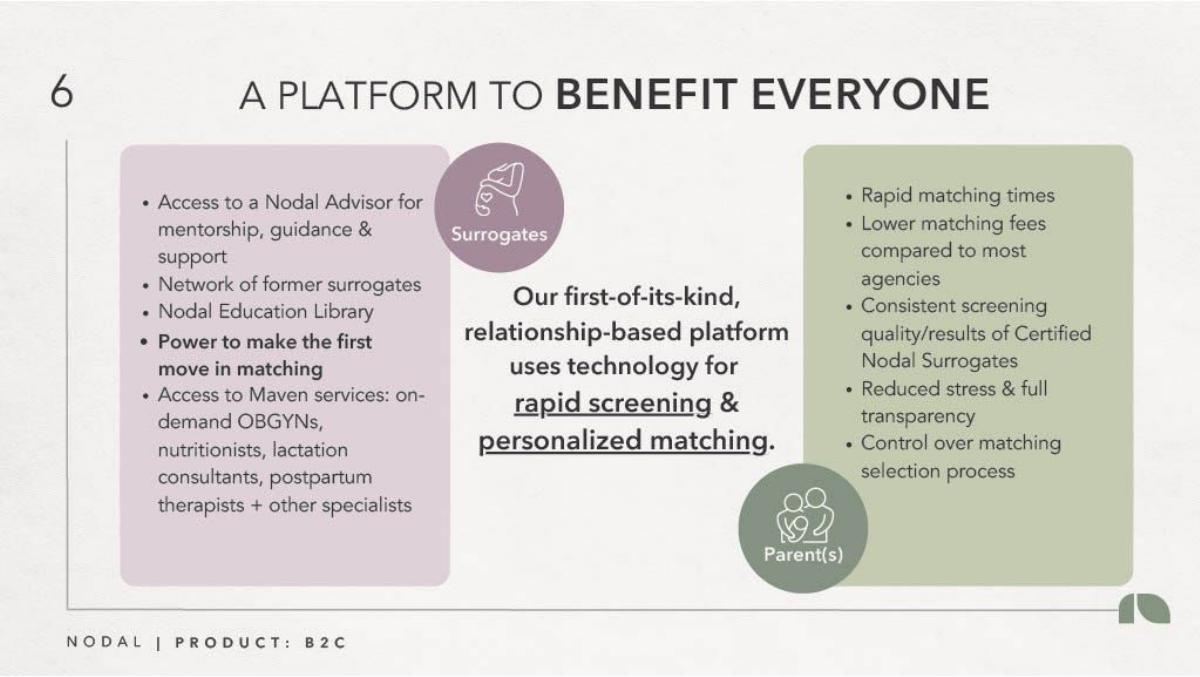
Slide 6, 'A Platform to Benefit Everyone,' lists specific features for surrogates and parents. For surrogates, it offers access to Nodal Advisors, an education library, and the 'power to make the first move in matching.' For parents, it promises rapid matching times, lower fees, and consistent screening quality. This slide reinforces the 'relationship-based' nature of the platform while leaning on technology for speed.
Slide 8: The Team and Pedigree
Slide 9 (skipping 7 and 8) is the team slide. It is exceptionally strong for a Seed round. CEO Brian Levine, MD, is a founding partner at CCRM NY, a major fertility clinic. The board includes Jon Oringer (Shutterstock) and Edward Lando (Goody). The slide also features logos from previous employers and affiliated brands, including Birchbox, LinkedIn, Maven, and Parsley Health. This level of industry and tech experience provides the 'right to win' in a complex regulatory and medical environment.
What Nodal Does Well
Nodal excels at identifying a 'hair-on-fire' problem. By quantifying the gap between the 500,000 applicants and the 10% of needs met by top agencies, they make the case for a scalable technology solution undeniable. The cost-disparity chart on Slide 2 is a powerful piece of evidence that the current agency model is extracting too much value without passing it on to the surrogates, creating a clear opening for a marketplace disruptor.
The team slide is another high point. In healthcare, 'founder-market fit' is often as important as 'product-market fit.' Having a MD who founded a major fertility clinic as the CEO immediately solves the credibility hurdle that many tech-first startups face when entering the medical space.
What is Missing from the Nodal Deck
The most glaring omission is the lack of unit economics and financial projections. While the deck identifies a $4B market, it does not explain how Nodal captures that value. Is it a flat matching fee? A percentage of the total surrogacy cost? A subscription for agencies? Slide 5 mentions 'Financing' and 'Concierge' services, but the revenue mix remains theoretical.
Additionally, there is no 'Ask' slide in this version of the deck. We know from publisher reports that they raised $4.7M, but the deck does not specify what that capital was intended for—whether it was for engineering, marketing to acquire surrogates, or clinical partnerships. The deck also lacks a competitive landscape slide; while it mentions 'traditional agencies,' it doesn't address other emerging fertility tech competitors.
Lessons for Founders
1. Quantify the Bottleneck: If you are building a marketplace, don't just say the market is big. Show exactly where the friction is. Nodal’s use of the 500k applicants vs. 10% met need is the most persuasive part of the deck.
2. Use Macro Tailwinds: Nodal points to corporate fertility benefits as a major driver of demand (Slide 3). Connecting your startup to a broader economic shift (like HR departments increasing benefits) makes your growth feel inevitable to investors.
3. Highlight the 'Double Opt-In': In marketplaces involving sensitive human services, 'agency' (the power to choose) is a product feature. By highlighting that surrogates have the 'power to make the first move,' Nodal addresses potential ethical concerns while improving the quality of the match.
4. Pedigree Matters in Regulated Spaces: If you are in healthcare, lead with your clinical credentials. Nodal’s team slide isn't just a list of names; it’s a map of industry influence that spans medicine, consumer tech, and venture capital.
Frequently asked questions
- How much did Nodal raise with this deck?
- According to publisher reports from Business Insider, Nodal raised $4.7 million in a Seed round in 2024. The deck itself does not state the amount being raised or the valuation.
- What is the primary problem Nodal is solving?
- Nodal addresses the 'bottleneck' in the surrogacy market. Slide 3 notes that while 500,000+ individuals apply to be donors or surrogates, the top 12 agencies meet less than 10% of the need, resulting in 12+ month wait times for intended parents.
- How does Nodal's technology improve the surrogacy process?
- Slide 4 details a 'Function' workflow that includes automated form screening, identity/background checks, and medical record flagging. This replaces the 'analogue screening' used by traditional agencies to move from 'months' to 'moments' for matching.
- What is Nodal's revenue model?
- Slide 5 categorizes the model as 'Strong B2C' within a 'Fertility Marketplace.' While specific pricing is not listed, it mentions 'lower matching fees compared to most agencies' on Slide 6 and identifies revenue opportunities in screening, matching, and ancillary services like financing.
- Who are the key people behind Nodal?
- The team is led by Founder and CEO Brian Levine, MD. The board includes Jon Oringer (Founder of Shutterstock) and Edward Lando (CEO of Goody). The team slide (Slide 9) also lists advisors from Parsley Health and Female Founders Fund.