NOCD’s 2022 company update is a lean, outcome-oriented deck that successfully navigated the transition from a consumer health app to a clinical-grade healthcare platform. By framing Obsessive-Compulsive Disorder (OCD) as a 'hidden' Serious Mental Illness (SMI) vertical, the company highlights a $317B cost burden driven by misdiagnosis. The deck is notably light on traditional financial disclosures—omitting revenue, burn, and valuation—but heavy on clinical validation, citing a 36% reduction in OCD severity and an $85B potential aggregate payer cost saving. This strategy effectively speaks the…
Key takeaways
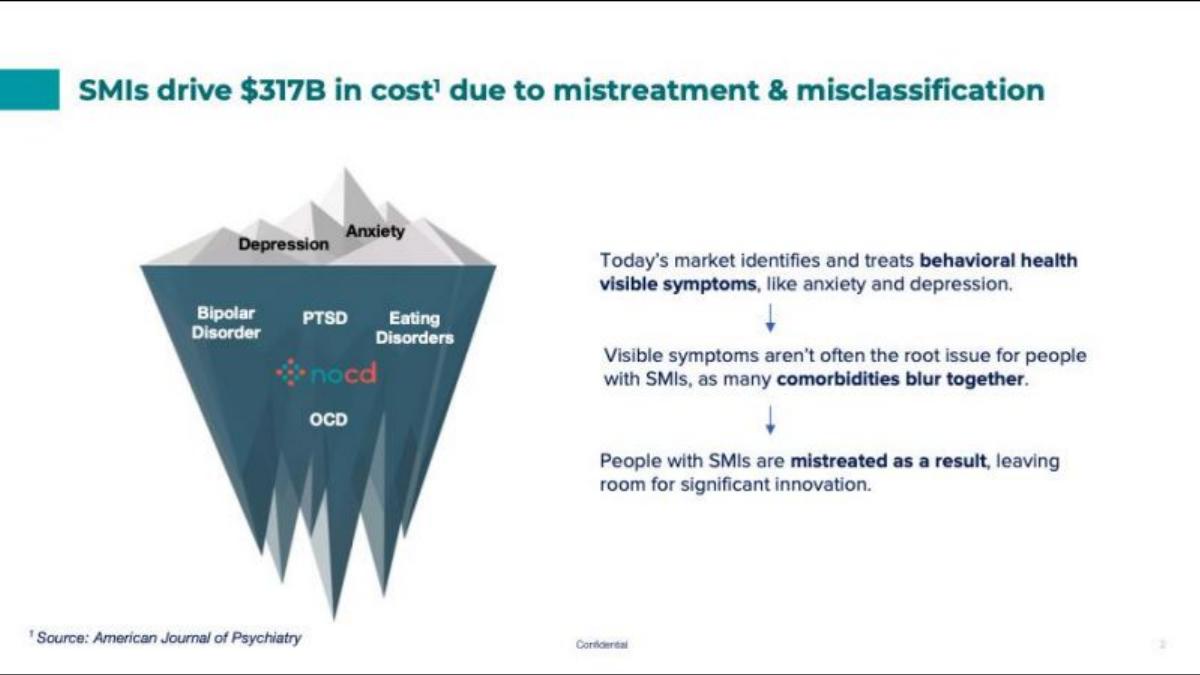
- The deck identifies a $317B market cost for SMIs due to mistreatment and misclassification on slide 2.
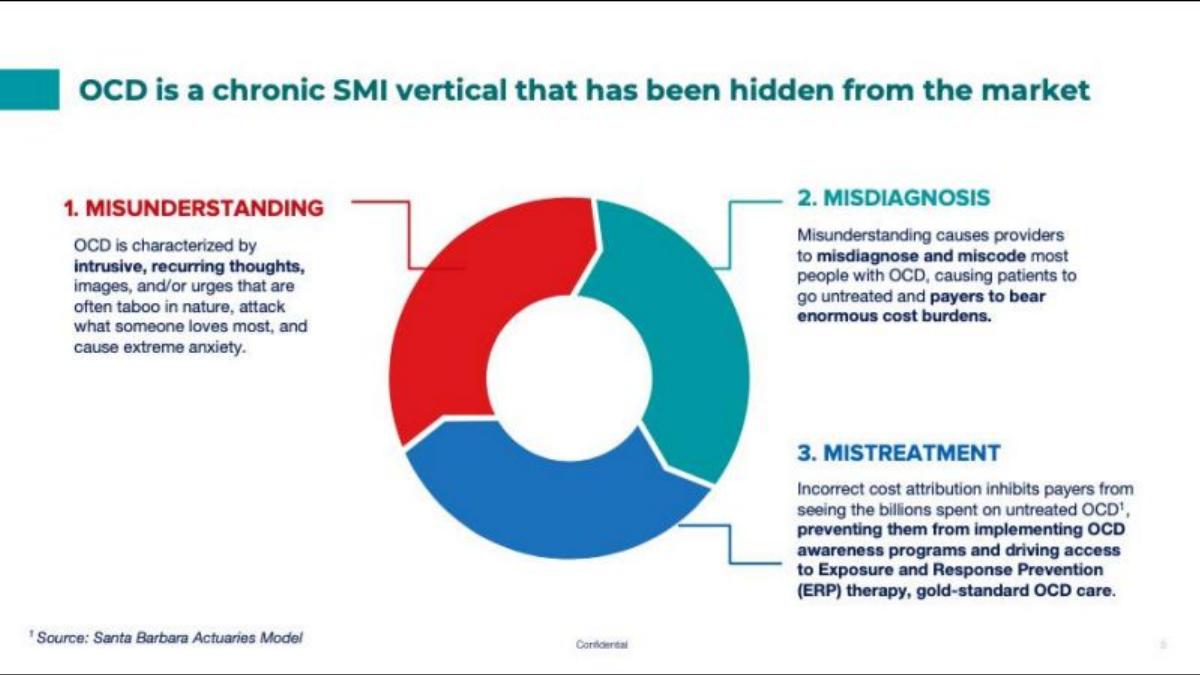
- NOCD positions OCD as a chronic SMI vertical that is frequently misdiagnosed, leading to enormous payer cost burdens as shown on slide 3.
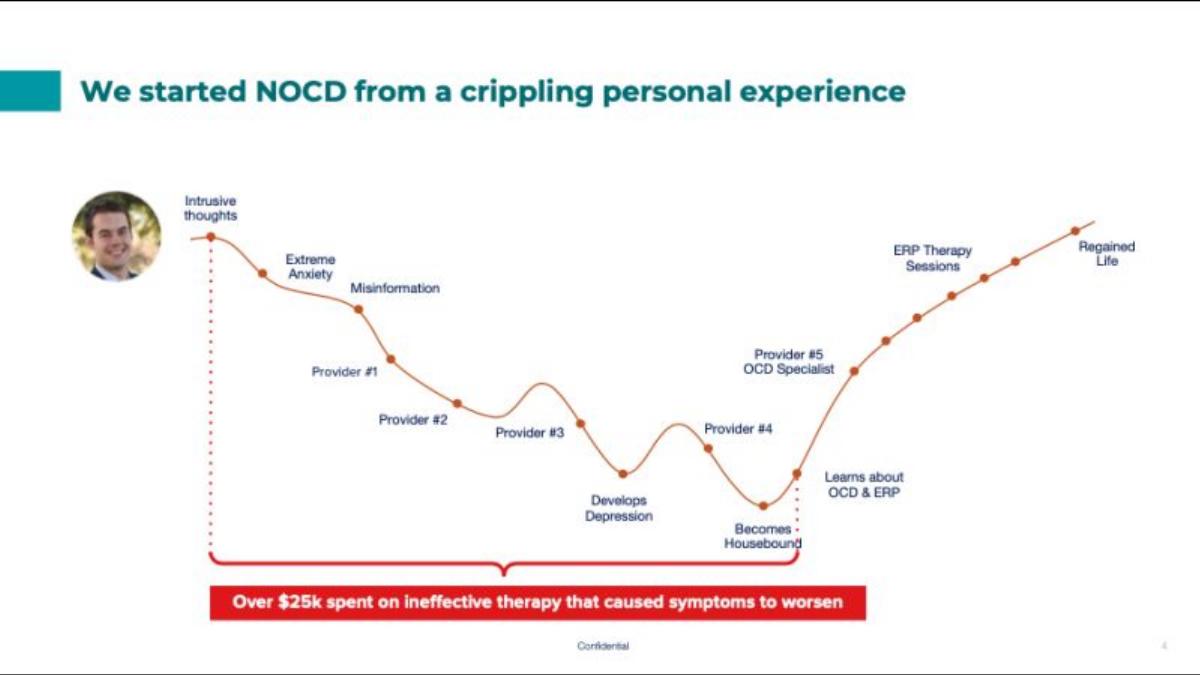
- A personal founder narrative on slide 4 illustrates the 'ineffective therapy' path that cost $25k before achieving recovery through ERP therapy.
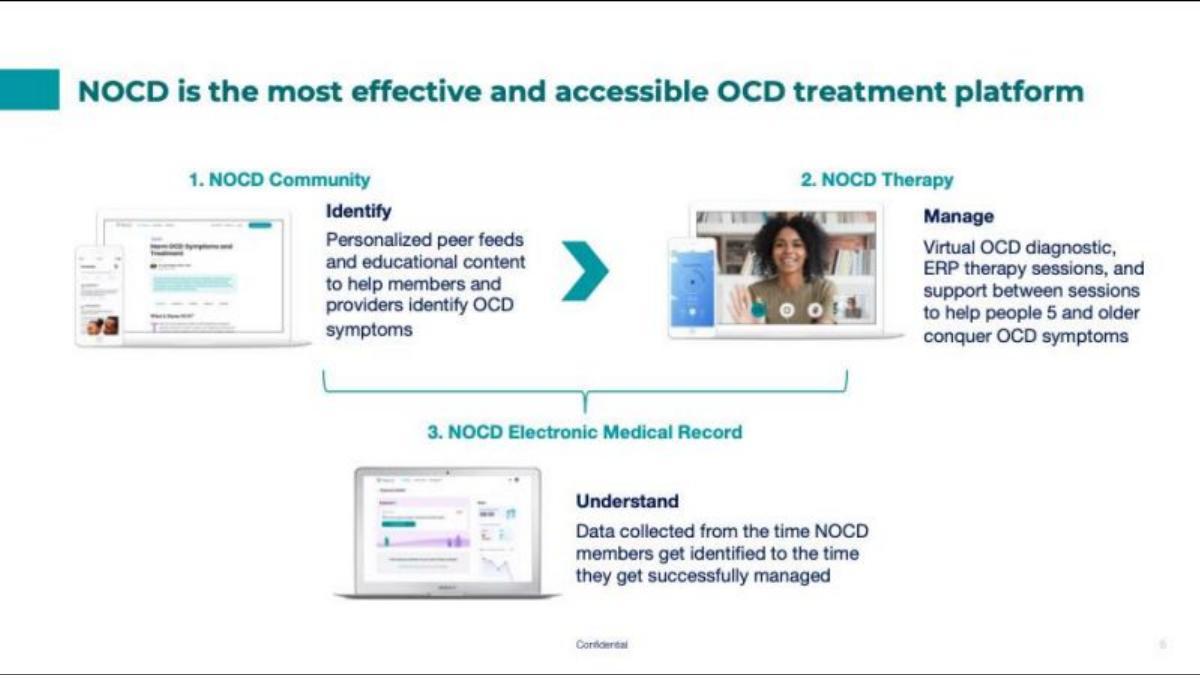
- The platform is divided into three pillars: Community (Identify), Therapy (Manage), and EMR (Understand) on slide 5.
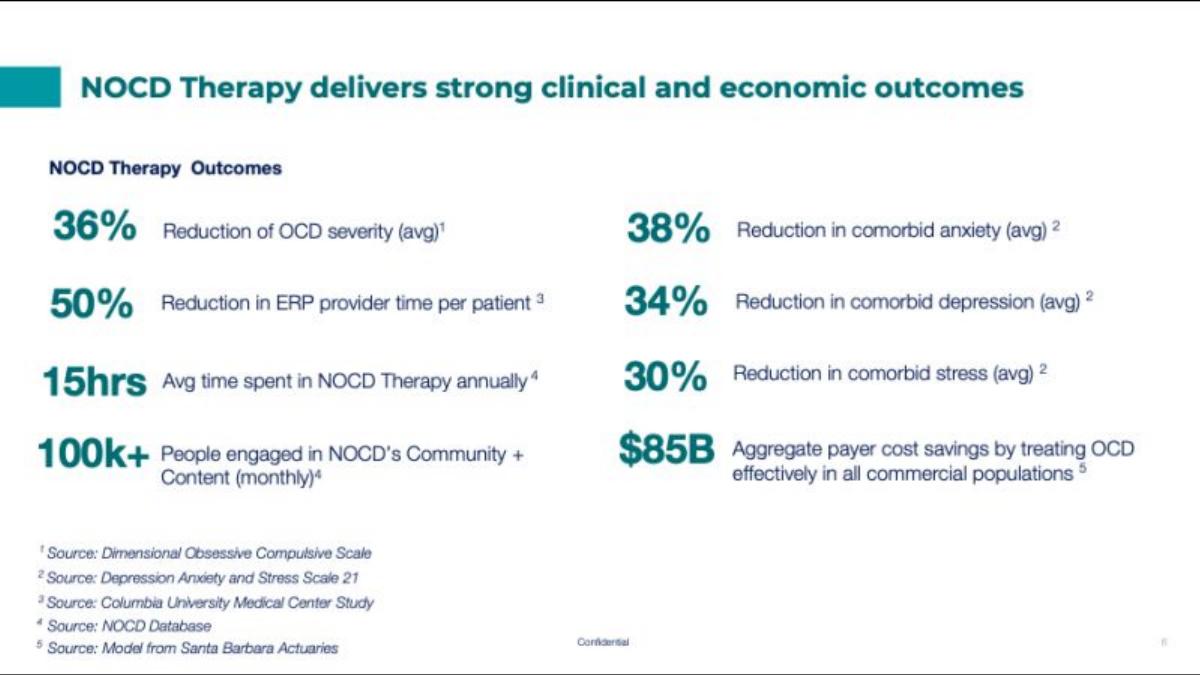
- Clinical outcomes are the centerpiece, claiming a 36% reduction in OCD severity and 38% reduction in comorbid anxiety on slide 6.
- Growth is demonstrated through volume rather than dollars, showing a steep increase in unique members and sessions from Q2 2020 to Q2 2022 on slide 7.
- The business model relies on a flywheel where community content drives patient demand, which is met by a proprietary network of trained specialists as seen on slide 8.
- The team slide (slide 10) features 11 leaders, including specific roles for Payer President and Chief Clinical Officer, emphasizing institutional healthcare expertise.
The Strategic Pivot to Serious Mental Illness (SMI)
NOCD’s Series C deck is a masterclass in verticalization. At a time when generalist mental health platforms were facing saturation, NOCD doubled down on a specific, high-acuity niche: Obsessive-Compulsive Disorder. The deck, titled as a '2022 Company Update,' moves away from the 'wellness' aesthetic of early-stage health apps and adopts the clinical, data-driven tone required for institutional healthcare investment.
Slide 1: Title and Mission
The cover slide establishes the brand identity and a bold mission: 'Using community-driven therapy to end the global OCD crisis.' The visual includes a laptop and smartphone showing the interface, immediately signaling a digital-first, telehealth delivery model. The subtitle '2022 Company Update' suggests this deck was used for ongoing investor relations and to bridge into the Series C round.
Slide 2: The $317B Problem
Slide 2 uses an iceberg graphic to illustrate the market opportunity. It places 'Depression' and 'Anxiety' at the visible tip, while 'Bipolar Disorder,' 'PTSD,' 'Eating Disorders,' and 'OCD' are submerged. The headline states that Serious Mental Illnesses (SMIs) drive $317B in cost due to mistreatment and misclassification. By citing the American Journal of Psychiatry, NOCD anchors its value proposition in macroeconomic healthcare costs rather than just user experience.
Slide 3: The OCD Vertical
This slide defines the specific problem within the OCD niche. It breaks the crisis down into three components: Misunderstanding (intrusive thoughts), Misdiagnosis (providers miscoding patients), and Mistreatment (lack of access to ERP therapy). Crucially, it mentions that misdiagnosis causes 'payers to bear enormous cost burdens,' which is a direct appeal to the interests of lead investor Cigna Ventures.
Slide 4: The Founder's Journey
Slide 4 features Stephen Smith’s personal story. A line graph shows a downward trajectory of 'Extreme Anxiety' and 'Developing Depression' as the founder spent over $25k on ineffective therapy . The graph only turns upward after he 'Learns about OCD & ERP' and 'Regains Life.' This slide serves two purposes: it establishes founder-market fit and highlights the economic inefficiency of the current healthcare status quo.
Slide 5: The Three-Pillar Solution
NOCD explains its platform through three distinct modules: 1. NOCD Community (Identify), 2. NOCD Therapy (Manage), and 3. NOCD Electronic Medical Record (Understand). This slide clarifies that they are not just a therapist marketplace; they are a full-stack clinical platform that collects data from identification through successful management.
Slide 6: Clinical and Economic Outcomes
This is the 'money slide' for a Series C healthcare company. It lists eight key metrics, including a 36% reduction in OCD severity and a 50% reduction in ERP provider time per patient . Most importantly for the business model, it claims $85B in aggregate payer cost savings by treating OCD effectively. These figures provide the 'proof of work' required to justify a growth-stage valuation.
Slide 7: Scaling Volume
Instead of a revenue bar chart, slide 7 shows two charts: 'Unique NOCD Therapy Members per Quarter' and 'Unique NOCD Therapy Sessions per Quarter.' The growth from Q2 2020 to Q2 2022 is significant, with the session count appearing to grow at a faster rate than the member count, suggesting high engagement and retention within the patient base.
Slide 8: The Demand Flywheel
Slide 8 illustrates the acquisition strategy. Search, social, and partnerships feed the 'NOCD Community.' This community creates 'Patient Demand' for 'NOCD’s Network' of specialist therapists. The network then generates 'Word of Mouth' back to the community. This circular model suggests a lower Customer Acquisition Cost (CAC) than competitors who rely solely on paid performance marketing.
Slide 9: The Ecosystem Expansion
This slide expands the flywheel to include external stakeholders: Payers, Researchers, and BH (Behavioral Health) Prescribers . It shows NOCD moving into adjacent conditions like Hoarding, BFRBs, and PTSD. This signals to investors that while they started with OCD, the infrastructure is built to capture the broader SMI market.
Slide 10: The Leadership Team
The team slide is heavy on clinical and operational expertise. It features 11 individuals, including a Payer President , Chief Medical Officer , and Chief Clinical Officer . This composition is designed to reassure investors that the company can navigate the complex regulatory and reimbursement landscape of US healthcare.
What Works in the NOCD Deck
Clinical Primacy: In a market full of 'mindfulness' apps, NOCD wins by being 'medical.' The heavy use of clinical scales (Dimensional Obsessive Compulsive Scale, DASS 21) on slide 6 gives the deck an air of scientific authority that generalist competitors lack.
Payer Alignment: The deck is obsessed with 'cost savings' and 'payers.' By framing OCD as a source of 'incorrect cost attribution,' they make a compelling case for why an insurance company should not only cover them but invest in them.
The Flywheel Narrative: The transition from slide 8 to slide 9 shows a clear path from a B2C community to a B2B healthcare ecosystem. This provides a logical explanation for how the company scales without a linear increase in marketing spend.
What is Missing from the NOCD Deck
Financial Transparency: There is a total absence of dollar-based metrics. There is no ARR, no Gross Margin, and no EBITDA. While this is a 'Company Update,' a Series C investor would typically expect to see the path to profitability or at least the revenue scale.
The 'Ask': The deck does not specify how much capital is being raised or what the 'Use of Proceeds' will be. It functions more as a narrative builder than a transactional document.
Competitive Landscape: There is no mention of other mental health giants (like Lyra or Modern Health) or how NOCD defends its 'specialist' moat against generalist platforms adding OCD tracks.
What Founders Should Copy
The 'Hidden Vertical' Strategy: If you are in a crowded market, use slide 2’s 'iceberg' approach. Show that the 'obvious' market is just the tip and that your company is solving a massive, submerged problem that others are misdiagnosing.
Outcome-Based Selling: Don't just say your product works; show the percentage reduction in the problem. Slide 6 is a perfect template for any startup that relies on efficacy—whether that’s clinical, technical, or financial.
The Personal-to-Macro Transition: Moving from the founder’s $25k struggle (slide 4) to the $317B market problem (slide 2) creates an emotional hook that is immediately validated by a massive TAM (Total Addressable Market).
Frequently asked questions
- How much did NOCD raise with this deck?
- According to the catalogue facts, NOCD raised $34M in a Series C round in 2023. The round was led by Cigna Ventures and 7wire Ventures. Interestingly, the deck itself does not state the amount being raised or the intended use of funds, functioning more as a strategic company update to facilitate the round.
- What is NOCD's primary treatment methodology?
- NOCD focuses on Exposure and Response Prevention (ERP) therapy. Slide 3 describes this as the 'gold-standard OCD care,' and slide 5 explains that their platform provides virtual ERP therapy sessions to help patients 'conquer OCD symptoms.' They also provide specialized training for therapists in their network to deliver this specific care.
- Who is the target audience for this pitch deck?
- While the platform serves B2C customers, the deck is heavily weighted toward 'Payers' (insurance companies). Slide 6 mentions an $85B aggregate payer cost saving, and slide 9 shows a bidirectional relationship with payers involving referrals and outcomes. This suggests the primary growth strategy is securing insurance reimbursement and partnership contracts.
- Does the deck show any financial performance metrics?
- No. The deck completely omits revenue, profit margins, and unit economics. Instead, it uses 'Unique Members per Quarter' and 'Unique Sessions per Quarter' on slide 7 as proxies for growth. This is common in Series C healthcare decks where clinical efficacy and market share are often prioritized over raw GAAP revenue in the narrative.
- What is the 'NOCD Community' and why is it important?
- The community is the top of NOCD's funnel. Slide 8 shows that search, social, and partnerships feed into the 'NOCD Community,' which consists of peer feeds and web content. This community generates 'Patient Demand' for the therapy network, creating a self-sustaining acquisition model that likely reduces traditional marketing spend.