Nodal Security’s 2014 deck is a concise, 9-slide presentation that leans heavily on a specific market catalyst: the 2013 Target data breach. The company proposes 'Numa,' a hardware device that sits between a modem and a router to provide enterprise-grade intrusion detection for remote workers. While the deck successfully establishes a 'hair-on-fire' problem using the Target case study—citing 70 million stolen records and $160 million in losses—it remains light on business fundamentals. There is no explicit financial ask, no detailed go-to-market strategy, and no competitive landscape analysis…
Key takeaways
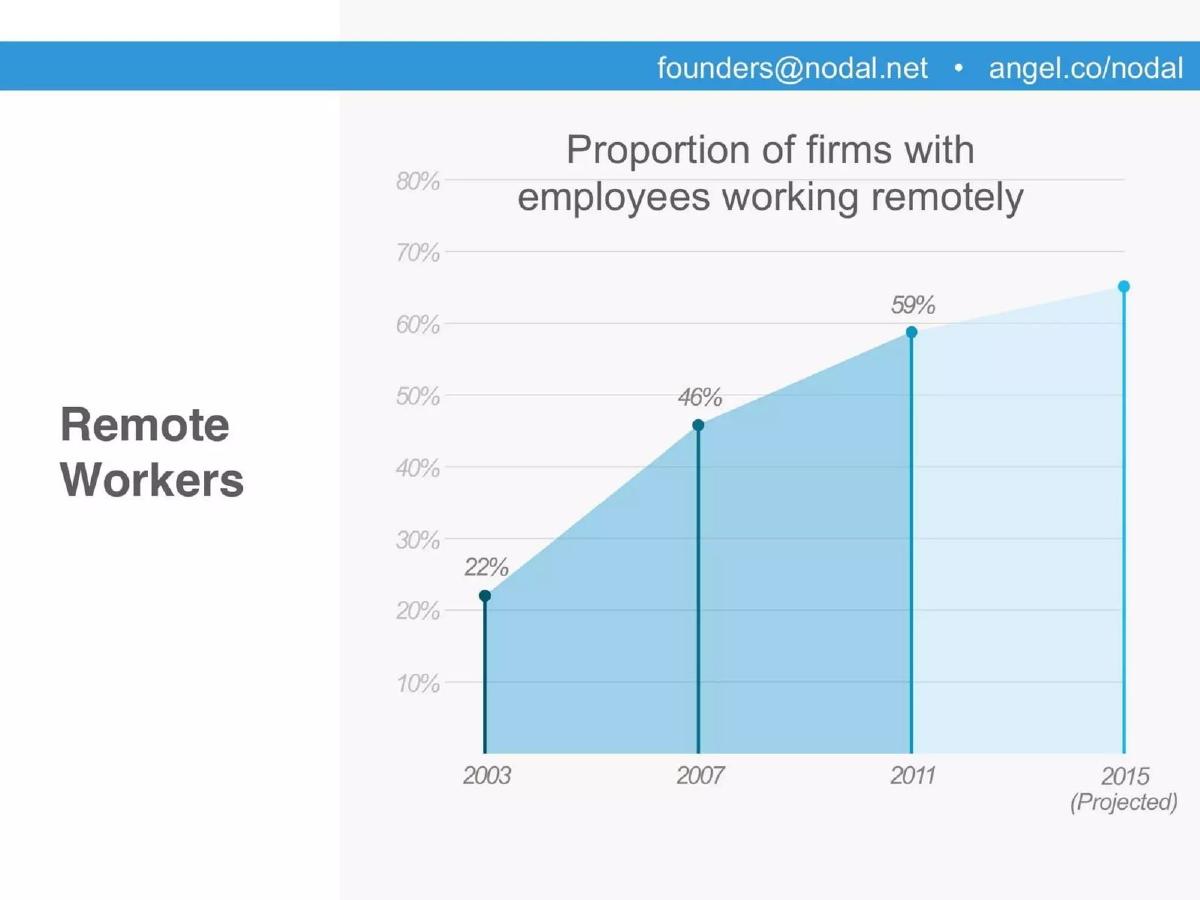
- The deck uses a specific macro trend, showing remote work firms grew from 22% in 2003 to a projected 65% in 2015 (Slide 2).
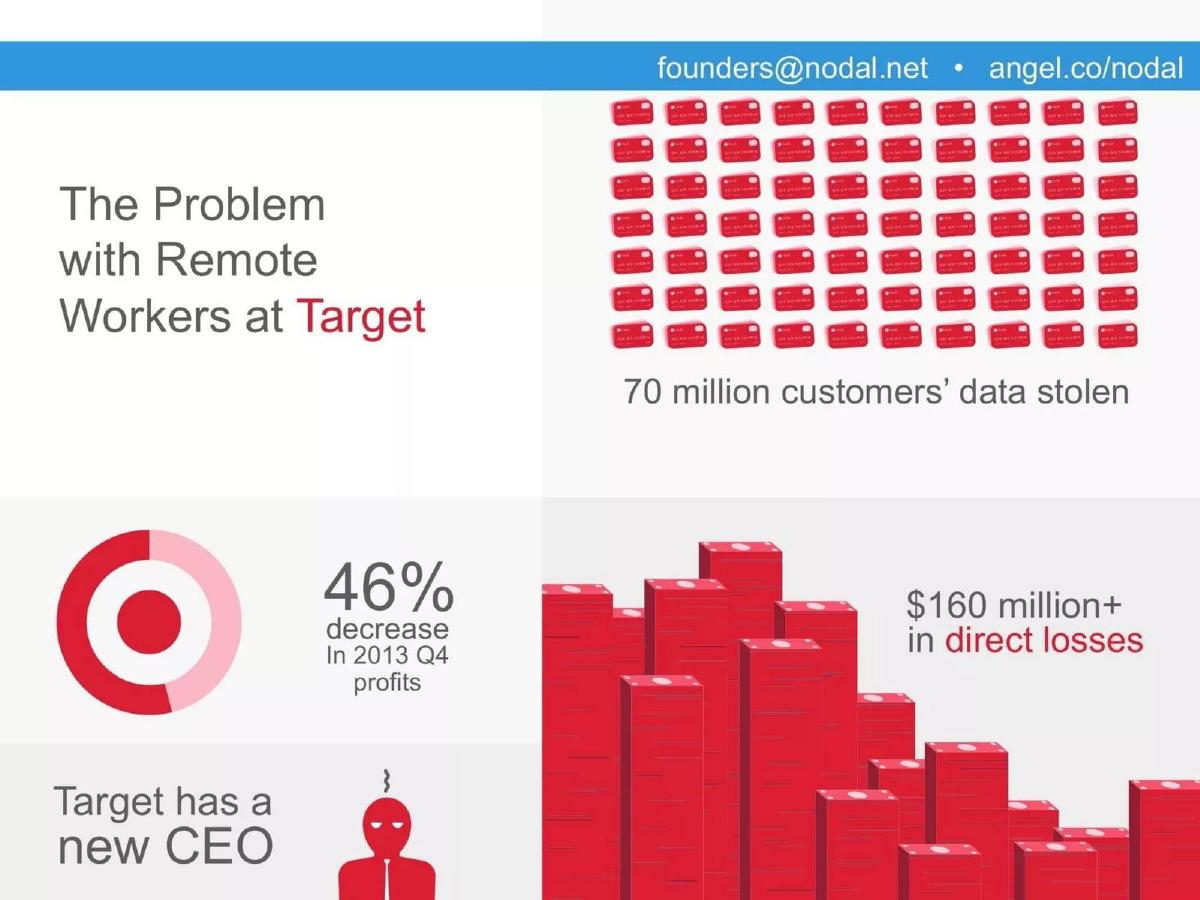
- Target's 2013 data breach is used as the primary 'why now' factor, citing a 46% decrease in Q4 profits and $160 million in direct losses (Slide 3).
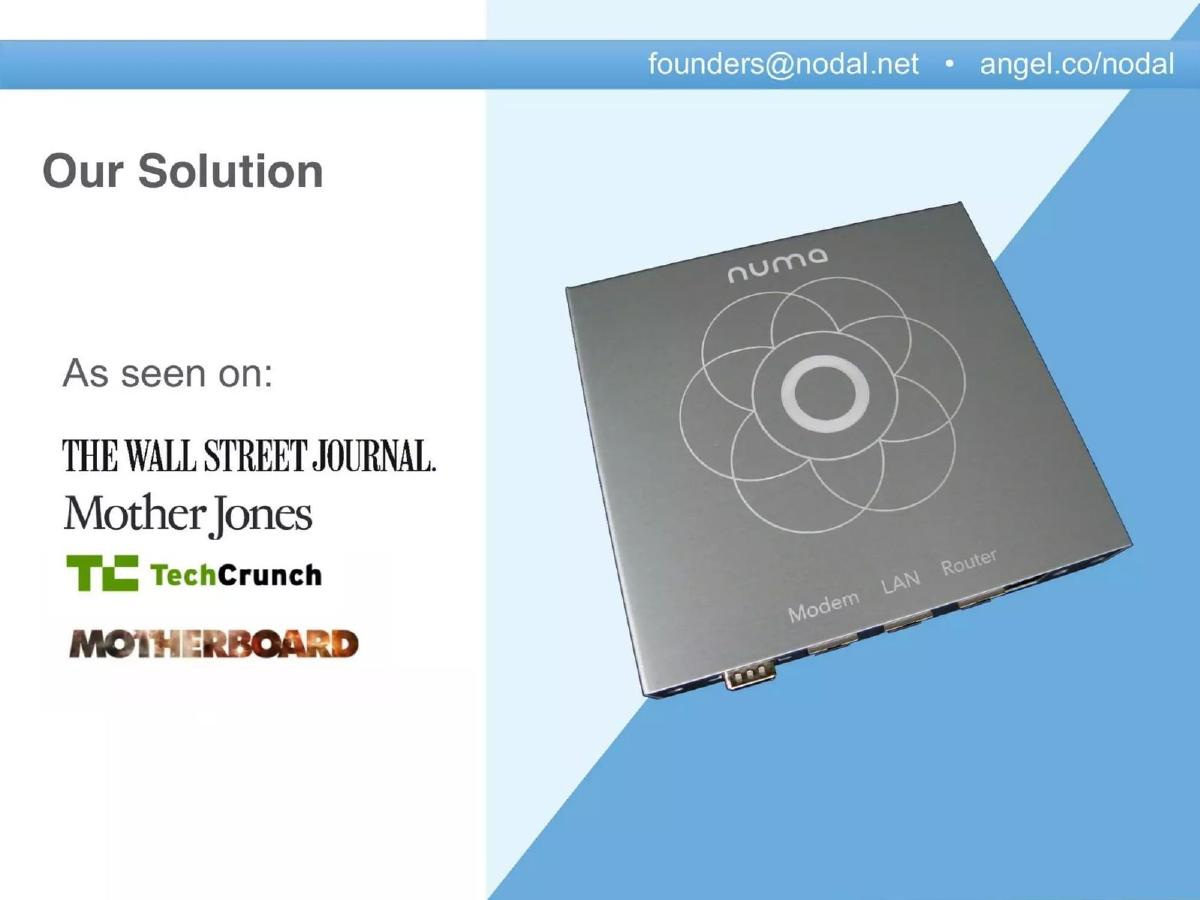
- The solution is a physical hardware device called 'Numa' that features ports for Modem, LAN, and Router (Slide 4).
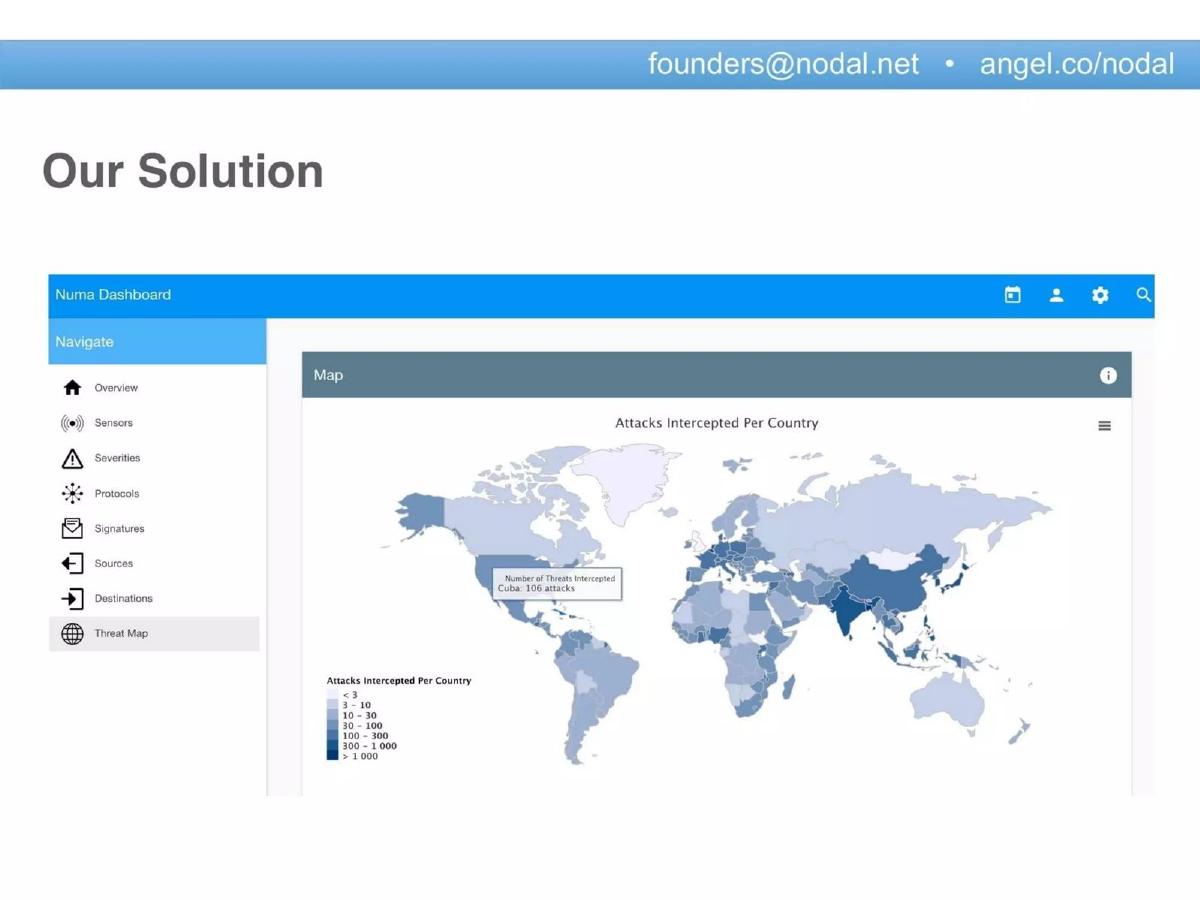
- Numa provides a software dashboard that visualizes intercepted attacks on a global map (Slide 5).
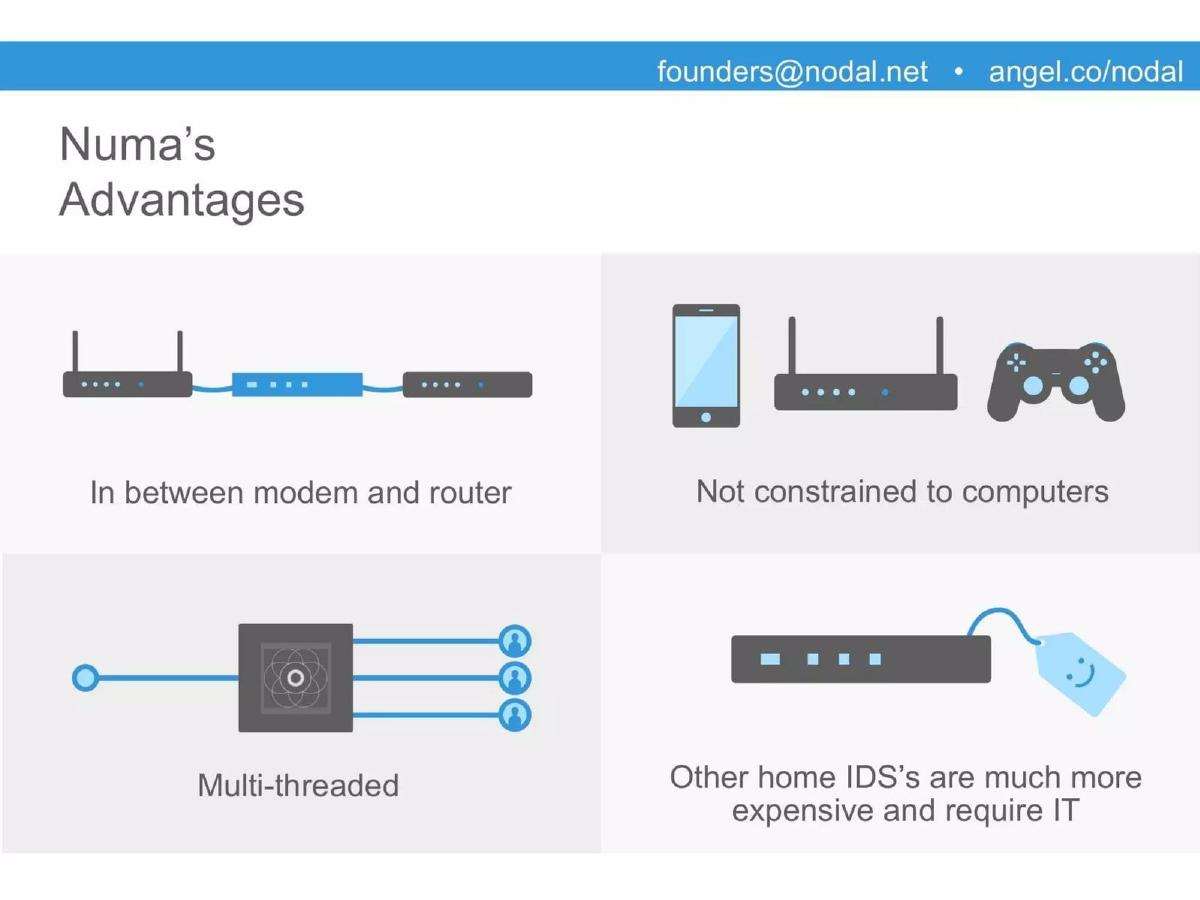
- The product's primary technical advantage is being 'multi-threaded' and not constrained to just computers, protecting all IoT devices (Slide 6).
- The company reported $8,000 in revenue for the month of July prior to the deck's publication (Slide 7).
- The deck claims 'Smart Customers' including logos for Symantec, Siemens, Ben & Jerry's, and the Fortune 1,000 (Slide 7).
- The core team consists of three members with experience spanning Juniper Networks, Grinnell College, and Stanford University (Slide 8).
The Nodal Security Teardown: Selling Hardware in a Software World
Nodal Security (which later branded its product as Numa) produced this 9-slide deck in 2014. At the time, the cybersecurity industry was reeling from massive retail breaches, and the 'Bring Your Own Device' (BYOD) trend was creating new headaches for IT departments. Nodal's approach was distinct: rather than a software agent installed on a laptop, they proposed a physical gatekeeper for the home network.
The Hook: Macro Trends and Micro Disasters
Slide 1: Title The cover slide is minimalist, featuring the Nodal Security logo and a bar chart graphic at the bottom. It includes the founders' email and an AngelList URL, signaling that this was likely used for early-stage seed or angel fundraising.
Slide 2: Remote Workers The deck begins with a market validation slide. It shows a steady climb in the 'Proportion of firms with employees working remotely.' The data points are 22% in 2003, 46% in 2007, 59% in 2011, and a projected 65% for 2015. This establishes the growing surface area for potential cyberattacks.
Slide 3: The Problem with Remote Workers at Target This is the 'Fear, Uncertainty, and Doubt' (FUD) slide. It leverages the infamous Target breach to create urgency. The slide lists staggering figures: 70 million customers' data stolen, a 46% decrease in 2013 Q4 profits, and over $160 million in direct losses. By linking these losses to 'Remote Workers,' Nodal creates a direct line between a massive corporate failure and the need for their specific solution.
The Solution: Numa Hardware and Software
Slide 4: Our Solution (Hardware) Nodal introduces 'Numa,' a sleek, grey hardware box. The device has visible ports labeled 'Modem,' 'LAN,' and 'Router.' The slide also includes 'As seen on' logos from The Wall Street Journal, Mother Jones, TechCrunch, and Motherboard, providing immediate third-party validation for the product's existence and relevance.
Slide 5: Our Solution (Software) To prove they aren't just a 'dumb' hardware play, Slide 5 shows the 'Numa Dashboard.' The UI features a world map titled 'Attacks Intercepted Per Country.' A tooltip shows 'Cuba: 106 attacks.' The sidebar lists features like Sensors, Severities, Protocols, Signatures, Sources, and Destinations, suggesting a robust enterprise-level feature set delivered through a web interface.
Slide 6: Numa’s Advantages This slide breaks down the value proposition into four quadrants:
In between modem and router: Explains the physical installation point. · Not constrained to computers: Shows icons for a phone and a game controller, emphasizing that Numa protects the entire IoT ecosystem. · Multi-threaded: A technical nod to performance and the ability to handle multiple data streams simultaneously. · Price/Ease of Use: States that 'Other home IDS’s are much more expensive and require IT,' positioning Numa as a consumer-friendly or 'prosumer' alternative.
Traction and Team
Slide 7: Where We’re At This is the traction slide. It claims '$8,000 in revenue in July.' It also mentions 'Active Entrepreneur Advisors' and 'Smart Customers,' displaying logos for Symantec, Siemens, Ben & Jerry's, and the Fortune 1,000. While the revenue is modest, the presence of these logos suggests either pilot programs or that these companies' employees are using the device.
Slide 8: Core Team The team slide features three founders. Unusually, it does not list their names, only their roles and backgrounds. One founder is linked to Juniper Networks with the tag 'Software, Networks, Scary.' Another is linked to Grinnell College ('Software, Analytics, Inspiration'), and the third to Stanford University ('Hardware, Sales, Marketing'). This highlights a balance of technical depth and business pedigree.
Slide 9: Questions? The deck ends abruptly with a contact slide. There is no 'Ask' slide, no mention of how much capital they are seeking, and no roadmap for what they intend to build next.
What Works in This Deck
The 'Why Now' is Crystal Clear: By using the Target breach as a centerpiece, the founders don't have to spend time explaining why security matters. They point to a specific, high-profile disaster and say, 'We prevent this.'
Hardware Visibility: In an era of ephemeral SaaS products, showing a high-quality photo of a physical device (Slide 4) makes the company feel more 'real' and substantial. It suggests that significant R&D has already taken place.
Clear Differentiation: Slide 6 does an excellent job of explaining exactly where the device sits in the network and why that matters (protecting non-computer devices). It simplifies a complex networking concept into four easy-to-digest points.
What is Missing
The Financial Ask: This is the most glaring omission. An investor viewing this deck has no idea if the company is looking for $50k or $5M. Without an 'Ask' slide, the deck feels more like a product pitch than a venture capital pitch.
Business Model: How does Nodal make money? Is it a one-time hardware sale? A monthly subscription for the 'Signatures' and 'Threat Map' updates? The deck mentions $8,000 in revenue but doesn't explain the unit economics or the pricing strategy.
Competitive Landscape: The deck mentions that other IDS solutions are expensive, but it doesn't name them or show a feature-by-feature comparison. Investors would want to know how Numa stacks up against incumbents like Cisco or newer software-based home security startups.
Go-to-Market (GTM) Strategy: Is this a B2B play (selling to companies to give to their remote employees) or a B2C play (selling to security-conscious individuals)? The 'Smart Customers' slide hints at B2B, but the 'Home IDS' language on Slide 6 suggests B2C. This ambiguity is a red flag for professional investors.
What a Founder Should Copy
The Use of Macro Data: Slide 2 is a perfect example of how to use a simple line or area chart to show that you are riding a massive wave. If your market is growing, show the numbers.
Visualizing the Problem: Slide 3 uses icons (credit cards and stacks of cash) to make the '70 million' and '$160 million' figures feel visceral. It’s much more effective than a bulleted list of facts.
The 'As Seen On' Bar: If you have press, use it. Placing reputable logos like The Wall Street Journal on your solution slide (Slide 4) acts as an immediate 'trust signal' that can carry a founder through the rest of the presentation.
Simplifying Technical Specs: The way Slide 6 explains 'Multi-threaded' and 'In between modem and router' using simple diagrams is a masterclass in making technical hardware accessible to non-technical investors.
Frequently asked questions
- What is the specific problem Nodal Security is trying to solve?
- Nodal Security targets the vulnerability of remote workers. According to Slide 3, they use the Target data breach as a cautionary tale, where remote access points led to 70 million customers' data being stolen. They argue that traditional home setups lack the enterprise-grade security necessary to protect corporate networks when employees work from home.
- How does the Numa hardware actually work?
- Based on Slide 6, the Numa device is an Intrusion Detection System (IDS) that is installed physically 'in between the modem and router.' This positioning allows it to monitor all traffic entering the home network, making it 'not constrained to computers' and able to protect devices like smartphones and gaming consoles.
- Does the company have any market traction?
- Yes, Slide 7 indicates the company generated $8,000 in revenue in July. It also lists several high-profile 'Smart Customers' and advisors, including logos for Symantec, Siemens, and Ben & Jerry's. However, the deck does not specify if these are paying enterprise clients or trial pilots.
- Who are the founders of Nodal Security?
- The 'Core Team' slide (Slide 8) shows three founders but does not list their names. It attributes 'Software, Networks, Scary' to one founder with a Juniper Networks background, 'Software, Analytics, Inspiration' to a second (Grinnell College), and 'Hardware, Sales, Marketing' to a third (Stanford University).
- What is missing from this pitch deck?
- The deck is missing several critical components for a standard VC pitch: a clear 'Ask' (how much money they want), a 'Use of Funds' breakdown, a 'Competition' slide, and any long-term financial projections. It is a product-heavy deck that lacks a comprehensive business roadmap.