Syneroid Technologies presents a straightforward case for disrupting the pet identification market with its GPC Smart digital tags. The deck highlights a significant pain point: 10 million pets go missing annually in the U.S., with less than 30% returning home. By utilizing NFC and QR technology, Syneroid bypasses the need for specialized scanners required by traditional microchips. The company demonstrates strong early traction through partnerships with municipalities in New York and California, and a manufacturing agreement with Avery Dennison. While the deck provides clear financial projec…
Key takeaways
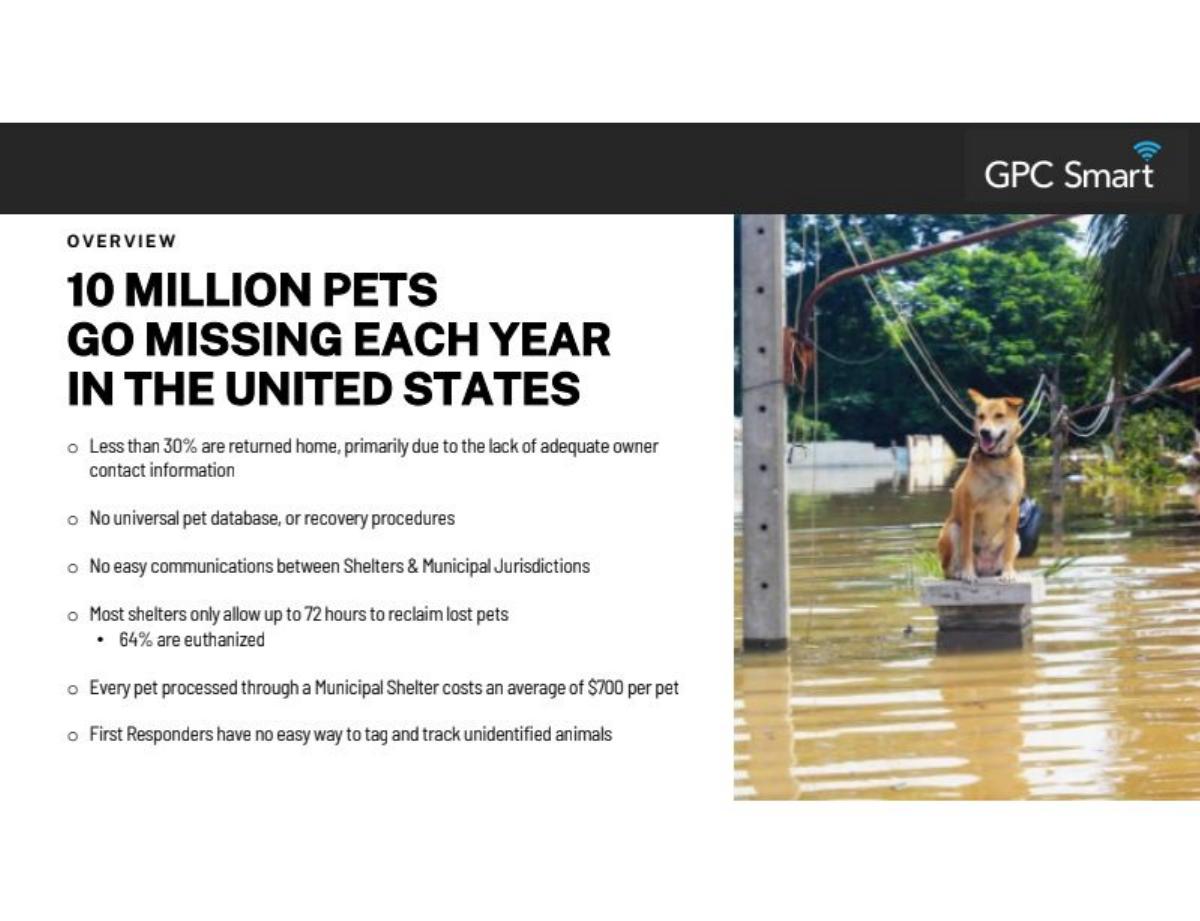
- The problem is quantified by the 10 million pets that go missing in the U.S. each year, with a 64% euthanasia rate for unclaimed pets in shelters (Slide 2).
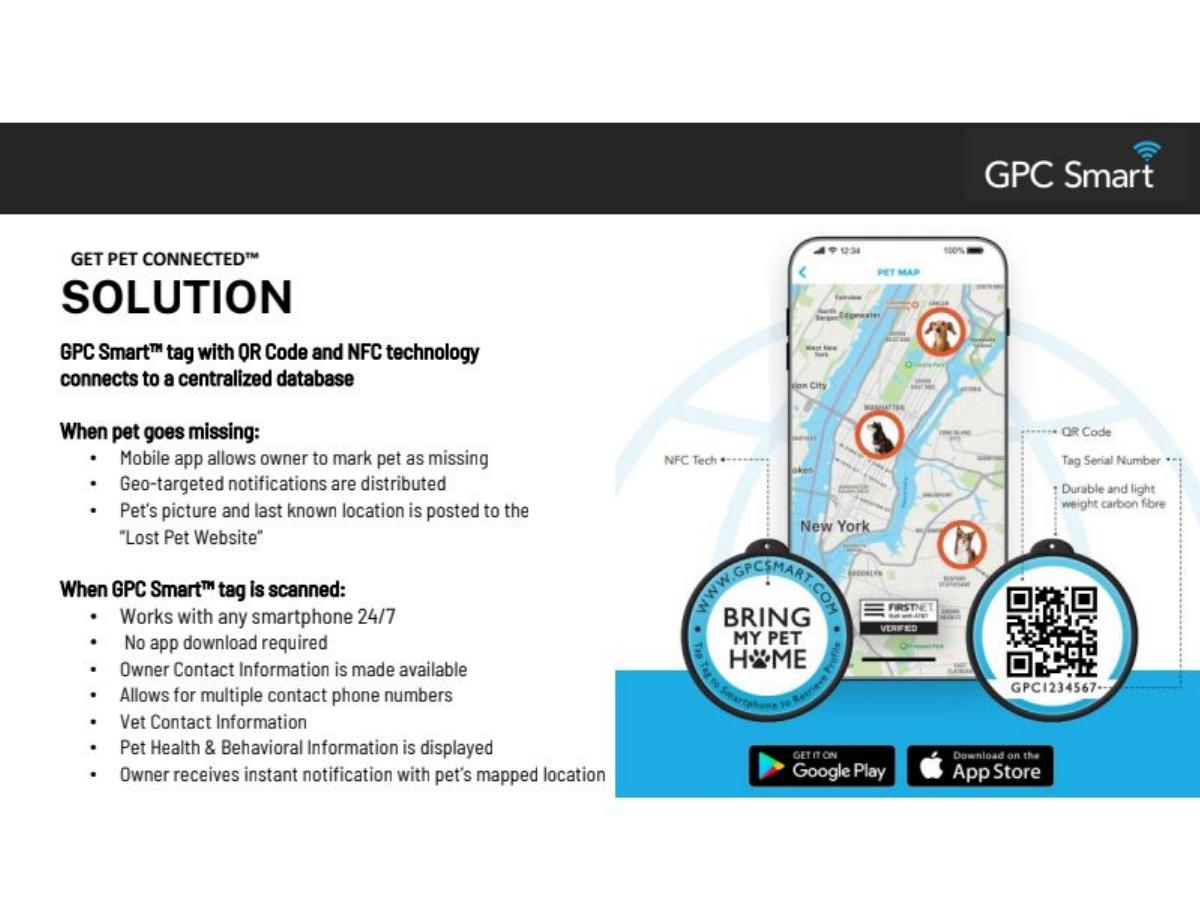
- GPC Smart tags use NFC and QR technology to allow any smartphone to access owner contact and pet health information without an app download (Slide 4).
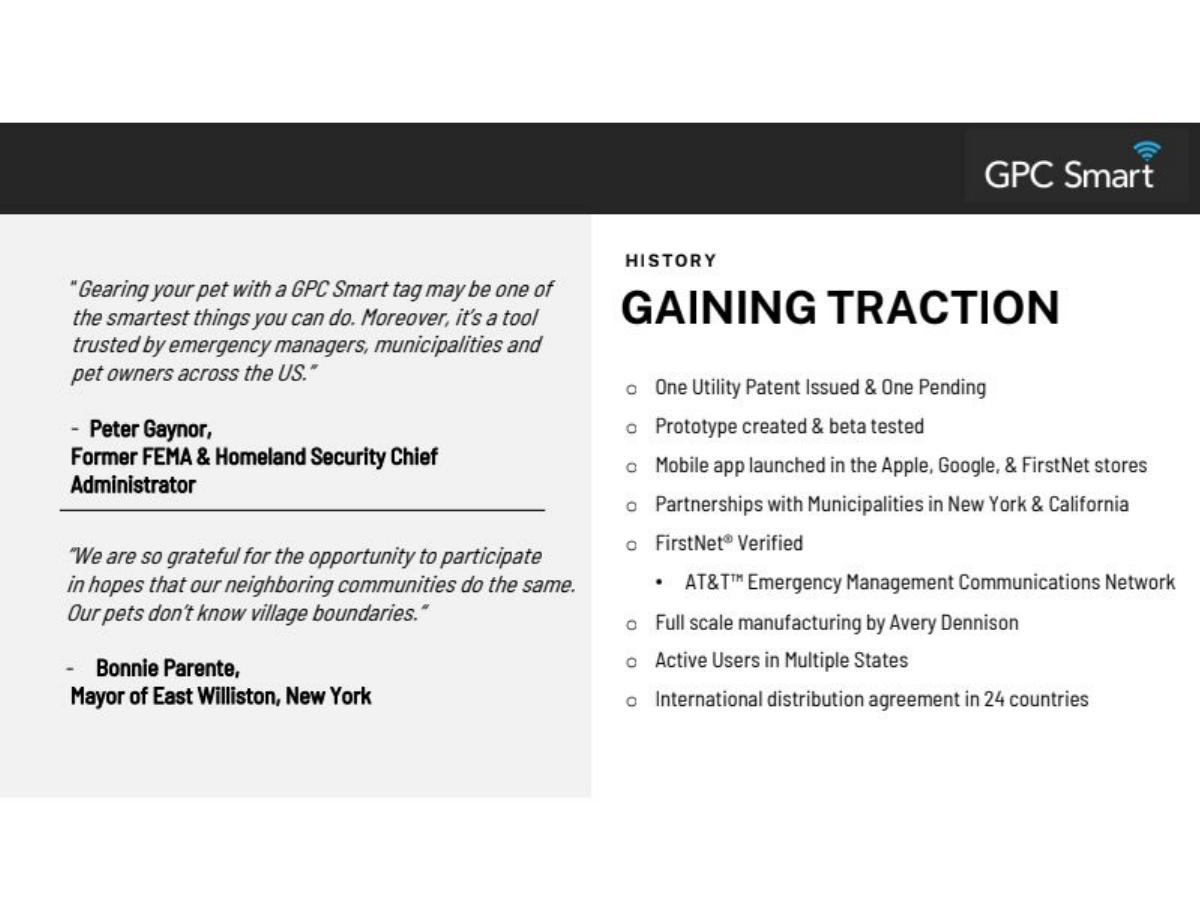
- The company holds one issued utility patent and has one pending, providing a legal moat for their technology (Slide 6).
- Traction is evidenced by a manufacturing partnership with Avery Dennison and an international distribution agreement spanning 24 countries (Slide 6).
- The global pet wearable market is valued at $2.1 billion, with a projected 14.3% CAGR through 2030 (Slide 7).
- The leadership team features 40 years of entrepreneurial experience from the CEO and 15 years of emergency management experience from the COO (Slide 9).
- First-year financial projections estimate $1.47M in gross revenue from 185K units distributed (Slide 10).
- The funding ask is $500K for 12.8% equity, implying a current valuation of $3.9M (Slide 11).
Executive Summary
Syneroid Technologies, through its GPC Smart brand, addresses the high failure rate of traditional pet recovery systems. The deck presents a cohesive narrative: the current system of engraved metal tags and injected microchips is fragmented and inefficient. By leveraging ubiquitous smartphone technology (NFC/QR), Syneroid aims to create a universal, cross-jurisdictional database for pet recovery. With a $500K seed ask, the company focuses on scaling its existing municipal partnerships and international distribution agreements.
Slide 1: Title Slide
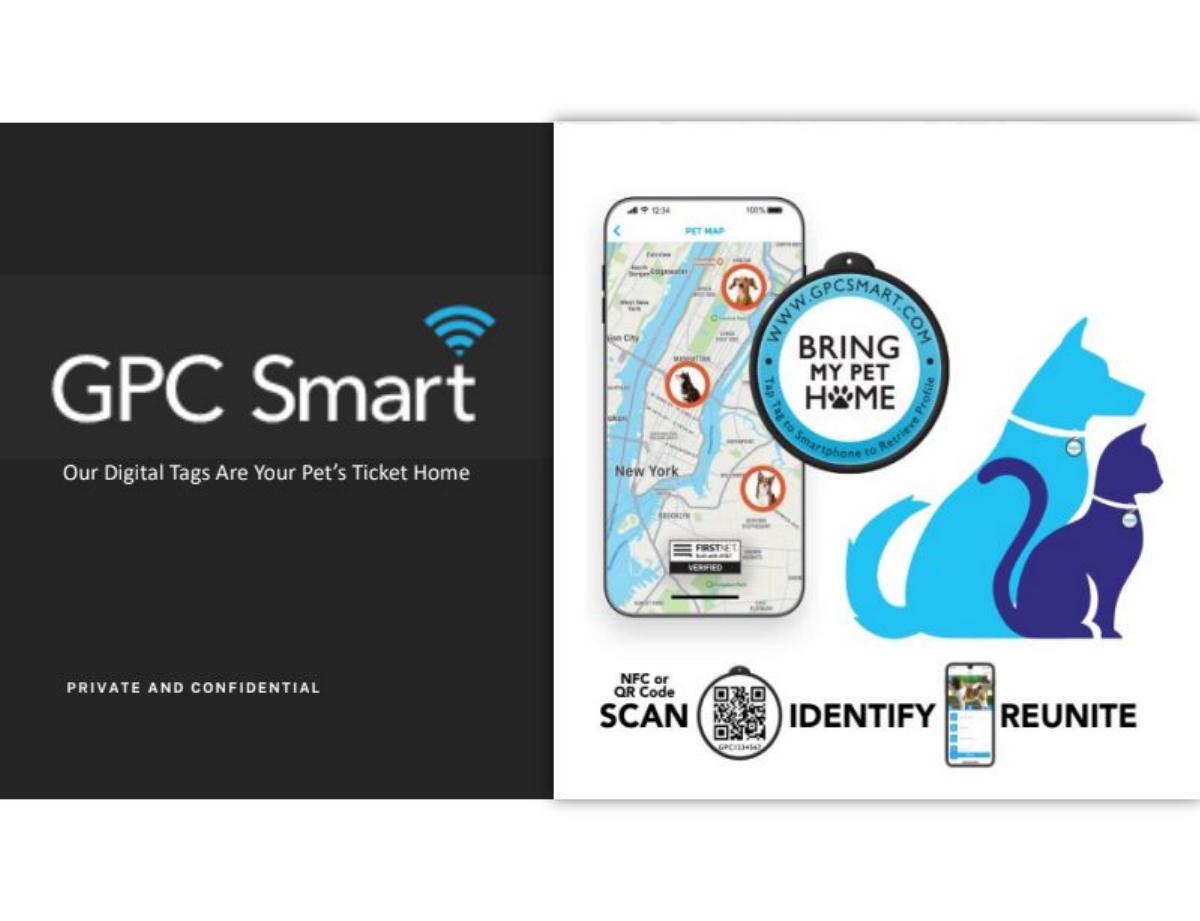
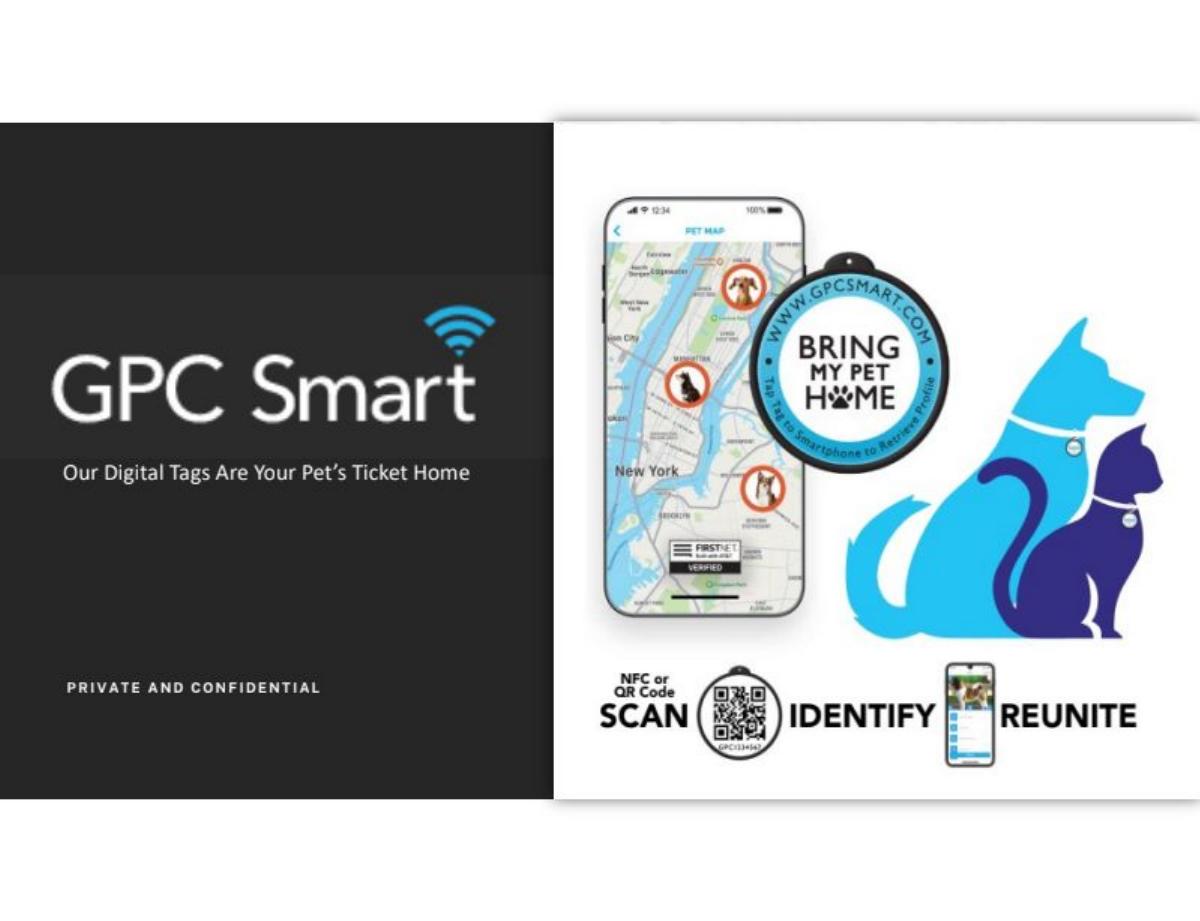
The opening slide introduces the brand "GPC Smart" with the tagline "Our Digital Tags Are Your Pet’s Ticket Home." It features a visual representation of the product: a smartphone displaying a map with pet locations, a physical tag with a QR code, and silhouettes of a dog and cat. The slide establishes the core value proposition—identify and reunite—while noting the company is "Private and Confidential."
Slide 2: The Problem (Overview)
This slide provides the emotional and economic hook for the pitch. It states that 10 million pets go missing annually in the U.S., and less than 30% return home. Key pain points include the lack of a universal database, poor communication between shelters and municipalities, and the 72-hour window shelters provide before euthanasia (affecting 64% of unclaimed pets). It also notes a fiscal burden on taxpayers: $700 per pet processed through municipal shelters.
Slide 3: Competition
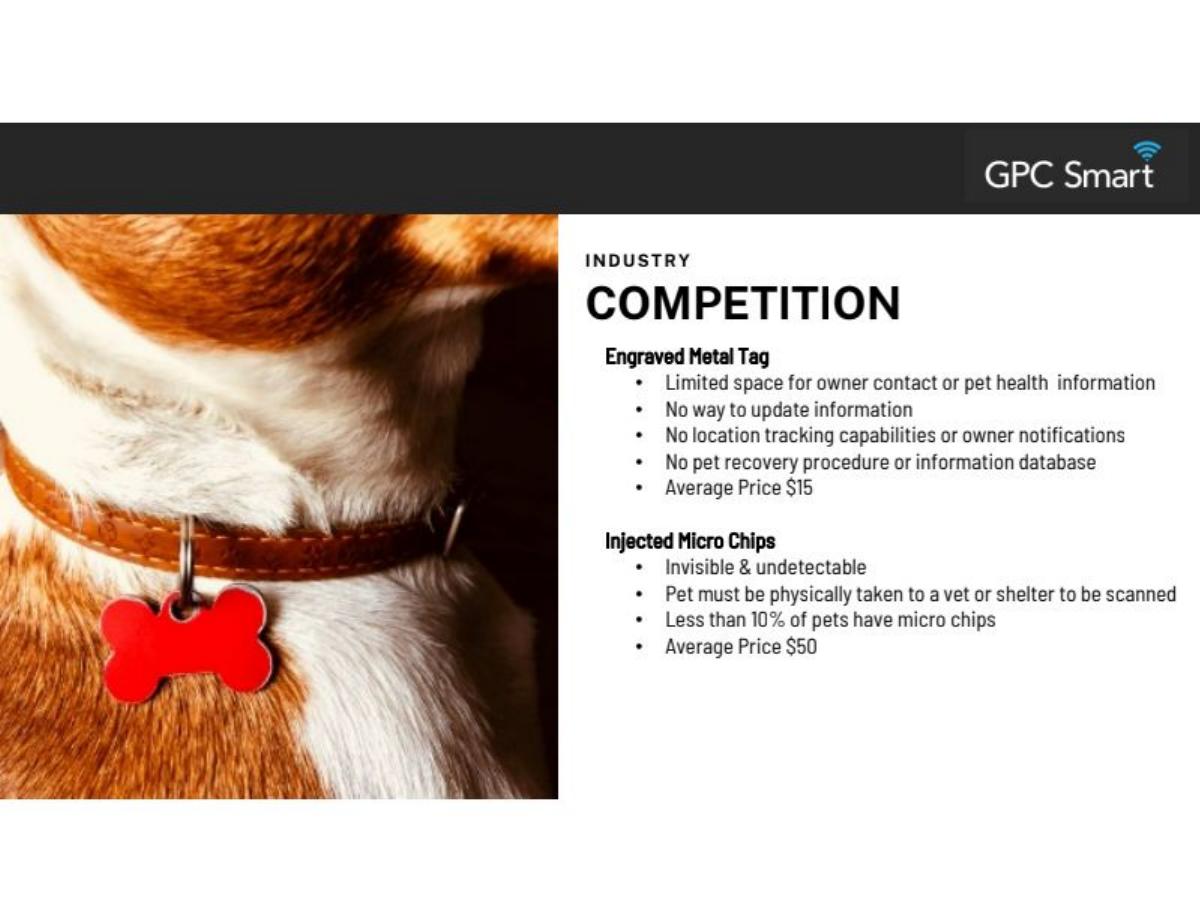
Syneroid categorizes its competition into two legacy groups: Engraved Metal Tags and Injected Microchips. Metal tags are criticized for limited space, inability to update information, and lack of tracking, despite an average price of $15. Microchips are noted as being "invisible & undetectable" to the average person, requiring a trip to a vet or shelter for scanning. The slide claims less than 10% of pets have microchips and cites an average price of $50.
Slide 4: The Solution
The solution slide details the GPC Smart tag’s functionality. It uses QR codes and NFC technology to connect to a centralized database. When a pet goes missing, the owner marks it as such in the app, triggering geo-targeted notifications. When the tag is scanned, the finder sees owner contact info, vet details, and health/behavioral data without needing to download an app. The owner receives an instant notification with the pet’s mapped location.
Slide 5: Competitive Advantages
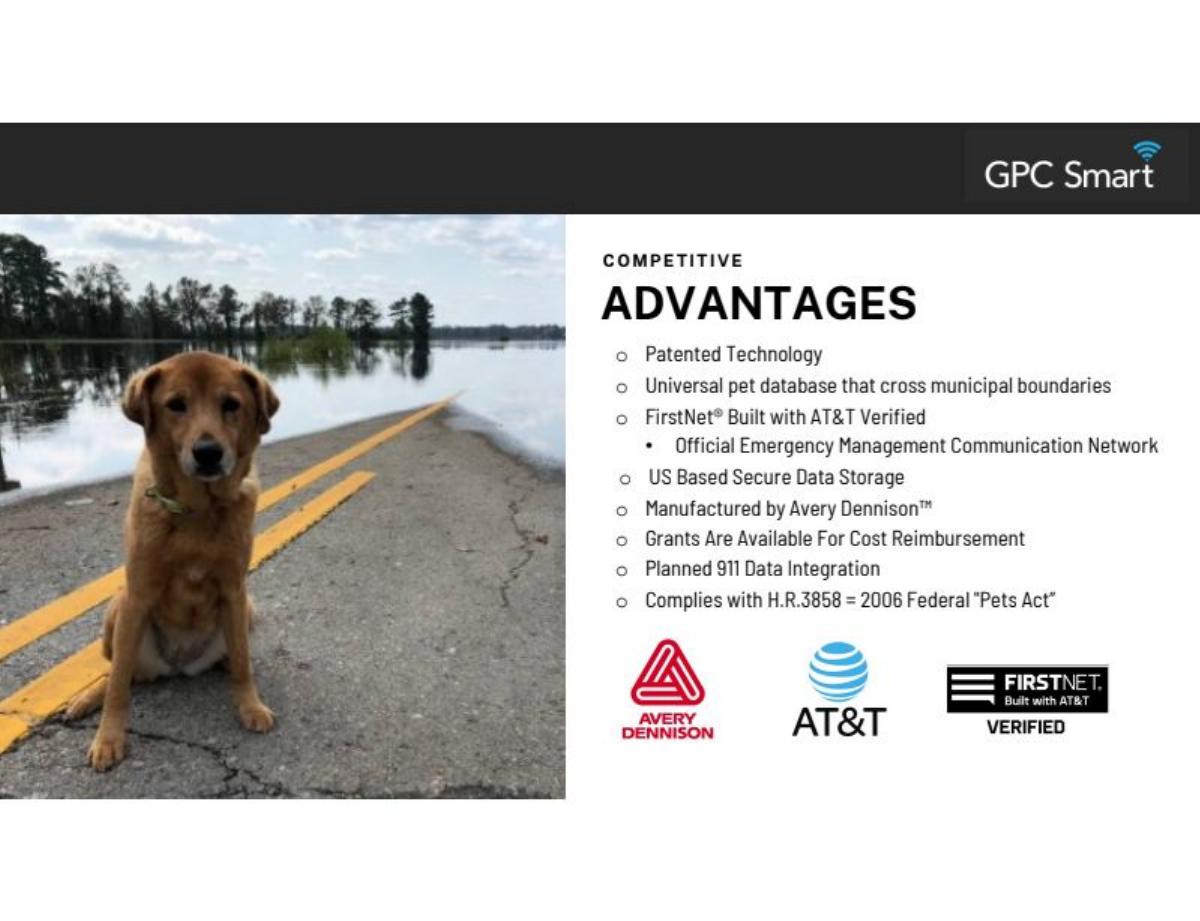
This slide lists the company's moats. Beyond patented technology, it highlights "FirstNet Built with AT&T Verified" status, which links the system to official emergency management networks. Other advantages include US-based secure data storage, manufacturing by Avery Dennison, and compliance with the 2006 Federal "Pets Act." The inclusion of the Avery Dennison and AT&T logos adds significant institutional credibility.
Slide 6: Gaining Traction
Traction is presented through a mix of technical milestones and partnerships. The company has one utility patent issued and one pending. They have moved past the prototype and beta testing phases, with a mobile app live on Apple, Google, and FirstNet stores. Crucially, they mention partnerships with municipalities in New York and California and an international distribution agreement covering 24 countries.
Slide 7: Market Size
Using data sourced from Grand View Research, the slide defines the opportunity. The Global Pet Wearable Market is valued at $2.1 Billion with a 14.3% CAGR. The U.S. market is $696 Million with a 12.9% CAGR. To ground these figures, the slide notes there are 135 million pets in the U.S., with 27 million born every year.
Slide 8: Target Markets
The strategy is split between B2B and DTC. B2B targets include municipalities for digital registration, pet insurance companies (who lose customers when pets are lost), subscription boxes, and shelters. DTC channels include Amazon, veterinarians, pet stores, and big-box retailers. This multi-pronged approach suggests a plan to capture both institutional and individual spend.
Slide 9: Leadership Team
The team slide emphasizes experience over flashy pedigrees. CEO Thomas Ickovic is credited with 40 years of entrepreneurial experience and $25M+ in exits. COO Renn Burke brings 15 years of Emergency Management experience, including FEMA certification. Other members include Richard Fry (Microchip Initiator), Bill Bruce (Board Member and former Director of Animal Services), Ossian B. Riday (Chief Engineer), and Muhammad Awais (Product Lead).
Slide 10: Projected Financials
The deck provides a snapshot of "First Year Operations Only." It projects 185K units distributed and 138K registered users. Gross revenue is estimated at $1.47M against $309K in COGS. The slide projects a profit of $420K in the second half of the year (Q3 & Q4). A disclaimer notes that additional financial information is available upon request.
Slide 11: The Ask
The funding proposal is explicit: $500,000 for 12.8% equity. This implies a current valuation of $3.9M. The slide details a monthly burn rate of $30K and a projected break-even in Q3 2023. It also includes an aggressive "Projected year 5 valuation" of $59.9M, based on an 8x profit multiple.
Slide 12: Contact Slide
The final slide provides direct contact information for CEO Thomas Ickovic, including a phone number and email. The background image of a "Lost Dog" poster serves as a final reminder of the problem the company intends to solve.
Slide 13: BestPitchDeck.com Promo
This is a standard promotional slide for the source of the deck and is not part of the Syneroid Technologies presentation.
What Syneroid Technologies Does Well
The Syneroid deck excels at establishing credibility through institutional validation. By securing "FirstNet Built with AT&T" verification and a manufacturing partnership with Avery Dennison, the company moves from being a simple "gadget" startup to a serious infrastructure play. The problem slide (Slide 2) is particularly effective because it doesn't just focus on the emotional toll of a lost pet; it highlights the $700 cost to municipalities, creating a clear B2B sales hook. The competitive analysis (Slide 3) is also strong, identifying the specific friction points of existing solutions—namely, the need for specialized hardware to read microchips.
What Is Missing from the Syneroid Technologies Deck
While the deck is professional, it leaves several critical questions unanswered. First, the unit economics are vague. While Slide 10 mentions COGS and gross revenue, it doesn't specify the MSRP of a single tag or the subscription cost (if any) for the digital service. Second, the "international distribution agreement in 24 countries" mentioned on Slide 6 is a massive claim that deserves more detail—who are the distributors, and what are the minimum order quantities? Finally, the deck lacks a "Use of Funds" chart. While it states the money will go to marketing and inventory, a visual breakdown of how that $500K is allocated would provide more confidence in the operational plan.
Founder Takeaways: What to Copy
Quantify the B2B Pain: If you are selling a consumer product that also solves a government or municipal problem, find the dollar amount it costs the government to ignore the problem (e.g., the $700 per pet figure on Slide 2). · Leverage Big Logos: If you have a manufacturing or verification partnership with a Fortune 500 company, put those logos front and center. It acts as a proxy for due diligence. · Clear Investment Terms: Slide 11 is a model of clarity. It states the amount, the equity, the valuation, the burn rate, and the break-even goal all in one place. · Problem/Solution Alignment: The deck does a great job of showing exactly how the solution (Slide 4) maps back to the specific failures of the competition (Slide 3).
Frequently asked questions
- What is the core technology behind Syneroid's GPC Smart tags?
- Syneroid utilizes a combination of NFC (Near Field Communication) and QR code technology embedded in durable carbon fiber tags. Unlike traditional microchips that require a vet's scanner, these tags can be read by any modern smartphone. This allows finders to instantly access the pet's profile, which includes owner contact details, multiple phone numbers, vet information, and behavioral data, while simultaneously sending a geo-located notification to the owner.
- How does Syneroid plan to distribute its products?
- The company employs a dual-track distribution strategy. In the B2B segment, they target municipalities for digital pet registration, pet insurance providers, subscription boxes, and shelters. For direct-to-consumer (DTC) sales, they leverage Amazon, online platforms, veterinarians, and big-box retail stores. They have already secured partnerships with municipalities in New York and California and have an international distribution agreement in 24 countries.
- What are the primary competitive advantages listed in the deck?
- Syneroid cites several moats: patented technology, a universal pet database that crosses municipal boundaries, and 'FirstNet Built with AT&T' verification, which is an official emergency management communication network. Additionally, their tags are manufactured by Avery Dennison, and the system complies with the 2006 Federal 'Pets Act' (H.R.3858). These certifications suggest a level of institutional trust that traditional consumer pet tags may lack.
- What are the financial projections for the first year of operations?
- The deck projects distributing 185,000 units in the first year, resulting in 138,000 registered users (a 75% conversion rate). This is expected to generate $1.47M in gross revenue. After accounting for $309K in COGS, $360K in burn rate (overhead and initial marketing), and $390K in R&D/marketing costs, the company projects a profit of $420K in the second half of the year (Q3 and Q4).
- What is the specific investment ask and valuation?
- Syneroid is seeking $500,000 in seed funding in exchange for 12.8% equity. This puts the current valuation at $3.9M. The deck also includes an ambitious five-year projection, estimating a valuation of $59.9M based on an 8x multiple of projected year-five profits. The funds are earmarked for ramping up marketing, inventory, and general operations, with a note that no funds will go to the founders.