Taceo’s 19-slide deck is a highly technical presentation designed for sophisticated investors in the cybersecurity and blockchain space. The company addresses a specific limitation in confidential computing: the lack of verifiable private compute. By introducing 'coSNARKs'—a hybrid of Multi-party Computation (MPC) and Zero-Knowledge Proofs (ZK)—Taceo positions itself as a performance leader that doesn't sacrifice security. The deck excels at visualizing complex data flows, particularly how their 'Coordination Layer' bridges applications to on-chain state updates. While the deck is light on tr…
Key takeaways
- Taceo positions its core innovation, coSNARKs, as the solution to the industry's critical gap in verifiable private compute (Slide 3).
- The technical architecture relies on combining Multiparty Computation (MPC) and Zero-Knowledge Proofs (ZK) to achieve sustained verifiability (Slide 4).
- The product is structured as a network of coSNARK subnets that interface with Ethereum and other L1/L2 blockchains via a dedicated SDK (Slide 5).
- Taceo provides a detailed user flow diagram showing how secret shares and circuits move from the app frontend through the Taceo network to public storage (Slide 6).
- The roadmap is divided into three distinct phases: Current (PPD), Near Future (PSS), and Soon (PSS Outlook) which includes private zkML and agents (Slide 7).
- Competitive positioning (Slide 8) claims coSNARKs offer 'Fast' performance and 'ZK' verifiability, outperforming FHE on speed and Vanilla MPC on verifiability.
- The team slide features 12 members, including a Lead Cryptographer and a Chief Scientist, signaling a research-heavy engineering culture (Slide 9).
- The deck omits traditional financial projections, market sizing (TAM), and a specific 'Ask' slide detailing the use of funds.
The Technical Frontier of Confidential Computing
Taceo’s pitch deck is a focused, engineering-centric document that targets the growing intersection of cybersecurity and blockchain. The company, based in Austria, raised $5.5M in 2024 to commercialize a specific cryptographic primitive: collaborative SNARKs (coSNARKs). The deck avoids the typical 'marketing fluff' found in many Seed rounds, opting instead for architectural diagrams and technical comparisons. This approach suggests the founders were pitching to specialized VCs who understand the limitations of current Multi-party Computation (MPC) and Zero-Knowledge (ZK) implementations.
Slide 1-2: The Hook and the Problem
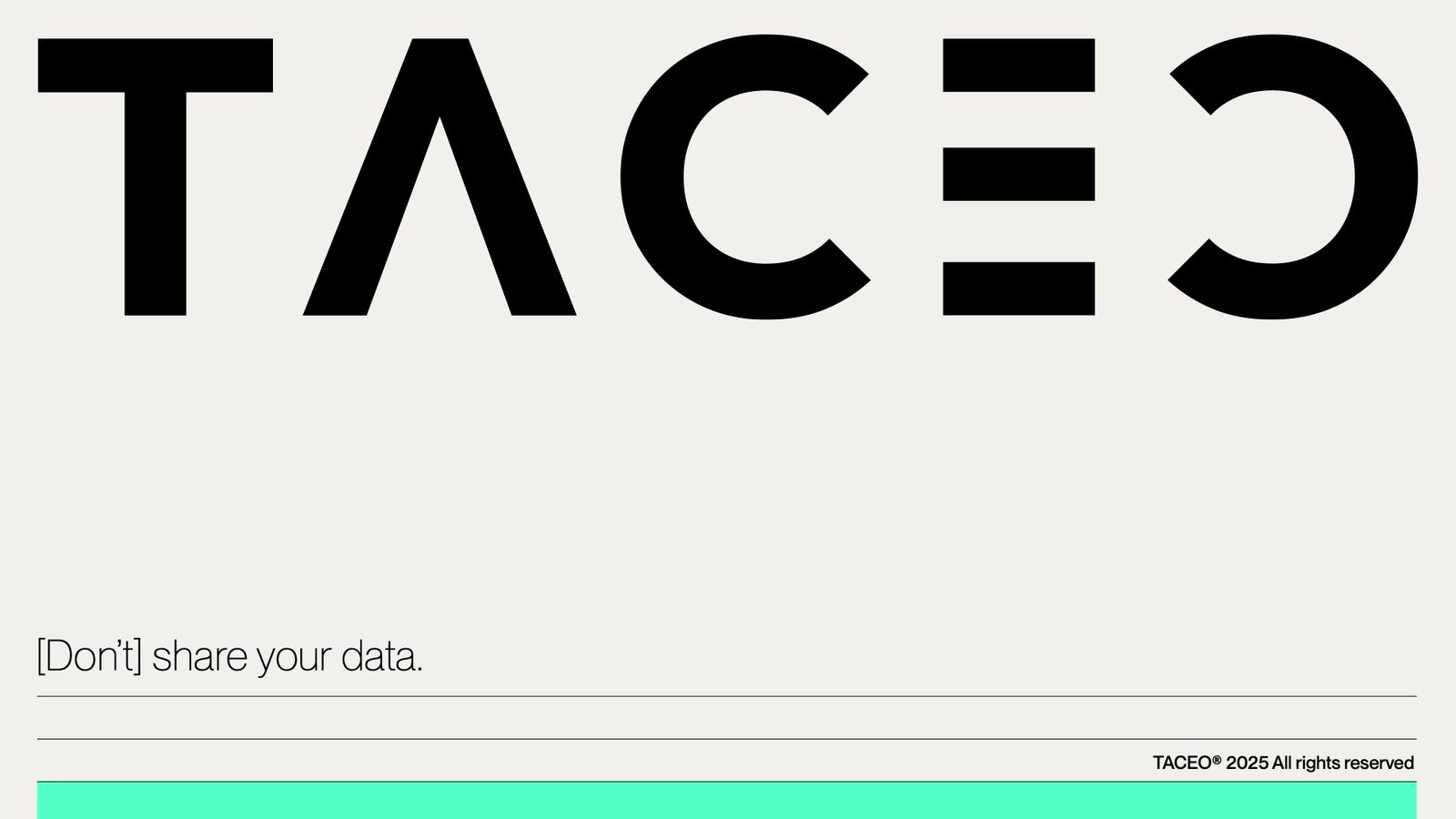
The deck opens with a minimalist title slide featuring the tagline "[Don't] share your data." This sets a clear tone for a privacy-focused company. Slide 2 introduces the core domain: Confidential Computing . By highlighting this term in a bright green box, Taceo immediately categorizes itself within a high-growth sector of cybersecurity. However, the deck does not spend time explaining why data privacy is important—it assumes the audience is already aware of the regulatory and security pressures driving the need for confidential compute.
Slide 3-4: The coSNARKs Solution
Slide 3 identifies the "industry's critical gap in verifiable private compute." This is the 'why now' of the deck. Taceo proposes collaborative SNARKs (coSNARKs) as the solution. The slide includes a simplified diagram comparing a standard Prover (P) and Verifier (V) relationship to a collaborative model involving multiple parties (P1, P2, P3). This visual aid is crucial for explaining how they distribute the computation load while maintaining a single proof of validity.
Slide 4 goes deeper into the benefits, stating that coSNARKs combine the strengths of Multiparty Computation (MPC) and Zero-Knowledge Proofs (ZK) . The primary outcome highlighted is "Sustained Verifiability." The text notes that as the industry increases its use of SNARKs, trust must be maintained even in confidential environments. This slide effectively positions Taceo as a hybrid solution that takes the best of two established cryptographic fields.
Slide 5-6: Product Architecture and User Flow
Slide 5 introduces the concept of a "Network for Private Shared State." This is a significant shift from just providing a library; Taceo is building a network infrastructure. The diagram shows the Taceo Coordination Layer bridging Ethereum and other L1/L2 blockchains to "coSNARK subnets." It lists three specific application examples: Private Voting, Private DEX, and Onchain Poker. This helps ground the abstract cryptography in real-world blockchain use cases.
Slide 6 provides a granular "User flow from the application, to the coordination layer, to the TACEO network, and then to on-chain state updates." This is perhaps the most important slide for technical due diligence. It maps out how a user interacts with the SDK, how "Secret Shares" and "Circuits" are handled, and how the "PSS Commitment" (Private Shared State) is updated. The use of distinct colors for different components (Coordination Layer in green, PSS in orange) makes a complex process relatively easy to follow.
Slide 7: The Roadmap to 'Soon™'
Taceo uses a three-column roadmap on Slide 7 to show product evolution. Phase 01 (Current) focuses on Private Proof Delegation (PPD) for transactions and identity. Phase 02 (Near Future) moves into Private Shared State (PSS) for more complex interactions like dark pools and passport verification. Phase 03 (Soon™) targets the 'holy grail' of current crypto-research: private zkML (Zero-Knowledge Machine Learning) and decentralized socials. This roadmap shows a logical progression from simple proof outsourcing to complex, multi-user private state management.
Slide 8: Competitive Landscape
Slide 8 is a classic 'competitor matrix' but focused on technical attributes rather than brand names. It compares TEE (Trusted Execution Environments), FHE (Fully Homomorphic Encryption), Vanilla MPC , and coSNARKs across four categories: Performance, Security, Verifiability, and Threshold. Taceo claims coSNARKs are "Fast" (beating FHE), use "Cryptography" for security (avoiding TEE's hardware vulnerabilities), and provide "ZK" verifiability (which Vanilla MPC lacks). This slide is a strong closing argument for their technical superiority.
Slide 9: The Team
The team slide (Slide 9) features 12 individuals, which is a large headcount for a Seed-stage startup, explaining the $5.5M raise. The leadership includes Lukas Helminger (CEO), Lukas Götz (CPO), and Daniel Kales (CTO). The presence of a "Lead Cryptographer" (Roman Walch) and a "Chief Scientist" (Christian Rechberger) reinforces the message that this is a research-led company. The team is almost entirely composed of engineers and researchers, which is consistent with the technical nature of the deck.
Slide 10-19: Closing and Omissions
The final slide (Slide 10) is a simple call to action with a QR code to "Subscribe for updates." Notably, the deck ends without several standard venture slides. There is no mention of the total addressable market (TAM), no financial projections, no business model (SaaS vs. Protocol fees), and no slide detailing the specific 'Ask' or use of funds. While these may have been in the 9 slides not provided in the image set, their absence in the core narrative suggests Taceo relied on their technical moat to drive investor interest.
What Taceo's Deck Does Well
Technical Clarity: The deck uses high-quality diagrams to explain complex cryptographic flows. Slide 6, in particular, is an excellent example of how to visualize a multi-step backend process. · Clear Differentiation: Slide 8 provides a definitive reason why coSNARKs are needed, by mapping them against the failures or limitations of existing technologies like FHE and TEE. · Roadmap Specificity: Instead of vague goals, Slide 7 lists specific applications (Dark pools, zkML, Passport verification) that give investors a sense of the market segments Taceo intends to capture.
What is Missing from the Taceo Deck
The Business Case: There is no information on how Taceo plans to make money. Whether they are selling enterprise licenses, charging per-proof fees, or launching a token is left unaddressed. · Market Sizing: The deck assumes the 'Confidential Computing' market is large and valuable but provides no data to support the scale of the opportunity. · The Ask: A standard pitch deck should clearly state how much capital is being raised and what milestones that capital will achieve. This is missing from the visible slides. · Customer/Partner Traction: While the deck mentions use cases, it does not list any current design partners, pilot programs, or letters of intent from developers.
Founder's Guide: What to Copy
The 'Gap' Slide: Copy the way Slide 3 identifies a "critical gap." Defining your startup as the missing piece in an existing industry puzzle is a powerful way to establish relevance. · Visualizing the SDK: If you are a dev-tool or infrastructure company, copy the way Slide 5 and 6 show where your product sits in the stack. Showing the 'Coordination Layer' between the app and the blockchain makes the product feel tangible. · Technical Comparison: Use a table like Slide 8 to compare technical trade-offs (Speed vs. Security vs. Verifiability) rather than just listing features. This shows a deep understanding of your engineering constraints.
Frequently asked questions
- What is the primary technical problem Taceo is solving?
- Taceo identifies a 'critical gap' in verifiable private compute. While existing solutions like Trusted Execution Environments (TEE) or Fully Homomorphic Encryption (FHE) exist, they often force a trade-off between speed, hardware reliance, and verifiability. Taceo uses coSNARKs to provide a cryptographic solution that is both fast and verifiable without relying on specific hardware.
- How does Taceo's technology differ from 'Vanilla' MPC?
- According to Slide 8, 'Vanilla MPC' offers fast performance and cryptographic security but has 'None' in the verifiability category. Taceo’s coSNARKs maintain the 'Fast' performance and 'Cryptography' security of MPC but add 'ZK' (Zero-Knowledge) verifiability, allowing users to prove the computation was performed correctly without revealing the underlying data.
- What are the specific use cases mentioned in the deck?
- Taceo lists several applications across its roadmap on Slide 7. Current use cases include transactions, identity, and web proofs. The 'Near Future' includes sign-up sequencers, passport verification, dark pools, and private games. The long-term outlook targets agents, private zero-knowledge Machine Learning (zkML), and decentralized socials.
- What is the role of the 'Coordination Layer' in their architecture?
- As shown on Slides 5 and 6, the Coordination Layer acts as a bridge. It receives requests from the Taceo SDK (integrated into an app's frontend) and routes them to the Taceo Network's coSNARK subnets. It then facilitates the 'State Update Procedure' to ensure private shared state is correctly updated on the blockchain.
- Is there information about Taceo's business model or pricing?
- No. The provided slides focus entirely on the technical problem, the cryptographic solution, the product architecture, and the team. There is no mention of pricing tiers, revenue models, customer acquisition costs, or sales strategies within these slides.