Sysdig raised $70M in 2020 using this 13-slide deck to position itself as the leader in the emerging 'Secure DevOps' category. The narrative is built on the premise that Kubernetes has become the default operating system for the cloud, creating a visibility gap that traditional tools cannot fill. The deck is notable for its focus on the 'Cloud Platform Team' as the new primary buyer and its use of a cohort-style scatter plot to demonstrate a 'land and expand' model, showing multiple customers growing their initial ACV by 5x to 10x over 40 months. While it lacks a traditional team slide or a s…
Key takeaways
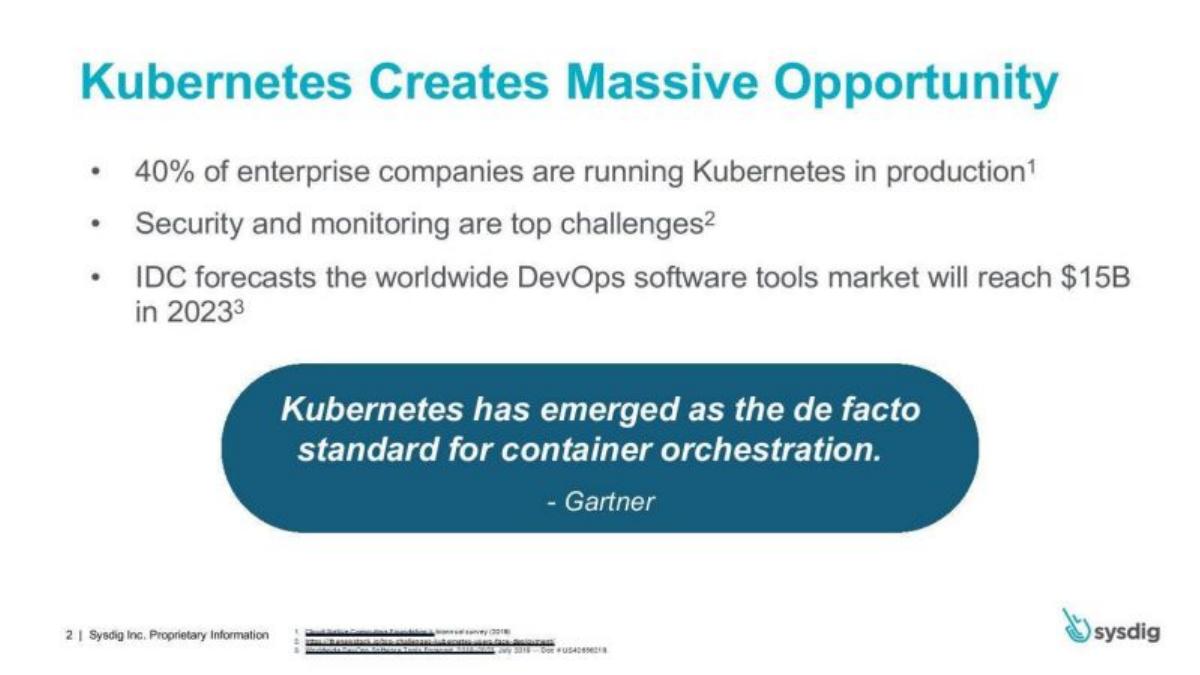
- Kubernetes adoption is the primary market driver, with 40% of enterprise companies running it in production as of Slide 2.
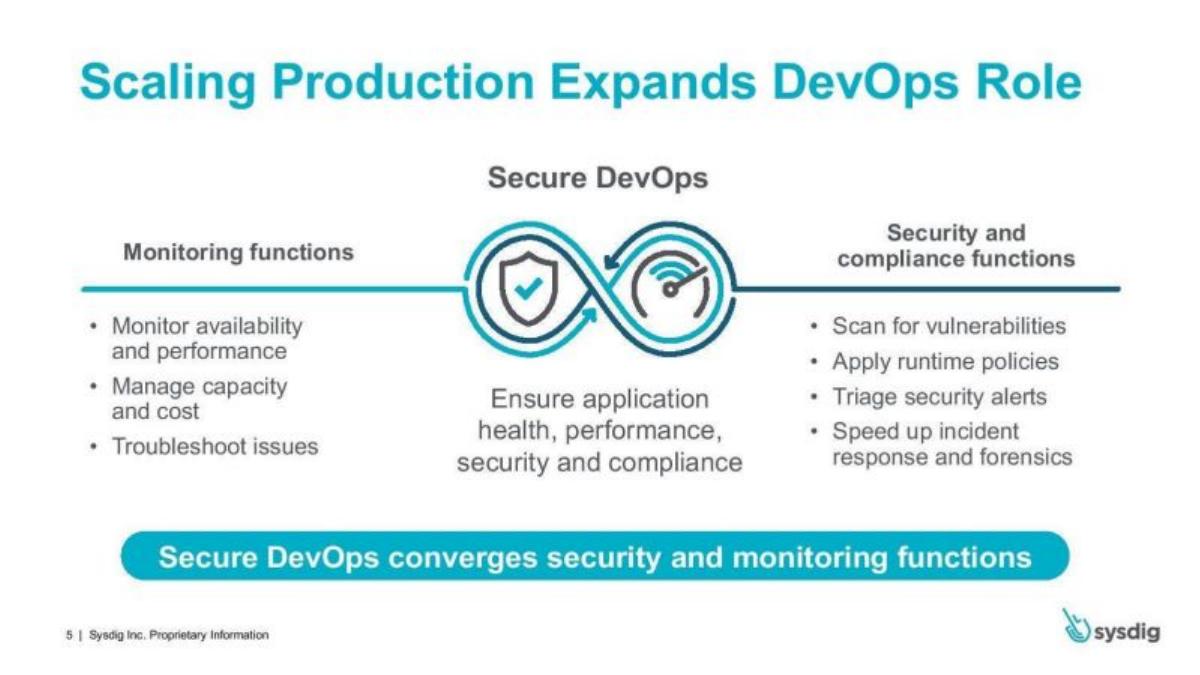
- The company defines a new category, 'Secure DevOps,' which converges monitoring functions with security and compliance functions (Slide 5).
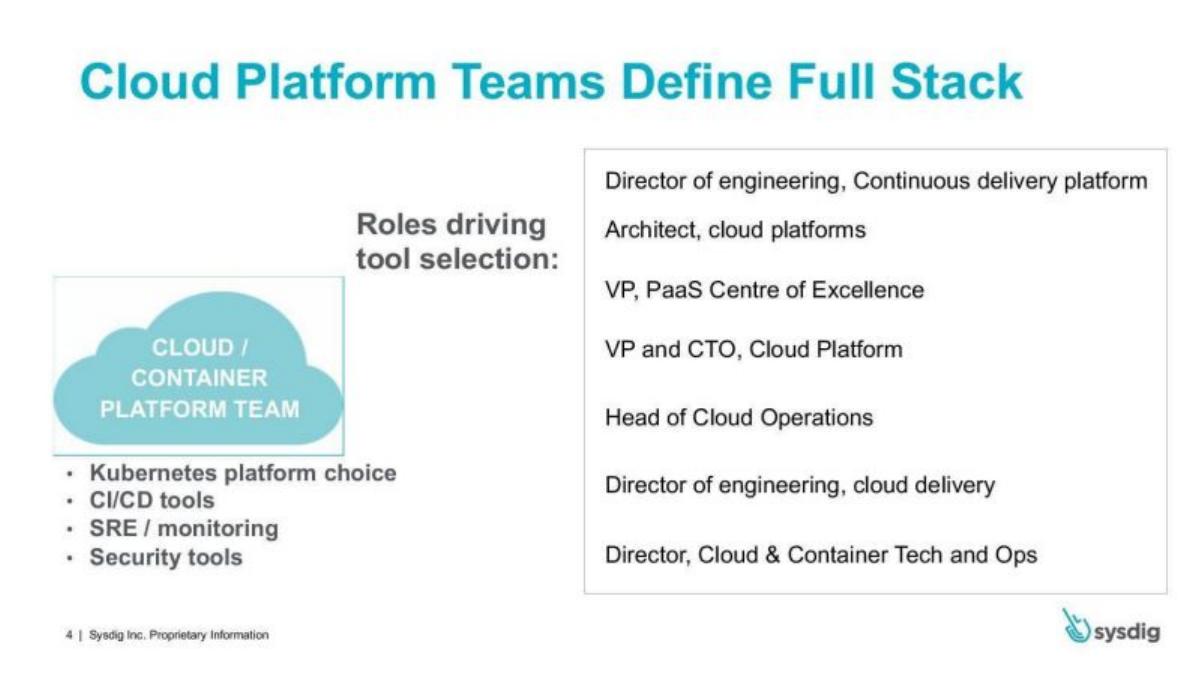
- Sysdig identifies the 'Cloud Platform Team' as the critical new decision-maker for infrastructure tool selection (Slide 4).
- The Total Addressable Market is calculated at $20B+, comprising vulnerability management ($6B), infrastructure monitoring ($7.5B), and endpoint detection ($7.6B) on Slide 7.
- The platform is built on an open-source foundation, specifically citing Prometheus for monitoring and Falco for runtime security (Slide 9).
- Revenue growth is aggressive, showing a greater than 5x increase in ARR between Q3CY17 and Q3CY19 (Slide 10).
- The 'Enterprise ARR expansion pattern' chart on Slide 10 provides evidence of a successful land-and-expand strategy with high-value outliers.
- The deck completely omits a team slide, a competition slide, and a specific financial 'Ask' for the Series E round.
The Strategic Narrative of Secure DevOps
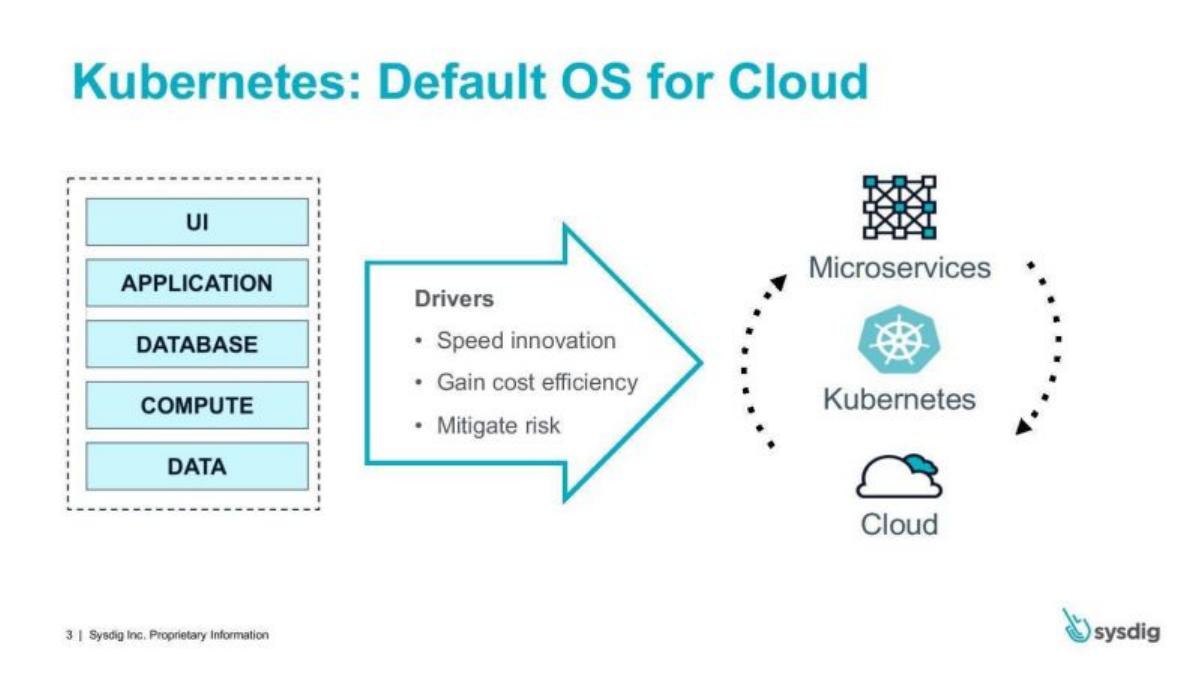
The Sysdig Series E pitch deck is a masterclass in category creation. Rather than positioning themselves as just another security tool or another monitoring dashboard, they introduce the concept of Secure DevOps . This narrative is essential for a Series E round, where the goal is to prove that the company is not just a successful startup, but a foundational piece of the modern enterprise stack. The deck focuses heavily on the shift to Kubernetes, which they describe as the Default OS for Cloud on Slide 3. By tying their fate to the explosive growth of Kubernetes, Sysdig makes their own growth seem inevitable.
Slide 1: Title Slide
The deck opens with a clean, professional title slide featuring the company logo and the tagline: Secure DevOps for Cloud-Native Applications . It is labeled as an Investor Pitch . The branding is consistent with the tech-heavy, enterprise-focused nature of the product.
Slide 2: The Kubernetes Opportunity
Slide 2 sets the stage by citing external validation. It notes that 40% of enterprise companies are running Kubernetes in production and quotes Gartner stating that Kubernetes has emerged as the de facto standard for container orchestration . It also references an IDC forecast that the worldwide DevOps software tools market will reach $15B in 2023 . This slide establishes the 'Why Now?' by showing a massive, rapidly growing market shift.
Slide 3: Kubernetes as the Default OS
This slide uses a diagram to show the transition from traditional stacks (UI, Application, Database, Compute, Data) to a microservices architecture managed by Kubernetes in the cloud. The drivers for this change are listed as Speed innovation , Gain cost efficiency , and Mitigate risk . This slide reinforces the idea that the underlying infrastructure of the world is changing, necessitating new tools.
Slide 4: The New Decision Makers
Slide 4 is a crucial strategic inclusion. It identifies the Cloud Platform Team as the group driving tool selection. It lists specific titles like VP, PaaS Centre of Excellence and Head of Cloud Operations . For an investor, this clarifies the 'Go-To-Market' (GTM) strategy by showing exactly who the sales team needs to call to close a deal.
Slide 5: Convergence of Functions
Slide 5 introduces the core value proposition: Secure DevOps converges security and monitoring functions . It uses an infinity loop graphic to show how monitoring functions (availability, performance, capacity) and security functions (vulnerability scanning, runtime policies, incident response) are now linked. This justifies why a customer should buy one platform (Sysdig) instead of two separate tools.
Slide 6: The Cloud-Native Lifecycle
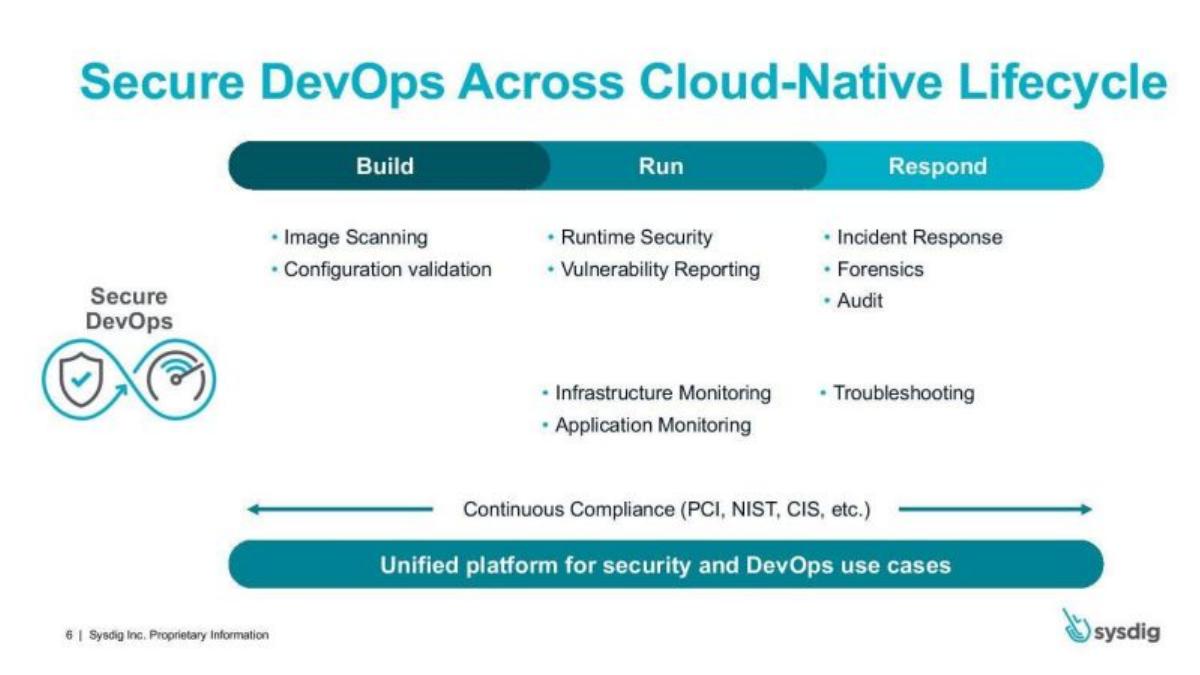
This slide breaks down the product's utility across three phases: Build , Run , and Respond . It lists specific features like Image Scanning , Runtime Security , and Forensics . Underpinning all of this is Continuous Compliance (PCI, NIST, CIS, etc.) . This slide moves the conversation from high-level strategy to concrete product capabilities.
Slide 7: The $20B+ TAM
Slide 7 is the 'Big Money' slide. It breaks the $20B+ TAM into three buckets: $6B for Vulnerability management , $7.5B for Infrastructure monitoring; APM , and $7.6B for Endpoint detection & response . The punchline at the bottom is key: Containers and Kubernetes leave existing visibility and security tools blind . This frames the $20B as a market ripe for disruption because the incumbents are technically incapable of serving it.
Slide 8: Unique Technology Advantages
Slide 8 addresses the 'How.' It claims Deep visibility through kernel-level container, network, application and system activity . It also mentions Automatic service-level context and Cloud scale collection . This slide is meant to satisfy the technical due diligence by explaining why their approach is superior to competitors who might only operate at the user-space level.
Slide 9: Open Source Foundation
Sysdig highlights its relationship with the open-source community here. It shows how the Sysdig Secure DevOps Platform adds value on top of projects like Prometheus and Falco . This is a common and successful strategy for enterprise software, as it allows for bottom-up adoption by developers while charging for the 'enterprise-grade' features like scale and workflow.
Slide 10: Global Momentum and Expansion
This is the most important slide for a Series E investor. The left side shows Rapid ARR growth with a > 5X growth increase from Q3CY17 to Q3CY19. The right side shows an Enterprise ARR expansion pattern . This scatter plot is impressive; it shows that as customers stay with Sysdig longer (moving right on the X-axis), their spending increases significantly (moving up on the Y-axis). Several dots represent customers who have reached 10x their initial ACV . This proves the 'Land and Expand' model is working.
Slide 11: Summary - The Secure DevOps Leader
Slide 11 recaps the three main pillars of the pitch: Massive opportunity , Unique technology , and Strong momentum . It serves as a closing argument, reiterating the $20B TAM, the kernel-level visibility, and the large enterprise adoption.
Slide 12 & 13: Closing
Slide 12 is a simple logo slide with the tagline Dig deeper . Slide 13 is a promotional slide for the source of the deck, bestpitchdeck.com, and is not part of the original Sysdig presentation.
What Sysdig Does Well
The deck is exceptionally strong at market positioning . By creating the 'Secure DevOps' category, they avoid being compared feature-for-feature with narrow competitors. They also do a great job of identifying the buyer persona (Slide 4), which is often overlooked in technical decks. The expansion chart on Slide 10 is the highlight of the deck; it provides visual proof of high Net Revenue Retention (NRR), which is the single most important metric for a late-stage SaaS company. Finally, the use of external validation from Gartner and IDC on Slide 2 gives the entire narrative immediate credibility.
What is Missing from the Deck
Despite raising $70M, this deck has several glaring omissions that a smaller startup might not be able to get away with:
No Team Slide: There is no mention of the founders, the executive team, or their backgrounds. At Series E, investors likely already know the team, but its absence is notable. · No Competition Slide: The deck mentions that existing tools are 'blind,' but it never names competitors like Datadog, Palo Alto Networks (Prisma Cloud), or Aqua Security. · No Unit Economics: While ARR growth is shown, there is no mention of CAC (Customer Acquisition Cost), LTV (Lifetime Value), or gross margins. · No Use of Funds: The deck does not state how much they are raising or what they plan to do with the capital (e.g., international expansion, R&D, sales hiring). · No Case Studies: While they show a scatter plot of anonymous customers, they don't name any of their 'Global Enterprises' or provide a specific success story.
Lessons for Founders
Founders can learn two major lessons from the Sysdig deck. First, frame your market around a shift in infrastructure . If you can convince investors that a fundamental change (like Kubernetes) is happening, you don't have to sell your product as much as you have to sell the necessity of a new tool for that new environment. Second, visualize your expansion . The scatter plot on Slide 10 is far more effective than a simple bullet point saying 'we have good retention.' It shows the magnitude of the growth within individual accounts over a multi-year period, which is exactly what late-stage investors want to see to justify a high valuation.
Note: All figures and claims, including the $20B TAM and the 5x ARR growth, are taken directly from the slides provided in the 2020 investor pitch.
Frequently asked questions
- What is the core problem Sysdig is solving according to the deck?
- According to Slide 7, the core problem is that 'Containers and Kubernetes leave existing visibility and security tools blind.' Traditional tools designed for legacy infrastructure cannot see into the kernel-level activity of ephemeral containers, creating a gap in vulnerability management, monitoring, and incident response that Sysdig's unified platform aims to fill.
- How does Sysdig define its target market size?
- Sysdig claims a $20B+ Total Addressable Market (TAM) on Slide 7. They reach this figure by aggregating three distinct sub-sectors: Vulnerability Management ($6B), Infrastructure Monitoring/APM ($7.5B), and Endpoint Detection & Response ($7.6B). This suggests they are not just competing in one category but are disrupting three established markets simultaneously.
- Who does Sysdig identify as the primary buyer for their software?
- Slide 4 explicitly identifies the 'Cloud Platform Team' as the group driving tool selection. This team includes roles such as Director of Engineering for Continuous Delivery, Cloud Architects, and VPs of PaaS Centers of Excellence. By focusing on this specific persona, Sysdig differentiates itself from tools sold strictly to CISO-led security teams or traditional IT ops.
- What evidence of product-market fit is provided in the deck?
- Product-market fit is demonstrated through the 'Global Enterprises Accelerate Momentum' slide (Slide 10). It shows two key metrics: a bar chart indicating ARR grew more than 5x over a two-year period, and a scatter plot showing that many customers significantly increase their spending over time, with some reaching 10x their initial ACV within 40 months.
- How does Sysdig leverage open source in its business model?
- Slide 9 highlights that the Sysdig Secure DevOps Platform is 'Built on an Open Source Foundation.' It specifically mentions image scanning, Prometheus for monitoring, and Falco for runtime security. The proprietary platform adds 'scale, workflow, K8s, and cloud context' on top of these open-source projects, which helps with developer adoption and trust.