Synder's 2021 Seed deck is a masterclass in brevity, using just nine slides to secure $2M in funding. Rather than over-explaining the technical architecture of their accounting automation, the founders focused on the pain points of multi-channel e-commerce and the quantifiable success they had already achieved. The deck highlights a significant $1B in reconciled transactions and exceptional retention rates—90% between days 150 and 365. By anchoring the narrative in social proof, including over 1,500 five-star reviews and multiple industry awards, Synder effectively de-risked the investment. W…
Key takeaways
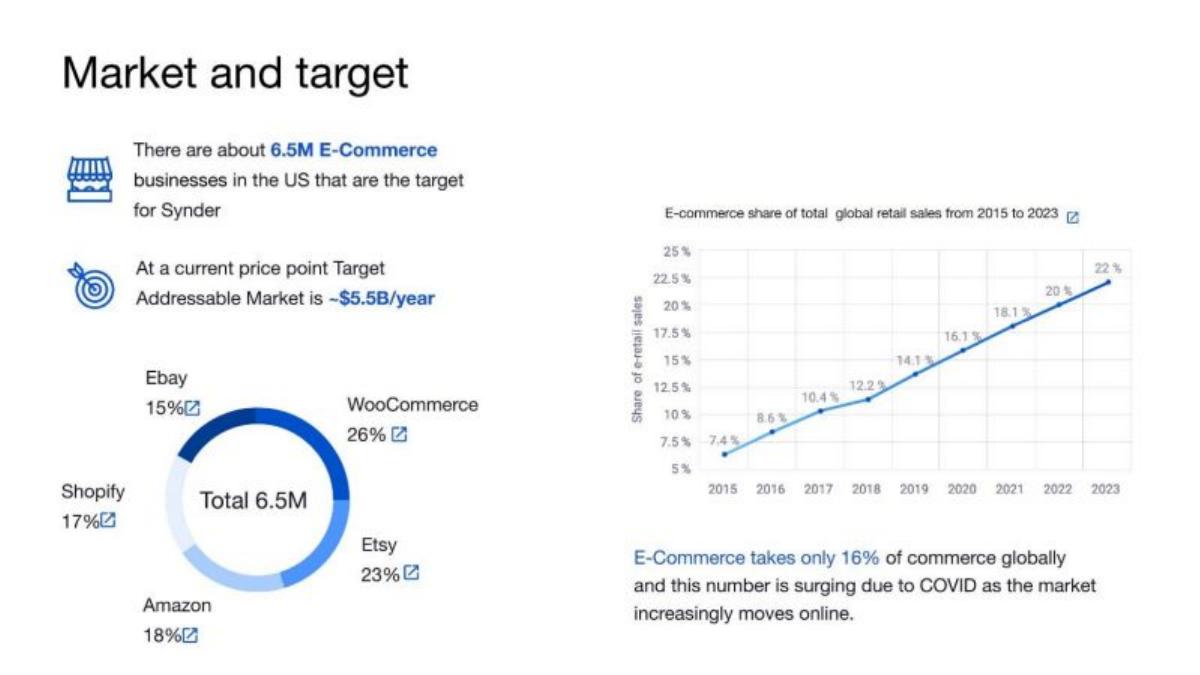
- The deck identifies a specific addressable market of 6.5M U.S. e-commerce businesses, valued at approximately $5.5B per year (Slide 4).
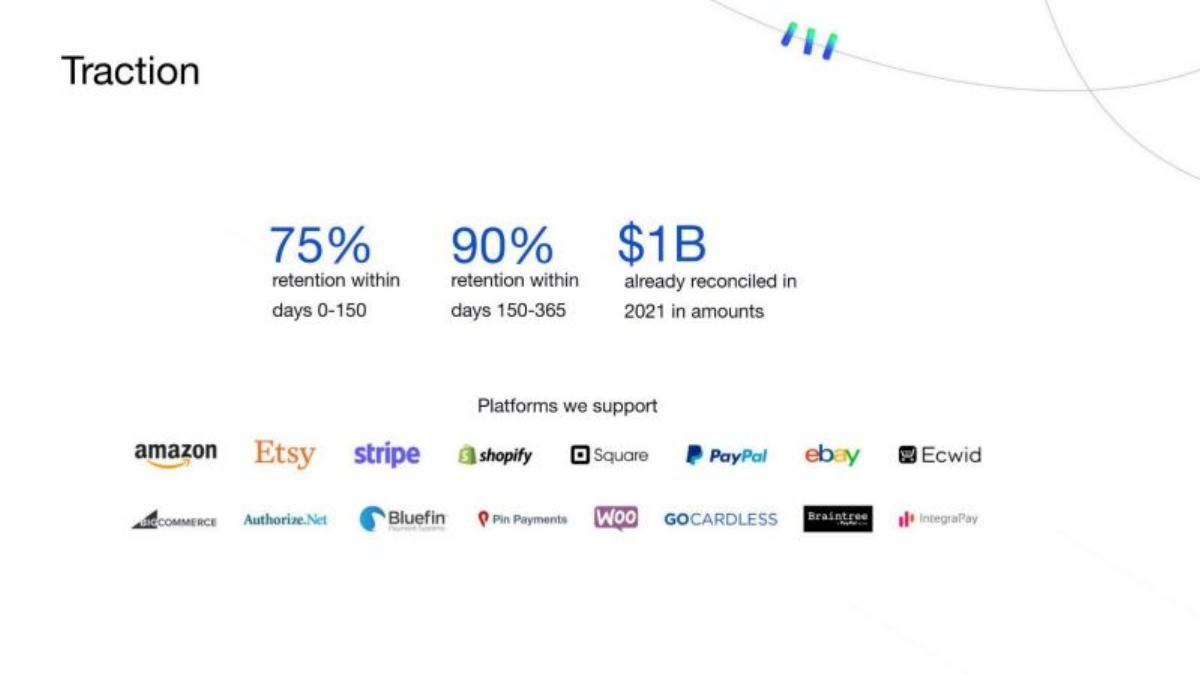
- Synder reports a significant milestone of $1B already reconciled in 2021, demonstrating high transaction volume (Slide 5).
- Retention metrics are a core strength, showing 75% retention within 0-150 days and increasing to 90% within 150-365 days (Slide 5).
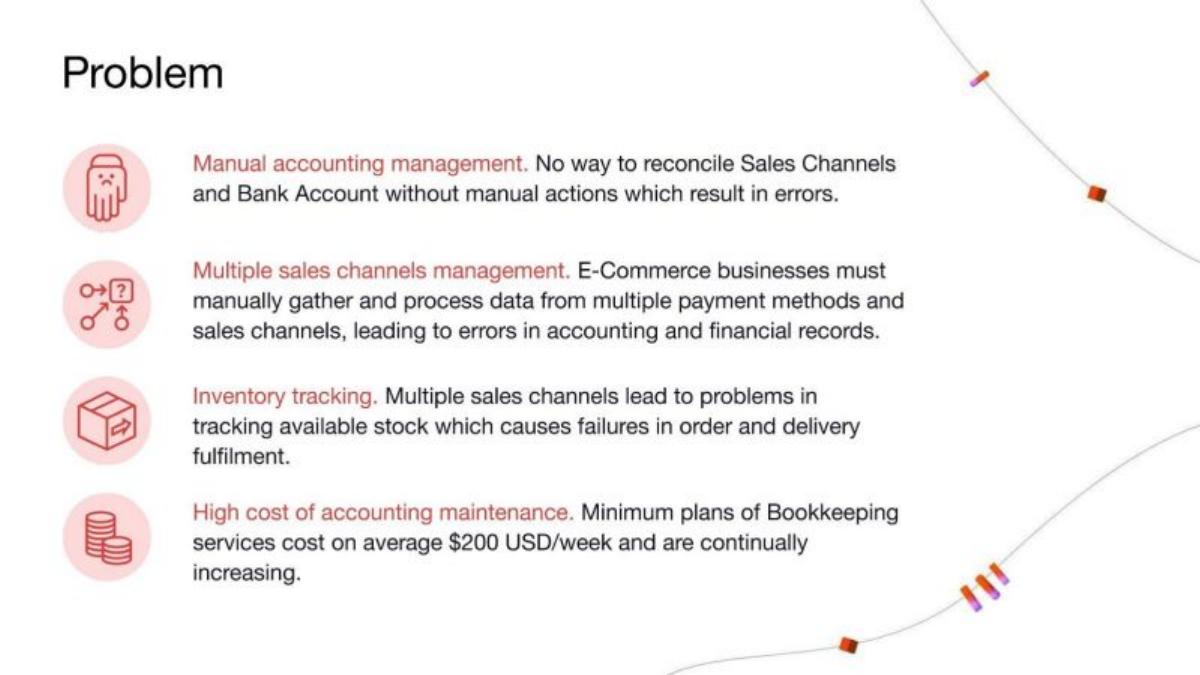
- The problem slide quantifies the cost of manual bookkeeping, stating that minimum plans average $200 USD per week (Slide 3).
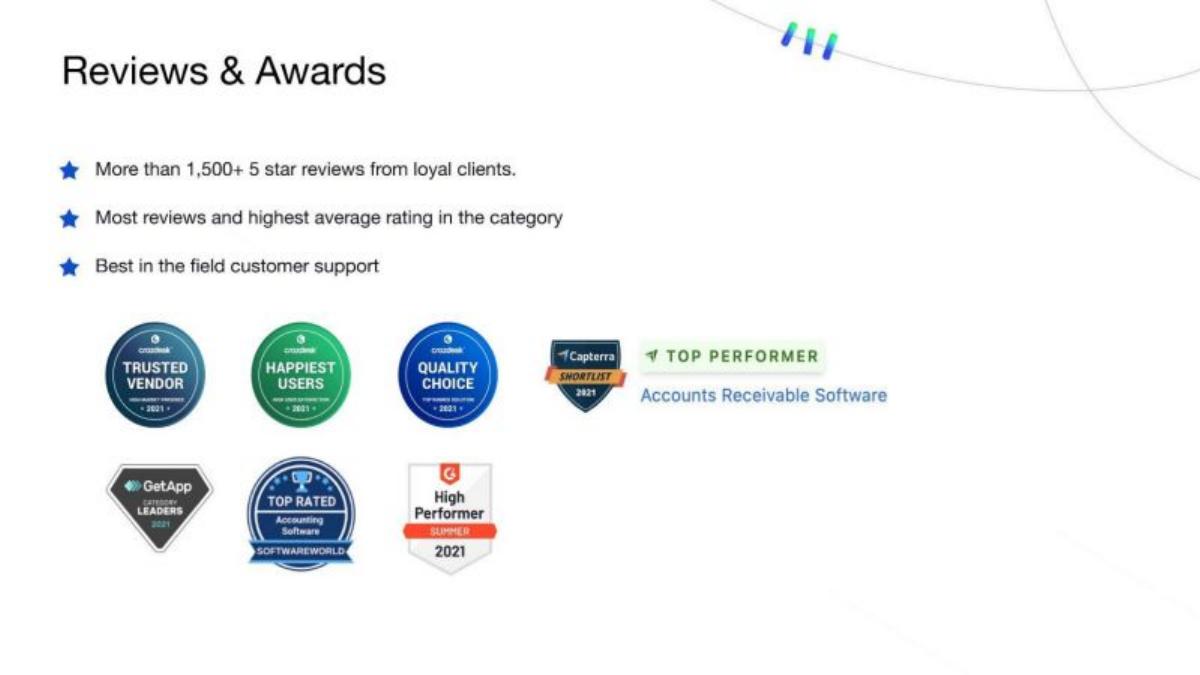
- Social proof is emphasized through 1,500+ five-star reviews and eight distinct industry award badges from platforms like Capterra and G2 (Slide 6).
- The team slide highlights deep domain expertise, with CEO Michael Astreiko having a 6-year focus on accounting platforms like QuickBooks and Xero (Slide 7).
- The deck omits a traditional 'Ask' slide, failing to specify the exact amount being raised or the intended use of funds within the slides themselves.
- Market timing is addressed by citing the surge in e-commerce due to COVID-19, noting that e-commerce then represented only 16% of global commerce (Slide 4).
Introduction
Synder’s 2021 Seed deck is a concise, 9-slide presentation that focuses on the explosive growth of e-commerce and the resulting complexity in financial management. The deck was used to raise $2M, a respectable sum for a Seed round in the accounting automation space. The narrative is straightforward: e-commerce is growing, manual accounting is failing, and Synder has the retention data to prove they have solved the problem.
Slide 1: Title Slide
The cover slide introduces the company name and a clear, one-sentence value proposition: "Easy accounting focused on E-Commerce." The visual identity is established with a blue-heavy color palette and 3D abstract shapes representing data and currency. It is professional and industry-appropriate, immediately signaling that this is a fintech or SaaS tool.
Slide 2: Vision
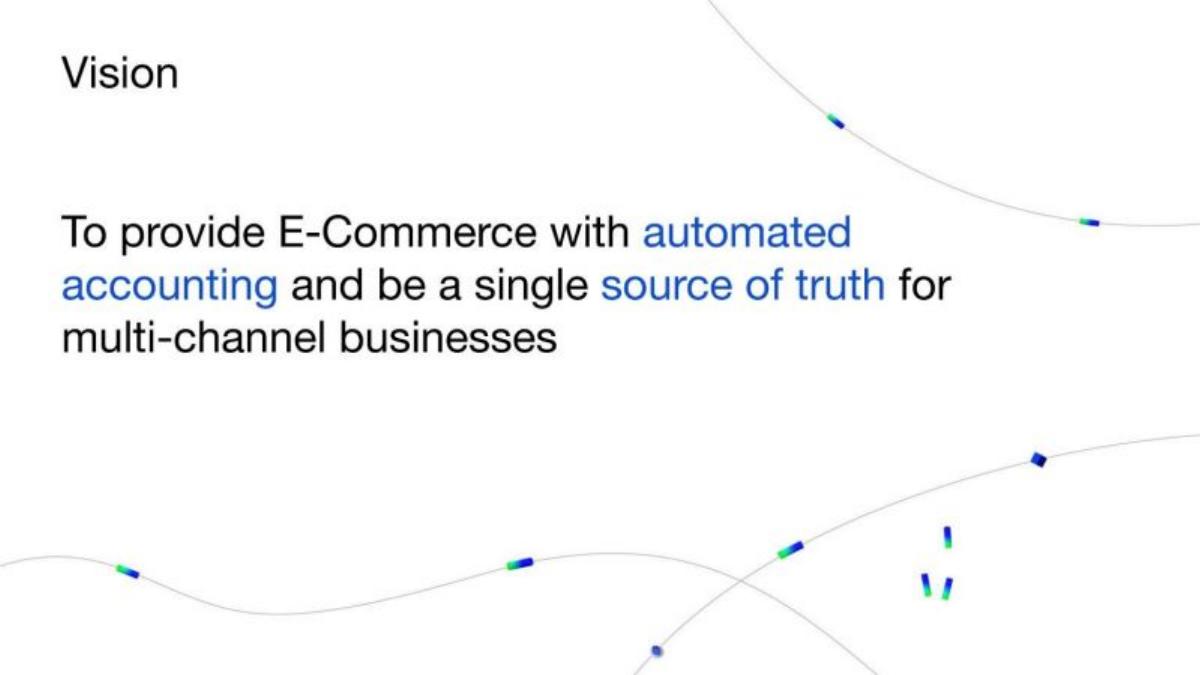
Slide 2 outlines the company's long-term goal: "To provide E-Commerce with automated accounting and be a single source of truth for multi-channel businesses." By using the phrase "single source of truth," Synder is positioning itself not just as a utility, but as the central infrastructure for a merchant's financial data. This is a common strategy for SaaS companies looking to increase their perceived value and defensibility.
Slide 3: Problem
The problem slide breaks down the pain points into four distinct categories: manual accounting management, multiple sales channels, inventory tracking, and high maintenance costs. Notably, it provides a specific figure for the cost of the status quo: "Minimum plans of Bookkeeping services cost on average $200 USD/week and are continually increasing." Quantifying the pain in dollars makes the eventual solution much easier to sell to an investor.
Slide 4: Market and Target
Synder defines its market with specific numbers. They claim there are "about 6.5M E-Commerce businesses in the US" and estimate an addressable market of "~$5.5B/year" at their current price point. The slide also includes a breakdown of the market by platform, showing WooCommerce (26%), Etsy (23%), Amazon (18%), Shopify (17%), and Ebay (15%). A line graph shows the steady climb of e-commerce as a percentage of total retail sales, peaking at a projected 22% in 2023. This slide successfully argues that the market is both large and growing.
Slide 5: Traction
This is arguably the strongest slide in the deck. It moves away from theoretical markets and into hard data. Synder reports 75% retention within the first 150 days, which remarkably increases to 90% retention for users who stay 150-365 days. This indicates a very "sticky" product. Furthermore, they state that $1B has already been reconciled in 2021. The bottom of the slide features a "wall of logos" representing supported platforms, including Stripe, Square, PayPal, and BigCommerce, demonstrating broad compatibility.
Slide 6: Reviews & Awards
Slide 6 is dedicated entirely to social proof. It claims "More than 1,500+ 5 star reviews from loyal clients" and shows badges from Capterra, GetApp, and SoftwareWorld. For a Seed-stage company, this level of third-party validation is rare and serves to mitigate the perceived risk of the product not working as advertised.
Slide 7: Founders
The team slide features two founders: Michael Astreiko (CEO) and Ilya Kisel (COO). The bullet points focus on relevant experience rather than just education. Astreiko is noted for having held CTO roles in four startups and having a "Strong focus on Accounting domain for the last 6 years," specifically mentioning QuickBooks and Xero. Kisel is credited with building a team of 20 and having 7+ years of experience in Customer Success and Sales. This suggests a balanced leadership team with both technical and operational depth.
Slide 8: Contact Us
The final slide provides contact information for Michael Astreiko, including Telegram, email, and the company website. It repeats the tagline from the first slide, maintaining brand consistency. It is a standard closing slide that invites further engagement.
Slide 9: Appendix/Source Credit
The final slide in this specific file is a promotional slide for the source library, bestpitchdeck.com, and is not part of the original Synder presentation.
What Synder Does Well
Synder excels at presenting retention as a proxy for product-market fit . Many Seed decks focus on user acquisition or top-line revenue, but Synder’s decision to highlight that 90% of users stay after the five-month mark is a powerful signal to investors that the product is essential to the customer's workflow. The deck is also highly focused; it doesn't try to be everything to everyone, repeatedly emphasizing its niche in e-commerce.
The use of quantifiable pain points is another strength. By stating that manual bookkeeping costs $200 per week, they set a clear benchmark for their own pricing and value proposition. If their software costs significantly less than $800 a month, the ROI for the customer is immediate and obvious.
What is Missing from the Deck
The most glaring omission is the Ask slide . There is no mention of how much capital is being raised, the valuation being sought, or how the funds will be allocated (e.g., hiring, marketing, R&D). While this information is often removed from decks before they are shared publicly, its absence makes it difficult to evaluate the strategic intent of the round.
Additionally, there is no Business Model slide . While the market slide mentions a "current price point," the deck never explains how Synder actually makes money. Is it a flat monthly subscription? A per-transaction fee? A tiered model based on the number of sales channels? Investors typically want to see the unit economics or at least the pricing structure to understand how the $5.5B TAM translates into company revenue.
Finally, there is no Competition slide . While they list the platforms they integrate with, they do not address other automated accounting tools or the threat of the platforms themselves (like Shopify or QuickBooks) building native reconciliation features that could sherlock Synder’s functionality.
Founder Takeaways
Focus on the 'Why Now': Synder effectively used the COVID-19 pandemic as a tailwind for their narrative. Founders should always look for macro trends that make their specific solution more urgent today than it was two years ago.
Let others speak for you: If you have 1,500 five-star reviews, you don't need to spend three slides explaining why your product is good. A single slide of badges and review counts can be more persuasive than a dozen feature descriptions.
Retention is king: If your retention numbers are high, lead with them. In a SaaS environment, high retention is the ultimate proof that you have built something people actually need, which is the primary question investors are trying to answer at the Seed stage.
Keep it brief: Synder proved that you don't need 20 slides to raise $2M. By sticking to the core pillars of Problem, Market, Traction, and Team, they created a fast-moving narrative that respects the investor's time.
Frequently asked questions
- How much did Synder raise with this deck?
- According to the catalogue listing from bestpitchdeck.com, Synder raised $2M in a Seed round in 2021. Interestingly, the deck itself does not explicitly state the fundraising goal or the terms of the round on any of its nine slides, which is a common omission in decks shared publicly after the close.
- What is Synder's primary value proposition?
- Synder positions itself as a 'single source of truth' for multi-channel e-commerce businesses. As stated on Slide 2 and Slide 3, the platform automates the reconciliation of sales channels and bank accounts, eliminating manual data entry errors and reducing the high cost of traditional bookkeeping services.
- What specific traction metrics did the founders highlight?
- The founders focused on three primary metrics on Slide 5: a 75% short-term retention rate, a 90% long-term retention rate, and a total of $1B in reconciled transaction volume for the year 2021. This combination of high stickiness and significant scale is a strong signal for Seed-stage investors.
- Who are the competitors mentioned in the deck?
- The deck does not include a traditional competitor matrix. Instead, it lists the platforms Synder supports and integrates with, such as Shopify, Amazon, and Stripe (Slide 5), and mentions the accounting ecosystems the founders have experience with, including QuickBooks, Xero, and Sage (Slide 7).
- What is the target market size for Synder?
- Slide 4 defines the target market as 6.5M e-commerce businesses in the U.S. alone. Based on their current price point, they estimate the Addressable Market to be approximately $5.5B per year. They also note that e-commerce only accounted for 16% of global commerce at the time, suggesting significant room for growth.