Planet Clean Recycling International (PCRI) presents a deck focused on scaling a mature plastic recycling business into a global operation with a unique logistical twist. The company, led by Rana Kashif Shahzad, has nearly three decades of experience in markets like the UAE, Pakistan, and China, with a current capacity of over 1,000 metric tons. Their primary innovation is the 'Hybrid Freight and Production Ship,' designed to process plastics at sea to save time and labor costs. The deck also outlines a move into the U.S. market, specifically Tennessee, to leverage tax incentives and proximit…
Key takeaways
- The company claims a 30-year track record in global markets including the UAE, Pakistan, India, China, and Hong Kong (Slide 4).
- A core value proposition is the 'Hybrid Freight and Production Ship' which intends to process plastics while in transit to increase profit margins (Slide 5).
- Planet Clean plans to establish an 80,000 sq ft manufacturing facility in Tennessee to capitalize on U.S. tax incentives and corporate demand (Slide 6).
- The management team features deep industry experience, specifically citing the founding of Hi Technological Plastic Industries in the UAE in 2013 (Slide 7).
- Financial projections estimate revenue growing from $21.69M in 2020 to $28.87M by 2024 (Slide 9).
- Key financial assumptions include a $1,205 selling price per ton and a $650 purchase price per ton for plastic (Slide 9).
- The deck assumes a 0% tax rate based on the business being export-focused, though it includes a disclaimer to verify this with accountants (Slide 9).
- There is no specific dollar amount requested from investors or a breakdown of how funds will be allocated across the ship and factory projects (Slide 10).
Planet Clean Pitch Deck Analysis
Planet Clean Recycling International (PCRI) presents a deck that attempts to bridge the gap between traditional industrial manufacturing and innovative maritime logistics. The company leverages a long history in the Middle Eastern and Asian recycling markets to pitch a two-pronged expansion: a unique at-sea processing model and a conventional land-based expansion into the United States.
Slide 1: Title and Branding
The cover slide introduces the company as Planet Clean and uses the hashtag #RecycleSmarter. The imagery of a clean beach and ocean serves as a thematic backdrop for their environmental mission. The logo uses a green and blue palette, reinforcing the connection between land and sea recycling.
Slide 2: The Problem
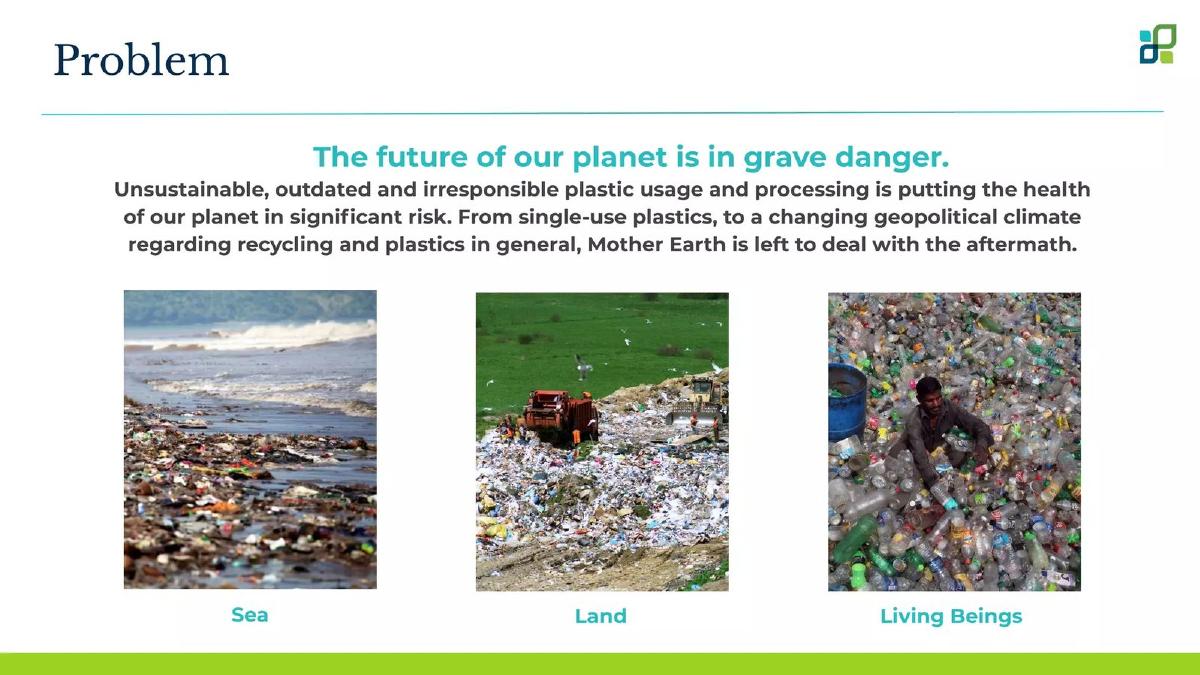
Slide 2 defines the problem in broad, emotional terms, stating that the "future of our planet is in grave danger." It categorizes the impact into three areas: Sea, Land, and Living Beings, accompanied by photos of polluted coastlines and landfills. While it establishes the 'why,' it lacks specific data points on the volume of plastic waste or the inefficiencies in current recycling rates that the company intends to solve.
Slide 3: Mission Statement
This slide positions PCRI as the leader of the "next global revolution of plastic processing." It emphasizes that the company focuses on the "underserved and overlooked." This is a common framing for companies operating in emerging markets or utilizing unconventional logistics, though the slide remains high-level without defining what those underserved areas are.
Slide 4: Planet Clean Recycling At-a-Glance
This slide provides essential credibility. It claims the team has nearly 30 years of experience in markets including the UAE, Pakistan, India, China, Hong Kong, and East Africa. It notes their evolution from a trading house for recycled polymers to a manufacturing business with a capacity of over 1,000 metric tons. This establishes that the founders are not newcomers to the space, but rather experienced operators looking to scale.
Slide 5: P.1: Hybrid Freight and Production Ship
This is the most technically ambitious part of the deck. The company proposes acquiring ships to process plastics at sea while sailing to the Middle East, Africa, or Asia. The slide claims this will "save time," "save costs by maximizing labor," and "increase profit margins." A simple graphic shows a ship divided into Phase 1 and Phase 2 of production. However, the slide does not address the significant engineering challenges of operating heavy recycling machinery (which often requires stable power and environments) on a moving vessel.
Slide 6: P.3: U.S. Based Plastics Processing Plants
The deck shifts to a land-based strategy here, specifically targeting Tennessee. The plan calls for an 80,000 sq ft facility. The rationale is three-fold: Tennessee is "plastic rich," offers tax incentives, and is home to corporations with mandates to buy recycled plastic. This slide is much more grounded in traditional business logic than the ship proposal, identifying a specific geographic advantage and a clear customer base (Fortune 500 corporations).
Slide 7: The Management Team
This slide focuses on Rana Kashif Shahzad (CEO) and Naseem Akhter (Compliance). It provides a detailed biography of Mr. Shahzad, highlighting his success in building Hi Technological Plastic Industries in the UAE, which grew to 75 employees. This is a strong signal for investors, as it proves the CEO has successfully managed a growing workforce and a manufacturing P&L in this specific sector.
Slide 8: PCR Team Cont’d
The team slide continues with Nafees Ahmad (Supervisor) and Awais Rehmat Ali (Sales Manager). Both individuals have direct experience at Hi Technological Plastic Industries and Osama Plastic Pipe Industry. The biographies emphasize practical, hands-on experience in manufacturing specific products like LDPE-Natural Clear Granules and PVC pipes. This reinforces the narrative that the team understands the technical side of the business.
Slide 9: P.2 Financial Projections - Factory
Slide 9 provides a five-year financial outlook for the factory component of the business. Revenue is projected to grow from $21.69M in 2020 to $28.87M in 2024. The net income is projected to start at $3.66M and reach $6.71M. Key assumptions are listed at the bottom: a 5% cargo load growth per year, a $1,205 selling price per ton, and a $650 purchase price per ton. Notably, they assume a 0% tax rate because the business is exporting, though they include a red-text disclaimer advising investors to check with accountants.
Slide 10: Conclusion
The final slide is a summary statement rather than a call to action. It mentions that the principals believe they can execute the plan within five years. It uses the phrase "unique and innovative processing operation stack" to describe their model. However, the slide is missing a specific "Ask"—there is no mention of the amount of capital required to fund the ships or the Tennessee factory.
What Planet Clean Does Well
The deck excels at establishing founder-market fit . By detailing the specific companies the management team previously built and the exact types of plastic granules they produced, they move beyond the "save the planet" rhetoric into the reality of industrial operations. The financial slide is also commendable for its transparency regarding assumptions; providing the specific purchase and sale price per ton allows an investor to immediately stress-test the margins against current market commodity prices.
Furthermore, the geographic focus on Tennessee shows a strategic understanding of the U.S. regulatory and corporate landscape. Instead of a vague "national launch," they have identified a specific state with favorable tax conditions and a high concentration of potential corporate off-takers.
What Is Missing from the Deck
The most glaring omission is the Investment Ask . An investor deck without a specific dollar amount, a use of proceeds, or a proposed valuation leaves the audience wondering what the next step is. Given the capital-intensive nature of acquiring ships and building 80,000 sq ft factories, the funding requirement is likely in the tens of millions, but the deck doesn't confirm this.
Additionally, the Hybrid Freight Ship concept requires much more technical validation. The deck treats "processing at sea" as a simple logistical win, but it ignores the complexities of maritime regulations, the energy requirements of plastic extruders, and the stability needed for precision manufacturing. A slide dedicated to the engineering feasibility or a pilot test of this ship model is missing. Finally, there is no Competition slide. The recycling industry is highly competitive, with both established waste management giants and new chemical recycling startups; Planet Clean does not explain how it will defend its market share against these players.
What a Founder Should Copy
Founders should emulate the Management Team slides (Slides 7 and 8). Instead of just listing logos of past employers, PCRI provides a narrative of growth—starting with 15 employees and scaling to 75. This tells a story of operational competence. The Key Assumptions section on the financial slide (Slide 9) is also a best practice. By listing the specific price per ton, the founders show they are thinking about the unit economics of their business, not just the top-line revenue numbers. This level of detail builds trust with sophisticated investors who understand that commodity-based businesses live and die by their margins.
Frequently asked questions
- What is the primary innovation Planet Clean is pitching?
- The primary innovation is the 'Hybrid Freight and Production Ship.' As detailed on Slide 5, the company plans to acquire ships and install processing equipment to convert plastic waste into finished products while the vessel is in transit between continents. This is intended to maximize labor efficiency and eliminate the downtime typically associated with long-haul maritime freight.
- How does the company plan to enter the North American market?
- According to Slide 6, the company is targeting the State of Tennessee for an 80,000 sq ft processing plant. They cite Tennessee's status as a 'plastic rich state' and the availability of tax incentives as primary drivers. The strategy is to position the facility near large corporations that have social responsibility mandates requiring the purchase of recycled domestic plastic.
- What is the historical background of the management team?
- The team has significant roots in the UAE plastics industry. CEO Rana Kashif Shahzad founded Hi Technological Plastic Industries, LLC in 2013, growing it from 15 to over 75 employees (Slide 7). Other team members, like Nafees Ahmad and Awais Rehmat Ali, also transitioned from roles at Osama Plastic Pipe Industry to Hi Technological Plastic Industries before joining PCRI (Slide 8).
- What are the projected margins for the factory operations?
- Based on the table on Slide 9, the company projects a gross profit of $9.99M on $21.69M in revenue for 2020, representing a gross margin of approximately 46%. By 2024, they project a net income of $6.7M. These figures are based on a purchase price of $650 per ton and a selling price of $1,205 per ton.
- What critical information is missing from the pitch deck?
- The deck lacks a clear 'Ask' slide; while it invites investment on Slide 10, it does not state how much capital is being raised or the valuation. Additionally, there is no detailed breakdown of the costs associated with acquiring and retrofitting a production ship, which is a significant capital expenditure compared to a land-based factory.