Pixeom’s 11-slide Series A deck is a technical briefing designed for investors who understand the shift from centralized cloud to distributed edge computing. The narrative focuses heavily on the 'latency and cost tradeoffs' of traditional cloud architectures, positioning Pixeom as the 'AWS of a 12-figure market.' While the deck lacks a traditional 'Ask' slide or detailed financial projections, it compensates with strong social proof, citing 'dozens of Fortune 500 customers' and a team with multiple exits from giants like EMC and Dell. The visual language is functional rather than aesthetic, r…
Key takeaways
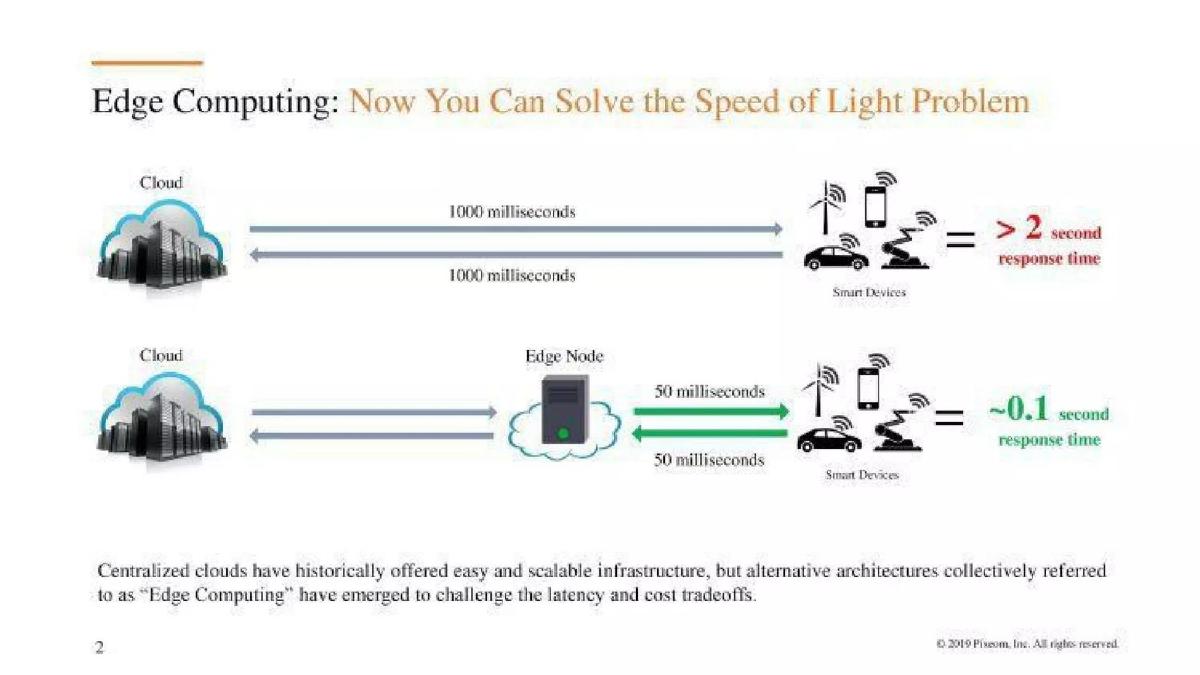
- The deck identifies a specific 'Speed of Light Problem,' showing how edge nodes reduce response times from >2 seconds to ~0.1 seconds on slide 2.
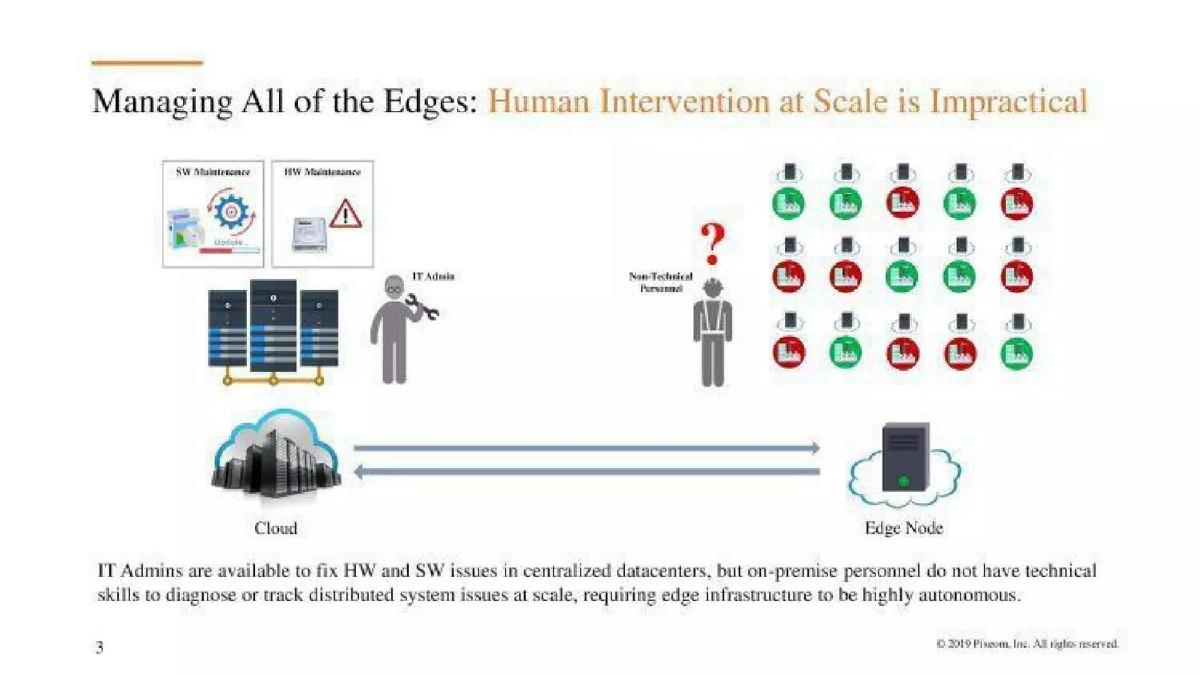
- It highlights a massive operational gap: IT admins can manage centralized data centers, but on-premise personnel lack the skills for distributed systems, necessitating autonomous infrastructure as shown on slide 3.
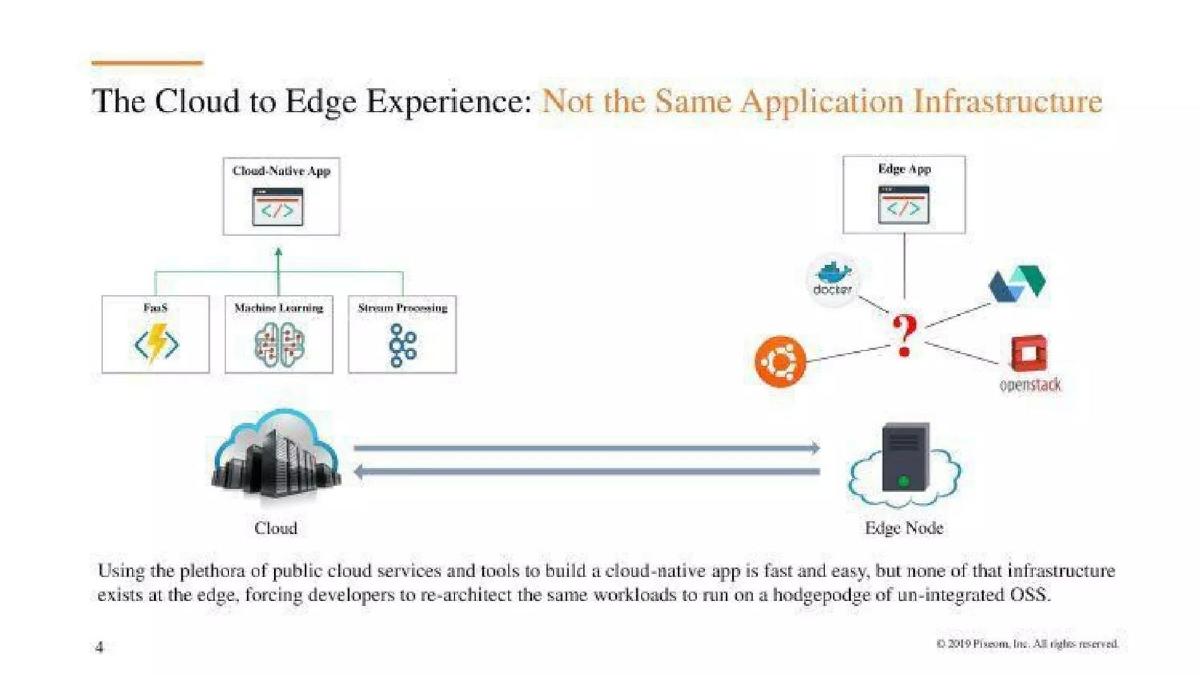
- Pixeom positions itself as a solution to the 'hodgepodge of un-integrated OSS' that developers currently face when moving from cloud to edge on slide 4.
- The company explicitly aims to become the 'next AWS' of a 12-figure market, targeting industries like Oil & Gas, Telecom, and Manufacturing on slide 5.
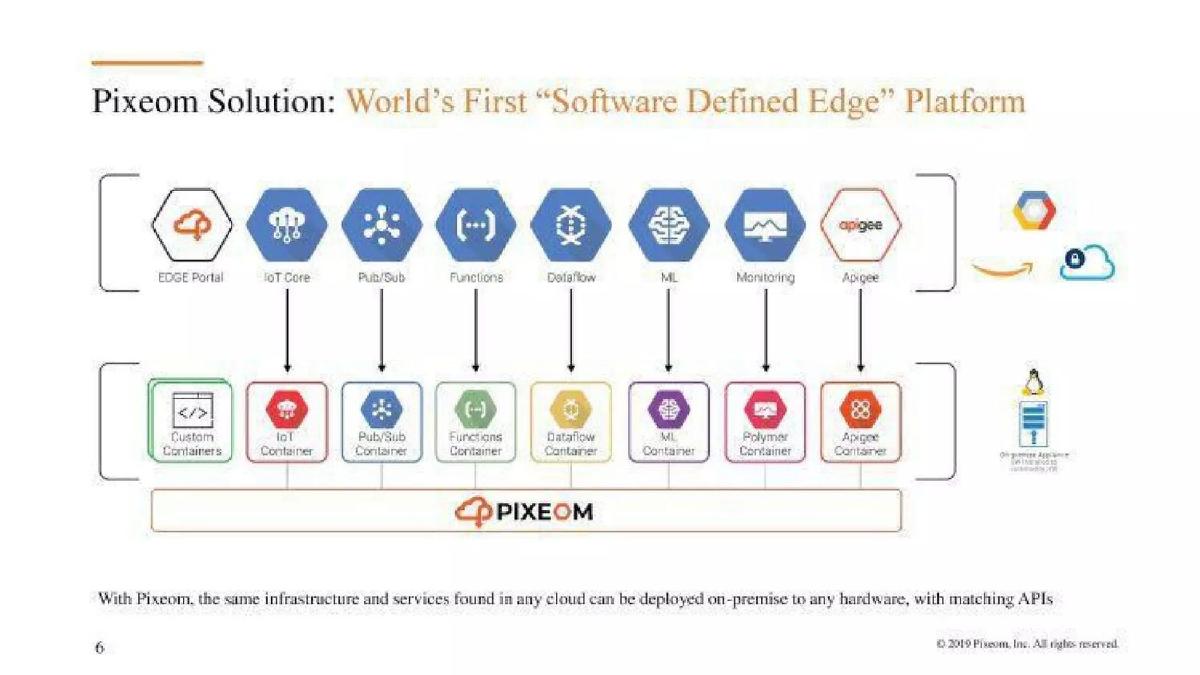
- The 'Software Defined Edge' platform is shown to replicate eight specific cloud services, including Functions, Dataflow, and ML, for on-premise deployment on slide 6.
- Traction is quantified on slide 10, noting 90+ FTEs, $15M+ raised to date, and 4x-5x year-over-year growth.
- The team slide (slide 10) emphasizes deep industry experience, citing 25+ years of experience for both the CTO and VP of Engineering, with histories at DEC, EMC, and VMware.
- There is no slide dedicated to competition, unit economics, or a specific fundraising target for the current round.
The Technical Infrastructure of the Edge
Pixeom’s pitch deck is a highly specialized document. Unlike many consumer-facing startups that lead with emotional hooks or lifestyle imagery, Pixeom leads with physics and architecture. The deck, dated 2019, represents a Series A stage company that has already moved past the experimental phase, boasting a team of 90+ and significant enterprise traction. The narrative is built on a single premise: the cloud is too slow and too hard to manage for the next generation of smart devices. By positioning themselves as the 'Software Defined Edge,' Pixeom attempts to claim the middle ground between the centralized cloud (AWS/Azure) and the raw hardware of the Internet of Things (IoT).
Slides 1-2: The Physics of Latency
Slide 1 is a standard title card featuring the logo and the tagline 'Leading Edge Computing.' It is clean and professional, establishing the brand's orange-and-black color palette which persists throughout the deck.
Slide 2 introduces the core problem: 'Edge Computing: Now You Can Solve the Speed of Light Problem.' This slide uses a simple diagram to compare response times. A centralized cloud architecture is shown resulting in a '> 2 second response time' due to 1000ms travel times in each direction. Below it, the 'Edge Node' architecture is shown reducing this to a '~0.1 second response time' with 50ms travel times. The text at the bottom notes that while centralized clouds are scalable, they face 'latency and cost tradeoffs' that edge computing is designed to challenge.
Slides 3-5: The Operational and Market Gap
Slide 3 addresses the 'Human Intervention' problem. It argues that 'Managing All of the Edges: Human Intervention at Scale is Impractical.' The visual contrasts an IT Admin in a centralized data center with a 'Non-Technical Personnel' at an edge site who is marked with a red question mark. The takeaway is that edge infrastructure must be 'highly autonomous' because the people on-site cannot diagnose or track distributed system issues.
Slide 4 focuses on the developer experience. Titled 'The Cloud to Edge Experience: Not the Same Application Infrastructure,' it highlights the difficulty of moving cloud-native apps (built with FaaS, ML, and Stream Processing) to the edge. The slide claims developers are currently forced to 're-architect the same workloads to run on a hodgepodge of un-integrated OSS [Open Source Software].' This sets up Pixeom as the integrator that provides a unified experience.
Slide 5 defines the market opportunity. It lists nine industries—including Oil & Gas, Telecom, and Manufacturing—under the header 'Universal Need.' The boldest claim of the deck appears here: 'The company which develops the most easy, effective, and scalable Edge Computing platform will be positioned to become the next "AWS" of a 12 figure market.' This is a classic venture scale argument, framing the company as a platform play rather than a point solution.
Slides 6-8: The Solution and Architecture
Slide 6 introduces the 'Pixeom Solution: World’s First "Software Defined Edge" Platform.' This is a dense architectural slide showing how Pixeom replicates cloud services. It lists eight specific modules: EDGE Portal, IoT Core, Pub/Sub, Functions, Dataflow, ML, Monitoring, and Apigee. The slide explains that the 'same infrastructure and services found in any cloud can be deployed on-premise to any hardware, with matching APIs.'
Slide 7 reinforces this with a deployment diagram. It shows the Pixeom logo in a central cloud, managing geographically distributed infrastructure at 'massive scale.' It explicitly mentions compatibility with Kubernetes and Docker, signaling to technical investors that the platform fits into existing modern DevOps workflows.
Slide 8 breaks down the 'Pixeom Components.' It identifies three parts of the system: 1. Pixeom Edge IoT Core(s) (the on-premise appliances), 2. Pixeom Edge IoT Portal (the backend management), and 3. Pixeom Edge IoT Publisher (the IDE/development environment). This slide is crucial for understanding that Pixeom is a full-stack offering, covering the hardware/software interface, the management layer, and the developer tools.
Slides 9-11: Traction, Team, and Contact
Slide 9 is a simple placeholder that says 'DEMO.' In a live pitch, this would be the moment the founder proves the software actually works, which is vital for a technical infrastructure play.
Slide 10 is the 'Executive Team' slide, and it is one of the strongest in the deck. It features three leaders: Sam Nagar (CEO, ex-Microsoft), Leo Salazar (CTO, 25+ years experience, ex-Dell/EMC), and Roger Gaudet (VP Engineering, 25+ years experience, ex-VMware/EMC). The text at the bottom provides the 'hard' traction metrics: 90+ FTEs, $15M+ raised, 'dozens of Fortune 500 customers,' and 'growing 4x-5x YoY.' It also notes the company has been in operation since 2014, suggesting a level of maturity and stability.
Slide 11 is the 'End of Document' and contact slide, providing the CEO’s email and phone number.
What Works in the Pixeom Deck
The deck excels at technical clarity . For an investor who understands infrastructure, the diagrams on slides 6 and 8 explain exactly what the product does without needing a long-winded explanation. It maps its features directly to known AWS services, which makes the value proposition immediately recognizable.
The social proof on slide 10 is also highly effective. Mentioning 'dozens of Fortune 500 customers' and '4x-5x YoY' growth provides the necessary validation that this isn't just a research project, but a commercially viable enterprise solution. The team's pedigree—specifically the 25+ years of experience at industry titans like EMC and Dell—is perfectly aligned with the technical complexity of the product.
What is Missing from the Pixeom Deck
The most glaring omission is the Competitive Landscape . The edge computing space is crowded with both startups and incumbents (like AWS Outposts or Azure Stack). The deck never explains why a customer would choose Pixeom over a first-party solution from their existing cloud provider.
There is also no Financial Detail . While the deck mentions growth rates, it lacks revenue figures, burn rate, or unit economics. For a Series A or B round, investors typically expect to see a path to profitability or at least a clear understanding of the sales cycle and customer acquisition costs.
Finally, the deck lacks a Call to Action or 'The Ask.' It does not state how much money the company is looking to raise or what the specific milestones for the next 18-24 months are. This makes the deck feel more like a general capabilities briefing than a targeted fundraising tool.
What a Founder Should Copy
Founders building technical products should copy the Problem-Solution Mapping found in slides 2 and 6. Pixeom identifies a physical constraint (latency) and an operational constraint (lack of on-site expertise) and then shows a solution architecture that addresses both.
The Industry Verticalization on slide 5 is also a great template. By showing specific use cases (Oil rigs, factories, retail stores), they move the conversation from abstract 'edge computing' to concrete business value. If you are building a platform, showing the breadth of industries you can serve—without losing focus on the core technology—is a powerful way to demonstrate market size.
Final Thoughts
Pixeom’s deck is a 'meat and potatoes' infrastructure pitch. It isn't flashy, but it is authoritative. It relies on the strength of its technical architecture and the seniority of its team to carry the weight. While it could benefit from more competitive positioning and financial transparency, it successfully communicates the 'why now' of edge computing by framing it as a fundamental shift in how the world processes data.
Frequently asked questions
- What is the primary problem Pixeom is solving?
- Pixeom addresses the latency and management issues inherent in centralized cloud computing. Slide 2 illustrates the 'Speed of Light Problem,' where round-trip data travel to the cloud takes over 2 seconds, whereas edge nodes reduce this to 0.1 seconds. Additionally, slide 3 points out that while central data centers have IT admins, edge locations lack technical staff, requiring a platform that can manage distributed infrastructure autonomously at scale.
- How does Pixeom define its product category?
- The company calls itself the 'World’s First Software Defined Edge Platform.' According to slides 6 and 7, this means providing a layer that allows cloud-native services—such as Machine Learning, IoT Core, and Pub/Sub—to be deployed on-premise to any hardware with matching APIs. It essentially acts as a translation and management layer between cloud-native applications and geographically distributed edge hardware.
- What evidence of market traction does the deck provide?
- Traction is primarily presented on slide 10. The company states it has been in operation since 2014 and is growing at a rate of 4x-5x year-over-year. Most significantly, they claim to have deployed their technology with 'dozens of Fortune 500 customers.' The deck also mentions a team size of over 90 full-time employees and a total of $15M+ raised prior to or including this deck's cycle.
- Which industries is Pixeom targeting?
- Slide 5 lists nine specific industries that benefit from edge computing: Oil & Gas, Telecom, Manufacturing, Entertainment, Gaming, Retail, Security, Agriculture, and Finance. The deck argues that any industry requiring low-latency processing or handling massive distributed data sets is a candidate for their 'AWS-like' edge infrastructure.
- What are the most notable omissions in this pitch deck?
- The deck is missing several standard venture components. There is no 'Ask' slide detailing how much capital is being raised in the current round or how it will be spent. There is no competitive landscape slide to differentiate Pixeom from other edge players or cloud providers. Finally, there are no detailed financial charts, unit economics, or specific revenue figures beyond the YoY growth percentage.