Piper’s 10-slide angel deck is a masterclass in using social proof to overcome the inherent skepticism of hardware startups. By the fourth and fifth slides, the company has already showcased endorsements from Steve Wozniak and Elon Musk, effectively silencing doubts about product-market fit. With 2,100+ units sold and $500K in revenue, the deck focuses on momentum rather than complex technical specifications. While it lacks a formal 'Ask' slide or a detailed roadmap, the combination of high-tier academic pedigree (Princeton, Oxford, MIT, Stanford) and strong unit economics (>60% margins) make…
Key takeaways
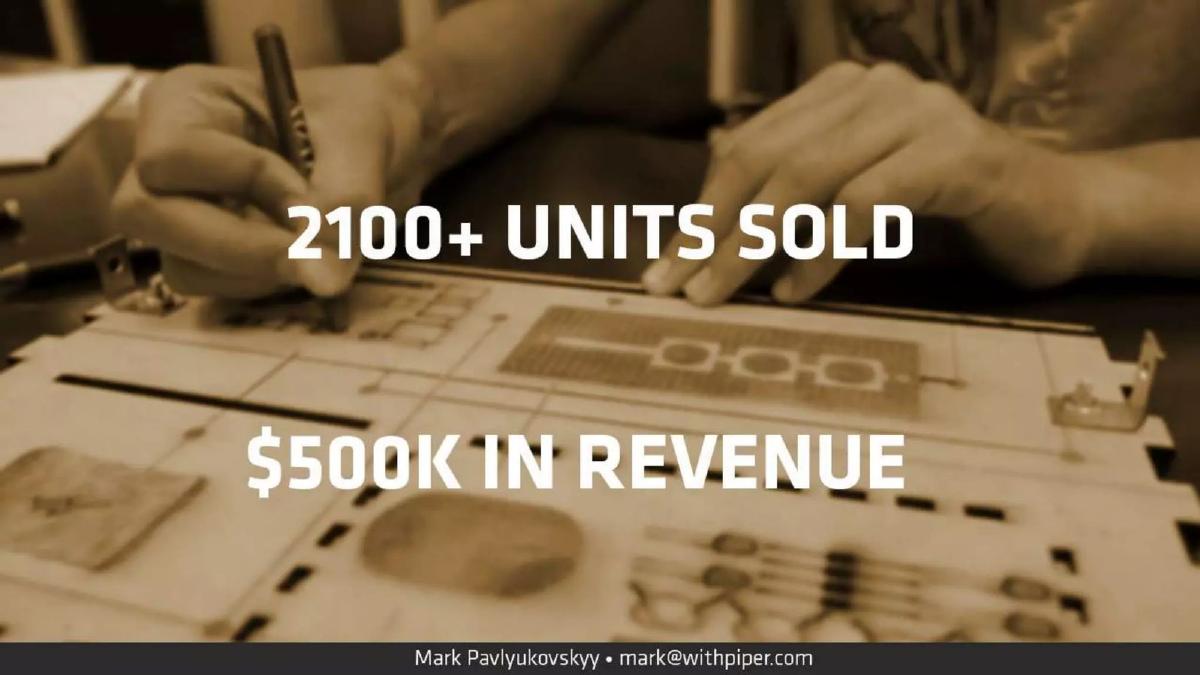
- The company demonstrates significant early traction with 2,100+ units sold and $500K in revenue on slide 3.
- High-impact social proof is used early, featuring a direct quote from Apple co-founder Steve Wozniak on slide 4.
- The deck claims Elon Musk purchased 8 units for his children and their school, providing a powerful celebrity customer testimonial on slide 5.
- Unit economics are stated as having >60% margins, a critical metric for hardware sustainability shown on slide 7.
- The market opportunity is defined by two large figures: a $40 billion parental spend on educational products and a $100 billion US schools market on slide 8.
- The founding team possesses elite academic credentials from Princeton, Oxford, MIT, and Stanford, as detailed on slide 9.
- The deck completely omits a specific funding 'Ask' or a breakdown of how the $165K would be utilized.
- Visual storytelling is prioritized, with 4 out of 10 slides dedicated almost entirely to photos of the product in use by children.
The Power of the 'Celebrity' Customer
Piper’s pitch deck is a concise, 10-slide presentation that leans heavily on the 'show, don't tell' philosophy. In the world of hardware, where manufacturing risks and inventory costs often scare off angel investors, Piper uses social proof as a shield. By the time an investor reaches slide 5, they have seen $500K in revenue and endorsements from two of the most recognizable names in technology. This teardown examines how Piper structured its narrative to move from product excitement to financial viability.
Slide 1: Title and Mission
The cover slide introduces the brand with the logo 'PIPER' and the tagline 'Creating Inventors.' It features a high-quality photograph of children looking at a wooden box while a mentor (Co-founder Joel Sadler) looks on. The contact information for Mark Pavlyukovskyy is clearly displayed at the bottom, a practice maintained throughout the deck. This slide immediately establishes the target demographic (children) and the emotional hook (empowerment/invention).
Slide 2: The Product Reveal
Slide 2 is a minimalist visual of a single laser-cut wooden board. This serves as a transition, hinting at the 'DIY' and 'maker' nature of the product without using a single word of copy. It builds curiosity about how a flat piece of wood becomes a tool for 'creating inventors.'
Slide 3: Traction and Revenue
Piper does not wait until the end of the deck to talk about money. Slide 3 features a sepia-toned background of someone working on the kit with bold white text: '2100+ UNITS SOLD' and '$500K IN REVENUE.' This is a critical move for an angel-stage company. It proves that the product isn't just a prototype; it is a validated commercial entity with half a million dollars in trailing or projected sales.
Slide 4: The Wozniak Endorsement
Social proof is the core of this deck. Slide 4 features a large photo of Apple co-founder Steve Wozniak with the quote: 'I love Piper because it represents what enabled me to do all the great technology things in my life.' For an EdTech hardware company, there is perhaps no higher form of validation than the man who built the Apple I and II. It frames Piper not as a toy, but as a foundational tool for the next generation of engineers.
Slide 5: The Musk Connection
If Wozniak provides the historical validation, Elon Musk provides the modern-day relevance. Slide 5 states: 'Elon Musk Purchased 8 units for his kids and their school.' This slide serves two purposes: it reinforces the product's appeal to high-net-worth 'tech parents' and suggests a potential for institutional (school) sales, which is a key growth lever in EdTech.
Slide 6: User Testimonial
Following the celebrity endorsements, slide 6 brings it back to the actual users. It shows two children with the product and the caption 'I like Piper because...' This humanizes the product and shows that children find it engaging, which is the ultimate test for any educational tool.
Slide 7: Unit Economics
Slide 7 is the most 'business-heavy' slide in the deck. It shows an exploded view of the kit's components—Raspberry Pi, wires, breadboards, and wooden panels—alongside a finished unit. The key text here is '>60% margins.' In hardware, margins are everything. By stating a 60%+ margin, Piper signals to investors that they have a handle on their supply chain and that the business is capable of generating significant cash flow as it scales.
Slide 8: Market Size
The market slide (Slide 8) uses two large circles to define the opportunity: '$40 billion' spent by parents on educational products and a '$100 billion US schools market.' This slide is intended to show that while they are currently selling to individuals (B2C), the B2B (School) market represents a massive expansion opportunity. However, it lacks a 'TAM/SAM/SOM' breakdown, opting for broad, top-down numbers instead.
Slide 9: The Founders
The 'Founders' slide (Slide 9) is a 'pedigree' slide. Mark Pavlyukovskyy is linked to Princeton and Oxford. Joel Sadler is linked to MIT and Stanford, with an Apple logo and a mention of a previous exit (D-Rev). This combination of Ivy League/Elite education and practical industry experience at the world’s most successful hardware company (Apple) is designed to de-risk the execution of the business plan.
Slide 10: The Collage
The final slide is a collage of children using the product in various settings—at home, in classrooms, and at maker fairs. It repeats the contact information for the CEO. This slide reinforces the 'Creating Inventors' mission and leaves the investor with a visual reminder of the product's impact.
What Piper Does Exceptionally Well
The standout feature of this deck is its unapologetic use of social proof . Most startups struggle to get a single testimonial; Piper leads with two of the biggest names in the history of Silicon Valley. This creates an immediate 'fear of missing out' (FOMO) for investors. If Elon Musk is buying it for his kids, the product must be good.
Furthermore, the clarity of the unit economics on slide 7 is a masterstroke. Hardware is notoriously difficult to fund because of 'hardware is hard' tropes regarding low margins and high shipping costs. By putting '>60% margins' in bold, they address the biggest investor objection before it can even be raised.
What is Missing from the Piper Deck
Despite its strengths, the deck has several glaring omissions that would typically be required in a more formal Seed or Series A round:
The Ask: There is no slide stating how much money they are raising, the valuation, or the specific milestones they intend to hit with the capital. · The Roadmap: We see the current product, but we don't see what comes next. Is there a software subscription? Are there expansion packs? The deck is silent on future product development. · Competition: The deck ignores the existence of LEGO Mindstorms, Kano, or LittleBits. Investors generally want to see that a founder understands their competitive positioning. · Distribution Strategy: While the market size is mentioned, the deck doesn't explain how they will capture the $100 billion school market. Is it a direct sales force? Partnerships? Retail?
What Other Founders Should Copy
1. Lead with Traction: Don't hide your revenue on slide 12. If you have $500K in sales, put it on slide 3 like Piper did. It changes the entire tone of the meeting from 'if' to 'how fast.'
2. High-Quality Visuals: Piper uses professional photography that makes the product look premium. In hardware, the aesthetic of the kit and the packaging (as seen on slide 7) is part of the value proposition.
3. Use 'Anchor' Customers: You don't need Elon Musk, but you do need someone recognizable in your niche. If a respected industry leader uses your product, that is more valuable than ten slides of market research.
4. Keep it Lean: 10 slides is the perfect length for an initial pitch. It provides enough information to hook an investor without overwhelming them with technical data that is better suited for a follow-up due diligence meeting.
Frequently asked questions
- How much did Piper raise with this deck?
- According to the catalogue facts, Piper raised $165,000 in an Angel Round in 2013. The deck itself does not state the amount raised or the terms of the investment, which is common for decks shared after the round has closed or for those used as a visual aid during a live pitch.
- What is the core product being pitched?
- The product is a DIY computer kit designed for children, branded with the tagline 'Creating Inventors.' Slide 7 shows the components, which include laser-cut wooden panels, a screen, a Raspberry Pi, breadboards, and various electronic sensors, all packaged in a Minecraft-style aesthetic.
- Who are the founders of Piper?
- The founders are Mark Pavlyukovskyy (CEO) and Joel Sadler, PhD (CTO). Mark's background includes Princeton and Oxford University. Joel’s background includes MIT and Stanford University, with a previous exit at D-Rev and experience at Apple, as shown on slide 9.
- What are the unit economics for the hardware?
- Slide 7 explicitly states that the product achieves >60% margins. For a hardware startup, this is a vital figure to include early on, as it suggests the business can scale profitably and isn't just a low-margin commodity play.
- Does the deck mention any competitors?
- No. The 10-slide deck completely omits a competitive landscape or 'X/Y' axis chart. It relies entirely on its own traction, high-profile endorsements, and the pedigree of the founders to establish its position in the market.