Pinwheel’s 10-slide Series B deck is a masterclass in momentum-based fundraising. By 2022, the company had established itself as a critical infrastructure layer for fintechs, reporting a staggering 177x revenue increase over the course of 2021 (Slide 4). The deck focuses heavily on the 'infrastructure play,' positioning payroll data as the missing link for the next generation of financial services. With 80% data coverage of paid Americans—double that of cited competitors—Pinwheel used this presentation to transition from a promising startup to a dominant utility. The deck is notably light on…
Key takeaways
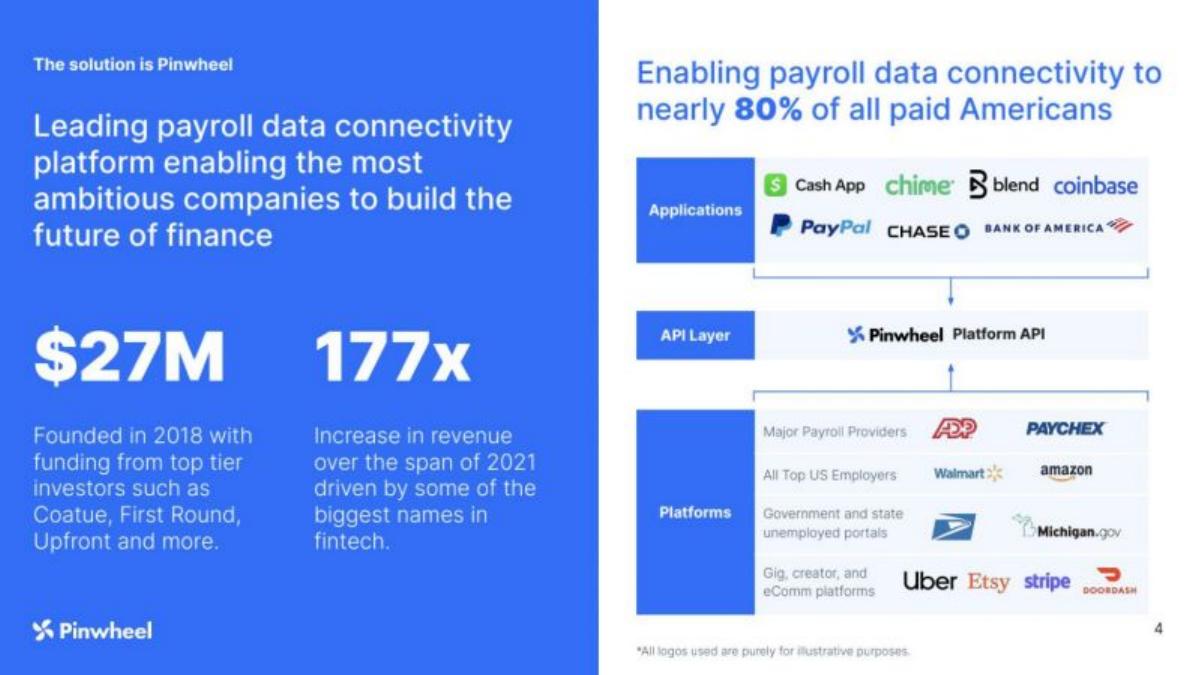
- Pinwheel reported a 177x increase in revenue over the span of 2021, a primary driver for their Series B momentum (Slide 4).
- The company claims to enable payroll data connectivity to nearly 80% of all paid Americans (Slide 4).
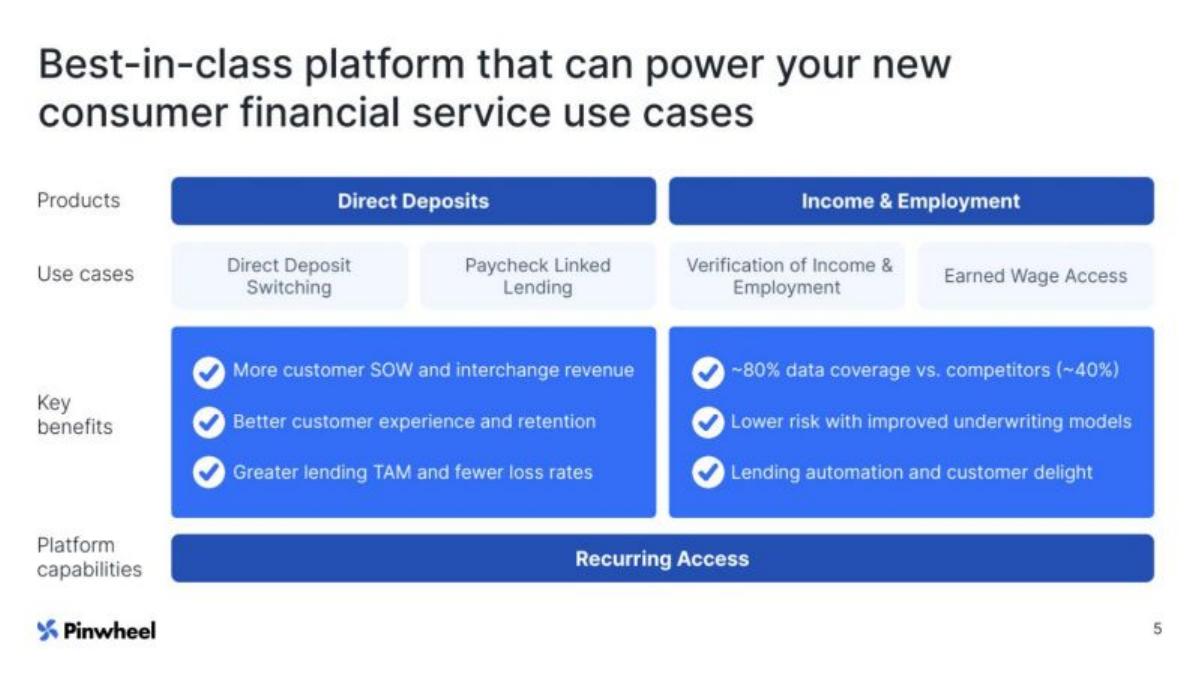
- Pinwheel positions its data coverage as a competitive moat, citing ~80% coverage versus ~40% for competitors (Slide 5).
- The deck highlights a blue-chip investor base including Coatue, First Round, and Upfront (Slide 4).
- The platform focuses on two core product pillars: Direct Deposits and Income & Employment data (Slide 5).
- Security and compliance are centralized as core value props, specifically mentioning SOC 2 Type 2 certification and FCRA compliance (Slide 6, 8).
- The deck omits a traditional team slide, detailed financial projections, and a specific 'ask' or use of funds (Slides 1-10).
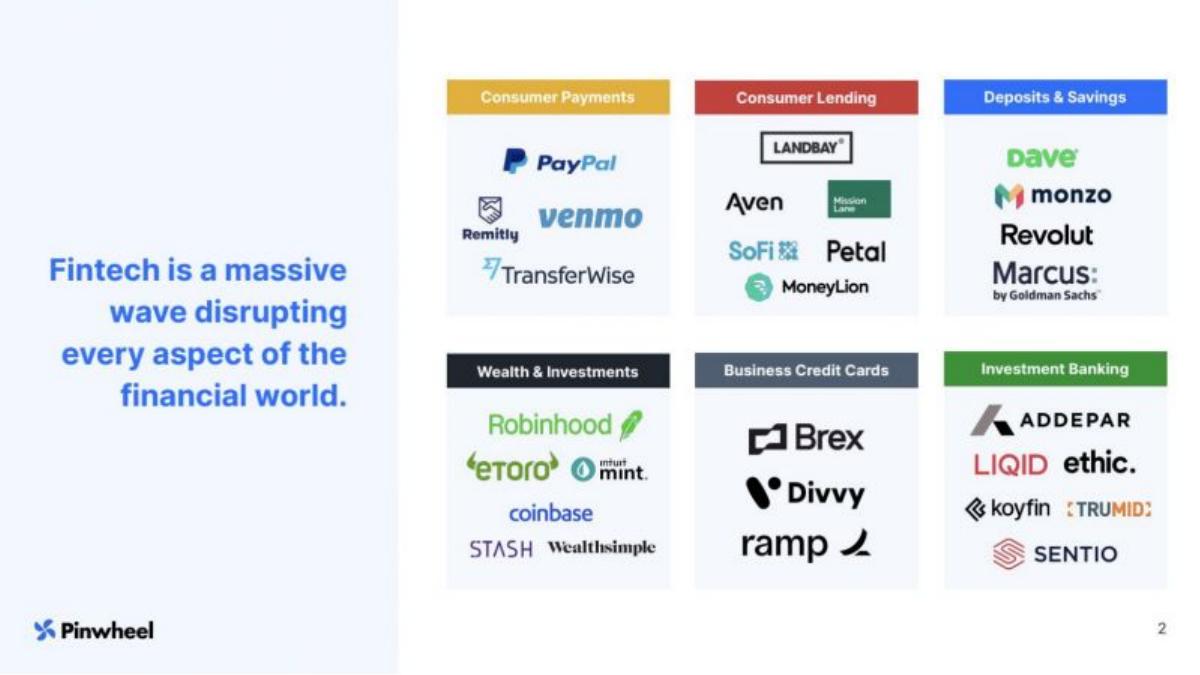
- Pinwheel targets six major fintech verticals: Payments, Lending, Savings, Wealth, Business Credit, and Investment Banking (Slide 2).
The Infrastructure of Payroll: A Series B Deep Dive
Pinwheel’s 2022 Series B deck is a concise, 10-slide presentation that focuses on the 'API-ification' of payroll data. At this stage of fundraising, the company is no longer selling a dream; it is selling a utility. The deck is designed to prove that Pinwheel has become the standard interface between employers (the source of funds) and fintech applications (the destination of funds).
Slide 1: Title and Vision
The cover slide introduces the brand with a simple tagline: "Driving the next generation of fintech innovation through payroll connectivity." It establishes the company's niche immediately. Unlike general data aggregators, Pinwheel is laser-focused on the payroll vertical. The branding is clean and professional, signaling a mature enterprise-grade solution.
Slide 2: The Fintech Landscape
Slide 2 serves as a market validation slide. It categorizes the fintech world into six segments: Consumer Payments, Consumer Lending, Deposits & Savings, Wealth & Investments, Business Credit Cards, and Investment Banking. By populating these categories with logos like PayPal, SoFi, Revolut, and Robinhood, Pinwheel is visually demonstrating its potential customer base. The message is clear: every one of these multi-billion dollar verticals needs the data Pinwheel provides.
Slide 3: State of the Industry
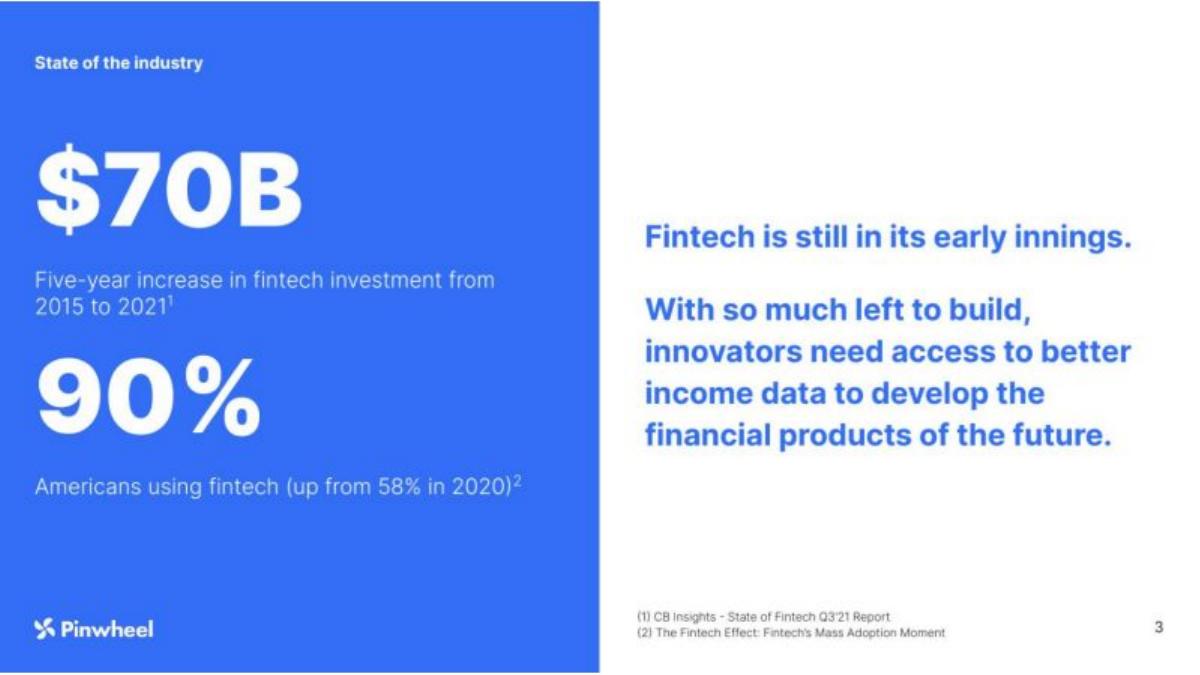
This slide provides the macro-economic justification for Pinwheel's existence. It cites a $70B five-year increase in fintech investment (2015-2021) and notes that 90% of Americans are now using fintech, up from 58% in 2020. By framing the industry as still being in its "early innings," Pinwheel suggests that the demand for better income data is only going to accelerate. This is a classic 'rising tide' argument.
Slide 4: The Momentum Slide
Slide 4 is the most critical slide in the deck. It contains three massive proof points: a 177x increase in revenue over 2021, 80% coverage of paid Americans, and a cap table featuring Coatue and First Round. The right side of the slide provides a functional diagram of the stack: Applications (Cash App, Chime) connect to the Pinwheel API, which in turn connects to Platforms (ADP, Walmart, Uber). This slide proves product-market fit and scalability in one glance.
Slide 5: Product and Use Cases
Here, Pinwheel breaks down its offering into two product lines: Direct Deposits and Income & Employment. The slide lists specific benefits, such as "Greater lending TAM and fewer loss rates." Most importantly, it includes a direct competitive comparison, claiming ~80% data coverage vs. ~40% for competitors. In the world of APIs, coverage is the primary metric of quality, and Pinwheel is positioning itself as the clear leader.
Slide 6: Data Integrity and Compliance
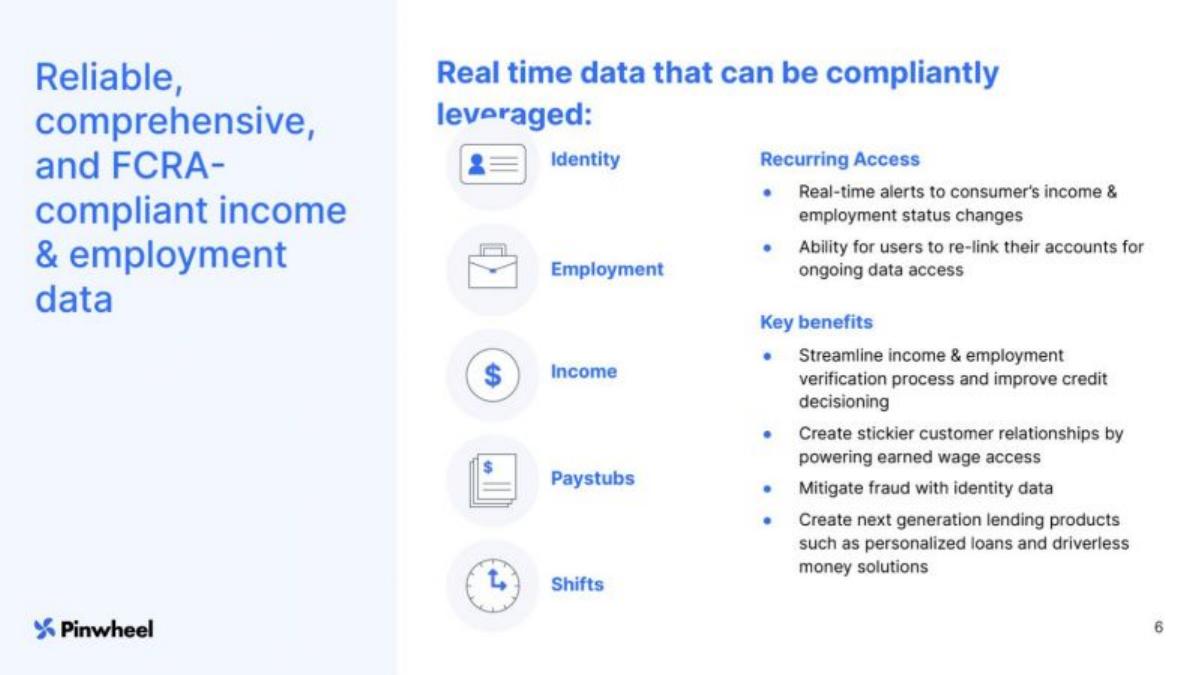
For financial institutions, data is useless if it isn't compliant. Slide 6 focuses on "Reliable, comprehensive, and FCRA-compliant" data. It lists the data points provided—Identity, Employment, Income, Paystubs, and Shifts. It also introduces "Recurring Access," which allows fintechs to receive real-time alerts on income changes. This transforms the product from a one-time verification tool into a long-term monitoring solution, which increases the 'stickiness' of the customer relationship.
Slide 7: How It Works
Slide 7 provides a visual walkthrough of the user experience. It shows a four-step flow: a consent screen, employer selection (Gusto, ADP, etc.), credential entry, and a final verification screen. This slide is intended to de-risk the technical implementation for investors, showing that the consumer-facing side of the API is as seamless as a Plaid-like experience.
Slide 8: Security at the Core
Given the sensitivity of payroll data (SSNs, bank accounts, salary), security is a deal-breaker. Slide 8 lists six security controls, including bank-level encryption, 24/7 monitoring, and SOC 2 Type 2 certification. This slide isn't about innovation; it's about checking the boxes required by the compliance departments of the major banks listed on Slide 4.
Slide 9 & 10: Closing and Source
Slide 9 is a simple logo closing slide. Slide 10 is an external promotional slide for the source library and is not part of the Pinwheel narrative. Notably, the deck ends without a team slide, a financial projection slide, or a specific 'ask' slide. This suggests this version of the deck may have been a 'teaser' or a high-level overview used to anchor a verbal presentation where those details were discussed separately.
What Pinwheel Does Well
The Pinwheel deck excels at momentum storytelling . By leading with a 177x revenue growth figure, they immediately frame the company as a 'breakout' success. This creates a sense of urgency for investors. They also do an excellent job of positioning as infrastructure . By showing how they sit between the biggest employers (Walmart, Amazon) and the biggest fintechs (Cash App, PayPal), they make their business seem inevitable. Finally, the competitive benchmarking on Slide 5 is highly effective; doubling the coverage of your nearest competitor is a powerful reason to win a round.
What is Missing from the Deck
The most glaring omission is a Team Slide . While the catalogue facts mention top-tier investors, the actual slides do not introduce the founders or the engineering talent required to maintain these complex payroll integrations. Also missing is Unit Economics . While revenue grew 177x, there is no mention of gross margins, customer acquisition cost (CAC), or lifetime value (LTV). For a Series B, investors usually want to see that the engine is not just fast, but efficient. Lastly, there is no Roadmap . The deck explains what Pinwheel does today, but it doesn't explicitly state where the company is going next—such as international expansion or moving into different types of data aggregation.
Founder's Playbook: What to Copy
The 'Stack' Diagram: Use Slide 4's layout to show exactly where you sit in the ecosystem. Showing your product as the 'bridge' between two massive groups of logos is a great way to explain a complex API business. · Quantify Your Moat: If your product is better because of a specific metric (like data coverage or processing speed), put a number on it and compare it directly to the industry average, as seen on Slide 5. · Focus on Compliance Early: If you are in fintech, dedicate a full slide to security and certifications (Slide 8). It signals to investors that you are ready for enterprise-level partnerships. · Lead with Growth: If you have a 'triple-triple-double-double' growth story, don't hide it. Pinwheel put their 177x growth front and center, which likely did most of the heavy lifting for the round.
Frequently asked questions
- How much did Pinwheel raise with this deck?
- According to the catalogue facts, Pinwheel raised $50M in a Series B round in 2022. While the deck itself does not state the specific 'ask' or dollar amount being sought, it highlights the 177x revenue growth achieved in 2021 as the primary justification for the expansion capital.
- Who are Pinwheel's primary customers?
- The deck and editorial context identify neobanks and fintechs as the primary customer base. Slide 4 illustrates the 'Applications' layer with logos including Cash App, Chime, Coinbase, PayPal, and traditional giants like Chase and Bank of America. They serve companies needing real-time income and employment data.
- What is Pinwheel's competitive advantage according to the deck?
- Pinwheel emphasizes its superior data coverage. Slide 5 explicitly states that Pinwheel offers ~80% data coverage compared to the ~40% coverage offered by its competitors. This 2x advantage in reach is presented as a key benefit for improving underwriting models and increasing lending total addressable market (TAM).
- Is the Pinwheel platform compliant with financial regulations?
- Yes, the deck places significant emphasis on compliance. Slide 6 highlights that their income and employment data is FCRA-compliant. Slide 8 further details their security posture, noting that they are SOC 2 Type 2 certified and use bank-level encryption to safeguard personal payroll information.
- What specific use cases does Pinwheel support?
- Slide 5 breaks down use cases into two categories. For Direct Deposits, they support switching and paycheck-linked lending. For Income & Employment, they support verification of income/employment and earned wage access (EWA). These tools help fintechs increase 'Share of Wallet' (SOW) and interchange revenue.