Taster’s 13-slide pitch deck from 2021 presents a compelling case for the 'Digital Restaurant Brand' (DRB) model, moving away from the asset-heavy nature of traditional dining. The company positions itself as a technology and brand platform rather than a logistics provider, leveraging existing kitchen infrastructure to scale. With a reported 1 million meals delivered in 2020 and a portfolio of five distinct brands, the deck highlights a low-capex, high-margin strategy. The narrative is driven by strong unit economics for partners (0-€2k equipment investment) and a leadership team with deep ro…
Key takeaways
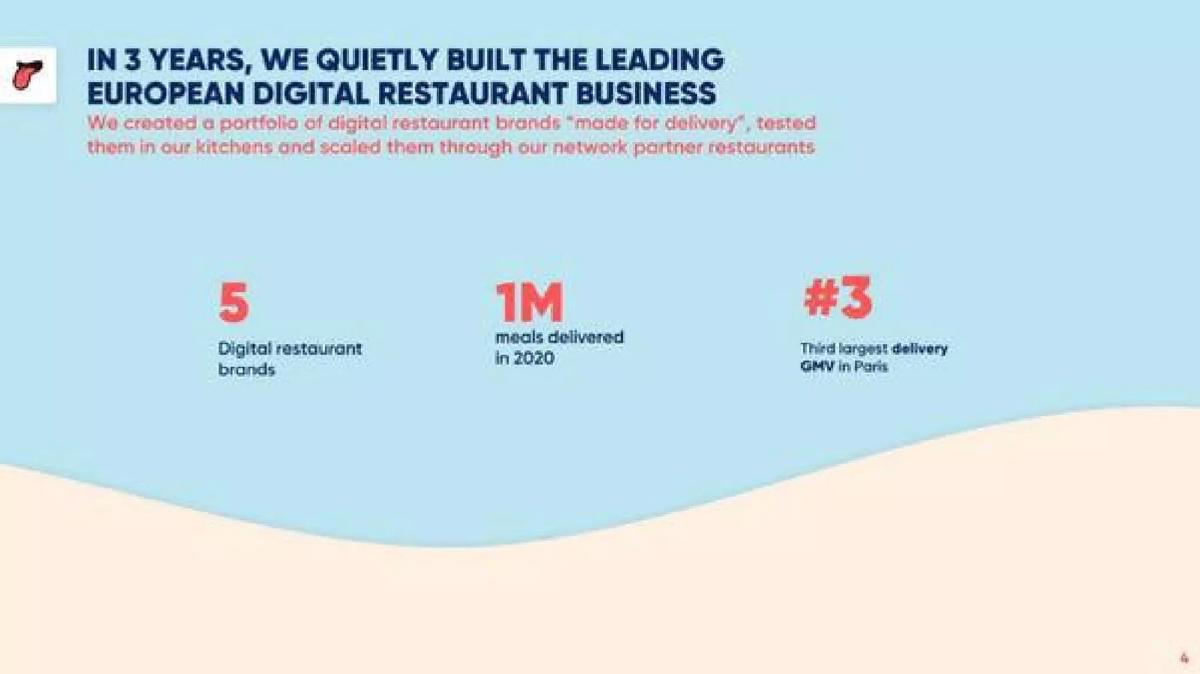
- Taster delivered 1 million meals in 2020 and became the third-largest delivery GMV player in Paris (Slide 4).
- The business model relies on licensing digital brands to existing restaurants, requiring 'nil' capex for partners in some cases (Slide 8).
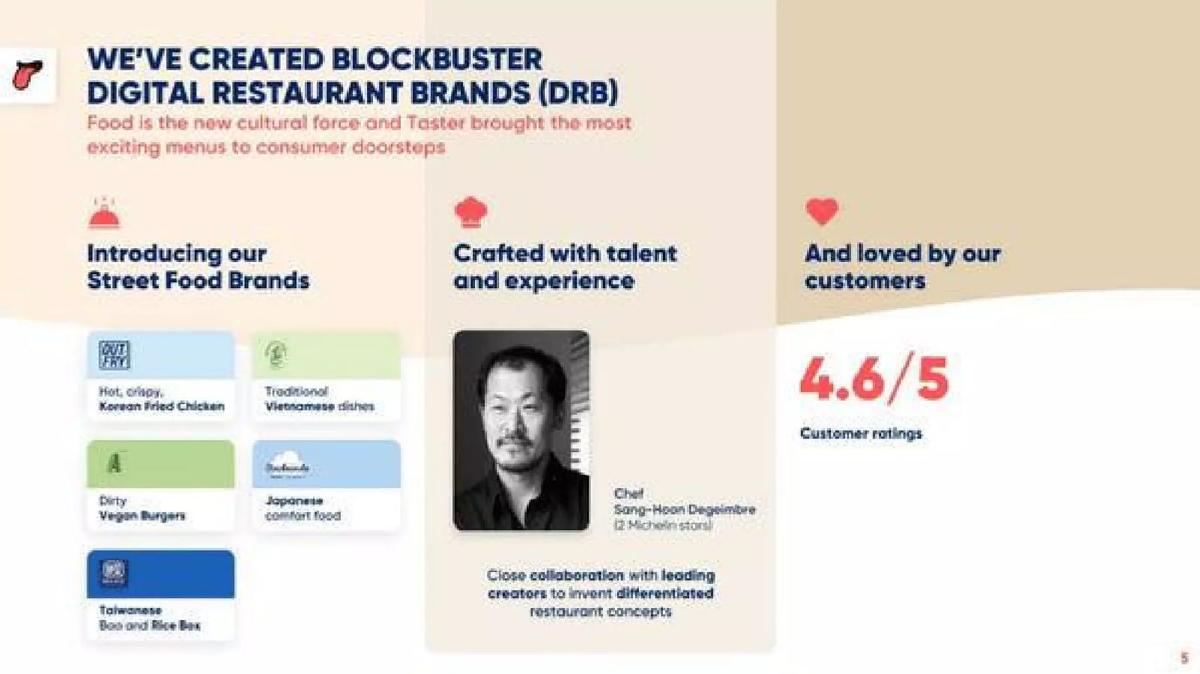
- The company maintains five digital restaurant brands, including Korean Fried Chicken and Vegan Burgers, with an average customer rating of 4.6/5 (Slide 5).
- Taster's proprietary tech stack includes 'ONE BOARD' for performance, 'ONE Tablet' for order management, and 'ONE Source' for supply chain (Slide 7).
- Partner restaurants can launch a Taster brand in as little as 2 weeks with minimal equipment investment of 0-€2k (Slides 8 and 9).
- The leadership team includes the 7th employee of Deliveroo and a former Supply Chain Director from Domino's (Slide 12).
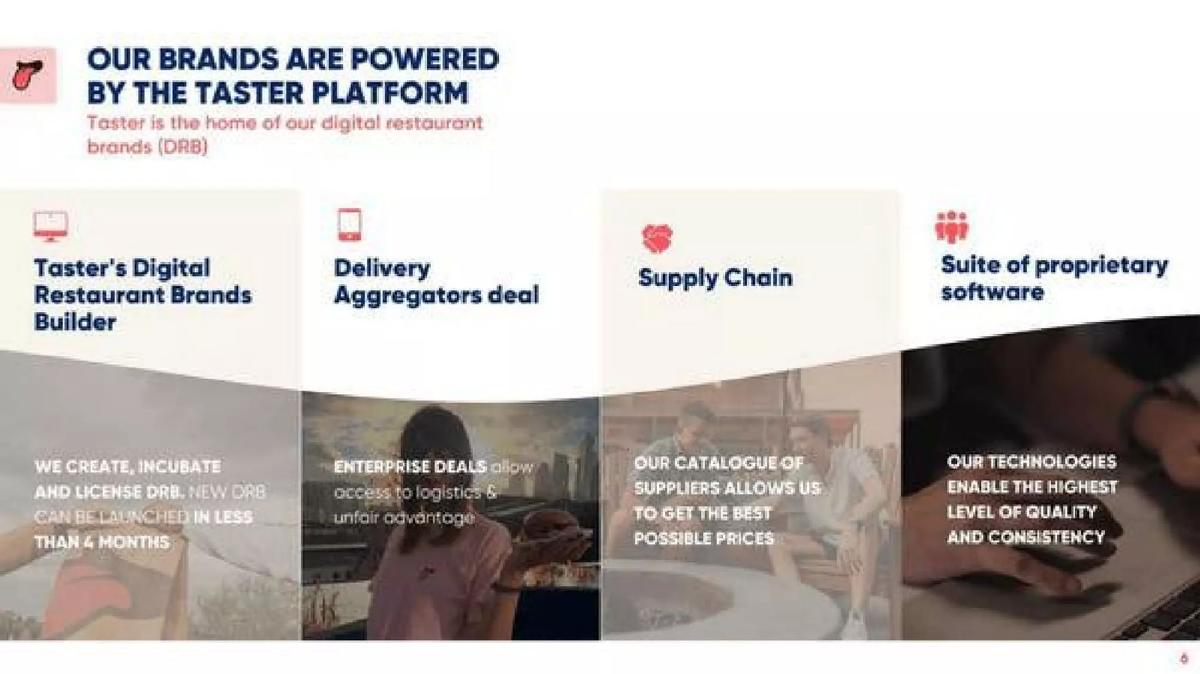
- The deck emphasizes a 'software-like' scale, claiming new brands can be launched in less than 4 months (Slide 6).
- Taster generates revenue through a royalty-based model and by reselling supplies to franchisees at scale (Slides 10 and 11).
Executive Summary: The Asset-Light Future of Dining
Taster’s 2021 pitch deck is a masterclass in positioning a food business as a scalable technology platform. By 2021, the 'ghost kitchen' and 'virtual brand' space was becoming crowded, but Taster differentiated itself by focusing on the licensing model rather than owning the real estate. This deck was used to showcase their rapid growth—specifically their 1 million deliveries in 2020—and their ability to turn any kitchen into a multi-brand digital storefront.
Slides 1-3: The Vision and Positioning
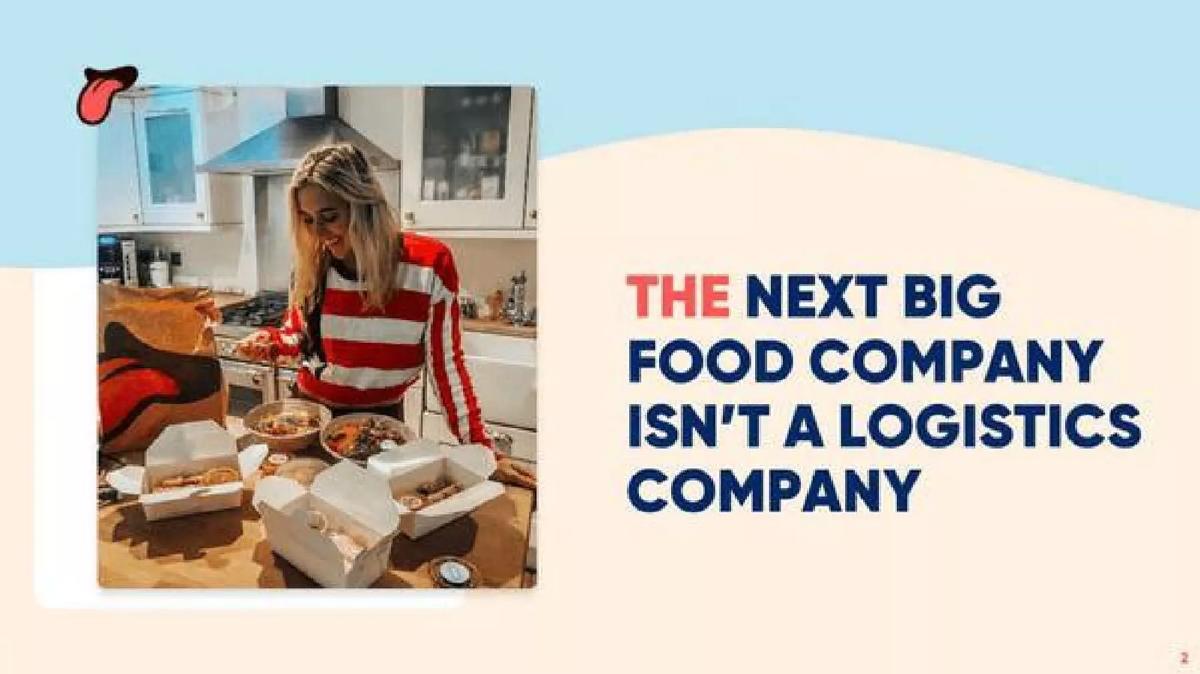
The deck opens with a bold, minimalist aesthetic. Slide 1 introduces the brand with its distinctive 'tongue' logo. Slide 2 immediately sets the strategic tone: "The next big food company isn't a logistics company." This is a direct nod to the market's over-saturation with delivery apps, signaling to investors that Taster operates further up the value chain in brand creation and food quality.
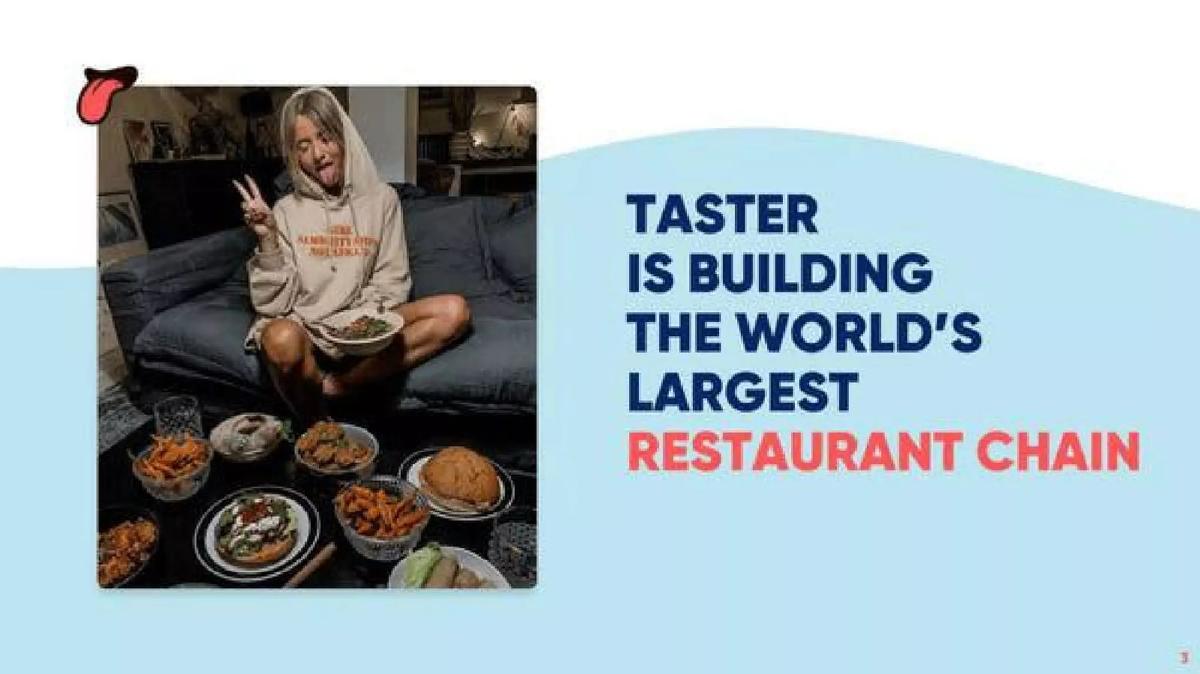
Slide 3 completes the introductory hook by stating Taster is "building the world's largest restaurant chain." By using the word 'chain' in the context of a digital-first business, they are signaling a move toward the scale of a McDonald's or Domino's, but without the traditional overhead associated with brick-and-mortar expansion.
Slides 4-5: Traction and Brand Portfolio
Slide 4 provides the 'meat' of the early deck. It claims that in three years, they built the "leading European digital restaurant business." The key metrics cited are:
5 Digital restaurant brands · 1M meals delivered in 2020 · #3 Third largest delivery GMV in Paris
Slide 5 introduces the brands themselves, which include 'Out Fry' (Korean Fried Chicken), 'A' (Dirty Vegan Burgers), and 'Mission Saigon' (Vietnamese). They emphasize quality by highlighting a collaboration with Chef Sang-Hoon Degeimbre, a 2-Michelin star chef. This slide is crucial for debunking the 'low-quality' stigma often attached to virtual brands, backed by a 4.6/5 customer rating .
Slides 6-7: The Technology Platform
Slide 6 explains the 'Taster Platform.' It breaks down the value proposition into four pillars: the Brand Builder (launching brands in under 4 months), Aggregator deals (access to logistics), Supply Chain (best possible prices), and Proprietary software. This slide transitions the narrative from 'food' to 'infrastructure.'
Slide 7 goes into the specifics of their software suite. They present three distinct products: ONE BOARD for performance management, ONE Tablet for order consolidation, and ONE Source for supply chain management. The mention of "Machine learning forecasts" on Slide 7 suggests a data-driven approach to reducing food waste and optimizing inventory, which is a significant pain point in the restaurant industry.
Slides 8-9: The Partner Value Proposition
Slide 8 uses a real-world testimonial from a partner in London (Bombay Burrito). It highlights a 2-week launch time and "Capex: nil." This is a powerful selling point for potential franchisees. Slide 9 formalizes the 'Restaurant partner economics,' listing four benefits: increased delivery volume, leverage of existing workforce, use of existing kitchen space, and significant contribution margins. The note that equipment investment is only "0-€2k" makes the barrier to entry remarkably low.
Slides 10-11: Taster's Unit Economics and Scalability
Slide 10 shifts the focus to 'Taster economics.' The company describes itself as a "high margin platform business." They cite economies of scale (buying large quantities and reselling to franchisees), no risk of demand fluctuation (no fixed costs or Opex), and no capex. This slide is designed to show investors that Taster’s growth is decoupled from capital-intensive requirements.
Slide 11 reinforces this by comparing the model to a "software business." It summarizes the barriers to entry: strong brands, market-leading tech, and franchise relationships. The mention of a "Royalty-based model" confirms their primary revenue stream is a percentage of sales from their licensed brands.
Slide 12: The Team
The team slide is exceptionally strong for a Series B-stage company. CEO Anton Soulier’s background as "Employee number 7" at Deliveroo provides immediate industry credibility. The inclusion of an ex-Supply Chain Director from Domino’s (Aubert Loury) and an ex-Global Brand Marketing VP from PepsiCo (Ian Pate) shows they have the specific expertise needed to manage both the logistics and the brand-building aspects of the business. The advisors/investors section features Will Shu (Founder & CEO of Deliveroo), further cementing their ties to the delivery ecosystem.
What Works in This Deck
Clear Differentiation: By explicitly stating they are not a logistics company, they avoid being compared to the low-margin delivery aggregators. · Low-Barrier Growth: The emphasis on 'nil' or '0-€2k' capex for partners makes the scalability of the model very believable. · Proof of Quality: Using a Michelin-starred chef and showing a 4.6/5 rating addresses the biggest concern in the virtual kitchen space: food quality. · Operational Depth: The breakdown of the three proprietary apps shows that Taster isn't just a marketing layer; they are deeply integrated into the kitchen's operations.
What Is Missing
The Ask: The deck does not specify how much capital they are raising or how they intend to use the funds. · Competition: There is no slide addressing competitors like Reef Technology, CloudKitchens, or other virtual brand aggregators. · Financial Projections: While they mention 'high margins,' there are no P&L projections or detailed breakdowns of the royalty percentages. · Market Size: The deck lacks a TAM/SAM/SOM slide to quantify the total addressable market for digital restaurant brands in Europe or globally.
What a Founder Should Copy
The 'One-Liner' Strategy: Slide 2 and 3 are excellent examples of how to use bold, contrarian statements to grab attention. · Partner Testimonials: Including a specific location (London, N1) with a photo of the partner and clear metrics (2-week launch) makes the business model feel tangible. · Visual Hierarchy: The deck uses a consistent color palette and clean icons to explain complex software and supply chain concepts without cluttering the slides. · Team-Market Fit: The way the team's past roles are highlighted (e.g., 'Ex Supply Chain Director') directly supports the business model's core needs.
Frequently asked questions
- What is Taster's core business model?
- Taster operates as a platform for Digital Restaurant Brands (DRBs). They create and incubate food brands designed specifically for delivery, then license these brands to existing, underutilized restaurant kitchens. This allows Taster to scale without the capital expenditure of opening physical locations, while providing restaurant partners with additional revenue streams and high contribution margins.
- How does Taster differentiate itself from delivery platforms like UberEats or Deliveroo?
- Slide 2 explicitly states that Taster is 'not a logistics company.' Unlike delivery aggregators that focus on the transport of food, Taster focuses on the 'food' and 'brand' layers. They develop the menus, supply chains, and proprietary kitchen software, then use existing aggregators for the actual delivery, often through enterprise deals that provide them with a competitive advantage.
- What are the financial requirements for a restaurant to partner with Taster?
- According to Slide 9, the investment for a partner is minimal. It leverages existing kitchen staff and space, requiring only 'modest' investments for specific equipment ranging from 0 to €2,000. Slide 8 highlights a specific case in London where the launch time was 2 weeks with 'nil' capex, making it a low-risk 'turnkey' solution for restaurateurs.
- What technology does Taster provide to its franchisees?
- Taster provides a suite of three proprietary apps: ONE BOARD (a live performance dashboard for administration), ONE Tablet (an online order manager that consolidates multiple brands and platforms), and ONE Source (supply chain software featuring machine learning forecasts and inventory management). This tech stack is designed to ensure quality and consistency across a decentralized network.
- Who is behind Taster?
- The team is led by CEO Anton Soulier, who was employee number 7 and ex-Deputy GM of France at Deliveroo. Other key executives bring experience from Domino’s (COO Aubert Loury), PepsiCo/Careem (CMO Ian Pate), and EY (CFO Caroline Tulloch). The deck also lists Will Shu, founder of Deliveroo, as an advisor and investor.