Keep Warranty is a mobile application designed to store product warranties and notify users before expiration. The pitch deck positions the company as a strategic partner for insurance providers, offering a solution to the 'lack of customer contact and data' that plagues the industry. By capturing data on products users already own—averaging 8 warranties per user across 60,000 downloads—Keep Warranty aims to facilitate AI-powered upselling and fraud reduction through cross-checking. While the deck provides strong early traction metrics and a clear B2B value proposition for insurers, it lacks…
Key takeaways
- The company reports 60,000 downloads with an average of 8 warranties saved per user on slide 5.
- Consumer behavior data on slide 2 indicates that 7 out of 10 people lose their product warranties.
- The platform targets high-value items, with 70% of saved items falling into home appliances or technology categories with an average price of 400€, according to slide 6.
- Market penetration for secondary services is low, with only 5% of warranties having extensions and 4% having insurance as noted on slide 6.
- The average active user spends 2.3 minutes in the app once a week, providing consistent touchpoints for insurers as shown on slide 7.
- The B2B value proposition focuses on reducing claim management costs and fraud through warranty data cross-checking on slide 8.
- The deck omits a specific funding ask, financial projections, and a competitive analysis slide.
- The team is led by Romana Ibrahim, who is identified as 'elected founder of the year' on slide 9.
Slide-by-Slide Analysis
Slide 1: Cover Page
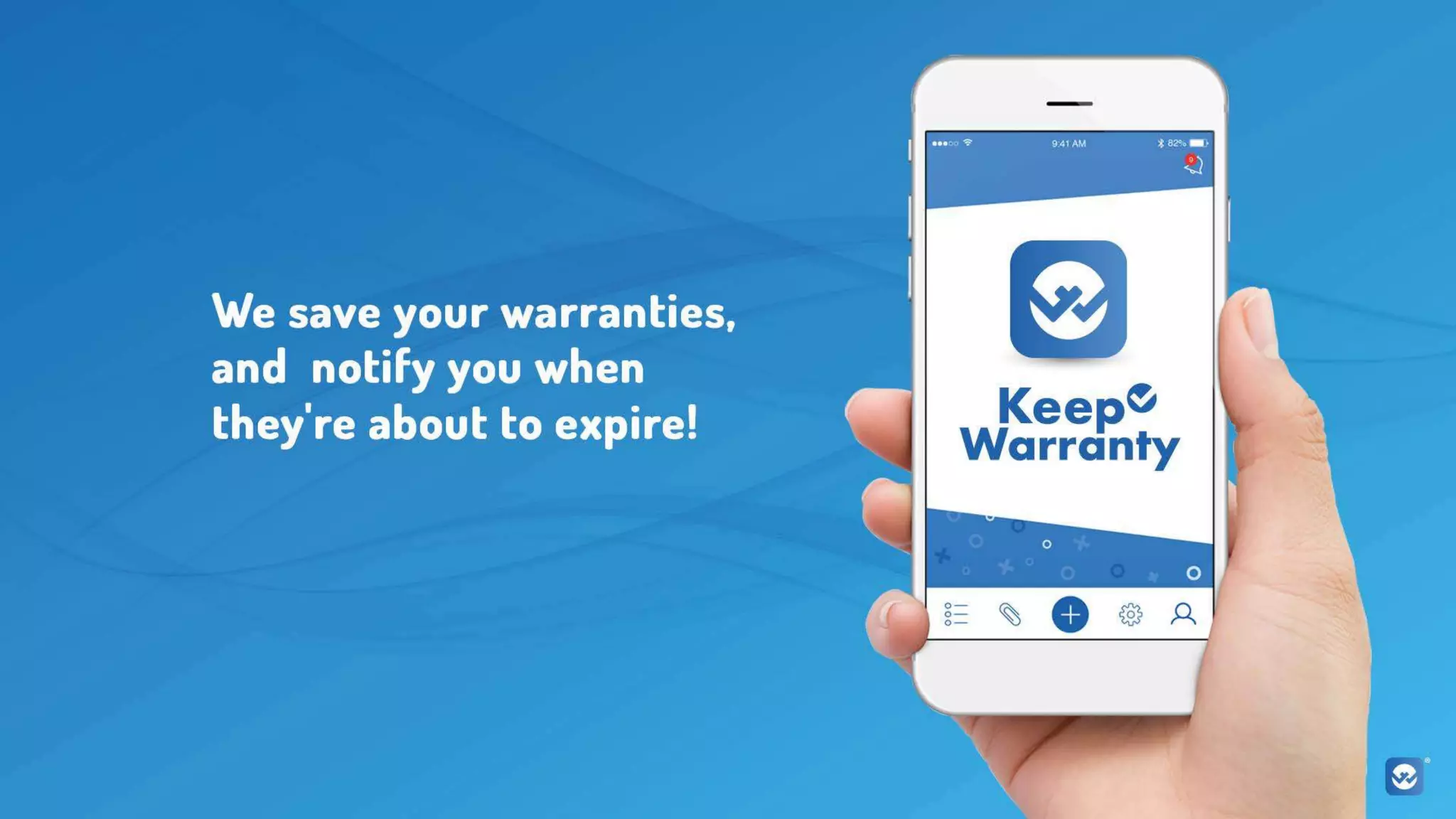
The deck opens with a clear value proposition: 'We save your warranties, and notify you when they're about to expire!' The visual focus is a smartphone displaying the Keep Warranty app interface. The branding is consistent, utilizing a blue and white color palette that suggests reliability and professional service. It immediately identifies the product as a mobile-first utility tool.
Slide 2: Problem on the Customer Side
This slide uses a simple infographic to show that '7 out of 10 people lose their product warranties.' It contrasts this with the fact that consumers generally know what insurances they have. Citing a 'Dutch Association of Insurers – Consumer Monitor Report 2017,' the slide establishes a clear pain point: consumers are disorganized regarding warranties, even though they value the protection that insurance provides. This sets the stage for a tool that bridges the gap between disorganized physical receipts and organized digital protection.
Slide 3 & 4: Insurance Companies (The B2B Problem)
These slides shift the focus from the consumer to the enterprise partner. Slide 3 identifies three core struggles for insurers: smaller sales/lower margins due to competition, inability to differentiate in a commoditized market, and a lack of customer contact/data. It notes that 'less than 5% of customers buy insurance for products at stores.' Slide 4 repeats these points without the secondary descriptions, emphasizing the 'Lack of customer contact and data' as the primary hurdle for traditional insurers in the digital age.
Slide 5: Solution and Initial Traction
The solution is presented in a three-step process: 1. Take a picture of the invoice (using OCR), 2. Categorize the product, and 3. Save the warranty. The slide includes significant traction metrics: 60,000 downloads and an average of 8 warranties per user. This is a critical slide because it proves that users are willing to perform the data entry task in exchange for the utility of the app, effectively building a database of insurable assets for the company.
Slide 6: Analysis of User Data
This slide provides a deep dive into what users are actually saving. It notes that 70% of items are in the Home Appliances and Technology categories, with an average price of 400€. Most importantly for the business case, it states that only 5% of these warranties have extensions and only 4% have insurance. This highlights a massive, untapped market for insurance products that Keep Warranty is uniquely positioned to identify and target.
Slide 7: User Profile
The target demographic is defined as '25-55 years, male, educated.' Engagement metrics are also provided: an average of 2.3 minutes spent in the app and one visit per week per active user. For a utility app, a weekly visit is a high frequency, suggesting that the app is being used as a general household management tool rather than just a storage locker for receipts.
Slide 8: The B2B Value Proposition
This slide answers the question, 'How can Keep Warranty help you?' directed at insurance companies. The benefits listed include reducing claim management costs, reducing fraud through data cross-checking, providing detailed customer product insights, promoting AI-powered upselling, and increasing brand awareness. This is the core of the company's monetization strategy: selling data and access to insurance providers.
Slide 9: Team
The team slide features four members: Romana Ibrahim (CEO), Liliana Nogueira (Marketing), João Pereira (IT), and Manuel Sande e Castro (COO). The CEO is highlighted as 'elected founder of the year.' While the slide shows a balanced team covering tech, marketing, and operations, it lacks specific professional backgrounds or previous company exits which would strengthen the 'why this team' argument.
Slide 10: Contact Information
The deck concludes with the CEO's email address and the company logo. It is a standard closing slide but lacks a final 'call to action' or a summary of the investment opportunity.
What Works Well
Clear Data-Driven Narrative: The deck does an excellent job of connecting consumer behavior (losing warranties) to an enterprise opportunity (lack of insurance data). By showing that users are already uploading high-value items (400€ average), they prove the platform's value as a lead generation engine for insurers.
Traction Metrics: Stating 60,000 downloads and 8 warranties per user provides immediate credibility. It shows that the 'friction' of taking photos of receipts is not a deal-breaker for their target audience.
Specific B2B Benefits: Instead of just saying 'we will sell insurance,' the deck breaks down how they help insurers: fraud reduction, claim cost management, and AI-powered upselling. This shows a sophisticated understanding of the insurtech value chain.
What Is Missing
The Business Model: While the deck hints at B2B partnerships, it never explicitly states how Keep Warranty makes money. Is it a lead-gen fee? A SaaS fee for the data dashboard? A percentage of insurance premiums? This is a significant omission for a fundraising pitch.
The Ask: There is no slide detailing how much capital the company is looking to raise, what the valuation is, or how the funds will be allocated. This suggests the deck may have been intended for a competition (like the TDI Insurtech Award) rather than a direct investor pitch.
Competitive Landscape: The deck assumes no one else is doing this. In reality, there are many receipt-scanning and personal finance apps. The deck needs to explain why Keep Warranty's focus on the 'insurance gap' makes it superior to general expense trackers.
Founder Takeaways
Focus on the 'Data Gap': If your startup collects data that a large, legacy industry (like insurance) lacks, make that the centerpiece of your B2B pitch. Keep Warranty successfully frames itself as a solution to the insurer's 'lack of customer contact.' · Use Category Analysis: Slide 6 is a masterclass in showing market potential. By identifying that 70% of items are high-value and 95% are uninsured, they make the 'upsell' opportunity feel inevitable rather than theoretical. · Quantify Engagement: For utility apps, 'time in app' and 'visits per week' are vital. Keep Warranty's 2.3 minutes per week proves the app isn't just 'zombie-ware' sitting unused on a phone. · Bridge the B2B and B2C: The deck effectively balances the 'free and simple' consumer side with the 'cost-reducing and fraud-detecting' enterprise side. Founders in the B2B2C space should ensure their deck speaks both languages fluently.
Frequently asked questions
- What is the primary problem Keep Warranty solves for consumers?
- According to slide 2, the primary consumer problem is that 70% of people lose their product warranties. Keep Warranty provides a 'free, simple and safe' mobile app where users can take a photo of an invoice, use OCR technology to digitize the data, and receive notifications before the warranty expires, as detailed on slides 1 and 5.
- How does Keep Warranty intend to make money?
- While a specific revenue model is not explicitly detailed on a single slide, slide 8 suggests a B2B2C approach. The company proposes helping insurance companies increase sales through 'AI-Powered' tailored upselling opportunities and reducing costs by providing 'insight information about customer products' to lower fraud and claim management expenses.
- What kind of traction has the company achieved?
- Slide 5 states that the app has reached 60,000 downloads. It also notes a high level of engagement per user, with an average of 8 warranties saved per person. Slide 7 further quantifies engagement, noting that active users visit the app once a week for an average duration of 2.3 minutes.
- What categories of products are most common on the platform?
- Slide 6 reveals that 70% of the products registered in the app belong to two categories: Home Appliances and Technology (laptops, tablets, and smartphones). These items have an average price point of 400€, representing a significant pool of insurable assets.
- Who are the key members of the leadership team?
- Slide 9 introduces the four-person leadership team: Romana Ibrahim (Founder & CEO), Liliana Nogueira (Marketing), João Pereira (IT), and Manuel Sande e Castro (COO). The slide highlights Romana Ibrahim's recognition as a 'founder of the year,' though it does not specify the awarding body or year.