Tealet’s 16-slide deck from 2012 successfully secured $260,000 in seed funding by identifying a massive inefficiency in the global tea trade. The presentation centers on a stark contrast: traditional supply chains leave growers with only a 15% margin, while Tealet’s model increases that to 60% while retaining a 40% transaction fee for the platform. With early traction of 100,000 cups sold across 20+ countries and a clear focus on the $27B US market, the deck uses high-quality photography and simple infographics to make a complex logistics problem feel solvable. While it lacks detailed financi…
Key takeaways
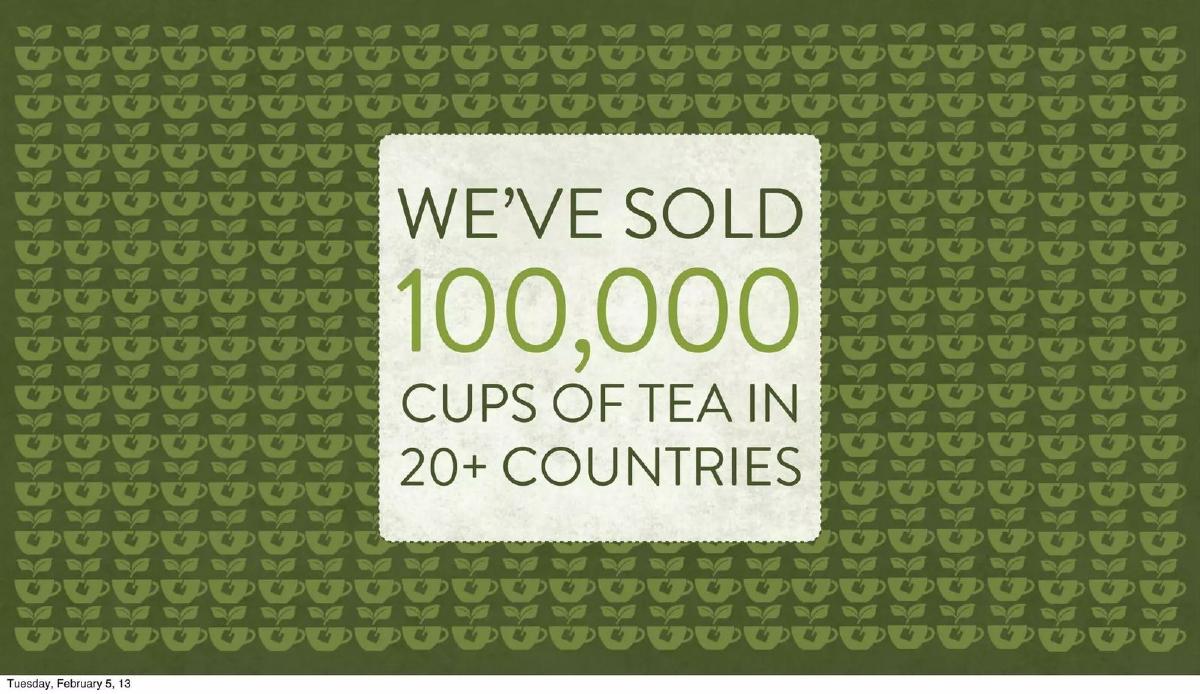
- Tealet established immediate credibility by leading with traction, citing 100,000 cups of tea sold in over 20 countries on slide 2.
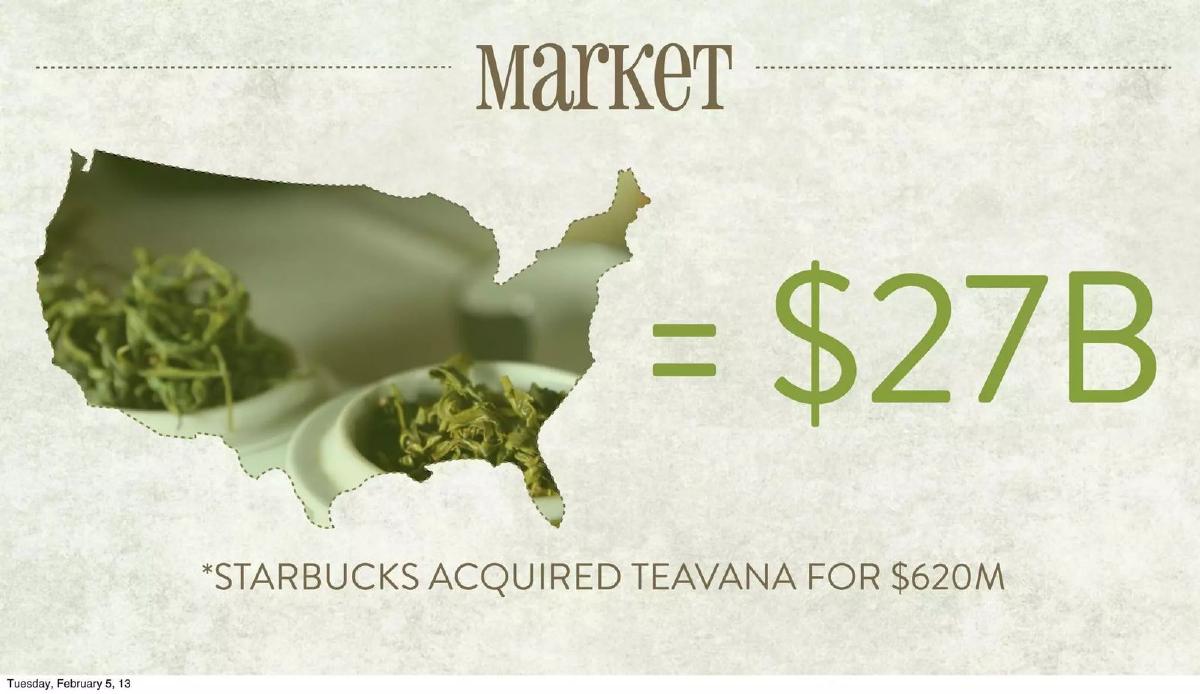
- The deck identifies a massive $27B US market opportunity and uses the $620M acquisition of Teavana by Starbucks as a key valuation benchmark on slide 6.
- A powerful 'Problem' slide (slide 7) illustrates that 85% of value is currently absorbed by corporate networks, leaving growers with only a 15% margin.
- The 'Solution' (slide 8) proposes a radical shift, increasing grower margins to 60% while the platform captures 40% of the revenue.
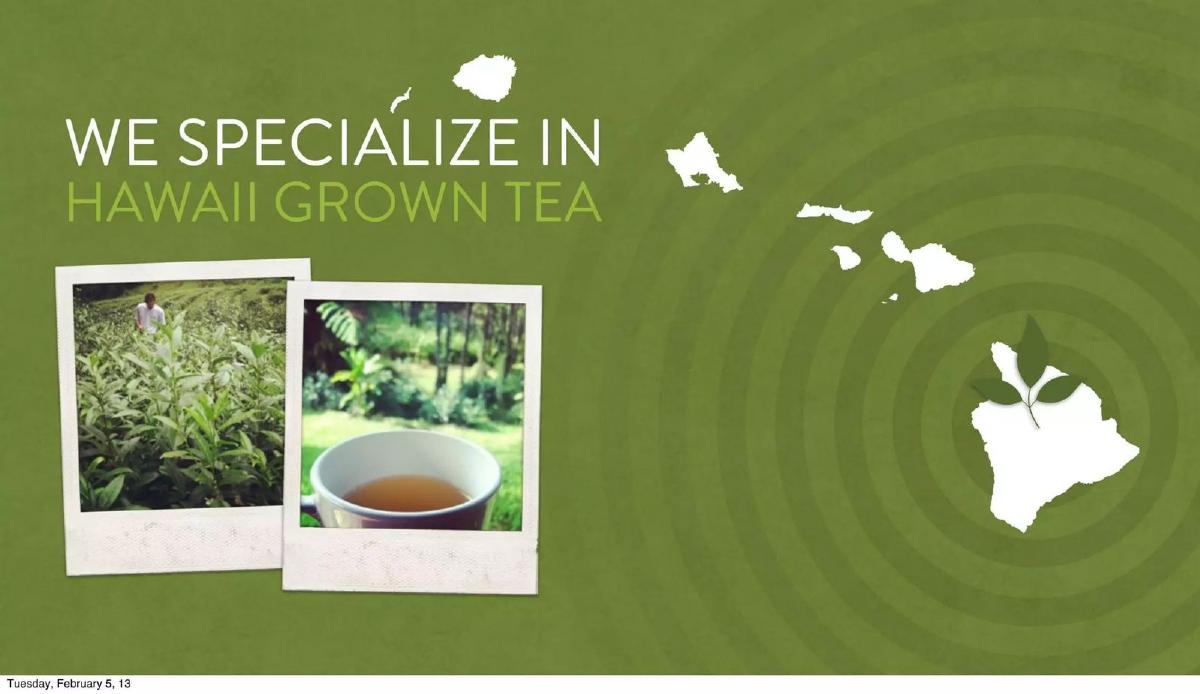
- Tealet highlights a specific niche in Hawaii-grown tea (slide 5) to demonstrate a localized starting point for their global ambitions.
- The business model is explicitly stated on slide 9: Tealet retains a 40% margin on all transactions.
- The deck features a lean team of three (Elyse, Christian, and Mike) but omits their professional backgrounds or specific roles on slide 11.
- The 'Raising' slide (slide 13) lists three goals—increase supply, scale, and international markets—but fails to mention a specific funding target.
The Marketplace for Exclusive Teas
Tealet’s 2012 pitch deck is a focused, 16-slide presentation that leans heavily on the 'farmers market' analogy for the digital age. At its core, the deck is about disintermediation—removing the 'corporate network' that sits between the person growing the tea and the person drinking it. By 2012 standards, the design is clean, using a consistent green palette and high-quality imagery to evoke the product's agricultural roots.
Slides 1-5: Traction and Global Reach
Slide 1 introduces the company with the tagline: 'The World’s Marketplace for Exclusive Teas.' The branding is clear, and the background image of a tea plantation immediately sets the scene. Slide 2 is a high-impact traction slide. It states, 'We’ve sold 100,000 cups of tea in 20+ countries.' This is a strong opening move; by leading with volume and geographic reach, Tealet proves that their logistics and marketplace model already function at a global scale.
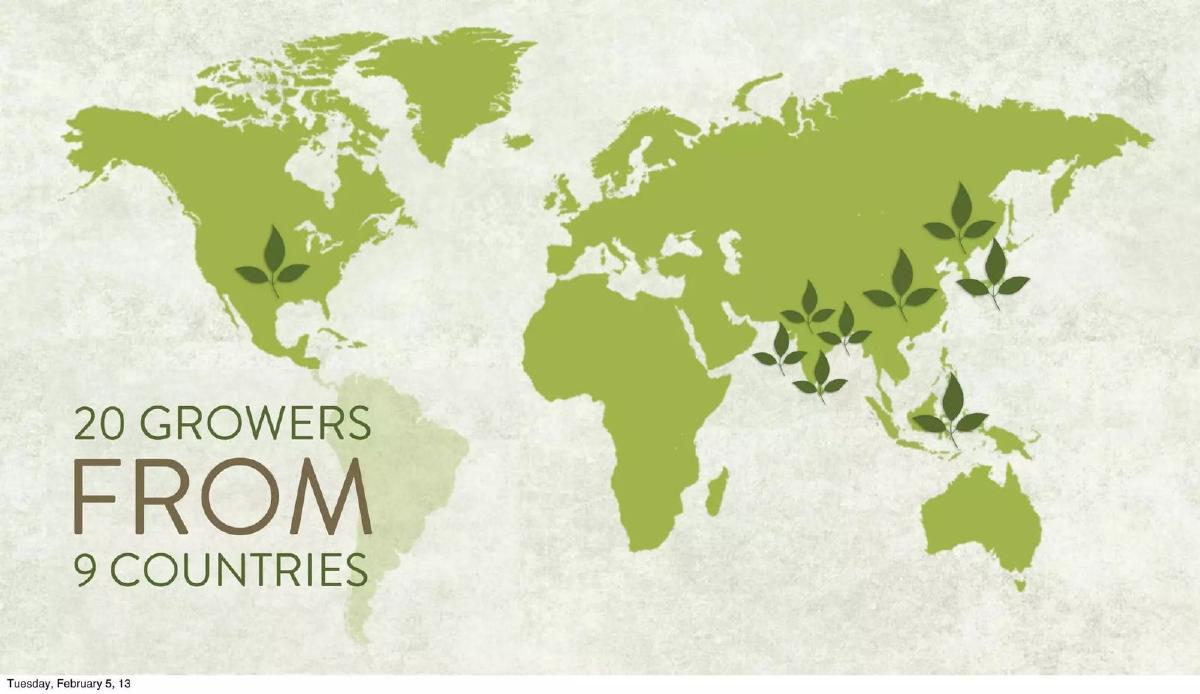
Slide 3 uses a series of Polaroid-style photos showing founders and workers in tea fields. This humanizes the supply chain, which is a key part of their brand identity. Slide 4 provides a map showing '20 Growers from 9 Countries.' The distribution of leaves across the map indicates a strong presence in East and Southeast Asia, as well as a single point in North America. Slide 5 clarifies that North American point: 'We specialize in Hawaii grown tea.' This is a clever strategic inclusion; it suggests they have a 'home court' advantage and a unique, high-value product category to anchor their marketplace.
Slides 6-9: Market Opportunity and the 'Margin Gap'
Slide 6 addresses the market size. It values the US market at '$27B' and includes a notable exit benchmark: 'Starbucks acquired Teavana for $620M.' This tells investors that the category is not only large but also has active M&A interest from major beverage players. Slide 7 is the 'Problem' slide, titled 'Current Distribution.' It uses a concentric circle diagram to show that the 'Corporate Network' absorbs 85% of the value, leaving the grower with a meager 15% margin and the consumer with 'Low Quality Tea.'
Slide 8 presents 'Tealet’s Value' as the solution. By replacing the corporate network with an 'Online Marketplace,' the grower margin jumps from 15% to 60%. Tealet takes the remaining 40% as revenue. This is the most important slide in the deck because it explains the economic incentive for both the supply side (growers make 4x more) and the platform (a healthy 40% take rate). Slide 9 reinforces this business model with a simple, bold statement: 'Tealet retains 40% margin on all transactions.' The visual of a grower pouring tea into a pile of coins that becomes a large money bag is a literal representation of profit growth.
Slides 10-12: Product and Team
Slide 10 , titled 'Market Visibility,' shows a screenshot of the Tealet website alongside a photo of a grower. The dashed line connecting the grower to the website illustrates the 'transparency' mentioned in the company's self-description. It shows a subscription model ('Global Tea Tasters') and individual product listings like 'Yellow Bud Yellow Tea.' Slide 11 introduces the team: Elyse, Christian, and Mike. While the photos are friendly and on-brand, the slide is notably lacking in professional history, titles, or specific expertise. In a seed round, investors usually want to see why this specific team is qualified to handle international logistics and e-commerce. Slide 12 is a transition slide featuring a 'Global Tea Network' graphic over a background of dried tea leaves.
Slides 13-16: The Ask and Conclusion
Slide 13 outlines the current goals under the heading 'Currently Raising.' The three pillars are 'Increase Supply,' 'Scale,' and 'International Markets.' However, the slide is missing the most critical piece of information for a fundraising deck: the amount of money they are seeking. Slide 14 is a simple call to action: 'Let’s have tea!' with their Twitter handle (@TealetTea) and website (Tealet.com). Slides 15 and 16 are closing graphics, with the final slide noting the deck was 'Created By' a third-party design firm (indicated by a logo).
What Works
The Margin Comparison: The contrast between Slide 7 and Slide 8 is the 'aha' moment of the deck. It clearly identifies a massive inefficiency in the status quo and shows exactly how Tealet captures value by fixing it. · Early Traction: Starting with 100,000 cups sold (Slide 2) immediately removes the 'will people buy this?' question from the investor's mind. · Visual Consistency: The use of earthy tones, tea-leaf textures, and plantation photography makes the deck feel professional and deeply connected to the industry they are disrupting. · The Teavana Benchmark: Including the Starbucks/Teavana acquisition (Slide 6) provides a 'comparable' that justifies the potential for a high-value exit.
What is Missing
The 'Ask': Slide 13 says they are 'Currently Raising' but doesn't list a dollar amount, a valuation cap, or a timeline. This is a significant omission for a pitch deck. · Team Pedigree: Slide 11 shows faces but no resumes. Investors need to know if the team has experience in logistics, software engineering, or the tea trade specifically. · Unit Economics: While we know the 40% margin, the deck doesn't explain the Customer Acquisition Cost (CAC) or the Lifetime Value (LTV) of a subscriber. · Competitive Landscape: There is no mention of other tea e-commerce sites or how they plan to compete with established specialty brands beyond just 'transparency.'
What a Founder Should Copy
The '15% vs 60%' Slide: If you are building a marketplace that removes middlemen, use a simple visual to show the 'before and after' of the supply chain's economics. It is the most persuasive way to justify your existence. · Humanizing the Supply Chain: For any business involving physical goods or agriculture, showing the actual producers (as seen on Slide 3 and 10) builds trust and supports a 'premium' or 'ethical' brand positioning. · Leading with Traction: If you have numbers that sound impressive (like 100,000 of anything), put them on Slide 2. Don't make the investor wait until the end of the deck to find out if you have product-market fit. · Niche Focus: By highlighting Hawaii-grown tea (Slide 5), Tealet showed they weren't just trying to boil the ocean; they had a specific, defensible entry point into the market.
Frequently asked questions
- How much did Tealet raise with this deck?
- According to catalogue data from pitchdeckhunt.com, Tealet raised $260,000 in a Seed round in 2012. The deck itself does not specify the amount being raised, only the intended use of funds.
- What is Tealet's primary business model?
- Tealet operates as a transparent marketplace for tea. As stated on slide 9, the company retains a 40% margin on all transactions. This is achieved by removing intermediaries in the 'corporate network' that typically absorb 85% of the tea's value.
- Who are Tealet's main investors?
- The company description notes that Tealet is a portfolio company of Vegas Tech Fund, 500Startups, and Blue Startups. These are prominent early-stage investors that typically focus on scalable marketplace and e-commerce models.
- What market size does the deck target?
- The deck focuses on the US market, which it values at $27 billion on slide 6. To provide context for potential exits, it mentions that Starbucks acquired the tea retailer Teavana for $620 million.
- What is missing from the Tealet pitch deck?
- The deck is missing several standard components, including a detailed competitor analysis, a breakdown of customer acquisition costs (CAC), long-term financial projections, and the specific dollar amount of the current funding round.