TeamOhana’s 15-slide Seed deck is a masterclass in narrative-driven problem-solving. Rather than leading with product features, the deck spends its first half establishing a structural deficit in the HR tech stack: the lack of a 'Strategic People Platform.' By highlighting that 70% of a startup's budget is spent on headcount (Slide 9), the company justifies why headcount management is the critical beachhead for their business. The deck effectively visualizes the current 'mess'—a complex web of HRIS, ATS, and data warehouses (Slide 11)—and positions TeamOhana as the unifying layer. While the d…
Key takeaways
- The deck identifies a specific market gap termed 'Strategic HR,' which includes headcount management and scenario planning (Slide 5).
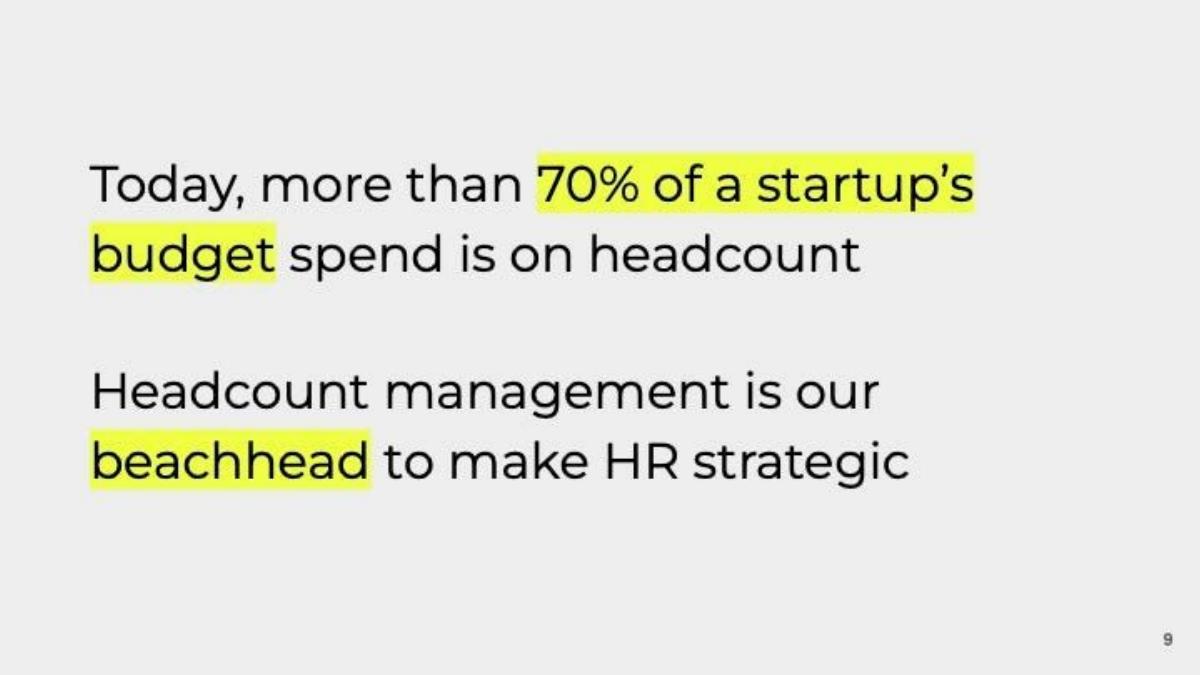
- Headcount is framed as the primary financial lever for startups, accounting for over 70% of total budget spend (Slide 9).
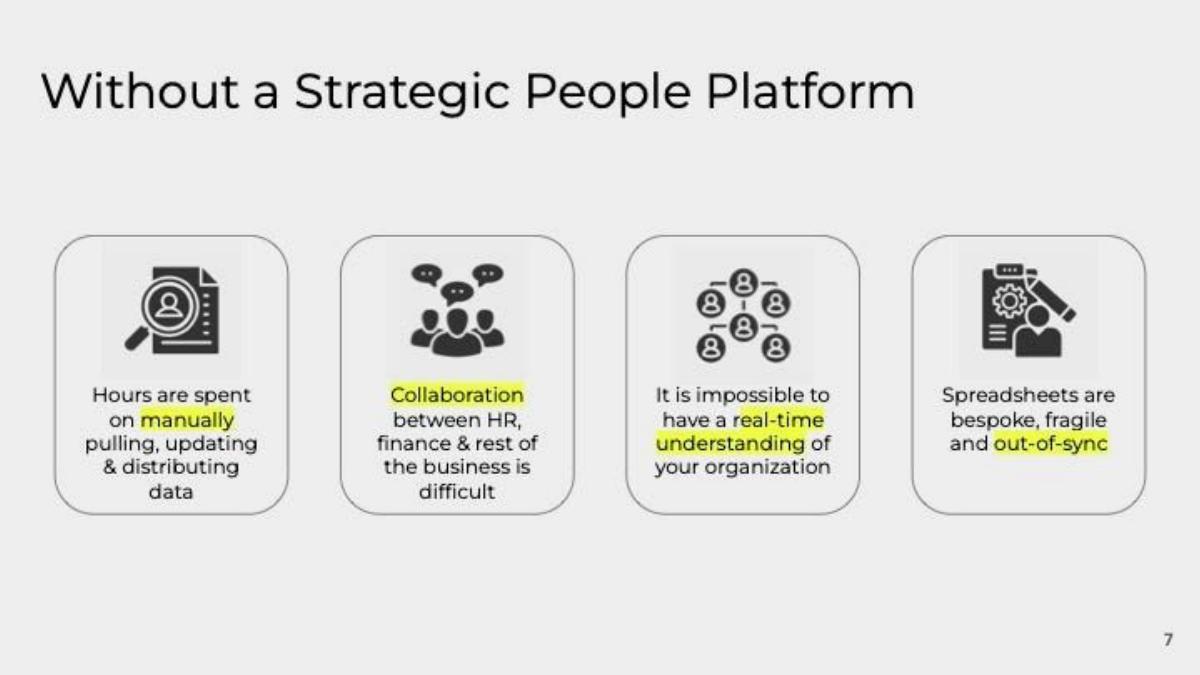
- The current market solution is depicted as a fragmented ecosystem of HRIS, ATS, and spreadsheets that are 'bespoke, fragile and out-of-sync' (Slide 7).
- TeamOhana positions itself as a 'single source of truth' that stays in sync with existing HRIS and ATS tools (Slide 13).
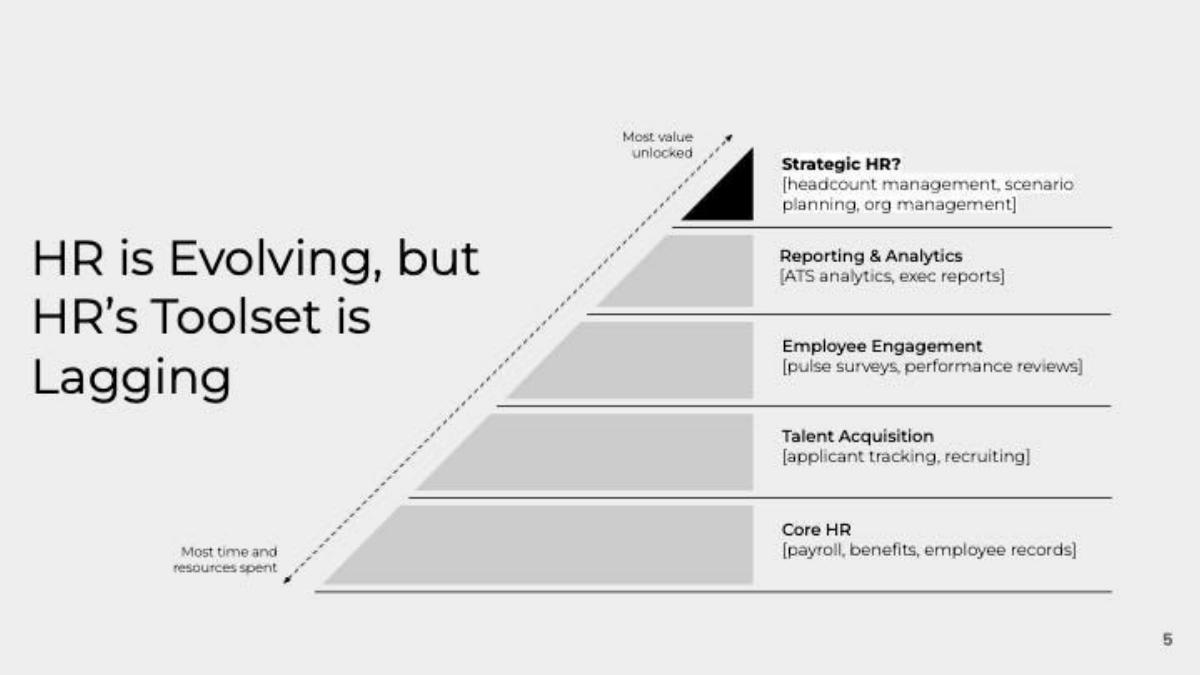
- The deck uses a pyramid visualization to show that while most time is spent on Core HR, the 'most value' is unlocked at the Strategic HR level (Slide 5).
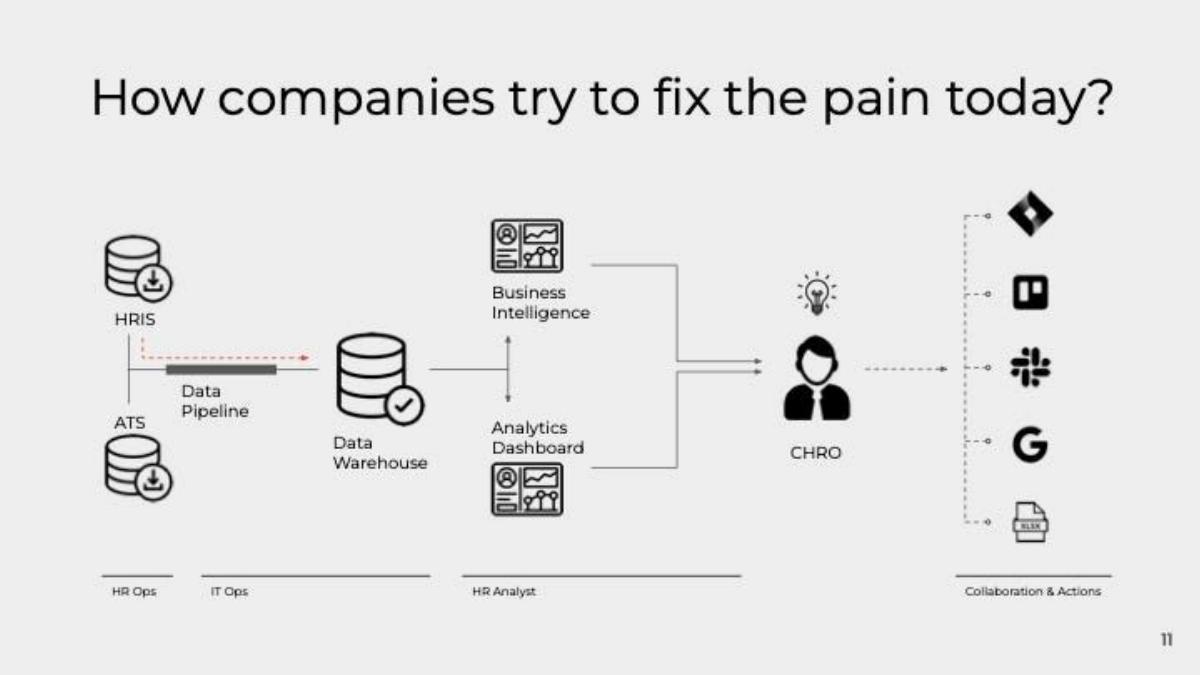
- A complex architectural diagram on Slide 11 illustrates the inefficiency of modern data pipelines involving CHROs and manual collaboration.
- The deck omits a traditional team slide, financial projections, and specific customer logos in the provided 15-slide sequence.
- The 'Ask' is framed as a partnership to build the first Strategic People platform rather than a specific dollar amount (Slide 15).
The Narrative of Strategic HR
TeamOhana’s pitch deck is a textbook example of selling a category rather than just a tool. In the HR tech space, which is notoriously crowded with legacy players and modern incumbents, TeamOhana avoids a feature-war by redefining the hierarchy of HR needs. The deck, which supported a $4M Seed round in 2024, focuses on the transition from 'Operational HR' to 'Strategic HR.' By the time the investor reaches the solution slides, the company has already convinced them that the current way of managing headcount is fundamentally broken.
Slide 1: The Vision Statement
The deck opens with a clean, minimalist title slide. The subtitle, "Strategic People Platform for fast-growing startups," immediately identifies the target market and the specific niche. It doesn't call itself an HRIS or a payroll tool; it uses the word 'Strategic' to signal a higher-level value proposition.
Slide 3: The Fragmented Ecosystem
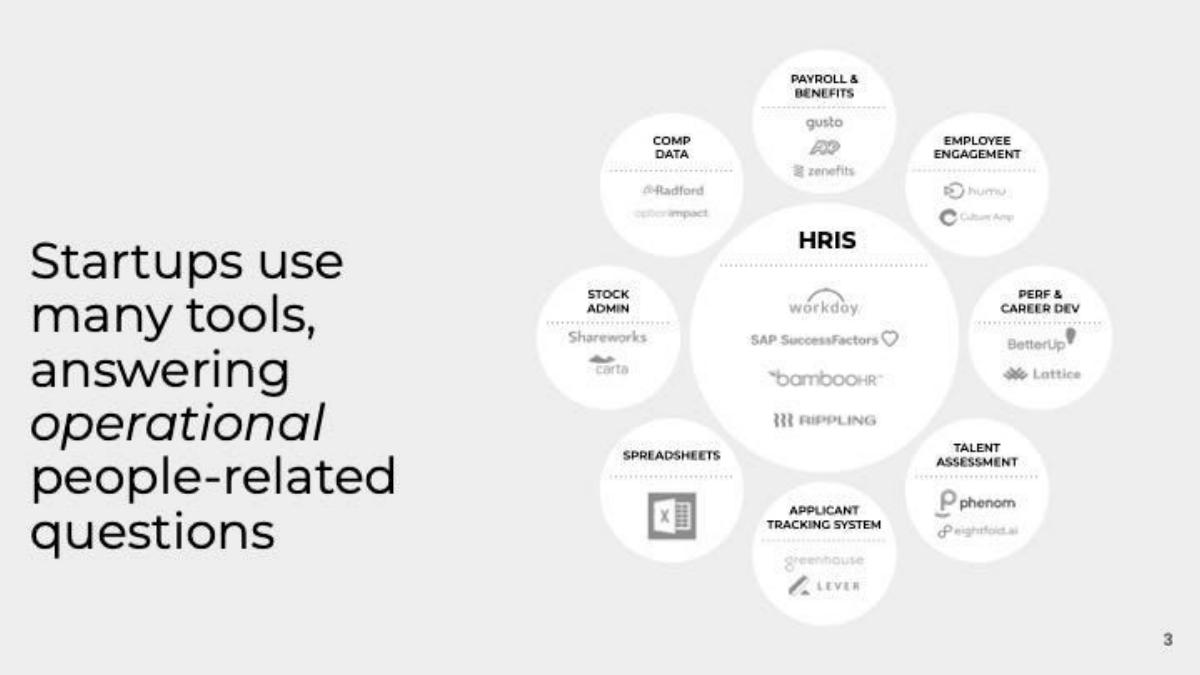
Slide 3 visualizes the 'Operational' side of HR. It shows a central HRIS (listing logos like Workday, SAP SuccessFactors, BambooHR, and Rippling) surrounded by specialized tools for Payroll, Comp Data, Stock Admin, Spreadsheets, ATS, Talent Assessment, Perf & Career Dev, and Employee Engagement. The text states: "Startups use many tools, answering operational people-related questions." This slide sets the stage for the complexity that TeamOhana intends to simplify.
Slide 5: The Hierarchy of HR Value
This is arguably the most important slide in the deck. It uses a pyramid to show that "HR is Evolving, but HR’s Toolset is Lagging." At the base is 'Core HR' (payroll, benefits), where the "most time and resources [are] spent." At the peak is "Strategic HR?" which includes headcount management, scenario planning, and org management. This peak is labeled as where the "most value [is] unlocked." By placing a question mark next to Strategic HR, they imply that this layer is currently missing or underserved.
Slide 7: The Cost of Absence
Slide 7 outlines the consequences of not having a Strategic People Platform. It highlights four pain points: "Hours are spent on manually pulling, updating & distributing data," "Collaboration between HR, finance & rest of the business is difficult," "It is impossible to have a real-time understanding of your organization," and "Spreadsheets are bespoke, fragile and out-of-sync." The use of yellow highlighting on keywords like 'manually,' 'difficult,' and 'out-of-sync' emphasizes the friction in current workflows.
Slide 9: The Beachhead Strategy
To justify why an investor should care about this specific niche, Slide 9 provides the financial context: "Today, more than 70% of a startup’s budget spend is on headcount." This is a powerful 'why now' and 'why this' metric. It positions headcount management not as an HR task, but as a financial imperative. The slide explicitly states: "Headcount management is our beachhead to make HR strategic."
Slide 11: The Current 'Fix'
Slide 11 is a technical diagram showing how companies currently try to solve this problem. It involves a messy pipeline where data moves from HRIS and ATS through a "Data Pipeline" into a "Data Warehouse," then to "Business Intelligence" and "Analytics Dashboards," eventually reaching the "CHRO." Even then, the CHRO must manually push actions to tools like Trello, Slack, and Google Sheets. This diagram visualizes the 'Rube Goldberg machine' that TeamOhana replaces.
Slide 13: The TeamOhana Solution
Finally, the deck presents the solution. "TeamOhana Makes Headcount Management Agile." The slide lists six core capabilities: "Predict plan success with forecasts," "Visualize plan w/ intelligent org-charts," "Stay on track with real-time reporting," "Single source of truth," "Always in sync with ATS & HRIS," and "Update and approval workflows." This slide directly maps back to the pain points identified on Slide 7.
Slide 15: The Call to Action
The deck concludes with a simple invitation: "Partner with us to build the first Strategic People platform for fast-growing startups." It provides contact emails for 'tushar' and 'bg,' presumably the founders, though their full names and backgrounds are not detailed in this specific slide sequence.
What Works in This Deck
Strong Problem-Solution Mapping: Every pain point mentioned in the first half of the deck is directly addressed by a feature in the second half. For example, the 'out-of-sync spreadsheets' on Slide 7 are countered by the 'Always in sync with ATS & HRIS' feature on Slide 13.
Strategic Positioning: By framing the product as a 'Strategic' layer rather than a 'Core' layer, TeamOhana avoids the perception that they are trying to replace massive, entrenched systems like Workday. Instead, they position themselves as a necessary addition that makes those systems more valuable.
The 70% Rule: Citing that 70% of spend is on headcount is the 'hook' that turns an HR tool into a business-critical financial tool. It raises the stakes of the pitch significantly.
What Is Missing from This Deck
Team Background: In the 15 slides provided, there is no dedicated team slide. For a Seed round, the founders' pedigree is usually a primary factor in the investment decision. The lack of bios or previous company experience is a notable omission.
Traction and Social Proof: There are no slides showing current revenue, number of customers, or growth rates. While the publisher reports a $4M raise, the deck itself relies entirely on the strength of the narrative rather than proof of market fit.
Competitive Landscape: The deck mentions legacy tools and spreadsheets, but it does not address other modern headcount management startups. A 'Competitor Matrix' or a 'Why We Win' slide would have helped clarify their unique moat.
The Ask: While the publisher reports the amount raised, the deck does not explicitly state the funding goal, the valuation, or the intended use of proceeds (e.g., hiring, R&D, sales expansion).
Lessons for Founders
Use the 'Beachhead' Logic: If you are building a platform that could eventually do a hundred things, follow TeamOhana’s lead. Identify the one area where the most money is spent (in their case, headcount) and call it your beachhead. It makes a broad vision feel achievable.
Visualize the Mess: Slide 11 is effective because it looks exhausting. When you can visualize the current manual workaround as a complex, fragile diagram, the simplicity of your proposed solution becomes much more attractive to an investor.
Sell the 'Why Now': The pyramid on Slide 5 is a great way to show market evolution. If you can convince an investor that the market is moving from 'Level A' to 'Level B' and that no tools exist for 'Level B,' you have created a compelling reason for your company to exist.
Frequently asked questions
- What is the core problem TeamOhana is solving?
- TeamOhana addresses the lack of strategic tools for HR. While startups have tools for payroll, benefits, and recruiting, they lack a centralized platform for headcount management and scenario planning. Currently, these tasks are handled via manual spreadsheets that are difficult to sync with real-time data from HRIS and ATS systems, leading to fragmented collaboration between HR and Finance.
- Why does the deck focus so heavily on headcount?
- The deck argues that headcount is the most important metric for a startup because it represents over 70% of the total budget. By focusing on headcount management as a 'beachhead,' TeamOhana aims to become the essential strategic layer that sits on top of operational tools like Workday, Rippling, and Greenhouse.
- Does the deck show the actual product interface?
- No, the provided 15-slide deck focuses on the conceptual framework, the problem landscape, and the value proposition. It uses icons and flowcharts to describe features like 'intelligent org-charts' and 'approval workflows' rather than showing high-fidelity screenshots of the software itself.
- What metrics are included in the TeamOhana deck?
- The deck is notably light on internal company metrics. It cites a general market statistic that 70% of startup spend is on headcount, but it does not list current ARR, user growth, or specific customer retention figures within these 15 slides.
- Who is the target customer for TeamOhana according to the deck?
- The deck explicitly targets 'fast-growing startups.' The narrative is built around the specific pain points of scaling organizations where manual data pulling and out-of-sync spreadsheets become a bottleneck for the CHRO and finance departments.