TeachMe.To’s 20-slide Seed deck is a masterclass in marketplace storytelling, focusing on the friction of finding in-person instructors for fragmented hobbies like golf and pickleball. By positioning themselves as the solution to 'expensive and intimidating' learning (Slide 7), the founders lean heavily on their pedigree—having previously raised over $23M collectively (Slide 15). The deck effectively uses a 'latent supply' argument (Slide 11), comparing their model to Uber and Airbnb to justify how they can scale in a $100B market (Slide 17). While the deck is light on specific unit economics…
Key takeaways
- The company identifies a $100B total addressable market for private learning, using a $1B golf lesson 'wedge' to prove the concept (Slide 17).
- Founder pedigree is a central pillar of the pitch, with the CEO and COO having previously raised a combined $23M+ in venture capital (Slide 15).
- The deck uses a 'latent supply' map of Los Angeles to visualize how they increase instructor density compared to existing options (Slide 11).
- TeachMe.To differentiates from legacy competitors by offering instant booking and guaranteed lesson quality (Slide 9).
- The mission focuses on three pillars: making learning more affordable, more approachable, and more trustworthy (Slide 7).
- The team includes former operators from high-growth marketplaces including Airbnb, Uber, and Faire (Slide 15).
- The deck utilizes a narrative 'hook' starting with a personal search for kiteboarding lessons to illustrate consumer friction (Slide 3).
- Social proof is established through direct testimonials from certified coaches who credit the platform for growing their business (Slide 13).
The Marketplace Narrative: TeachMe.To Slide-by-Slide Analysis
TeachMe.To entered the 2024 fundraising market with a clear objective: prove that the 'Uber for X' model still has massive, untapped potential in the service economy. Based in San Diego, the company raised $5M in Seed funding to scale their platform for in-person lessons. The deck is characterized by high-quality photography, minimal text, and a heavy reliance on the founders' previous successes.
Slides 1-3: The Hook and the Friction
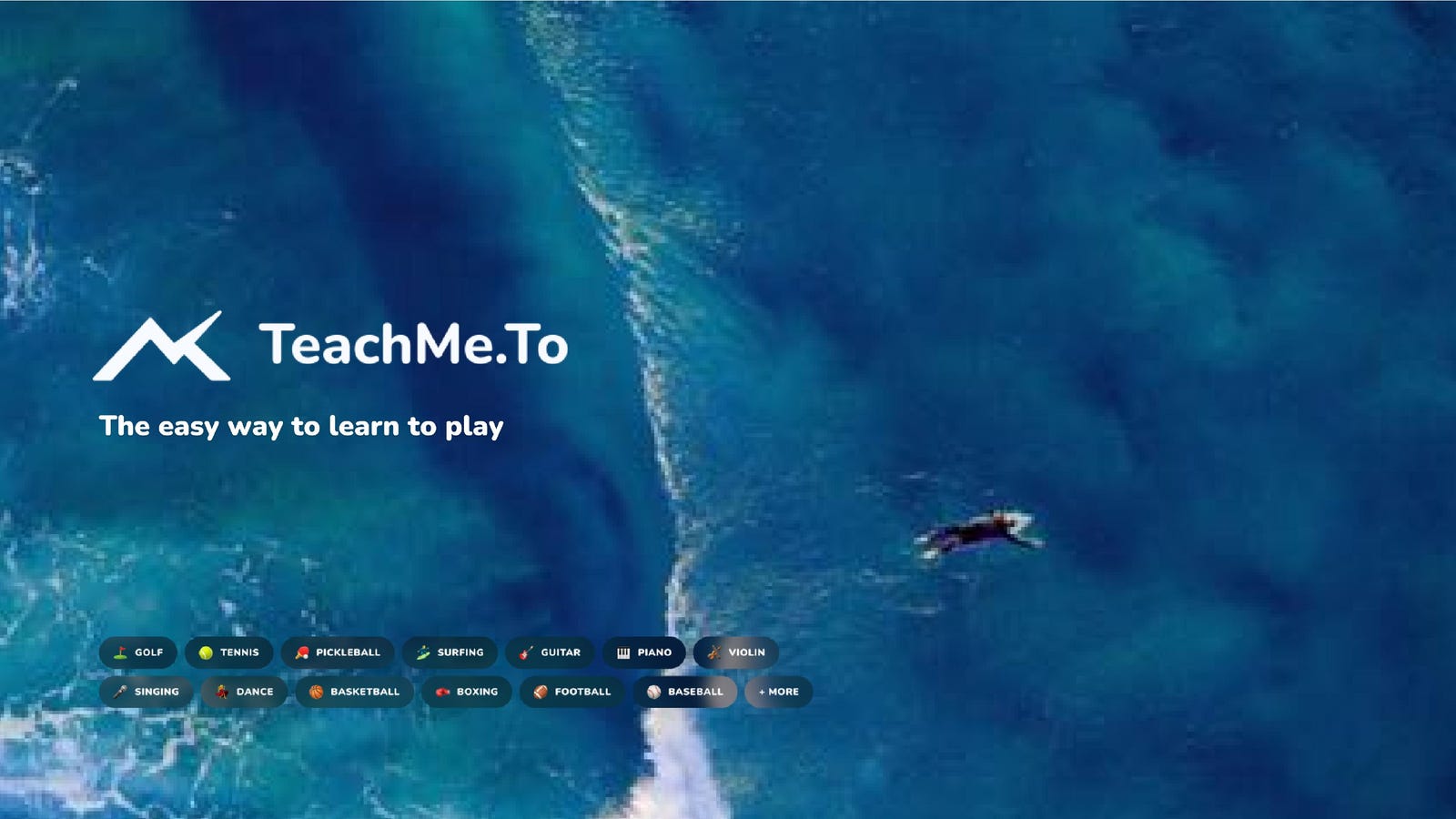
Slide 1 introduces the brand with a high-action background image of surfing, immediately signaling that this is a platform for physical, real-world skills. The tagline 'The easy way to learn to play' is supported by a row of icons representing diverse categories: Golf, Tennis, Pickleball, Surfing, Guitar, Piano, Violin, Singing, Dance, Basketball, Boxing, Football, and Baseball.
Slide 3 moves into the problem statement using a relatable consumer journey. It shows a simple Google search bar with the query 'Kiteboarding lessons near me.' This sets the stage for the 'discovery problem'—the difficulty of finding specific, high-quality instruction through generic search engines.
Slides 7-9: Mission and Differentiation
Slide 7 defines the mission: 'We’re increasing access to life-changing skills.' The slide explicitly states that learning is currently 'expensive and intimidating.' To counter this, TeachMe.To promises to be more affordable, more approachable, and more trustworthy. The inclusion of a photo showing a coach (Tom) helping a young student with a golf swing grounds the digital platform in a physical result.
Slide 9 is a standard but effective competitive matrix. It lists 'What new students want'—comparing coaches, instant booking, guaranteed quality, and an app—and shows TeachMe.To checking every box while 'Legacy Marketplaces' and 'Local Businesses' fail on almost every count except for coach comparison. This slide is designed to show that the current market is underserved by existing technology.
Slides 11-13: The Latent Supply Thesis
Slide 11 is perhaps the most important strategic slide in the deck. Titled 'Our Breakthrough Insight,' it uses two maps of the Los Angeles basin to show a dramatic increase in instructor pins. The caption, 'Like Airbnb & Uber, we unlock latent supply hidden in plain sight,' suggests that TeachMe.To isn't just aggregating existing pros, but enabling a new class of instructors to monetize their skills.
Slide 13 provides social proof from the supply side. It features Marc Escalante, a certified golf coach, who states that the platform has helped grow his 'lessons business, memberships and greens fees.' By showing that the platform benefits both the individual coach and the physical venue (the golf range), TeachMe.To addresses potential concerns about platform leakage or venue opposition.
Slides 15-17: Team Pedigree and Market Scale
Slide 15 focuses on the 'world-class team.' The credentials here are significant for a Seed round: CEO Tyler Maloney (Stanford MBA) and COO Nick O'Brien (Vanderbilt) have collectively raised over $23M in previous ventures. The slide also highlights that their team includes former employees from Airbnb, Uber, Faire, and Facebook, suggesting they have the operational blueprint for scaling a marketplace.
Slide 17 addresses the TAM (Total Addressable Market). They use a 'wedge' strategy, starting with a $1B market for golf lessons, expanding to a $15B local learning market, and ultimately targeting a $100B private learning market. This helps investors see a path from a niche vertical to a massive horizontal platform.
Slides 19-20: The Vision
Slide 19 concludes the narrative with a call to 'Join us as we build a happier, healthier world,' accompanied by photos of instructors in TeachMe.To branded apparel. This emphasizes the community and lifestyle aspect of the brand, moving beyond just a utility app to a mission-driven company.
What TeachMe.To Does Well
1. Narrative Simplicity: The deck avoids technical jargon. It frames the business as a simple marketplace problem (discovery and trust) with a proven solution (the Airbnb/Uber model applied to a new vertical).
2. Founder-Market Fit: Slide 15 is exceptionally strong. In a Seed round, investors are betting on the team's ability to execute. Showing that the founders have already raised tens of millions of dollars and scaled products to millions of users significantly de-risks the investment.
3. Visual Proof of Supply: The map on Slide 11 is a powerful way to visualize growth. Instead of just saying 'we have more coaches,' they show the density of the network, which is a key indicator of marketplace health.
What is Missing from the Deck
1. Unit Economics: While the publisher reports a $5M raise, the provided slides do not show the take rate, customer acquisition cost (CAC), or lifetime value (LTV) of a student. For a marketplace, these metrics are usually critical to proving the business model's sustainability.
2. Growth Velocity: There are no charts showing month-over-month growth in bookings or revenue. While the 'latent supply' map shows potential, investors typically want to see the actual transaction volume to date.
3. The 'Ask' Slide: The provided slides do not include a specific breakdown of how the $5M will be spent or what milestones the company intends to hit with this capital. This is a common omission in public-facing versions of decks, but it is a vital component of the actual pitch.
Founder's Playbook: Lessons to Copy
Use the 'Wedge' Strategy: If you are building a horizontal platform, follow TeachMe.To’s lead on Slide 17. Don't just claim a $100B market; show the specific $1B vertical (like golf) where you are currently winning. It makes the massive TAM feel achievable rather than delusional.
Leverage 'Latent Supply': If your marketplace creates new supply rather than just aggregating existing supply, highlight that as a 'Breakthrough Insight' (Slide 11). Investors love models that expand the market rather than just fighting for a piece of the existing pie.
Humanize the Supply Side: Don't just treat your service providers as data points. The testimonial on Slide 13 shows that the platform creates real economic value for people. This builds a 'moat' of loyalty that is harder for competitors to disrupt with just lower fees.
Frequently asked questions
- What is the primary problem TeachMe.To is solving?
- According to Slide 7, the company addresses the fact that it is currently 'expensive and intimidating to learn something new.' They aim to solve this by making the process of finding and booking in-person instructors more affordable, approachable, and trustworthy than traditional methods.
- How does TeachMe.To compare itself to competitors?
- On Slide 9, the company contrasts itself against 'Legacy Marketplaces' and 'Local Businesses.' They claim to be the only option that offers the combination of coach comparison, instant booking, guaranteed lesson quality, and a dedicated app with practice tools.
- What is the 'Breakthrough Insight' mentioned in the deck?
- Slide 11 explains that their insight is 'unlocking latent supply hidden in plain sight,' drawing a direct parallel to how Airbnb and Uber found underutilized assets (spare rooms and cars). They illustrate this with a map showing a significant increase in available instructors across the Los Angeles region.
- Who are the founders and what is their track record?
- Slide 15 lists Tyler Maloney (CEO) and Nick O'Brien (COO). Maloney has raised over $20M in venture capital and holds a Stanford MBA, while O'Brien has raised over $3M and generated over $10M in revenue. Both are repeat founders who have scaled multiple companies.
- What is the market size for this platform?
- Slide 17 breaks the market down into three tiers: a $1B 'wedge' in golf lessons, a $15B market for local learning, and a $100B total market for all private learning. They cite IBISWorld and PerfectPutt as sources for these figures.