Voxel’s pitch deck is a concise, high-impact presentation that secured a $12M strategic round in 2024. The company uses computer vision to transform existing security cameras into proactive safety monitors for high-risk environments like warehouses. The deck excels by avoiding technical AI jargon in favor of clear business outcomes: reducing 'hidden' iceberg costs such as insurance premiums and OSHA violations. By highlighting a 'privacy first' approach and a 48-hour installation window, Voxel addresses common enterprise friction points early. While the deck lacks a formal team slide with nam…
Key takeaways
- The deck uses an 'iceberg' visual on Slide 3 to effectively communicate the massive indirect costs of workplace accidents beyond simple workers' compensation.
- Voxel addresses the 'reactive' nature of current safety protocols by showing a visibility pyramid on Slide 2, targeting 'near misses' before they become fatalities.
- Technical friction is mitigated on Slide 6 by promising compatibility with all IP/analog cameras and a live setup within 48 hours.
- Privacy concerns are handled proactively on Slide 6, explicitly stating the system uses no facial recognition or individual identification.
- The platform's breadth is demonstrated on Slide 4, covering ergonomics, PPE compliance, vehicle safety, and operational efficiency.
- Social proof is anchored by a quote from a Rudy Bowling, an executive at Americold, on Slide 7, providing industry validation.
- The deck reports significant traction on Slide 7, citing 200,000+ workers protected and 50 million+ events identified.
- Despite raising $12M, the deck omits a specific 'Ask' slide or a detailed breakdown of how the new capital will be deployed.
Slide 1: Title Slide
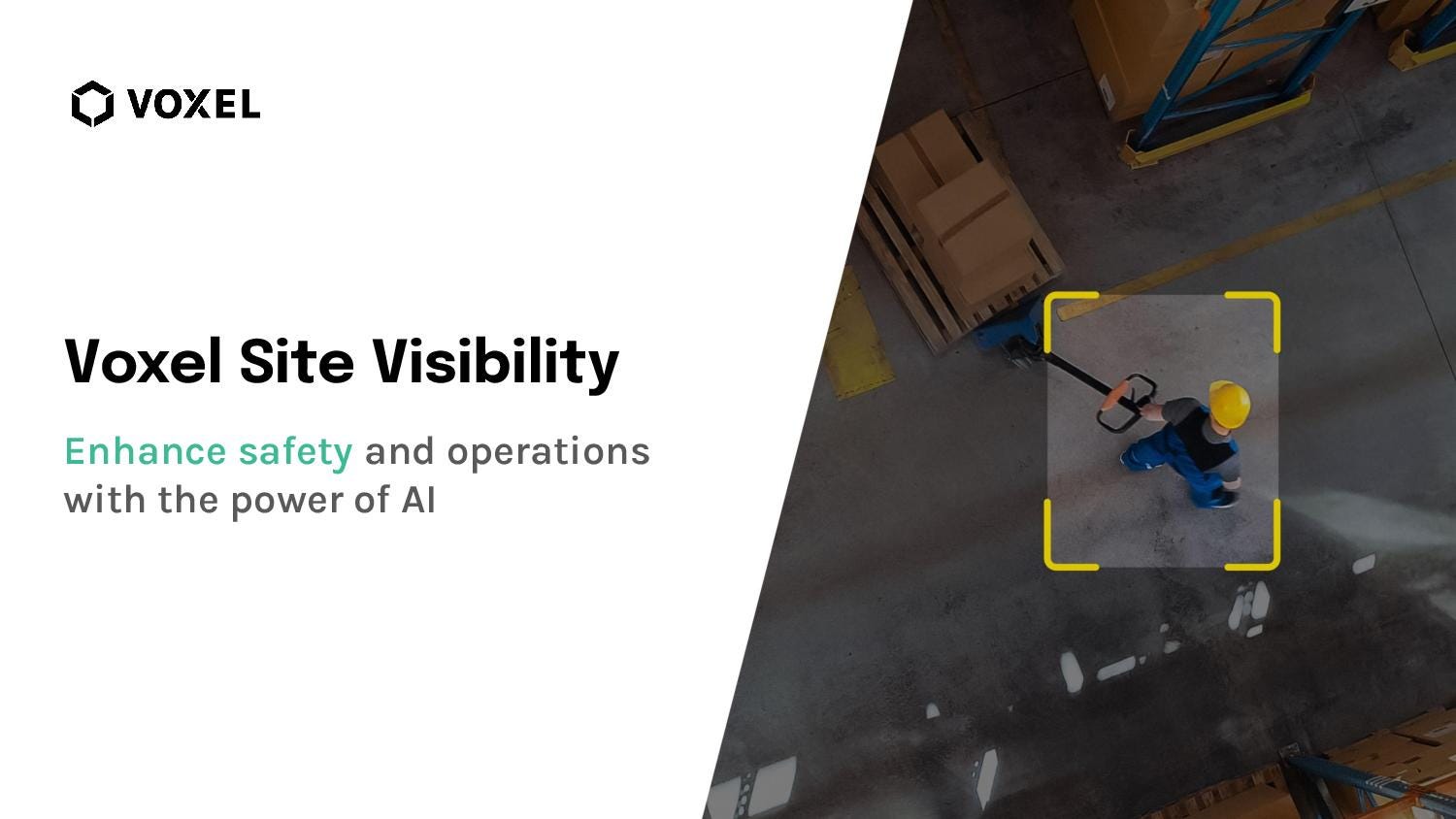
The opening slide is minimalist, featuring the Voxel logo and the title 'Voxel Site Visibility.' The subtitle, 'Enhance safety and operations with the power of AI,' immediately positions the product as a dual-purpose tool. The background image shows a top-down view of a warehouse worker being tracked by a yellow bounding box, which is a classic visual shorthand for computer vision technology. This slide sets a professional, enterprise-grade tone without unnecessary clutter.
Slide 2: The Problem - Reactive Safety
Slide 2 identifies the core pain point: 'Safety is reactive because visibility is limited.' It uses a pyramid graphic to illustrate the hierarchy of industrial incidents. At the top, visible events like 'Fatalities' and 'Lost time' are high-visibility but represent a failure of the system. The bottom of the pyramid, 'Near misses' and 'Unsafe conditions,' are labeled as 'Low visibility.' Voxel’s argument is that standard safety training fails because security cameras are under-utilized, with footage only reviewed after an incident has occurred. This slide successfully shifts the conversation from 'how do we record accidents' to 'how do we see the risks that lead to them.'
Slide 3: The Economic Impact - Hidden Costs
Slide 3 uses the 'Iceberg' metaphor to explain the financial burden of workplace injuries. Above the water line are the obvious costs: Workers' compensation and insurance premiums. Below the water, Voxel lists ten 'hidden' costs, including property damage, hiring/training new workers, OSHA violations, and lost productivity. By quantifying the problem in terms of 'Administrative time' and 'Equipment repairs,' Voxel moves the product from a 'nice-to-have' safety feature to a 'must-have' cost-saving operational tool. This is a critical slide for convincing CFOs and strategic investors.
Slide 4: The Solution - Real-Time Detection
Slide 4 introduces the product's capabilities. It explicitly states that the software 'Utilizes your existing security cameras to detect events in real-time.' This is a major selling point because it implies no new hardware investment is required. The slide breaks down detection into five categories: Ergonomics (lifting posture, REBA scoring), PPE (hard hats, glasses), Vehicle Safety (speeding, proximity near misses), Operations (asset utilization, machine downtime), and Environment (spills, blocked exits). A partial dashboard mockup on the right shows a 'Site Score' of 76, suggesting a gamified or quantified approach to safety management.
Slide 5: Platform Features
Slide 5 focuses on the 'Integrated Platform for Visibility, Management & Analysis.' It highlights four key functional areas: Dynamic rules (allowing users to teach the AI specific worksite rules), Collaborative case tools (mobile app, email, and text alerts), Smart alerts (ranked by severity), and Risk scoring & analytics . This slide demonstrates that Voxel isn't just a 'detector' but a full workflow tool that helps managers coach their teams and uncover 'hotspots' of risk.
Slide 6: Implementation and Privacy
Slide 6 addresses the two biggest hurdles in enterprise AI sales: installation and privacy. It promises a 'Simple plug and play installation' that works with all IP or analog cameras and is 'Live within 48 hours.' Crucially, it includes a 'Privacy first' section, stating there is 'No facial recognition or identification of individuals' and that the company is SOC-2 certified. It also mentions 'Low bandwidth' (less than 250 Kbps per camera), which reassures IT departments that the software won't crash their internal networks. The visual of a smartphone showing a 'No Stop at Intersection' alert makes the technology feel tangible and immediate.
Slide 7: Traction and Pedigree
Slide 7 serves as the 'Why Us' and 'Traction' slide. It lists impressive stats: 200K+ workers protected, 50M+ events identified, and 30M+ in funding. Rather than a traditional team slide with headshots, it lists the logos of companies where the builders originated, including Apple, Google, AIG, Stanford, Uber, Waymo, Carnegie Mellon, and Samsara. The right side of the slide is dedicated to a testimonial from Rudy Bowling, an executive at Americold, who calls the product 'truly revolutionary.' This social proof from a major logistics player is likely what helped secure the strategic investment.
Slide 8: Conclusion and Contact
The final slide provides a full view of the Voxel dashboard, showing a 'Voxel Site Score' of 71 and a breakdown of incidents like 'Improper Lifting' and 'No Stop at Aisle.' It lists a 25% decrease in total incidents over the last 30 days, providing a concrete example of the ROI. The slide ends with a clear call to action: 'Eliminate injuries with Voxel site visibility' and provides a contact email and website. It is a clean, data-driven finish to a highly focused deck.
What Voxel Does Well
Voxel excels at objection handling . By the time an investor reaches Slide 6, the three most common reasons to say 'no' to an industrial AI startup—hardware costs, privacy concerns, and IT bandwidth—have already been addressed. The deck is also highly effective at translating technical features into business outcomes . Instead of talking about neural networks or frame rates, they talk about 'OSHA violations' and 'insurance premiums.' This makes the deck accessible to strategic investors who may be more interested in the industrial application than the underlying code.
What is Missing from the Deck
The most notable omission is a detailed Team slide . While Slide 7 mentions the companies the founders came from, it does not name the founders or explain their specific roles. For a strategic round, investors usually want to know who is steering the ship. Additionally, there is no 'Ask' slide . The deck does not specify how much money is being raised in this specific round or how those funds will be allocated (e.g., R&D, sales expansion, international growth). Finally, there is a lack of competitor analysis . The deck assumes a vacuum, failing to mention how Voxel differs from other computer vision safety startups or legacy safety consulting firms.
Founder Takeaways
Focus on the 'Unseen' Problem: Voxel doesn't just say 'accidents are bad.' They use the iceberg visual to show that accidents are expensive in ways people forget. If your startup solves a problem, map out the indirect costs your solution eliminates. · Address Friction Early: If your product requires integration with existing infrastructure, dedicate a slide to how easy that process is. Voxel’s '48 hours to live' claim is a powerful closer for skeptical enterprise buyers. · Use Social Proof Over Specs: A quote from a high-level executive at a target-market company (like Americold) is worth more than ten slides explaining your algorithm. It proves market-product fit instantly. · Quantify the Impact: The '25% decrease in incidents' on the final slide gives investors a concrete metric to anchor their valuation on. Always try to show the 'Before and After' of your product's intervention.
Frequently asked questions
- What is Voxel's core value proposition?
- Voxel uses AI and computer vision to turn existing security cameras into proactive safety tools. Instead of reviewing footage after an accident, the system detects risks like improper lifting, missing PPE, or vehicle speeding in real-time. This allows site managers to intervene during 'near misses,' preventing the costly fatalities and injuries that typically occur when safety is purely reactive.
- How does Voxel handle employee privacy concerns?
- Voxel explicitly addresses privacy on Slide 6, stating they have a 'privacy first' policy. The software does not use facial recognition or the identification of specific individuals. This is a critical inclusion for industrial sales, where labor unions and HR departments often push back against 'Big Brother' style surveillance in the workplace.
- What are the 'hidden' costs Voxel claims to reduce?
- On Slide 3, Voxel identifies several costs below the surface of a standard accident: property damage, equipment repairs, overtime for healthy workers, low morale, turnover, administrative paperwork, and OSHA violations. By preventing the accident at the source, Voxel aims to reduce these indirect expenses which often outweigh the direct cost of workers' compensation.
- Is the hardware installation difficult for customers?
- No, Voxel emphasizes a 'plug and play' model. According to Slide 6, the system is compatible with all existing IP or analog cameras and Network Video Recorders (NVRs). They claim a site can be live within 48 hours of installation and requires low bandwidth, utilizing less than 250 Kbps per camera.
- What metrics does Voxel use to prove its scale?
- On Slide 7, Voxel highlights three key figures: over 200,000 workers protected, more than 50 million safety events identified, and over $30 million in total funding (at the time the deck was produced). These figures serve to demonstrate that the AI has been trained on a massive dataset and is already operational at enterprise scale.