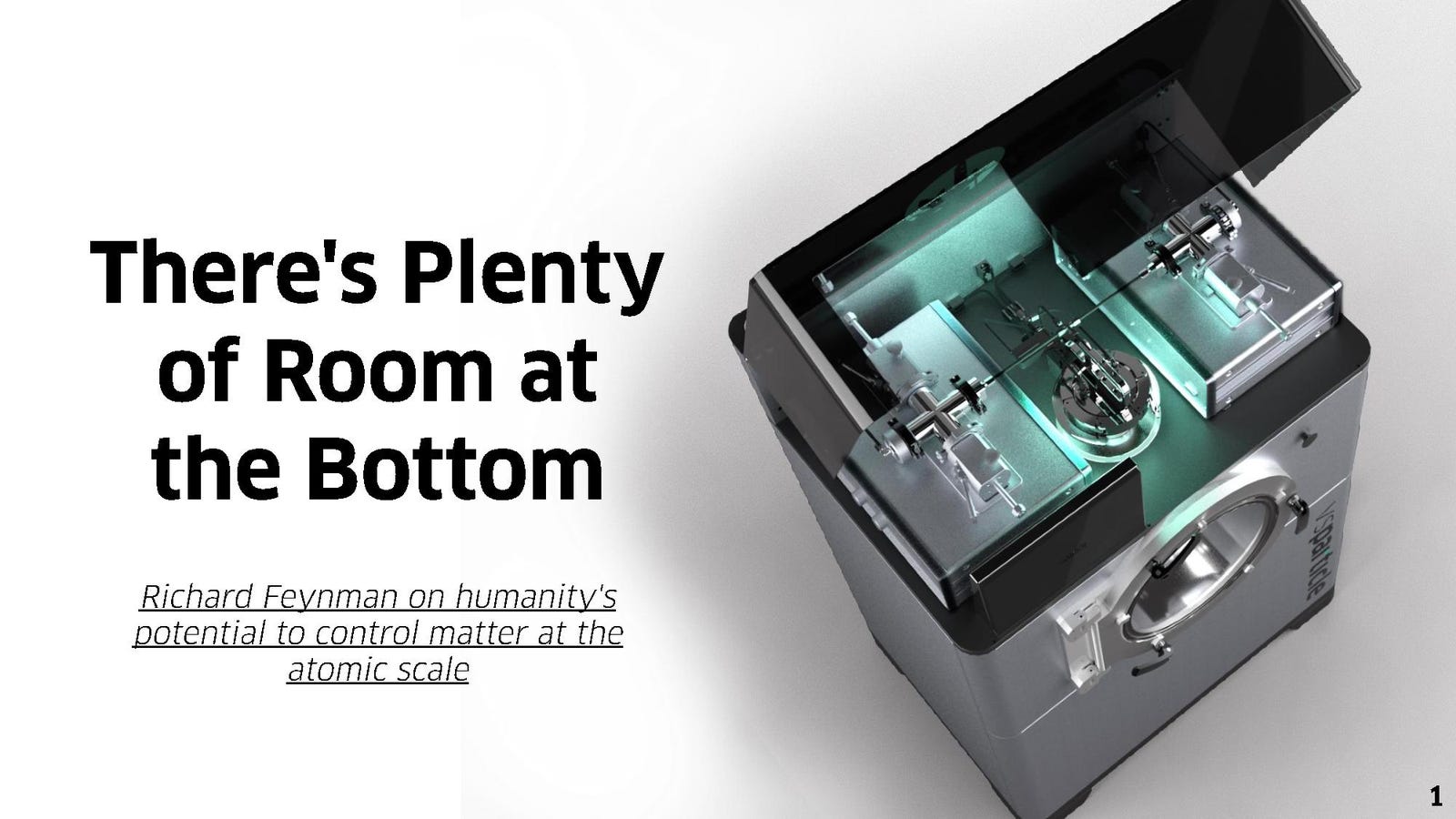
VSParticle’s Series A deck is a masterclass in framing a complex hardware value proposition through the lens of time-to-market. By identifying a specific bottleneck in material science—the 15-year gap between discovery and mass production—the company positions its nanoparticle printing tools as the essential infrastructure for the green transition. The deck highlights 40 successful installations and a global distribution network, providing the necessary social proof for a deep-tech investment. While it lacks granular unit economics and a specific financial 'Ask' slide in the public version, i…
Key takeaways
- The deck frames the core problem as a time-to-market issue, citing a 15-year cycle for traditional material development on Slide 2.
- VSParticle claims a 100x acceleration in material development to unlock the 'other 99%' of materials within a decade on Slide 4.
- Traction is evidenced by 40 systems installed globally across academia, research, and industry as shown on Slide 7.
- The company has established a global distribution network including partners like Phenom Scientific (China) and NanoScience Instruments (USA/Canada) on Slide 7.
- The team has scaled from 4 to 30 individuals, supported by seed investors like Blue Yard and Possible Ventures as noted on Slide 7.
- Market opportunities are quantified across three sectors: Solar (€170B), Batteries (€193B), and Electronics (€893B) on Slide 9.
- The solution involves moving from a 10-year trial-and-error phase to an 8-month 'self-driving lab' phase as illustrated on Slide 10.
- The deck omits a specific breakdown of the $15.8M Series A use of funds or detailed financial projections.
The Vision: Atomic Scale Control
Slide 1: Title and Hook
VSParticle opens with a high-fidelity render of their hardware and a quote from Richard Feynman: 'There's Plenty of Room at the Bottom.' This is a classic deep-tech opening. By referencing Feynman’s 1959 lecture on nanotechnology, the company immediately signals that they are operating at the atomic scale. The slide is clean, professional, and focuses on the physical product, which is crucial for a hardware-centric Series A raise.
Slide 2: The 15-Year Bottleneck
Slide 2 identifies the 'Enemy.' It asks, 'Why does it take 15 years?' and maps out the current state of material science. The slide shows a messy, spiraling 'Design-Build-Test-Learn' cycle that consumes 10 years of trial and error, followed by another 5 years to reach mass production. This slide is effective because it quantifies the pain point not just in dollars, but in time—the most precious resource for companies trying to solve climate change or semiconductor shortages.
Slide 4: The 100x Acceleration
This slide presents the 'Promise.' VSParticle claims to accelerate material development by 100x. The visual metaphor of an open-pit mine contrasted with the text 'unlock the other 99% within the next 10 years' suggests that current material discovery has only scratched the surface. It sets a bold, moonshot-style goal that is necessary to justify the high valuations often associated with Series A hardware companies.
Slide 7: Proof of Life and Traction
This is arguably the most important slide in the deck. It moves the conversation from theory to reality. VSParticle lists several key achievements: 40 systems installed globally, a team grown from 4 to 30, and a global distribution network including partners like Phenom Scientific and NanoScience Instruments. The inclusion of a map showing installations in Europe, North America, and Asia proves that there is international demand. Furthermore, the 'Seed round' section lists heavy hitters like Blue Yard and Taavet Hinrikus, which provides massive social proof to new investors.
Slide 9: The Trillion-Euro Opportunity
Slide 9 breaks down the Total Addressable Market (TAM). Instead of giving one giant, unbelievable number, they segment the opportunity into three logical verticals: Solar (€170B), Batteries (€193B), and Electronics (€893B). By showing the physical applications (a solar panel, a battery pouch, a microchip), they ground the abstract concept of 'nanoparticles' in multi-billion dollar industries that investors already understand and covet.
Slide 10: The Future State
This slide mirrors Slide 2 but shows the 'VSParticle Way.' The messy 10-year spiral is replaced by 'Self-driving labs' that take only 8 months, and the 5-year scaling period is reduced to 4 months via 'Scalable technology.' The total timeline is compressed from 15 years to 12 months. This visual comparison is a powerful way to demonstrate the ROI of their hardware: it’s a time machine for R&D departments.
Slide 11: The Mission
The deck concludes with a call to action: 'Join us in enabling society to decarbonize faster.' The hardware is shown again, reinforcing the brand. By tying the technology to 'decarbonization,' VSParticle aligns itself with ESG (Environmental, Social, and Governance) mandates, which opens up a wider pool of capital, especially in the European market where this round was raised.
What Works in the VSParticle Deck
Clarity of Value Proposition: The deck is obsessed with the number 15. By repeatedly highlighting the 15-year R&D cycle and then showing how they reduce it to 1 year, the founders make the benefit of their complex technology easy to grasp for a generalist VC.
Global Footprint: For a Series A company, having 40 installations across three continents is impressive. The deck does a great job of showcasing that they aren't just a lab project; they have a functioning sales and distribution engine.
Strategic Market Segmentation: They don't just say 'we make nanoparticles.' They say 'we enable the next generation of batteries and solar cells.' This connects their tool to the biggest macro trends in the global economy.
What is Missing from the VSParticle Deck
Unit Economics: While the deck shows market size and traction, it omits the cost to build a machine versus the sale price. For a hardware company, understanding the margins and the 'razor-razorblade' model (if they sell consumables like the 'particle sources') is vital for Series A investors.
Competitive Landscape: The deck operates as if VSParticle is the only player in the space. Investors will want to know how this compares to traditional chemical vapor deposition (CVD) or other additive manufacturing techniques at the nanoscale.
The 'Ask': The public version of this deck does not include a slide detailing how much they are raising (though we know from publisher reports it was $15.8M) or how they plan to spend the capital. A standard pitch should usually include a slide on 'Use of Funds'—e.g., 40% R&D, 30% Sales, 30% Manufacturing scale-up.
Founder Takeaways: How to Pitch Deep-Tech Hardware
Focus on Time-to-Value: If your technology is complex, don't lead with the physics. Lead with the time you save your customers. VSParticle’s '15 years to 1' is a perfect example of this.
Show, Don't Just Tell: The photos of the actual machine (Slides 1, 7, and 11) are high-quality and make the company feel 'real.' In hardware, investors are terrified of 'vaporware.' High-quality imagery of the physical product is non-negotiable.
Leverage Your Cap Table: If you have notable angels or seed VCs, put their logos and names front and center. In deep tech, where the technical due diligence is hard, investors often look for 'signals' from other smart people who have already done the work.
Connect to Megatrends: VSParticle could have pitched as a 'nanoparticle printer.' Instead, they pitched as a 'decarbonization accelerator.' Always frame your startup within the context of a massive, inevitable global shift.
Frequently asked questions
- What is the primary product VSParticle sells?
- Based on Slide 1 and Slide 7, VSParticle sells hardware systems for nanoparticle printing. These tools are used to automate the 'Design-Build-Test-Learn' cycle in material science, allowing researchers to create and test new material combinations at the atomic scale much faster than traditional manual methods.
- How does VSParticle justify its market size?
- On Slide 9, the company identifies three massive downstream markets that rely on material breakthroughs: Solar cells and thermoelectric devices (€170 Billion), Solid state batteries and supercapacitors (€193 Billion), and Next generation electronics (€893 Billion). They position their tool as the enabling technology for these trillion-euro industries.
- What is the '15 years to 1' claim?
- This is the central value proposition found on Slides 2 and 10. Traditional material development takes roughly 10 years for trial-and-error discovery and another 5 years to scale. VSParticle claims their 'self-driving labs' and 'scalable technology' can compress this entire 15-year process into just 12 months.
- Who are the existing investors in VSParticle?
- Slide 7 lists Blue Yard and Possible Ventures as institutional seed investors. Notable angel investors include Hermann Hauser, Albert Wenger, Taavet Hinrikus, Charles Sunghurst, and the Bridford Group. This high-profile cap table provided significant credibility for their $15.8M Series A.
- Is the technology already in the market?
- Yes. Slide 7 explicitly states that 40 systems have already been successfully installed globally. They also list a comprehensive distribution network covering APAC (China, Japan, Korea, India), AMER (USA, Canada), and EMEA (UK), indicating they have moved past the pure R&D phase into commercialization.