VuSay’s pitch deck centers on solving the 'diluted brand experience' and 'inequitable benefits' of the 2016 video landscape dominated by YouTube and Facebook. By introducing a custom player that enables time-specific commenting—a direct parallel to SoundCloud’s audio interface—VuSay aimed to provide publishers with better moderation tools and more relevant advertising. The deck outlines a $2 million 'Seed++' raise intended to scale their mobile presence and acquire 200K-250K users. While the product vision is clear, the deck relies heavily on high-level strategy and pilot pipelines (including…
Key takeaways
- The company positions itself as 'The SoundCloud of Video' to immediately communicate its core value proposition of time-stamped interaction (Slide 1).
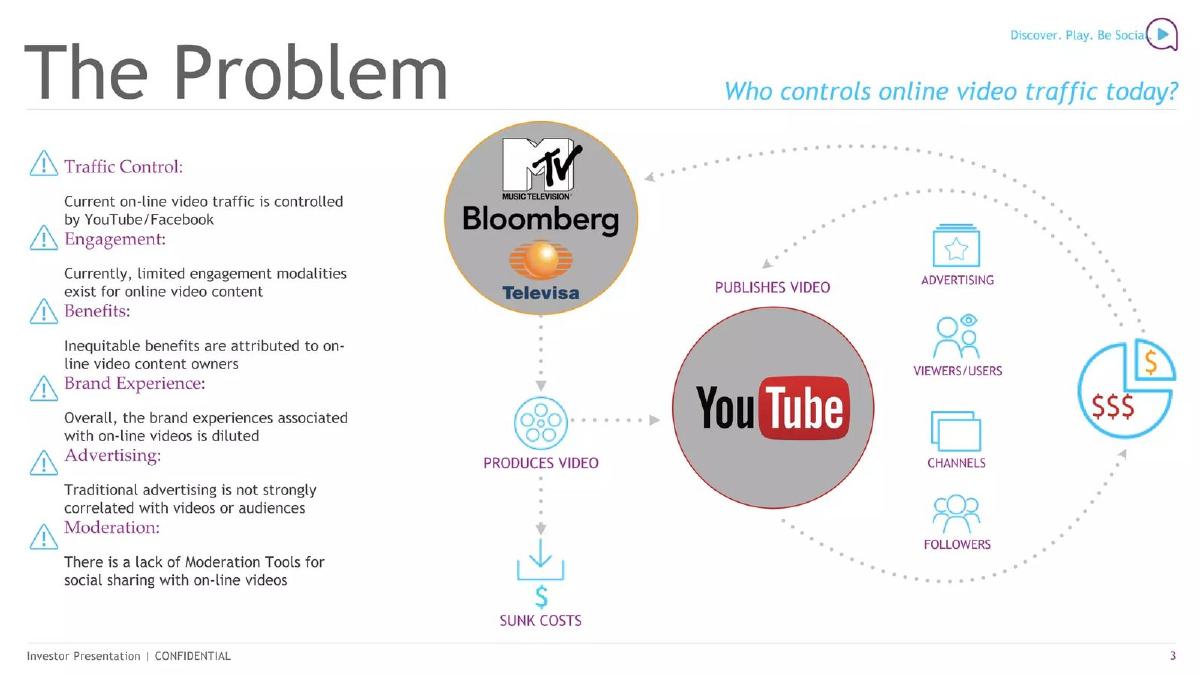
- VuSay identifies six core problems with current video platforms, including lack of moderation tools and poor correlation between traditional ads and video content (Slide 3).
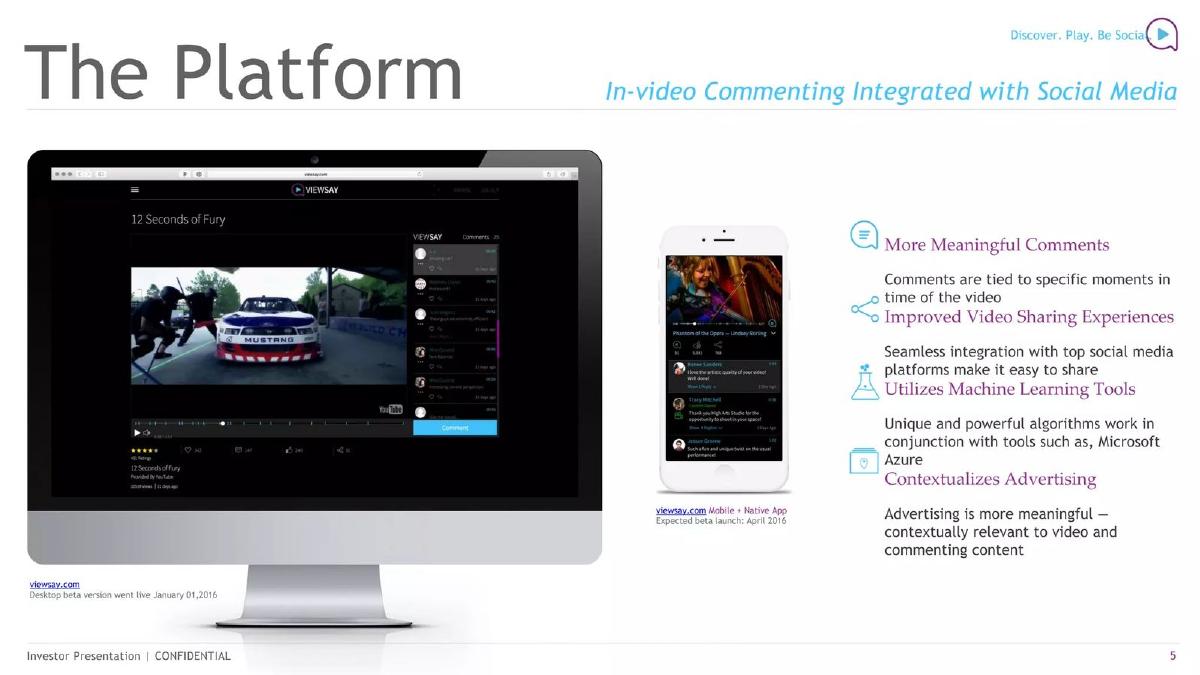
- The platform utilizes machine learning tools, specifically mentioning integration with Microsoft Azure for contextualizing advertising (Slide 5).
- A desktop beta version was launched on January 1, 2016, with a mobile native app launch expected in April 2016 (Slide 5).
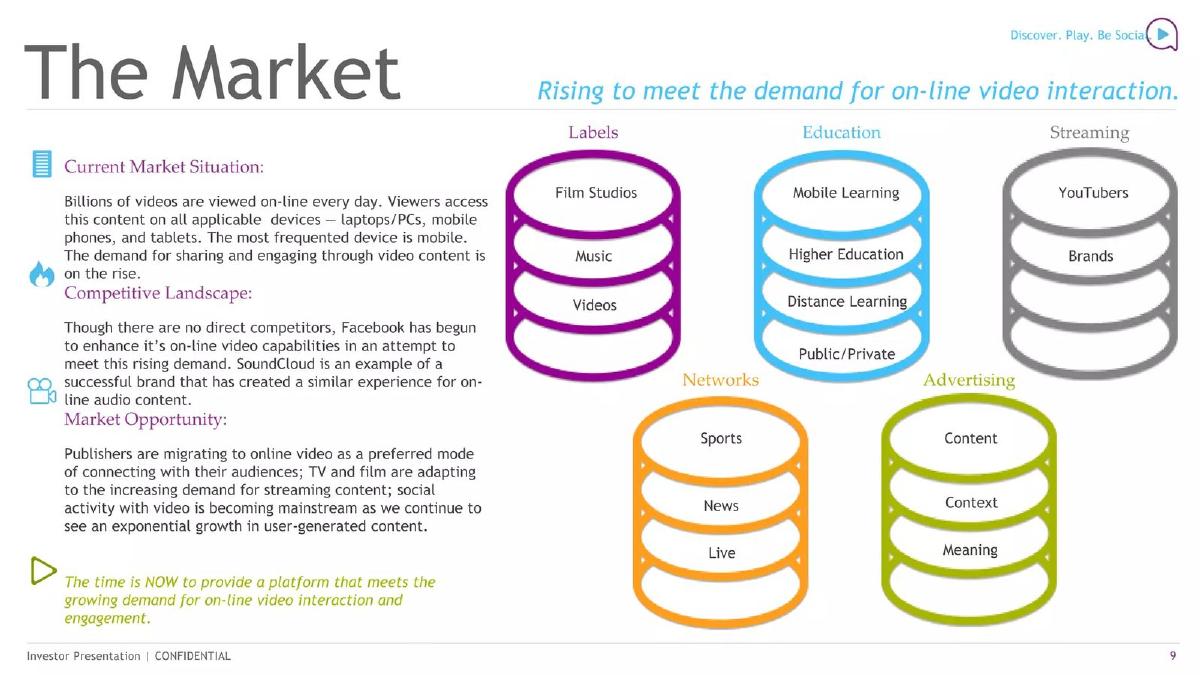
- The market slide claims there are 'no direct competitors,' though it acknowledges Facebook's growing video capabilities (Slide 9).
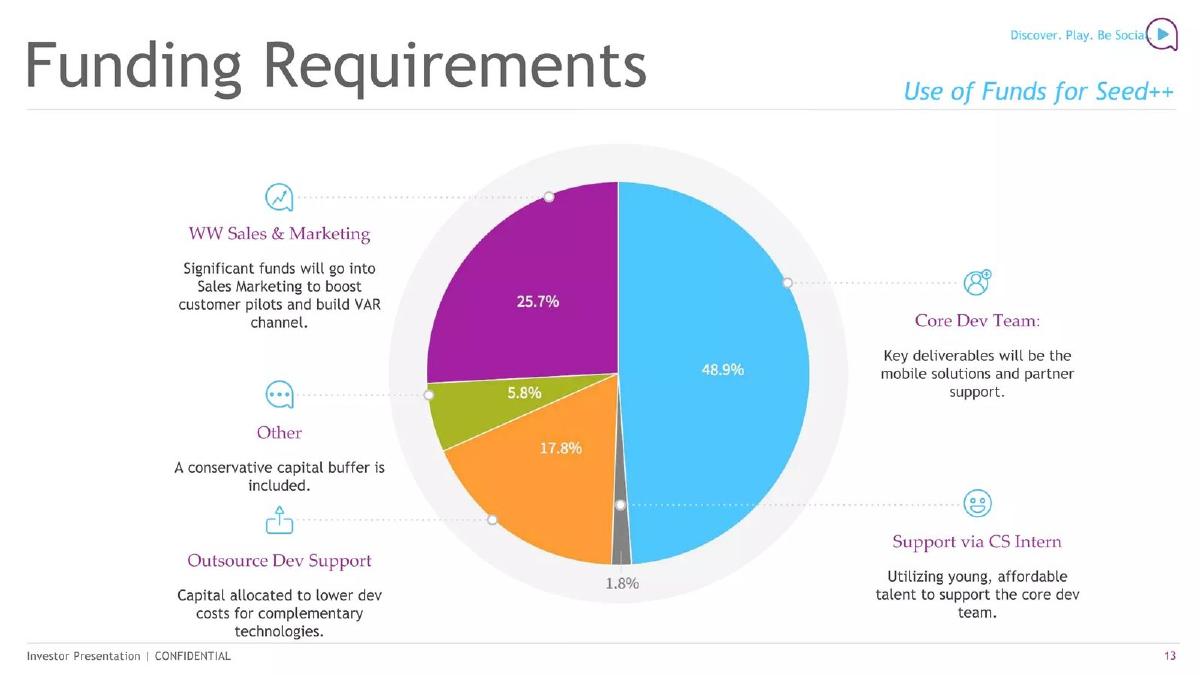
- The 'Seed++' funding request is for US$ 2 million, with nearly half (48.9%) allocated to the Core Dev Team (Slide 13).
- VuSay lists an active pilot pipeline including major brands like Red Bull, Televisa, and Discovery Canada (Slide 17).
- The growth strategy involves a 'long view approach,' prioritizing platform dissemination and user engagement over short-term revenue goals (Slide 17).
Slide-by-Slide Analysis
Slide 1: Title Slide
The title slide introduces the company name, VIEWSAY (stylized as VuSay in the source), with the tagline "Discover. Play. Be Social." It prominently features the analogy 'The SoundCloud of Video' in the bottom right corner. The background image is a black-and-white street scene with a central figure using a mobile phone, emphasizing the social and mobile nature of the product. A confidentiality notice is included at the bottom.
Slide 3: The Problem
This slide outlines six specific pain points in the 2016 online video market. Traffic Control is noted as being dominated by YouTube and Facebook. Engagement is described as having "limited modalities." Benefits are labeled as "inequitable" for content owners. Brand Experience is called "diluted." Advertising is criticized for not being strongly correlated with audiences. Finally, Moderation is cited as lacking for social sharing. A diagram shows how publishers currently produce video and send it to YouTube, resulting in "sunk costs" and a loss of control over advertising revenue ($$$ vs $).
Slide 5: The Platform
This slide showcases the product interface on both desktop and mobile. It notes that the desktop beta version went live January 01, 2016 , and the mobile + native app had an expected launch of April 2016. Key features listed include More Meaningful Comments (tied to specific moments), Improved Video Sharing , and the use of Machine Learning Tools via Microsoft Azure to Contextualize Advertising . The visual shows a comment sidebar next to a YouTube-embedded video, indicating the platform acts as a layer over existing content.
Slide 7: How it Works
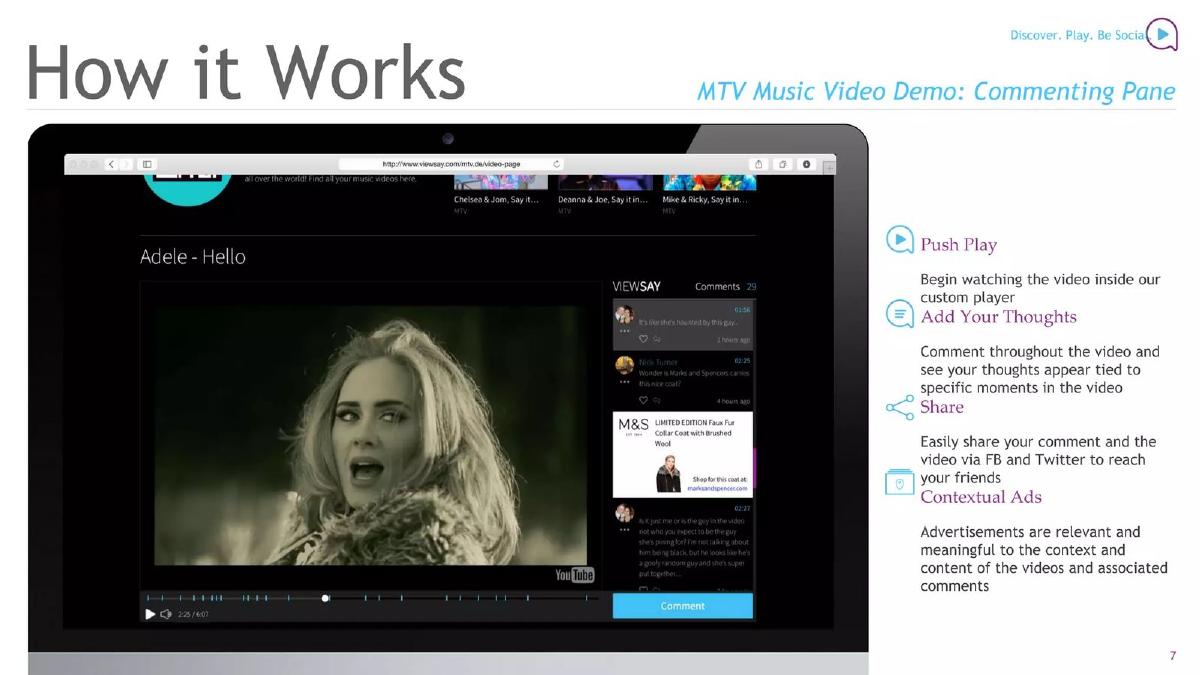
Using an Adele music video as a demo, this slide walks through the user journey: Push Play , Add Your Thoughts (comments appear tied to specific moments), Share (via FB and Twitter), and Contextual Ads . An example ad for M&S (Marks & Spencer) is shown appearing in the comment pane, demonstrating how the platform serves ads "relevant and meaningful to the context and content of the video."
Slide 9: The Market
The market slide describes the "Rising to meet the demand for on-line video interaction." It segments the opportunity into Labels (Film Studios, Music, Videos), Education (Mobile, Higher Ed, Distance), Streaming (YouTubers, Brands), Networks (Sports, News, Live), and Advertising (Content, Context, Meaning). The text asserts that while Facebook is enhancing its capabilities, there are "no direct competitors" for this specific interaction model, again citing SoundCloud as the successful audio equivalent.
Slide 11: Strategic View
This is a transition slide featuring an upward-looking architectural photograph of a skyscraper. It contains only the text "Strategic View."
Slide 13: Funding Requirements
This slide breaks down the Use of Funds for Seed++ . A pie chart shows the following allocations: 48.9% for the Core Dev Team (mobile solutions and partner support), 25.7% for WW Sales & Marketing (customer pilots and VAR channels), 17.8% for Outsource Dev Support (lower dev costs for complementary tech), 5.8% for Other (capital buffer), and 1.8% for Support via CS Intern (utilizing "young, affordable talent").
Slide 15: Extra Details
This is a transition slide featuring a blurred close-up of a smartphone. It contains only the text "Extra Details."
Slide 17: Executive Summary
The final slide in the provided set summarizes the Viewsay Strategy and the Investment Opportunity . It explicitly states the ask: Raising US$ 2 million . The strategy focuses on pioneer in-time commenting, dynamic video management, and site analytics. It lists active pilots with Red Bull, Televisa, UNO TV, Tecnologico de Monterrey, Sportnet.AT, Discovery Canada, and Viacom/MTV . The pipeline includes Bloomberg and the Harvard Institute . Short-term highlights include a Q1 '17 launch for mobile products and a goal to "Double user-base per quarter."
What Works
Clear Analogy: By calling themselves the "SoundCloud of Video," the founders bypass a long explanation of their UI. Investors instantly understand that comments will be pinned to a timeline. · Specific Pilot List: Slide 17 provides a very strong list of recognizable brands (Red Bull, MTV, Discovery) that are supposedly in active pilots. This provides significant social proof for an early-stage company. · Contextual Advertising Focus: The deck identifies a specific monetization pain point—the disconnect between video content and generic ads—and offers a machine-learning-driven solution that feels more sophisticated than simple pre-roll ads. · Defined Use of Funds: The breakdown on Slide 13 is granular, even including a specific (if small) allocation for interns, which shows a high level of planning regarding headcount and burn.
What is Missing
Team Slide: The provided slides do not include a team slide. There is no information on the founders' backgrounds, technical expertise, or prior exits, which is critical for a $2M seed round. · Unit Economics: While the deck mentions contextual advertising, it provides no data on CPMs, projected revenue per user, or the cost of user acquisition (CAC). · Traction Metrics: The desktop beta launched in January 2016, but the deck (likely written shortly after) contains no data on how many users signed up, how many comments were left per video, or average session duration. · Exit Strategy: There is no mention of potential acquirers or the long-term financial path for investors, other than a "long view approach."
Founder Takeaways
Leverage Familiar Patterns: If your product uses a UI pattern popularized by another successful company (like SoundCloud's timeline comments), use that comparison to save time and mental energy for the investor. · Validate with Names: If you are pre-revenue, your "Traction" slide should be a "Partnerships" slide. Listing high-tier pilots like Viacom and Bloomberg suggests that the market has already vetted the product's utility. · Address the Giant in the Room: VuSay explicitly mentions YouTube and Facebook. Rather than claiming they will kill these giants, they position themselves as a tool that works with them (e.g., the player shows a "Provided by YouTube" tag on Slide 5). This makes the business model feel less risky. · Be Realistic About Revenue: The deck admits to a "long view approach" as opposed to "short term revenue goals." While risky, this honesty can build trust with investors who are looking for platform plays rather than immediate cash flow.
Frequently asked questions
- What is VuSay's primary product offering?
- VuSay offers a custom video player that integrates time-stamped commenting, allowing users to leave feedback at specific moments in a video. This is designed to create 'more meaningful comments' and a better social sharing experience. The platform also uses machine learning to serve contextual advertisements based on the video content and user comments, aiming to solve the disconnect between traditional ads and viewer interest.
- How much capital was VuSay seeking in this deck?
- According to Slide 17, VuSay was raising US$ 2 million. They categorized this as a 'Seed++' round. The primary use of proceeds was to increase business development and developer headcount, build native mobile solutions, and acquire a global user base of 200,000 to 250,000 users through B2C marketing efforts.
- Who were VuSay's target customers and partners?
- The deck identifies two primary targets: Content Creators (B2C) and Publishers (B2B). Slide 17 lists several high-profile pilot partners, including Red Bull, Televisa, Discovery Canada, and Viacom/MTV. They also mention a pipeline of potential partners like Bloomberg and the Harvard Institute, and native integrations with existing video players like Ooyala and Brightcove.
- What was the company's competitive stance?
- VuSay claimed on Slide 9 that there were 'no direct competitors' in the space of time-stamped video interaction. However, they acknowledged that Facebook was enhancing its video capabilities. They used SoundCloud as a successful analog for their business model, suggesting that what SoundCloud did for audio, VuSay would do for video.
- What were the key milestones mentioned in the deck?
- Key milestones included the desktop beta launch on January 1, 2016, and an expected mobile app launch in April 2016. For the future, they targeted a Q1 2017 launch for additional mobile products, signing 10 content creator pilots in 2016, and achieving a goal to double their user base every quarter.