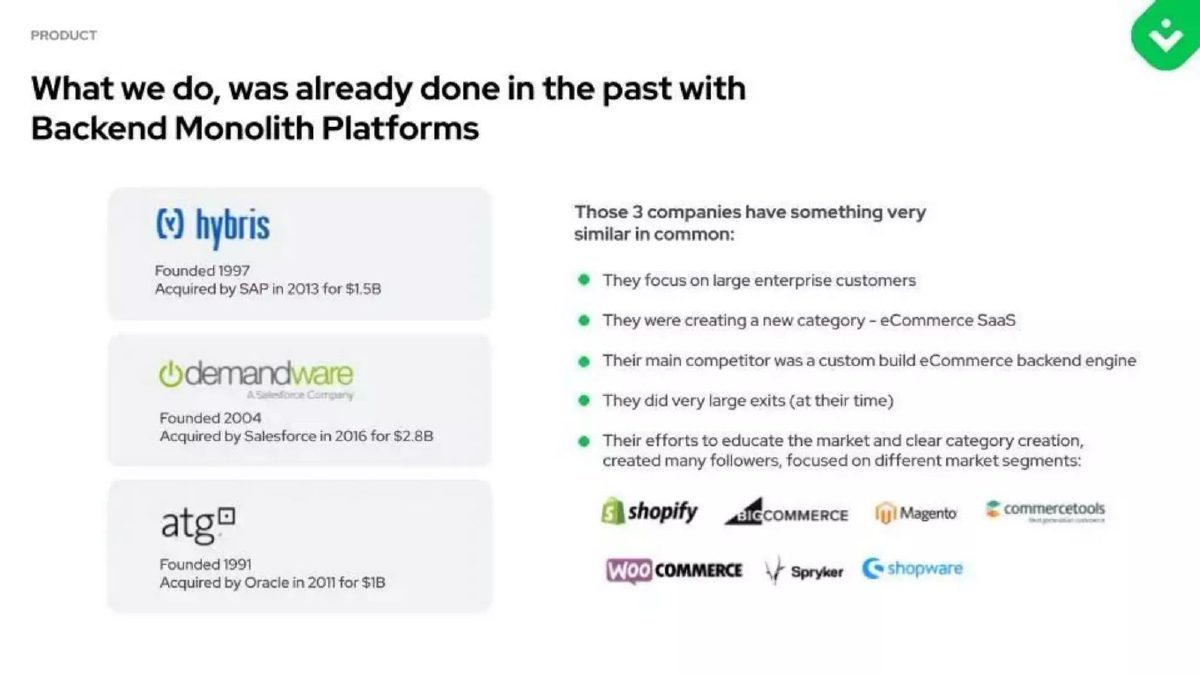
Vue Storefront’s pitch deck is a masterclass in category creation and technical positioning. By identifying a specific bottleneck in the e-commerce migration path—the complexity of building custom frontends for headless backends—they successfully pitched 'Frontend-as-a-Service' (FEaaS) as a necessary infrastructure layer. The deck leans heavily on the experience of its founding team, including a serial entrepreneur who sold three companies and a technical lead who is an official Vue.js Community Partner. While the provided slides lack specific financial metrics or a detailed market size break…
Key takeaways
- The company positions itself as the creator of a new category called Frontend-as-a-Service (FEaaS) on Slide 5.
- The deck identifies the core problem as the complexity of building frontends, involving five distinct teams and over 15 technical components as shown on Slide 2.
- Vue Storefront targets the 'mid-market and enterprises' specifically, noting that headless is currently only a good fit for these larger players (Slide 5).
- The product acts as a bridge, allowing companies to keep legacy backends while upgrading to a modern frontend, or moving fully to headless CMS and platforms (Slide 4).
- The founding team possesses significant exit experience, with COO Bart Roszkowski having started and sold three companies (Slide 7).
- CEO Patrick Friday brings 10 years of B2B sales experience and was an early employee at Vivino (Slide 7).
- The deck lists high-profile early backers including Y Combinator, Creandum, Earlybird, and SquareOne on the title slide.
- The main competitor is identified not as another software vendor, but as 'custom build eCommerce frontend' (Slide 5).
The Narrative of Category Creation
Vue Storefront’s pitch deck is less about a specific tool and more about a fundamental shift in how e-commerce stacks are built. By the time they reached this $20M round, they had already secured backing from top-tier firms like Y Combinator and Creandum. The deck reflects a company that is no longer proving its existence, but rather defining the boundaries of its industry. The central theme is the transition from 'monolithic' legacy systems to 'composable' headless architectures, with Vue Storefront positioning itself as the essential connective tissue.
Slide 1: Title and Social Proof
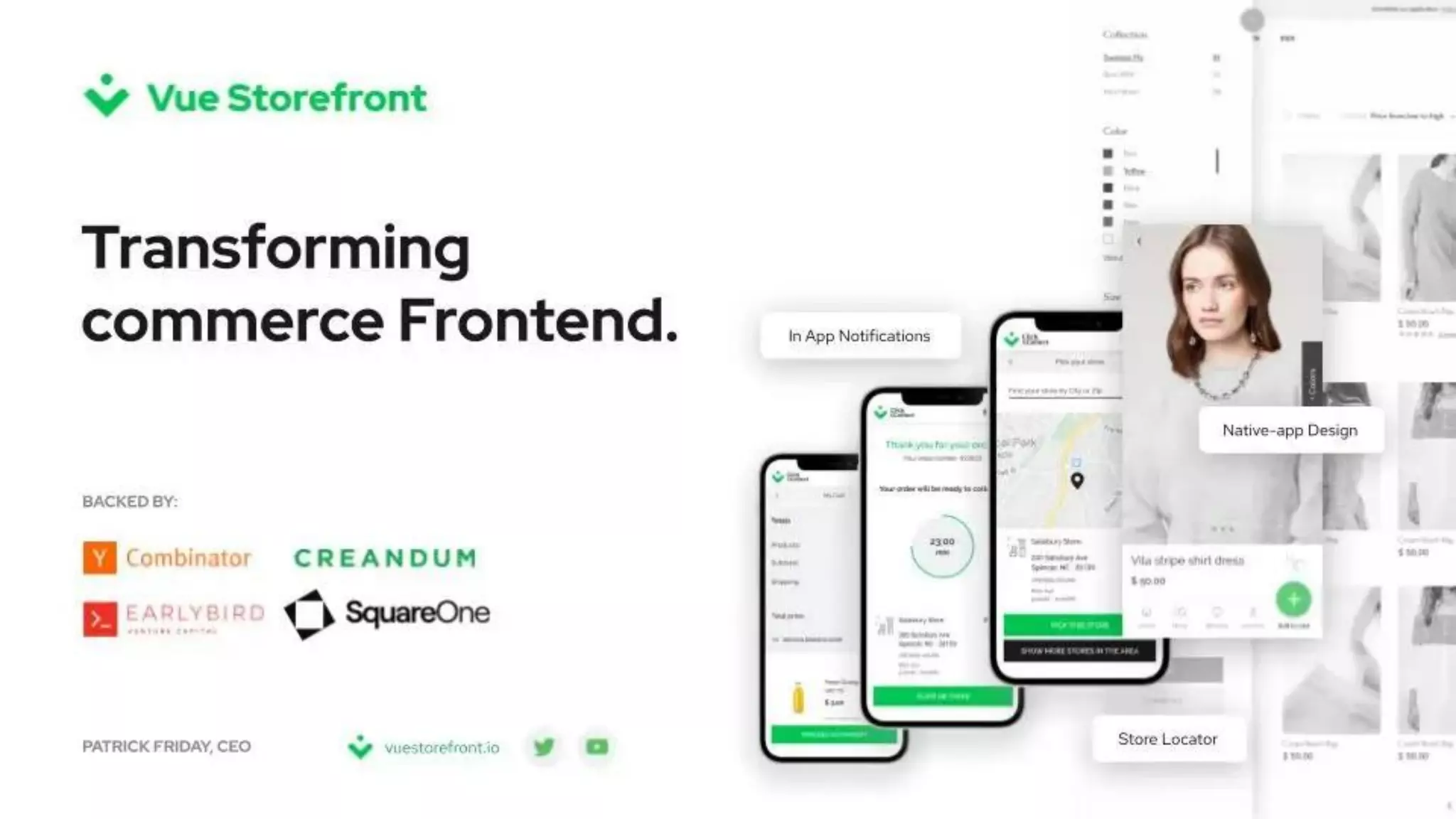
The title slide immediately establishes credibility by listing four major venture capital backers: Y Combinator, Creandum, Earlybird Venture Capital, and SquareOne . The tagline, "Transforming commerce Frontend," is broad but functional. Visually, the slide uses mobile mockups to highlight "In App Notifications," "Native-app Design," and "Store Locator" features, signaling that their solution is multi-channel and mobile-first. CEO Patrick Friday is the only name listed on the cover, providing a direct point of contact for the pitch.
Slide 2: The Complexity of the Status Quo
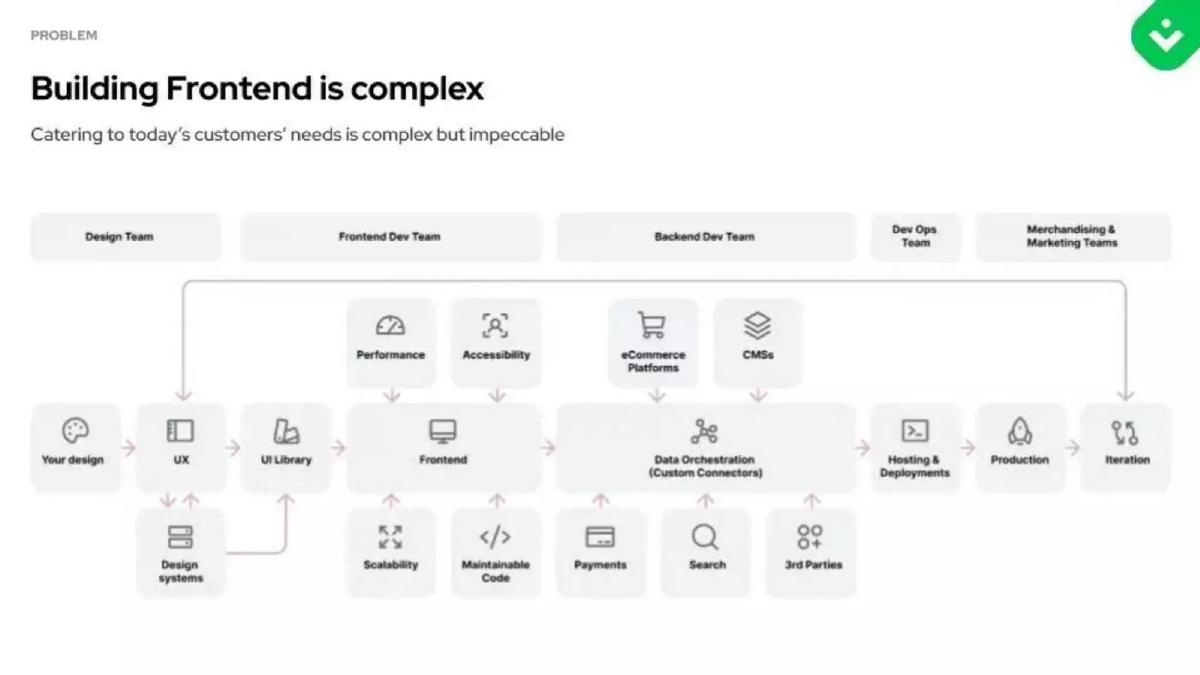
Slide 2, titled "Building Frontend is complex," uses a detailed flowchart to visualize the friction in the current market. It maps out the involvement of five distinct teams: Design, Frontend Dev, Backend Dev, Dev Ops, and Merchandising & Marketing . Below the teams, it lists 16 different technical requirements, ranging from Accessibility and Performance to Data Orchestration and 3rd Parties . The visual goal of this slide is to overwhelm the investor with the sheer number of moving parts required to build a modern frontend, setting the stage for a solution that simplifies this mess.
Slide 3: The Four Barriers to Entry
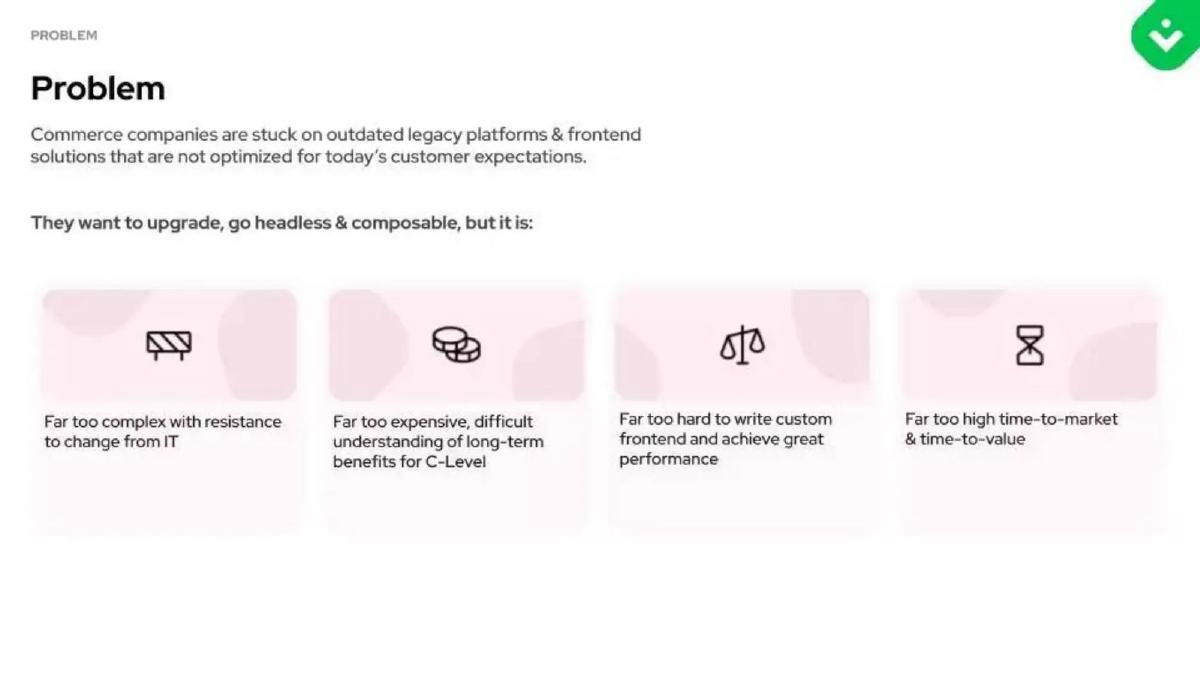
This slide categorizes the "Problem" into four distinct buckets. First is IT resistance due to complexity. Second is C-Level skepticism regarding the high cost and long-term benefits. Third is the technical difficulty of achieving high performance with custom code. Finally, it cites Time-to-Market . By addressing the concerns of three different stakeholders (IT, C-Suite, and Developers), Vue Storefront demonstrates a sophisticated understanding of the enterprise sales cycle.
Slide 4: The Migration Path
One of the strongest slides in the deck, Slide 4 explains the "unique approach" to migration. It shows how Vue Storefront can be implemented incrementally. It starts with a Current Monolithic Stack and shows a transition where the brand can keep a Legacy Backend Platform while adopting a Headless CMS , all while using Vue Storefront as the frontend. This "bridge" strategy is a powerful selling point because it reduces the risk of a 'big bang' migration, which often scares off enterprise clients.
Slide 5: Category Creation - FEaaS
Slide 5 is the strategic heart of the deck. It explicitly claims the creation of a new category: Frontend As A Service (FEaaS) . It makes several bold claims: that headless is only for mid-market/enterprise, that their main competitor is "custom build," and that they are the "key educator" in the market. By listing logos like Shogun, Frontastic, and Magento PWA Studio as "followers" or "not direct competitors," they attempt to position themselves as the premium, enterprise-grade leader in a vacuum of their own making.
Slide 6: The Market Opportunity
Slide 6 is a transition slide with the text "Huge market potential" and a rocket graphic. In the context of the provided slides, this is a placeholder. In a full deck, this would typically be followed by a breakdown of the Total Addressable Market (TAM). Its presence here suggests the founders wanted to signal a massive scale-up phase, aligning with a $20M Series A or B investment profile.
Slide 7: The Founding Team
The team slide focuses on deep industry experience and previous successes. Patrick Friday (CEO) is noted for 10 years in B2B sales and a previous e-commerce exit. Filip Rakowski (CTO) is positioned as a thought leader—an "Official Vue.js Community Partner" and "Author of Storefront UI." Bart Roszkowski (COO) provides the "serial entrepreneur" weight, having started and sold three companies. This combination of sales grit, technical authority, and operational experience is designed to de-risk the investment.
Slide 8: The Call to Action (External)
The final slide in this set is an external promotional slide for a pitch deck library and does not contain company-specific information. It serves as a reminder that the deck was sourced from a public repository.
What Works in This Deck
1. The "Bridge" Strategy: The migration visual on Slide 4 is excellent. It solves the biggest objection in enterprise software: "We can't afford to turn everything off and start over." Showing that Vue Storefront works with legacy backends while companies modernize their CMS is a brilliant tactical move.
2. Category Ownership: By naming their category "Frontend-as-a-Service," they move the conversation away from being a "library" or a "framework" (which are often free or low-cost) to being a "service" (which implies recurring revenue and high value).
3. Team Credibility: The team slide doesn't just list titles; it lists specific achievements that matter to investors, such as previous exits and community leadership. Filip Rakowski’s status as a Vue.js Community Partner is particularly important for a company named Vue Storefront.
What Is Missing
1. Financial Metrics: There is a total absence of ARR, MRR, or growth percentages in these slides. For a $20M round, investors would require deep dives into Net Revenue Retention (NRR) and Customer Acquisition Cost (CAC) payback periods.
2. The "Ask": The deck does not state how much is being raised or how the capital will be deployed. While the source listing mentions $20M, the slides themselves do not detail the hiring plan or R&D roadmap.
3. Customer Proof: While the deck mentions "mid-market and enterprises," it does not show case studies or logos of actual brands using the software. Social proof from paying customers is a significant omission in this selection of slides.
Founder Takeaways
Define your competition as 'The Old Way': Vue Storefront identifies "custom build" as their main competitor. This is effective because it frames the choice not between two products, but between a modern solution and a manual, expensive process. · Use flowcharts to illustrate pain: Slide 2 does a great job of showing why a problem is hard without using too much text. If your product simplifies a complex workflow, map that workflow out. · Position yourself as the educator: If you are in a new space, claim the role of the market educator. It positions your company as the thought leader and makes your product the default choice for newcomers to the space. · Highlight exit experience: If anyone on your team has sold a company before, make it a bullet point. It is one of the strongest signals of "founder-market fit" and operational competence you can provide.
Frequently asked questions
- What is Frontend-as-a-Service (FEaaS)?
- As defined on Slide 5, FEaaS is a category Vue Storefront claims to have created. It refers to a pre-built, modular frontend layer that connects various backend platforms and CMSs. Instead of a company building a custom frontend from scratch—which the deck identifies as their main competition—they use Vue Storefront to achieve a faster time-to-market while maintaining a headless, composable architecture.
- How does Vue Storefront handle legacy migrations?
- Slide 4 illustrates a three-step migration scenario. It shows that Vue Storefront can sit on top of a 'Current Legacy Frontend (Coupled)' and 'Legacy Backend Platform.' It allows a brand to swap out the legacy CMS for a Headless CMS first, or move entirely to a Headless Backend Platform while keeping the Vue Storefront frontend consistent throughout the transition.
- Who is the target customer for this solution?
- According to Slide 5, the company focuses on 'larger mid-market and enterprises.' The deck explicitly states that composable and headless architectures are currently only a good fit for this segment. They differentiate themselves from 'followers' who focus on the small and mid-market or low-code segments, which Vue Storefront does not consider direct competitors.
- What are the primary pain points Vue Storefront solves?
- Slide 3 outlines four main barriers: IT resistance due to complexity, high costs that are difficult for C-level executives to justify, the difficulty of writing custom frontend code that achieves high performance, and an excessively high time-to-market. By solving these, they aim to lower the 'time-to-value' for e-commerce brands moving away from monolithic legacy platforms.
- What is missing from this version of the deck?
- The provided slides are missing several critical components usually found in a $20M round. There are no slides detailing current Revenue/ARR, growth metrics, or unit economics. Additionally, while Slide 6 mentions 'Huge market potential,' the specific TAM/SAM/SOM figures are omitted. The 'Ask' slide—detailing how the $20M will be spent—is also not present in this selection.