VULCAM’s 2020 investor deck targets the $150 billion musculoskeletal injury market with a visual AI platform for motion analysis. The company demonstrates significant early traction, listing high-prestige paying customers including Nike Sport Research Lab, USA Track & Field, and several top-ranked university sports medicine programs. The business model is bifurcated between a high-touch 'PRO' hardware/software subscription for institutions and a scalable mobile app for individual therapists and coaches. While the deck provides a detailed four-year financial forecast projecting a jump from $10…
Key takeaways
- Musculoskeletal injuries in the USA are cited as a $150 billion annual cost on slide 2.
- The company identifies a $1 billion global musculoskeletal market, aiming for 4-10% penetration ($40-100M) on slide 3.
- VULCAM positions itself as the leader in both 'Ease-of-Use' and 'Effective Feedback' compared to competitors like Dartfish and PlaySight on slide 4.
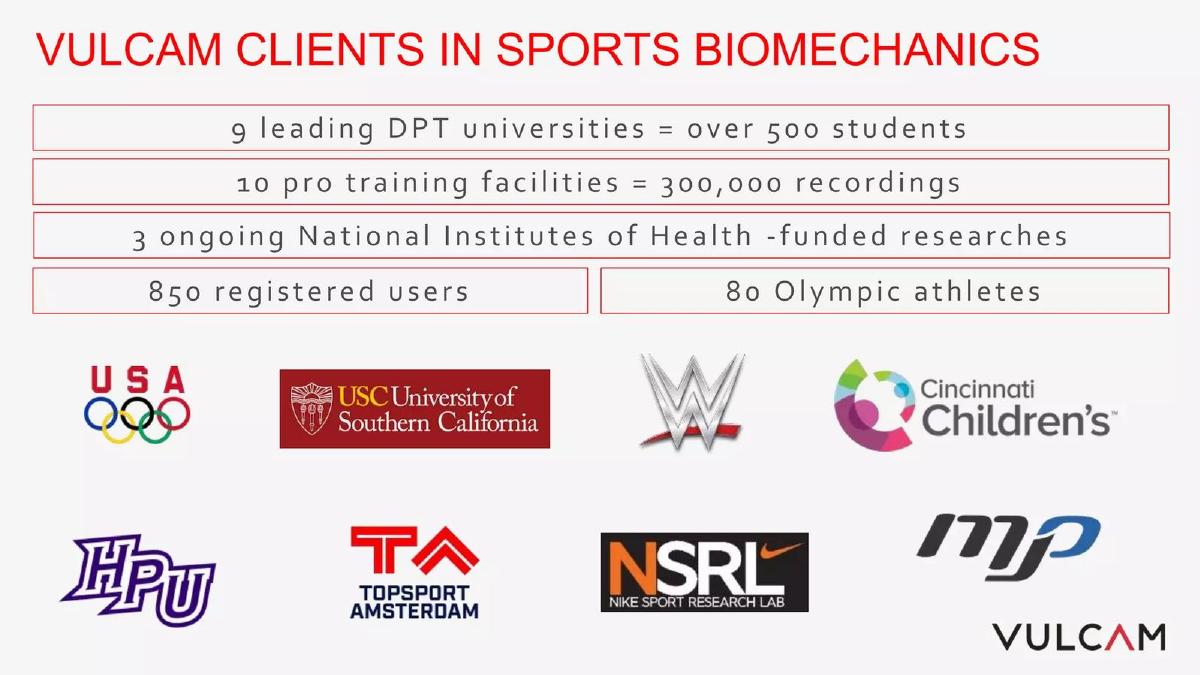
- Institutional validation is high, with slide 8 listing paying customers such as Nike SRL, Duke University, and Ohio State.
- The business model includes a 'PRO' kit for institutions and an 'APP' for therapists, with 2D motion tracking planned as an add-on (slide 7).
- Financial projections on slide 9 forecast revenue growth from $104k in 2020 to $3.22M by 2023.
- Gross profit margins are projected to scale aggressively from 75% in 2020 to 96% in 2023 (slide 9).
- The deck mentions planned investments of $800k in 2020 and $500k in 2022 to maintain working capital (slide 9).
VULCAM Pitch Deck Analysis
VULCAM’s investor deck from May 2020 presents a vision for the future of healthcare centered on prevention through AI-powered biomechanics. The deck is structured to move quickly from a massive macroeconomic problem to specific, high-prestige institutional validation. By focusing on the portability and ease of use of their motion analysis software, VULCAM attempts to disrupt a field traditionally dominated by expensive, stationary laboratory equipment.
Slide 1: Title and Vision
The cover slide introduces the brand with the tagline "Discover the Invisible." It sets a broad healthcare context, stating that "Prevention is the future of all healthcare!" and positioning AI as the tool to achieve this for biomechanics. The slide establishes a professional tone and includes a 2020 copyright notice for Vulcan Vision.
Slide 2: The Problem in Sports Biomechanics
VULCAM identifies a significant financial and human cost associated with musculoskeletal injuries. Key data points include:
Annual cost of $150B for musculoskeletal injuries in the USA. · 5 million pediatric injuries, which are noted as "rapidly increasing." · The claim that most non-impact injuries are preventable. · A lack of cost-effective tools that fit into the clinical workflow.
Analysis: This slide successfully frames the problem as both a massive financial burden for the healthcare system and a personal tragedy for athletes (loss of scholarships and early retirement).
Slide 3: Market Potential
Sports biomechanics global market: $6.6B (2019) to $9.1B (2024). · Body monitoring & evaluation: $4.2B (2019). · Musculoskeletal global market: $1B (2019). · VULCAM Potential: 4-10% of the $1B market, equating to $40-100M in revenue or 1-2.5M users.
Additional context is provided regarding North American dominance (40% market share) and the specific value of knee-related injuries ($2.5B annually). They also cite a 22% CAGR for the physical therapy job outlook.
Slide 4: Visual Competition
VULCAM uses a standard 2x2 matrix to position itself against competitors. The axes are "Ease-of-Use" and "Effective Feedback." VULCAM places itself in the top-right quadrant, claiming superiority over:
Analysis: While these charts are subjective, it clearly communicates VULCAM's intended value proposition: a tool that is both simpler to use and more insightful than legacy video analysis software.
Slide 5: Product in Action
Titled "VULCAM Today," this slide shows a split-screen video/image of an athlete (a baseball pitcher) undergoing motion analysis. It emphasizes "Motion Analysis" as the core current capability. The visuals suggest a multi-angle capture system, which aligns with the later mention of a 2-3 device recording setup.
Slide 6: Institutional Testimonials
Social proof is delivered through two high-ranking academic and clinical figures:
Prof. Mark Paterno (Cincinnati Children's): "I believe VULCAM could revolutionize all of physical therapy!" · Prof. Jill McNitt-Gray (USC Biomechanics Research Lab): "...making VULCAM a perfect tool."
These testimonials are strategically chosen to validate the product's utility in both research and clinical recovery (specifically ACL prevention).
Slide 7: Business Model
VULCAM PRO: A hardware and software subscription sold directly to universities, institutions, and professional teams. It is described as a "plug-n-play recording setup." · VULCAM APP: An in-app subscription for a 2-3 device recording app, targeted at individual therapists, coaches, and eventually consumers. · Future Add-on: A subscription for 2D motion tracking is listed as "To be added."
Slide 8: Paying Customers
This is arguably the strongest slide in the deck. It lists eight high-profile paying customers:
USA Track & Field (Chula Vista and Colorado Springs) · University of Miami Health System (Sports Medicine) · USC (Biomechanics & Physical Therapy) · Ohio State (ACL Research) · Cincinnati Children's (CCHMC) · Duke University (ACLR Rehabilitation) · High Point University (Biomechanics) · Nike Sport Research Lab (NSRL)
Analysis: Having Nike and the US Olympic training centers as paying customers in 2020 provides immense credibility that the technology meets elite professional standards.
Slide 9: Financial Summary
The deck concludes the provided sequence with a detailed four-year projection (2020-2023):
Revenue: Grows from $104k (2020) to $3.22M (2023). · Gross Profit: Scales from 75% to 96%. · EBITDA: Projected to turn positive in 2023 at $1.79M. · Headcount: Remains lean, growing from 4 to 9 people. · Metrics: App downloads are projected to hit 250k by 2023, while PRO kit sales grow from 8 to 43 units.
A sidebar note indicates that working capital calculations assume investments of $800k in 2020 and $500k in 2022.
What VULCAM Does Well
The deck excels at institutional validation . For a seed or early-stage health-tech company, listing Nike and Duke University as paying customers is a powerful signal of product-market fit. The clear distinction between the "PRO" institutional model and the scalable "APP" model shows a sophisticated understanding of how to capture both high-value contracts and high-volume users. The financial slide is also unusually detailed for a pitch deck, providing a full P&L view rather than just a revenue bar chart.
What is Missing
The most glaring omission in this 9-slide sample is the Team Slide . In early-stage fundraising, the pedigree of the founders—especially in a technical field like AI biomechanics—is often as important as the traction. We do not know if the founders are data scientists, former athletes, or medical doctors. Additionally, there is no Ask Slide . While the financial summary mentions $800k and $500k investment figures for capital modeling, it does not explicitly state what the company is raising at the time of the deck's publication or what the specific milestones for that funding would be.
Founder Takeaways
Founders should look at Slide 8 as a masterclass in social proof . Instead of just listing logos, VULCAM includes the specific department and the national ranking of the institution (e.g., "US rank #1"). This adds layers of prestige to the customer list. Furthermore, the use of a Financial Summary table (Slide 9) that includes unit economics (kits sold vs. licenses sold) is a great way to show investors that you understand the levers of your own growth. However, always ensure your deck includes a team slide to humanize the data and prove you are the right people to execute the plan.
Frequently asked questions
- What specific problem does VULCAM solve in the sports industry?
- VULCAM addresses the high cost and complexity of biomechanics analysis. Slide 2 notes that musculoskeletal injuries cost the US $150 billion annually and that most non-impact injuries are preventable. The company aims to provide cost-effective tools that fit into the clinical workflow, moving away from expensive lab setups to portable AI-driven motion analysis.
- Who are VULCAM's primary customers according to the deck?
- The deck highlights elite institutions as current paying customers. Slide 8 lists Nike Sport Research Lab (NSRL), USA Track & Field, the University of Miami Sports Medicine, USC, Ohio State, Duke University, and Cincinnati Children's Hospital. These represent top-tier athletic and medical organizations, providing strong social proof for the technology's efficacy.
- How does VULCAM generate revenue?
- VULCAM uses a two-tier subscription model. The 'VULCAM PRO' is a hardware and software bundle sold directly to universities and professional teams. The 'VULCAM APP' is an in-app subscription for therapists and coaches using 2-3 mobile devices for recording. Slide 7 also mentions a future revenue stream from 2D motion tracking subscriptions.
- What are the company's financial growth expectations?
- Slide 9 projects significant scaling. Revenue is expected to grow from $104,000 in 2020 to over $3.2 million by 2023. During this period, the company expects to reach EBITDA positivity in 2023 ($1.79M) while maintaining a lean team, growing from 4 to 9 employees.
- What is missing from this pitch deck?
- The provided slides lack a dedicated team slide, which is critical for assessing the founders' technical and clinical expertise. Additionally, while slide 9 mentions investment amounts for working capital calculations ($800k and $500k), there is no explicit 'Ask' slide detailing the current round's terms, valuation, or specific use of funds.