VRMotion presents a concise 9-slide deck focused on disrupting the driver training market for high-risk sectors like the military and law enforcement. The company identifies a significant pain point: auto accidents account for nearly half of all military and law enforcement deaths, despite $4 billion being spent annually on training. The deck highlights a strong founding team, including a former Indy 500 driver and a veteran Intel engineer, providing credibility in both automotive and technical domains. With $266,000 in revenue generated over 12 months and a $4 million pipeline, the deck demo…
Key takeaways
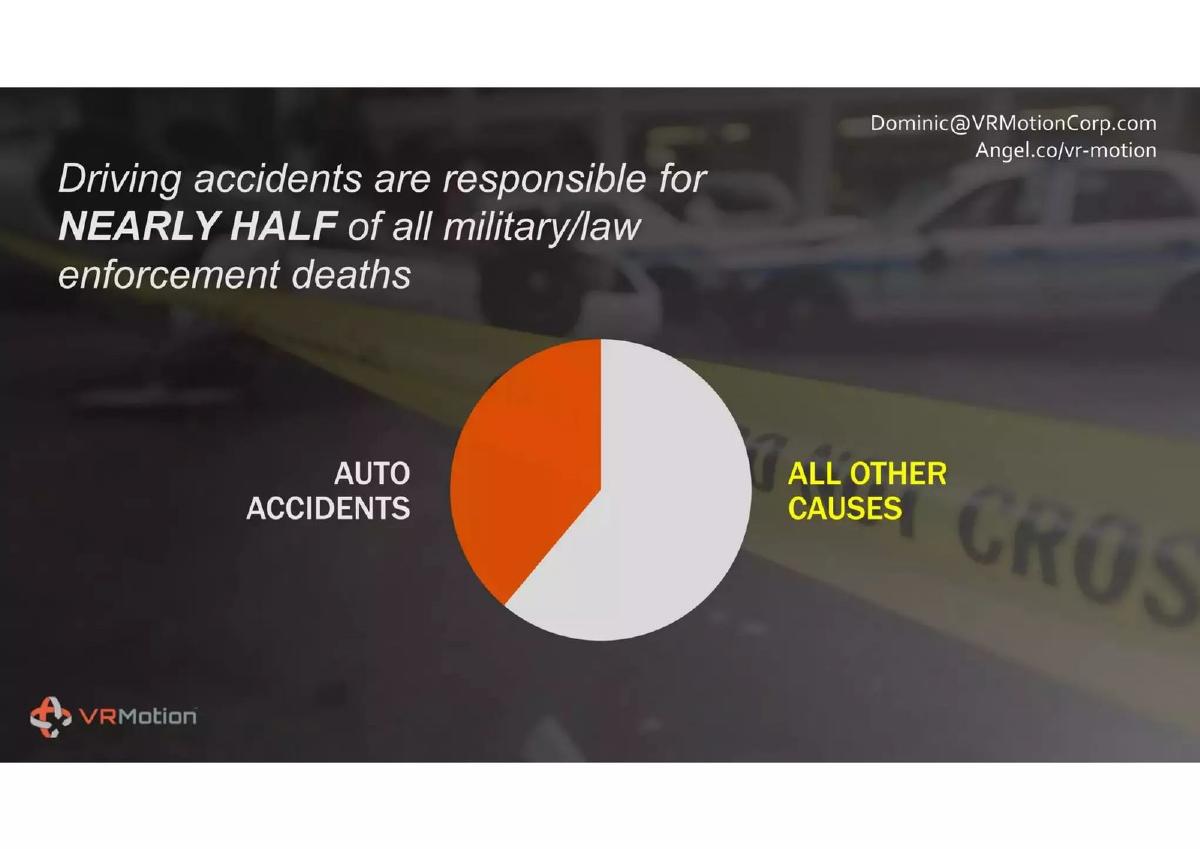
- Auto accidents represent nearly half of all military and law enforcement deaths, establishing a high-stakes problem (Slide 2).
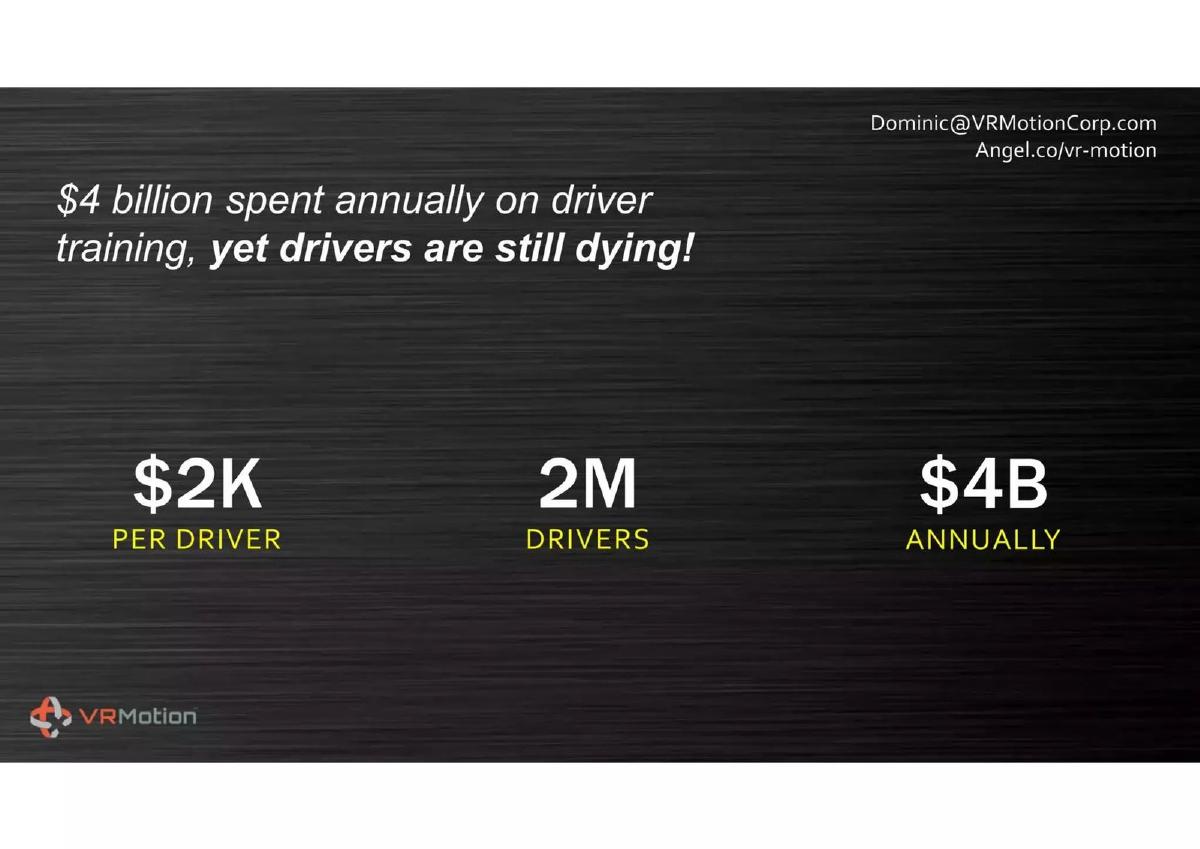
- The current market spends $4 billion annually on driver training, yet fatalities persist (Slide 3).
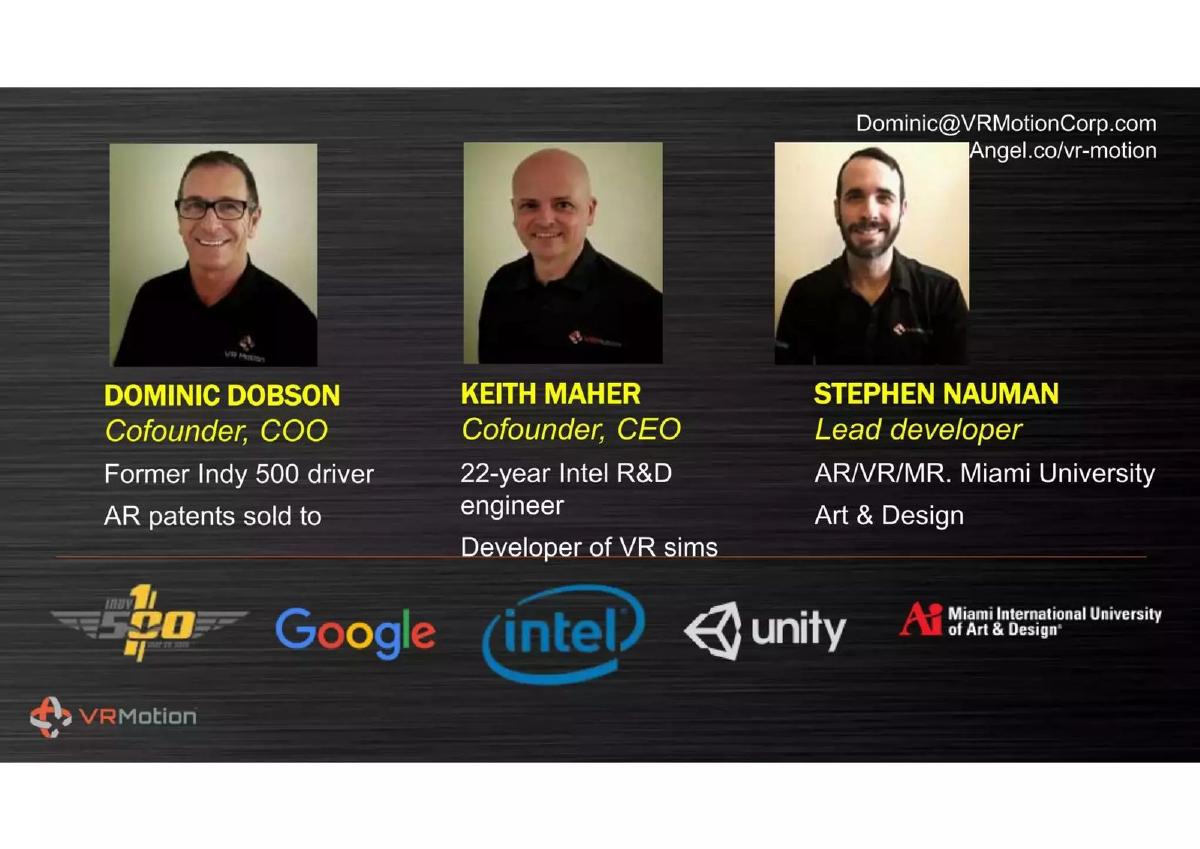
- The team includes a former Indy 500 driver with AR patent experience and a 22-year Intel R&D veteran (Slide 6).
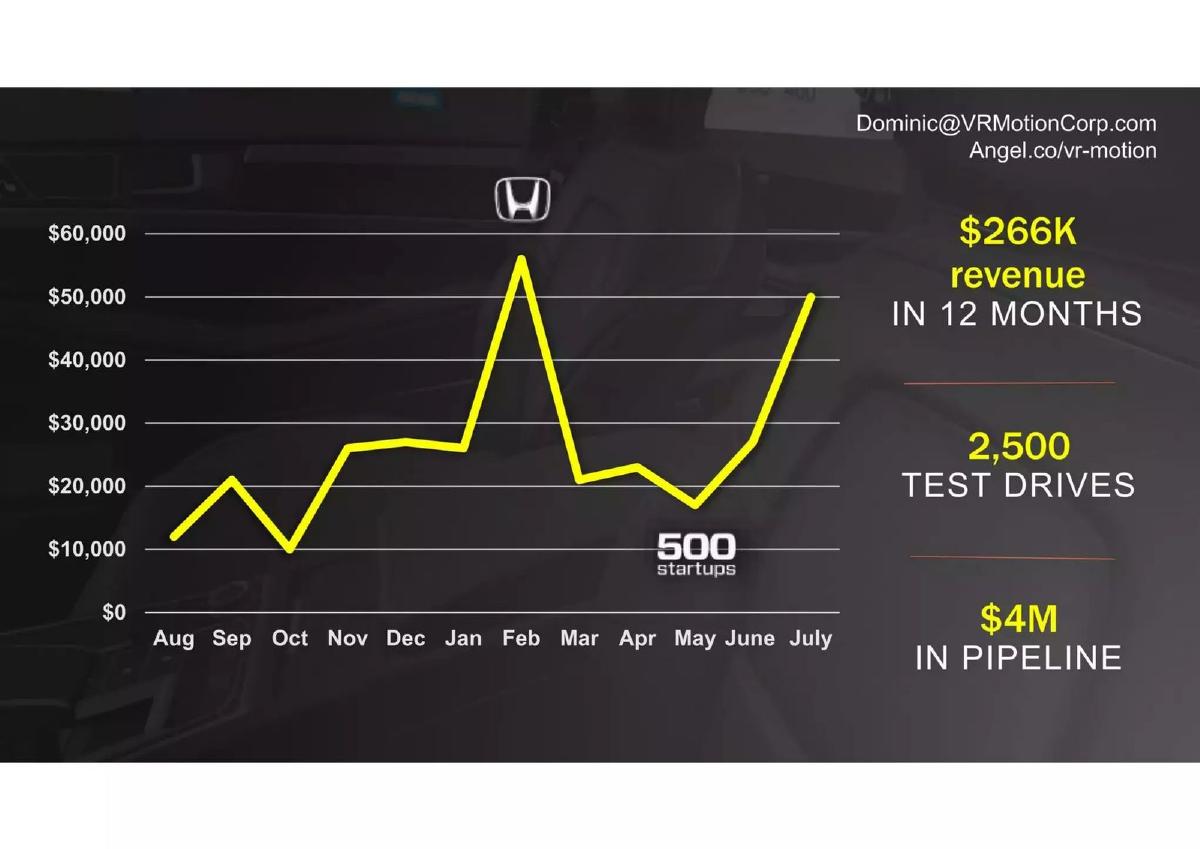
- The company achieved $266,000 in revenue over a 12-month period with a peak monthly revenue exceeding $50,000 (Slide 7).
- A $4 million sales pipeline is claimed, supported by logos from the U.S. Air Force and various state police departments (Slide 7, 8).
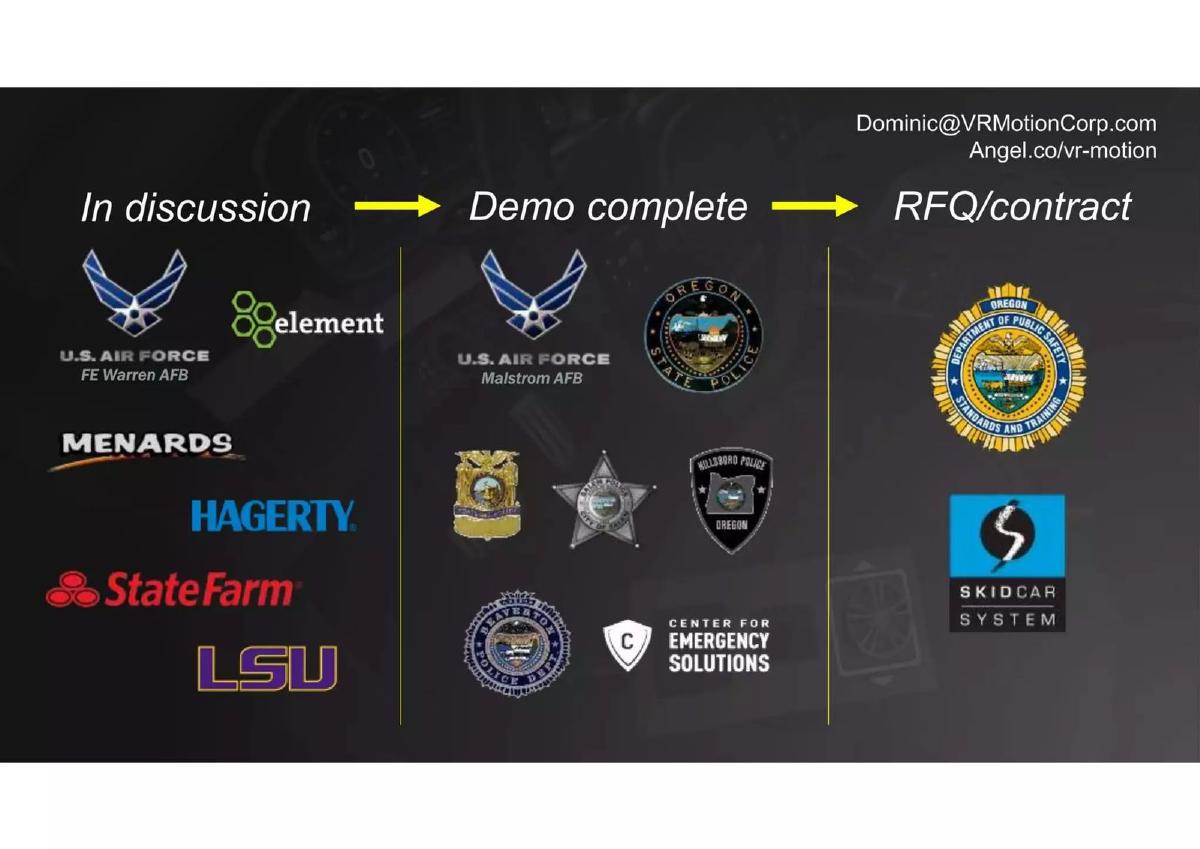
- The sales funnel is clearly visualized, moving from 'In discussion' to 'Demo complete' to 'RFQ/contract' (Slide 8).
- The deck lacks a specific financial 'Ask' or a breakdown of how investment capital would be deployed.
- There is no explicit slide detailing the business model or unit economics for the VR hardware/software units.
VRMotion: A High-Octane Approach to Virtual Training
VRMotion enters the market with a pitch deck that is visually sparse but top-heavy with industry credibility. By focusing on the high-risk niche of military and law enforcement driver training, the company attempts to turn a commodity service—driver education—into a mission-critical technology play. The deck relies heavily on the pedigree of its founders and early revenue signals to bridge the gap between a hardware-heavy simulation product and a scalable tech investment.
Slide 1: Title and Contact
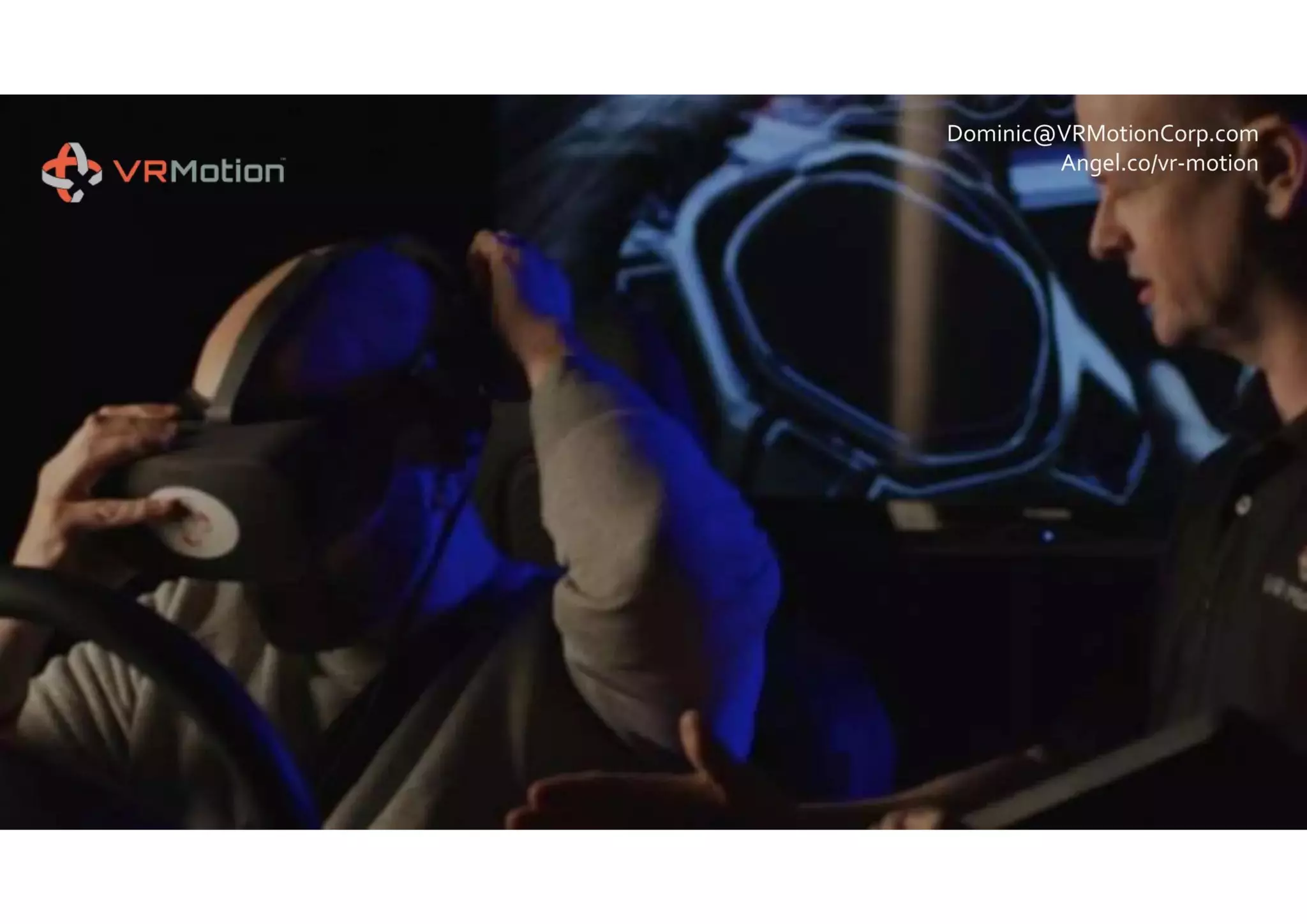
The opening slide features a high-resolution image of a user wearing a VR headset while seated in what appears to be a driving simulator. The branding is clean, and the slide includes direct contact information for Dominic Dobson and a link to their AngelList profile. This immediately establishes the sector: professional-grade virtual reality for automotive applications.
Slide 2: The Fatal Problem
Slide 2 presents a stark statistic: "Driving accidents are responsible for NEARLY HALF of all military/law enforcement deaths." This is supported by a simple orange and grey pie chart. By framing the problem around fatalities rather than just costs or efficiency, VRMotion elevates the stakes of their solution. It moves the conversation from "better training" to "saving lives," which is a powerful motivator for government and defense contracts.
Slide 3: The Market Opportunity
This slide quantifies the inefficiency of the current market. It states that $4 billion is spent annually on driver training, yet "drivers are still dying." The slide breaks this down into three key figures: $2K per driver , 2M drivers , and $4B annually . This slide identifies a large, stagnant market ripe for disruption by a more effective technological solution.
Slide 4: The Failure of Current Methods
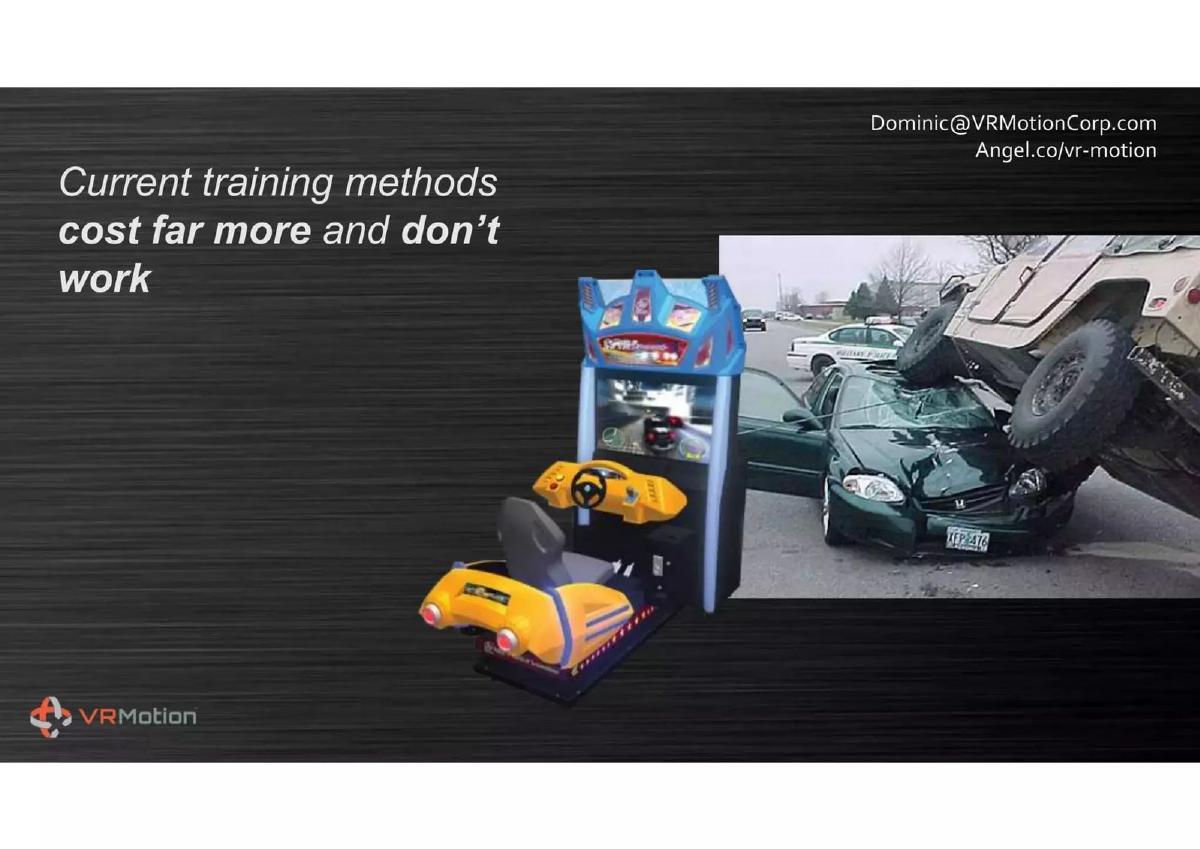
VRMotion uses Slide 4 to critique existing solutions. The text "Current training methods cost far more and don’t work" is paired with two images: a brightly colored, arcade-style racing cabinet and a photo of a Humvee crushed on top of a civilian car. The juxtaposition suggests that current simulators are toys, whereas real-world consequences are catastrophic. It is a visual argument for the necessity of high-fidelity VR over traditional screen-based simulators.
Slide 5: Transition/Visual Break
Slide 5 is a dark, nearly black image that appears to be a placeholder or a transition slide. In a live presentation, this might be where a video demo would play. In a static deck, it serves as a visual reset before moving into the team and traction sections.
Slide 6: The Team
This is arguably the strongest slide in the deck. The team is presented with clear roles and impressive credentials:
Dominic Dobson (Cofounder, COO): A former Indy 500 driver who has already sold AR patents to Google. This provides massive domain expertise. · Keith Maher (Cofounder, CEO): A 22-year Intel R&D engineer and developer of VR sims. This provides the technical backbone. · Stephen Nauman (Lead Developer): An AR/VR/MR specialist from Miami University.
The inclusion of logos for the Indy 500, Google, Intel, and Unity reinforces their professional standing and suggests they have the requisite experience to build and sell complex technical systems.
Slide 7: Traction and Revenue
Slide 7 provides the hard data investors look for. A line graph shows monthly revenue from August to July. Key figures include:
$266K revenue in 12 months. · 2,500 test drives completed. · $4M in pipeline.
The revenue graph shows volatility, with a significant spike in February (over $55,000) followed by a dip and a recovery in July (reaching $50,000). The presence of the 500 Startups logo indicates they have already passed through a reputable accelerator program.
Slide 8: The Sales Funnel
This slide visualizes their go-to-market progress. It categorizes various organizations into three stages:
In discussion: U.S. Air Force (FE Warren AFB), Menards, Hagerty, State Farm, LSU, and Element. · Demo complete: U.S. Air Force (Malstrom AFB), Oregon State Police, and several local police departments. · RFQ/contract: Oregon Department of Public Safety Standards and Training and Skidcar System.
This slide proves that their solution has broad appeal across military, law enforcement, insurance, and retail sectors.
Slide 9: Closing
The final slide is a simple closing image featuring a General Motors vehicle and the COO's email address. It lacks a final "Ask" or summary of the investment opportunity, which is a missed chance to leave a lasting impression on the specific terms of the deal.
What VRMotion Does Well
The deck excels at establishing Founder-Market Fit . Having a professional racing driver and a long-tenured Intel engineer as co-founders is a compelling combination for a VR driving simulator company. They also do an excellent job of Problem Framing . By focusing on the fatality rate in specific government sectors, they move the product out of the "gaming" category and into the "essential equipment" category.
The Traction Slide is also a highlight. Showing actual revenue—even if it is relatively modest at $266k—is far more persuasive than showing projected growth. It proves that there are customers willing to pay for the current iteration of the product.
What is Missing from the Deck
The most glaring omission is The Ask . A pitch deck is a tool to raise capital, yet this deck never specifies how much money is being raised, the valuation, or what the funds will be used for (e.g., hiring more developers, manufacturing hardware, or expanding the sales team).
Furthermore, the Business Model is unclear. Is VRMotion selling the hardware rigs as a one-time purchase? Is there a software-as-a-service (SaaS) component for the training modules? Without understanding the unit economics, it is difficult for an investor to judge the scalability of the $4 million pipeline mentioned on Slide 7.
Finally, there is no Competition Slide . The VR training space is becoming crowded, with companies like STRIVR and various defense contractors offering simulation tools. VRMotion needs to explicitly state why their specific "motion" or "fidelity" is superior to what a large contractor like Lockheed Martin or a general VR training startup might offer.
Founder's Playbook: What to Copy
Founders should emulate VRMotion's Pipeline Visualization (Slide 8). Instead of just listing logos, categorizing them by sales stage (In Discussion vs. Demo vs. Contract) provides a much clearer picture of the company's commercial momentum. It shows that the team understands their sales cycle and is actively moving leads through the funnel.
Another takeaway is the Credibility by Association strategy used on the team slide. By listing where patents were sold (Google) and previous long-term employers (Intel), the founders borrow the brand equity of established giants to validate their own expertise. If you have a high-profile exit or a long career at a top-tier firm, make sure it is front and center.
Final Thoughts
VRMotion has the ingredients of a solid specialized technology play: a massive, high-stakes problem, a team with deep domain expertise, and early revenue. However, the deck feels like a "teaser" rather than a complete investment proposal. To close a round, they would need to supplement this with a deep dive into their technology's defensibility (IP) and a clear roadmap for how they turn $266k in revenue into a multi-million dollar recurring business.
Frequently asked questions
- What is the primary problem VRMotion is solving?
- VRMotion addresses the high rate of fatalities in military and law enforcement due to vehicle accidents. According to Slide 2, these accidents cause nearly half of all deaths in these sectors. The company argues that current training methods, which cost $2,000 per driver and total $4 billion annually, are ineffective and outdated, often resembling arcade games rather than professional simulators.
- Who are the founders of VRMotion?
- The leadership team consists of Dominic Dobson (COO), a former Indy 500 driver who has previously sold AR patents; Keith Maher (CEO), who spent 22 years as an Intel R&D engineer and developed VR simulations; and Stephen Nauman (Lead Developer), who specializes in AR/VR/MR with a background from Miami University (Slide 6).
- What kind of traction does the company show?
- Slide 7 shows a 12-month revenue chart totaling $266,000. The revenue peaked in February at over $55,000. Additionally, the company has conducted 2,500 test drives and claims a $4 million pipeline. They are also alumni of the 500 Startups accelerator, as indicated by the logo on the traction chart.
- Which organizations are in VRMotion's sales pipeline?
- The pipeline includes high-profile entities such as the U.S. Air Force (FE Warren and Malstrom AFB), Oregon State Police, Hillsboro Police, and commercial entities like State Farm, Hagerty, and Menards. Slide 8 indicates they have reached the RFQ/contract stage with the Oregon Department of Public Safety Standards and Training and Skidcar System.
- What is missing from the VRMotion pitch deck?
- The deck is missing several critical components: a detailed product slide explaining the hardware/software stack, a business model slide (SaaS vs. hardware sales), a competitor analysis, and most importantly, a 'The Ask' slide. There is no mention of how much money they are raising or the valuation they are seeking.