VRJAM is a real-time streaming platform designed for immersive 3D experiences, ranging from music concerts to business events. The deck positions the company as a '5G ready' solution, timing its consumer launch with the UK's 5G rollout. With a diverse revenue model encompassing subscriptions, advertising, brand partnerships, and virtual products, the company seeks $500k in exchange for 10% equity. The funding is split into two tranches, primarily targeting product completion and infrastructure scaling. While the deck boasts impressive 'development affiliates' like Google and Agora.io, it lack…
Key takeaways
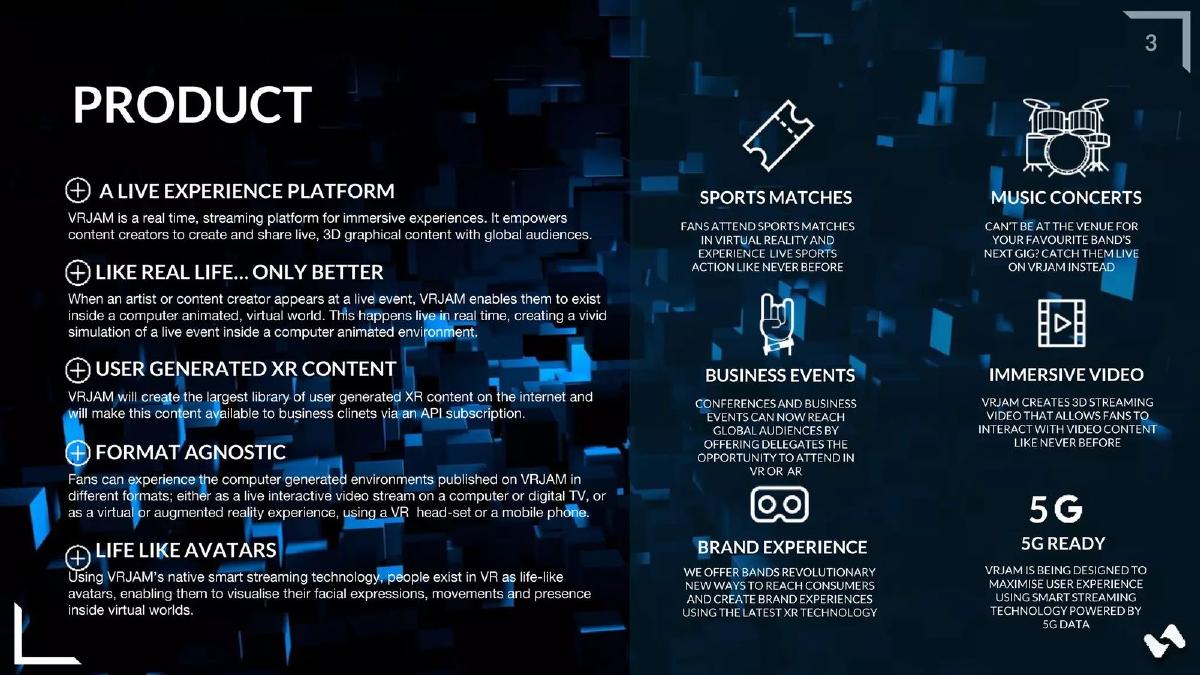
- The product is defined as a real-time, streaming platform for immersive 3D graphical content (Slide 3).
- VRJAM identifies as '5G Ready,' stating that its consumer launch is designed to coincide with the launch of 5G in the UK (Slide 3, Slide 5).
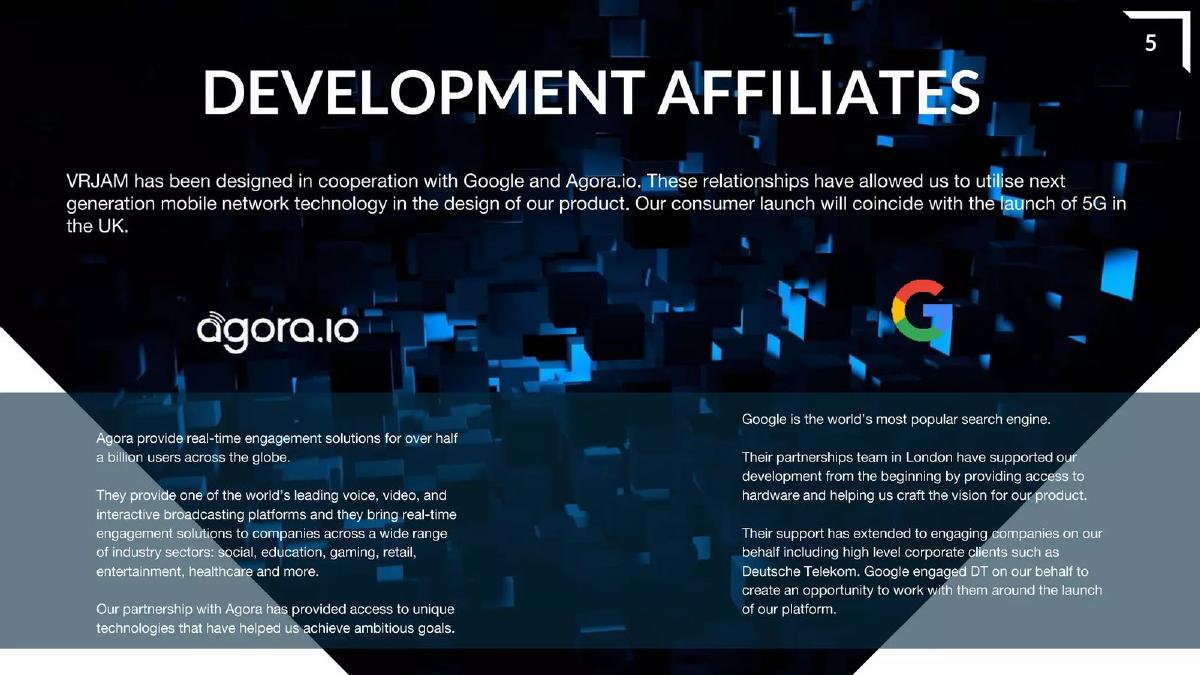
- The company highlights significant technical support from Google's partnerships team in London and Agora.io (Slide 5).
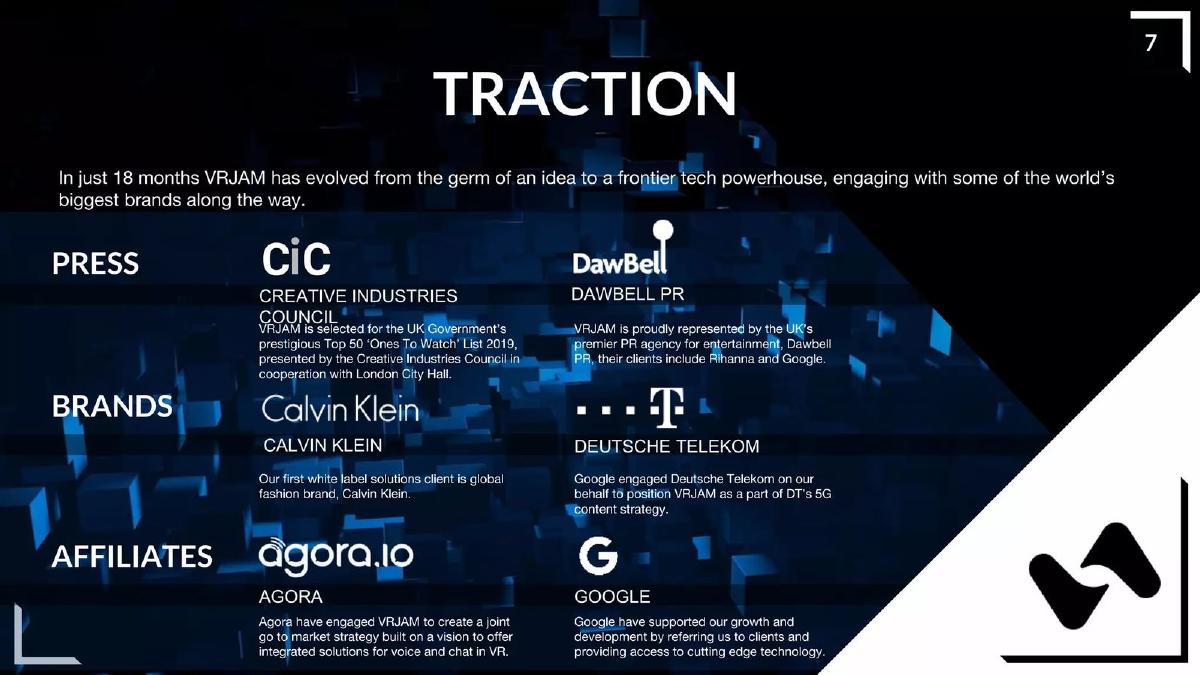
- Traction includes being named to the UK Government's 'Ones To Watch' List 2019 and securing Calvin Klein as a white-label client (Slide 7).
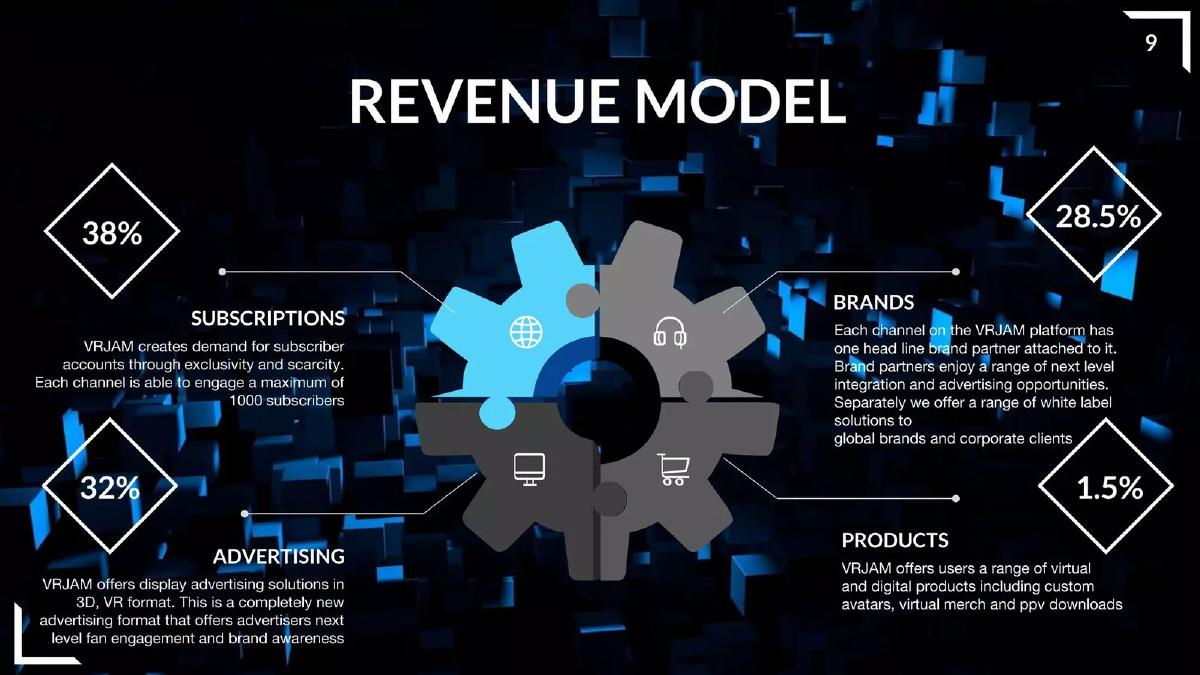
- The revenue model is split across four streams: Subscriptions (38%), Advertising (32%), Brands (28.5%), and Products (1.5%) (Slide 9).
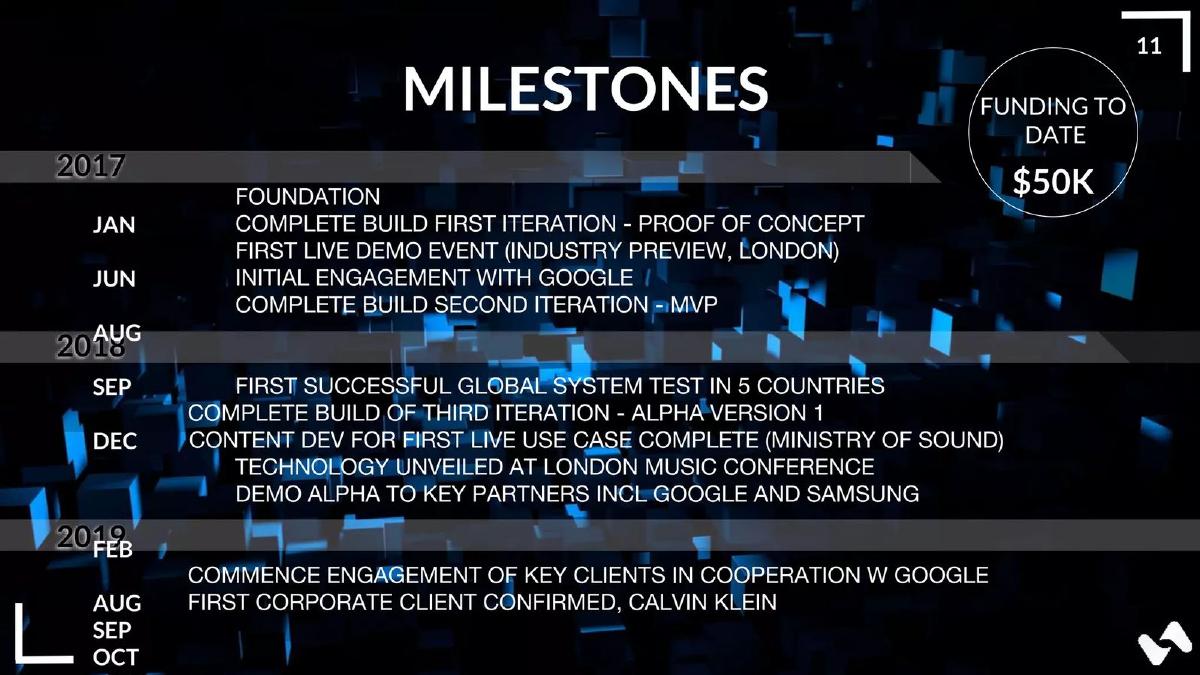
- Funding to date is stated as $50K as of the 2017-2019 milestone timeline (Slide 11).
- The current funding ask is $500k for 10% equity, structured in two tranches of $150k and $350k (Slide 13).
- The deck omits a team slide, market size (TAM/SAM/SOM) analysis, and a detailed competitive landscape (Slides 1-14).
Slide-by-Slide Analysis
Slide 1: Title Slide
The deck opens with a high-fidelity visual of two figures standing before a celestial, neon-ringed landscape. The VRJAM logo is prominent, utilizing a soft, rounded typeface. There is no tagline or mission statement on this slide, relying entirely on the imagery to convey a sense of 'metaverse' or virtual exploration.
Slide 3: Product
This slide defines the platform's core utility. It is described as a "real time, streaming platform for immersive experiences" that allows creators to share live 3D content. The slide lists five key features: Live Experience Platform , User Generated XR Content , Format Agnostic (supporting mobile, TV, VR, and AR), Life Like Avatars , and 5G Ready . The right side of the slide lists specific use cases: Sports Matches, Music Concerts, Business Events, Brand Experience, and Immersive Video. The emphasis on being "5G Ready" suggests the company views network latency as its primary technical hurdle and 5G as its primary enabler.
Slide 5: Development Affiliates
VRJAM highlights its technical pedigree by citing cooperation with Google and Agora.io . The slide claims these relationships allowed the company to utilize "next generation mobile network technology." Specifically, Agora provides real-time engagement solutions, while Google's London partnerships team provided hardware access and strategic vision. A significant claim here is that Google engaged Deutsche Telekom (DT) on VRJAM's behalf to integrate the platform into DT's 5G content strategy. This slide serves as a proxy for technical validation in the absence of a team slide.
Slide 7: Traction
The traction slide covers 18 months of development. It is divided into three categories: Press , Brands , and Affiliates . Under Press, it notes that VRJAM was selected for the UK Government’s Top 50 ‘Ones To Watch’ List 2019 . Under Brands, it identifies Calvin Klein as its first white-label solutions client. Under Affiliates, it reiterates the Google and Agora partnerships, mentioning a "joint go to market strategy" with Agora for voice and chat in VR. The mention of DawBell PR (whose clients include Rihanna) adds a layer of entertainment industry connectivity.
Slide 9: Revenue Model
The revenue model is presented as a four-part gear system with specific percentage allocations:
Subscriptions (38%): Based on exclusivity, with a cap of 1,000 subscribers per channel. · Advertising (32%): 3D, VR-format display advertising. · Brands (28.5%): Headline brand partners for channels and white-label solutions for corporate clients. · Products (1.5%): Virtual merch, custom avatars, and PPV downloads.
The logic for these specific percentages is not explained (e.g., whether they represent projected margins or total revenue mix), but it shows a heavy reliance on recurring subscription and ad revenue over one-off virtual goods sales.
Slide 11: Milestones
This timeline spans from January 2017 to October 2019 . Key milestones include:
Jan 2017: Proof of Concept completion. · Jun 2017: Initial engagement with Google and MVP completion. · Sep 2018: Global system test in 5 countries. · Dec 2018: Alpha version 1 and demo to Samsung. · Aug 2019: Confirmation of Calvin Klein as a corporate client.
A callout bubble states "Funding to Date: $50K," indicating a very lean operation relative to the technical milestones claimed.
Slide 13: Opportunity + Funding Required
The final slide in this set details a $500k ask for 10% equity , implying a $5M post-money valuation . The ask is split into two tranches:
Tranche 1 ($150k for 4% equity): Earmarked for final product development and content creation for headline artists. · Tranche 2 ($350k for 6% equity): Earmarked for the launch campaign, hardware scaling, and expanding the full-time team.
The slide includes a legalistic note regarding 'first right of refusal' for Tranche 1 investors, suggesting a structured approach to follow-on participation within the same round.
What VRJAM Does Well
Strategic Partnerships: The deck leans heavily on the credibility of Google and Agora.io. By positioning these giants as 'Development Affiliates' rather than just vendors, VRJAM suggests a level of technical integration that is difficult for early-stage startups to achieve. The mention of Deutsche Telekom further reinforces the narrative that the company is a key player in the 5G ecosystem.
Clear Monetization Strategy: Unlike many VR startups that focus solely on 'metaverse' land sales or vague 'community' growth, VRJAM provides a specific breakdown of revenue streams. The decision to cap subscribers at 1,000 per channel to drive 'scarcity' is an interesting tactical choice that speaks to a premium, rather than mass-market, positioning.
Milestone Transparency: The timeline on Slide 11 is detailed and covers nearly three years of development. It shows a logical progression from proof of concept to global testing and finally to corporate client acquisition. This helps build a case for execution capability, especially given the modest $50k previously raised.
What is Missing from the VRJAM Deck
The Team: The most glaring omission is a team slide. In early-stage fundraising, the 'who' is often more important than the 'what.' There is no information regarding the founders' backgrounds in VR, streaming, or the music industry. Investors cannot evaluate the human capital behind the technology.
Market Sizing: The deck assumes the reader agrees that VR streaming is a massive opportunity. It lacks TAM (Total Addressable Market) or SAM (Serviceable Addressable Market) figures. Without these, it is difficult to judge if the $5M valuation is grounded in a large enough market opportunity.
Competitive Landscape: The deck operates in a vacuum. There is no mention of competitors like Wave, MelodyVR (at the time), or even broader social platforms like VRChat or Rec Room. A 'Competitor Matrix' would help define VRJAM's unique value proposition in a crowded space.
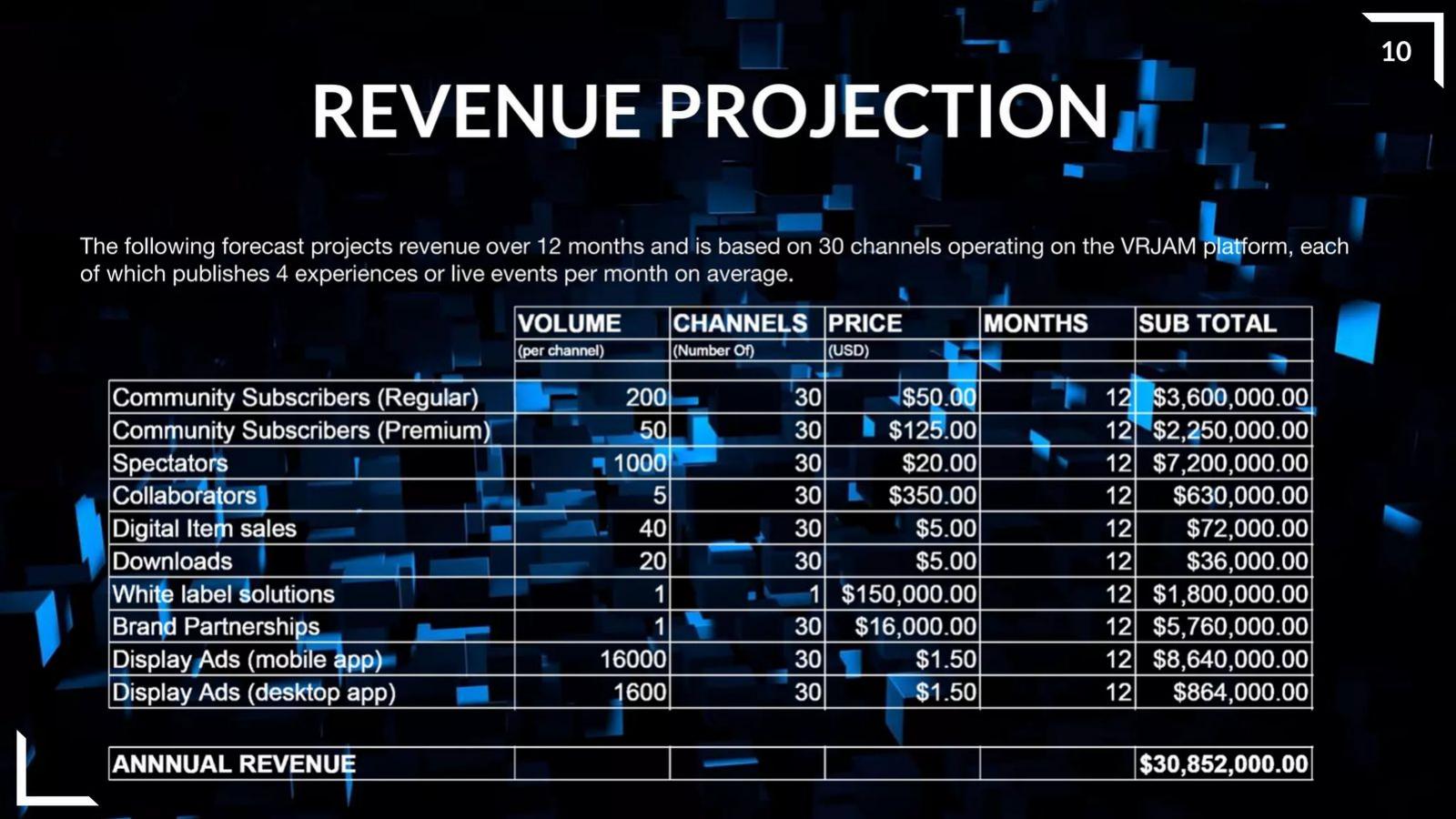
Financial Projections: While the revenue model is listed, there are no forward-looking projections. Investors want to see how the 38% subscription revenue translates into actual dollars over 12, 24, and 36 months.
Founder Takeaways: What to Copy
The Tranche Structure: For founders in capital-intensive industries like VR or hardware, structuring an investment in tranches (Slide 13) can be a smart move. It allows you to de-risk the investment for the lead, showing exactly what the first $150k will achieve before the larger check is required. It also creates a natural 'right of refusal' mechanism that can simplify future rounds.
Use Case Specificity: Rather than saying 'we do VR,' Slide 3 lists five distinct verticals (Sports, Music, Business, Brands, Video). This makes the product feel like a tool for existing industries rather than a solution in search of a problem. Founders should always map their tech to specific, recognizable business needs.
Leveraging 'Affiliates': If you have a partnership with a major tech provider (like Google or AWS), don't just put their logo on a 'Partners' slide. Explain the nature of the support (Slide 5). VRJAM does a good job of explaining that Google provided hardware and strategic introductions, which is far more valuable than a simple vendor relationship.
Focus on Infrastructure: By highlighting '5G Readiness,' VRJAM aligns itself with a massive external tailwind. Founders should always look for the 'Why Now?'—in this case, the rollout of high-speed mobile networks—and make it a central pillar of the pitch.
Frequently asked questions
- What is the core technology behind VRJAM?
- VRJAM is built as a real-time streaming platform for immersive 3D content. According to Slide 3, it utilizes 'native smart streaming technology' to render life-like avatars that visualize facial expressions and movements. The platform is format-agnostic, supporting live interactive video on standard screens as well as VR and AR headsets. It is specifically optimized for 5G data to maximize user experience.
- How does VRJAM plan to generate revenue?
- The revenue model on Slide 9 is highly diversified. The largest projected share comes from Subscriptions (38%), where each channel is limited to 1,000 subscribers to create scarcity. Advertising in 3D/VR formats accounts for 32%, followed by Brand partnerships at 28.5%. A small fraction (1.5%) is attributed to 'Products,' which includes virtual merchandise, custom avatars, and pay-per-view downloads.
- What is the nature of VRJAM's relationship with Google?
- Slide 5 describes Google as a 'Development Affiliate.' The Google partnerships team in London reportedly supported development by providing hardware access and helping craft the product vision. Furthermore, Google acted as a facilitator, engaging Deutsche Telekom on VRJAM's behalf to position the platform within DT's 5G content strategy. Google also refers clients to the company.
- What are the specific terms of the $500k funding ask?
- Slide 13 outlines a two-tranche investment structure. Tranche 1 seeks $150k for 4% equity to complete product development and content creation. Tranche 2 seeks $350k for 6% equity to fund the launch campaign and scale hardware. Notably, Tranche 1 investors receive a 'first right of refusal' for Tranche 2 and a total 5% equity stake incentive.
- What key information is missing from this pitch deck?
- The deck lacks several standard components essential for investor due diligence. There is no slide introducing the founding team or their expertise. It also omits a market size analysis (TAM) and a competitive matrix comparing VRJAM to other metaverse or streaming platforms. Additionally, while it mentions a $50k initial funding, it does not provide detailed burn rate or financial projections.