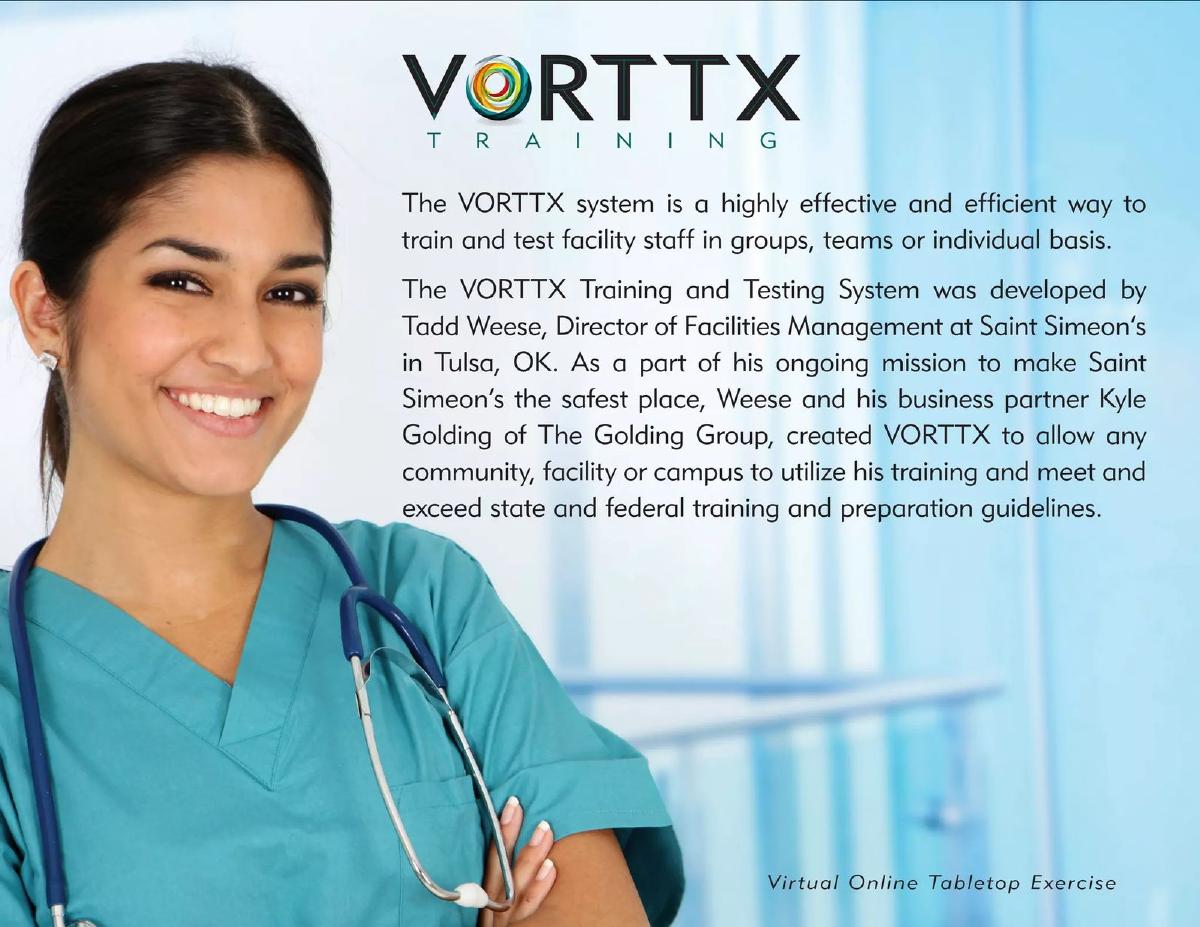
Vorttx is a specialized training platform designed for long-term healthcare providers, addressing the critical need for emergency preparedness compliance. The 2017 deck identifies a clear regulatory catalyst: federal requirements for Medicare and Medicaid-certified nursing homes to maintain written emergency plans and conduct staff training. By contrasting the archaic 'Word Doc' and 'hard copy' methods currently used with their automated, variable-outcome online tool, Vorttx makes a strong case for efficiency and liability reduction. While the deck effectively sizes the market at 67,000 regul…
Key takeaways
- The company identifies a specific regulatory pain point based on 2016 FEMA reporting regarding gaps in nursing home preparedness (Slide 2).
- Vorttx positions itself against manual 'CDC Action Plans' which are criticized for being static Word documents with no interaction or variables (Slide 3).
- The product is defined as a 'Virtual Online Tabletop Exercise' that requires zero preparation and offers shift-specific scenarios (Slide 4).
- Co-founder Tadd Weese provides a mission-driven narrative linked to his experience at Saint Simeon’s (Slide 5).
- The value proposition is centered on two pillars: license compliance and liability reduction, both framed as cost-saving measures (Slide 6).
- Market sizing identifies 67,000 regulated long-term care facilities and 15,600 nursing homes as the primary targets (Slide 9).
- The deck utilizes long-term demographic trends, citing a projected increase in the 85+ population to 17.9 million by 2050 to justify market growth (Slide 9).
- The technical implementation appears to be built on Typeform, as indicated by the 'add @typeform.com to your safe senders list' instruction in the product screenshot (Slide 4).
Vorttx Pitch Deck Analysis
Vorttx Training and Testing entered the market with a highly specialized focus: the intersection of emergency preparedness and regulatory compliance in the long-term healthcare sector. The 2017 deck is a study in identifying a regulatory 'moat' or catalyst. By focusing on the specific requirements of Medicare and Medicaid-certified facilities, Vorttx positions itself not just as a 'nice-to-have' training tool, but as a compliance necessity.
Slide 1: Title and Mission
The opening slide establishes the brand identity and a clear mission statement. Vorttx Training and Testing aims to be the 'premier provider of virtual staff training programs for long-term healthcare providers and other regulated industries.' The subtitle, 'Virtual Online Tabletop Exercise,' introduces the specific terminology of their product category immediately. The use of a professional healthcare worker in the background imagery reinforces the target vertical.
Slide 2: The Regulatory Catalyst
This slide is the 'Why Now?' of the deck. It cites 2016 FEMA Reporting to highlight a critical gap: while federal regulations require emergency plans and training, existing plans 'lacked relevant information—including only about half of the tasks on the Centers for Medicare & Medicaid Services checklist.' By citing a federal agency, the founders establish immediate credibility and define a problem that has legal and financial consequences for their customers.
Slide 3: The 'Before' State (The Problem)
Slide 3 visualizes the current, inefficient solution. It shows a CDC Action Plan which is characterized as a 'Word Doc' that is 'printed, then filled out by hand.' The deck lists the failures of this method: 'No interaction,' 'No variables,' and 'No summary report.' This is a classic 'status quo' slide designed to make the current way of doing business look archaic and risky.
Slide 4: The 'After' State (The Solution)
The solution slide introduces the Vorttx online tool. Key features include 'zero preparation' and 'shift and time of day specific scenarios.' The screenshots are revealing; they show a user interface that appears to be built using Typeform , as evidenced by the instruction to 'Add "@typeform.com" to your email safe senders list.' This suggests a lean, MVP-style approach to software development, focusing on logic and content over custom-coded infrastructure.
Slide 5: The Founder's Mission
Co-Founder Tadd Weese is introduced through a personal quote. He discusses his transition into the profession and his 'Mission of Saint Simeon’s.' This slide serves to build emotional resonance, connecting the software product to the real-world safety of 'parents, grandparents, friends or other loved ones.' It attempts to move the conversation from 'compliance software' to 'resident safety.'
Slide 6: The Business Case
This slide distills the value proposition into two bullet points: 1. License compliance and 2. Reduced liability . Crucially, both points are followed by the parenthetical '(cost saving)' . This tells the investor exactly how the company intends to sell to facility administrators: by protecting the bottom line from regulatory fines and legal payouts.
Slide 7: Product Ecosystem and Web Presence
Slide 7 provides a collage of the company's digital footprint, including their website (vorttx.com) and a YouTube preview. It mentions that the system offers '3,000+ potential combinations' of scenarios, ensuring that staff do not become disengaged by repeating the same training. This slide emphasizes the 'variable outcome' nature of the platform, which is a key differentiator mentioned throughout the deck.
Slide 8: Competitive Differentiation
The deck claims Vorttx is the 'only online, automated, variable outcome staff training system specifically designed for long-term healthcare facilities.' By narrowing the niche so specifically, they effectively eliminate broader, horizontal LMS (Learning Management System) competitors who lack the specific 'tabletop exercise' logic required for this type of emergency compliance.
Slide 9: Market Size and Demographics
The final slide in this set provides the macro-economic justification for the business. It lists 67,000 regulated facilities and 15,600 nursing homes . It then uses US Census and HHS data to show that the population requiring these services is set to explode, with the 85+ demographic projected to triple to 17.9 million by 2050 . This frames Vorttx as a play on a guaranteed demographic trend.
What Works in the Vorttx Deck
The deck is exceptionally strong at identifying a regulatory pain point . Many startups struggle to explain why a customer must buy their product today; Vorttx points directly to FEMA and CMS checklists and says, 'You are currently failing these.' The contrast between the 'Word Doc' and the 'Variable Outcome' tool is a clear, easy-to-understand product evolution.
The market focus is also a strength. By ignoring the broader 'corporate training' market and focusing exclusively on 'long-term healthcare,' the founders can speak the specific language of their buyers (e.g., 'tabletop exercises,' 'CMS checklists,' 'shift-specific scenarios'). This specificity usually leads to higher conversion rates and lower customer acquisition costs.
What is Missing from the Vorttx Deck
The most glaring omission in the provided slides is financial data . There is no mention of the business model (SaaS vs. per-exercise fees), current revenue, or growth projections. While Slide 7 shows some pricing tiers on a website screenshot, they are not discussed in the narrative flow of the deck.
Furthermore, there is no 'The Ask' slide. We do not know how much capital the company is seeking or how they intend to use the funds. There is also a lack of unit economics —investors would want to know the cost to acquire a nursing home facility and the lifetime value of that contract, especially given the high regulatory barriers to entry.
Finally, the Team slide is weak. While Tadd Weese is quoted, the full professional pedigree of the founding and engineering team is not detailed. In a regulated healthcare space, having deep expertise in compliance or clinical operations is a major trust signal that is under-utilized here.
Founder's Playbook: What to Copy
The 'Before/After' Comparison: Use Slide 3 and 4 as a template. Show the manual, 'dumb' way the industry currently works, then show your 'smart,' automated alternative. · Regulatory Anchoring: If your industry has mandatory reporting or compliance checks, cite the specific government agency or checklist you satisfy. It transforms your product from a luxury to a tax-like necessity. · Demographic Tailwinds: Use long-term, indisputable data (like Census projections) to show that your market isn't just large, but inevitably growing. · Liability as a Sales Tool: Framing your product as a way to 'reduce liability' is often more effective in B2B sales than promising 'increased productivity,' as the fear of loss is a more powerful motivator for executives.
Frequently asked questions
- What specific problem does Vorttx solve for healthcare facilities?
- Vorttx addresses the failure of traditional emergency preparedness training. According to Slide 2, while most nursing homes have written plans, they often lack relevant information and only cover about half of the CMS checklist tasks. Vorttx automates this process to ensure facilities meet federal license compliance and reduce liability through better-trained staff.
- How does the Vorttx platform differ from existing training methods?
- Slide 3 describes the status quo as 'Word Doc' based plans that are printed and filled out by hand, offering no interaction or variable scenarios. Slide 8 counters this by positioning Vorttx as the 'only online, automated, variable outcome staff training system' that uses shift and time-of-day specific complications to create unique experiences every time.
- What is the total addressable market defined in the deck?
- Slide 9 identifies 67,000 regulated long-term care services provider facilities and 15,600 nursing homes. The deck further supports the market opportunity by citing US Census Bureau data projecting that the population aged 85 and over will triple to 17.9 million by 2050, increasing the demand for these facilities.
- Who is the key team member mentioned in the slides?
- Slide 5 introduces Co-Founder Tadd Weese. His background is linked to Saint Simeon’s, and he frames the company's purpose around a personal mission to create the 'safest places' for elderly residents. While Slide 7 shows a 'Team' section on a website screenshot, Tadd Weese is the only individual explicitly quoted and named in the main slide content.
- What are the primary business drivers for potential customers?
- As stated on Slide 6, the two primary drivers are local, state, and federal license compliance and the creation of well-trained staff to reduce liability. Both of these are explicitly categorized as 'cost saving' measures, suggesting the product is sold as a way to avoid fines and legal expenses.