Vori Health’s 11-slide Series A deck is a masterclass in establishing founder-market fit through clinical authority. Raising $56.3 million in 2020, the company tackled the musculoskeletal (MSK) space by positioning itself as a physician-led, virtual-first alternative to a fragmented, high-cost traditional system. The deck avoids dense financial tables, choosing instead to focus on the 'why' and the 'who.' By highlighting a leadership team with backgrounds from the Mayo Clinic, Yale, and McKesson, Vori Health convinced investors that they possessed the medical and operational expertise to navi…
Key takeaways
- The deck establishes massive credibility early by featuring a 'World-Class Executive Team' with clinical roots at Mayo Clinic and Yale (Slide 2).
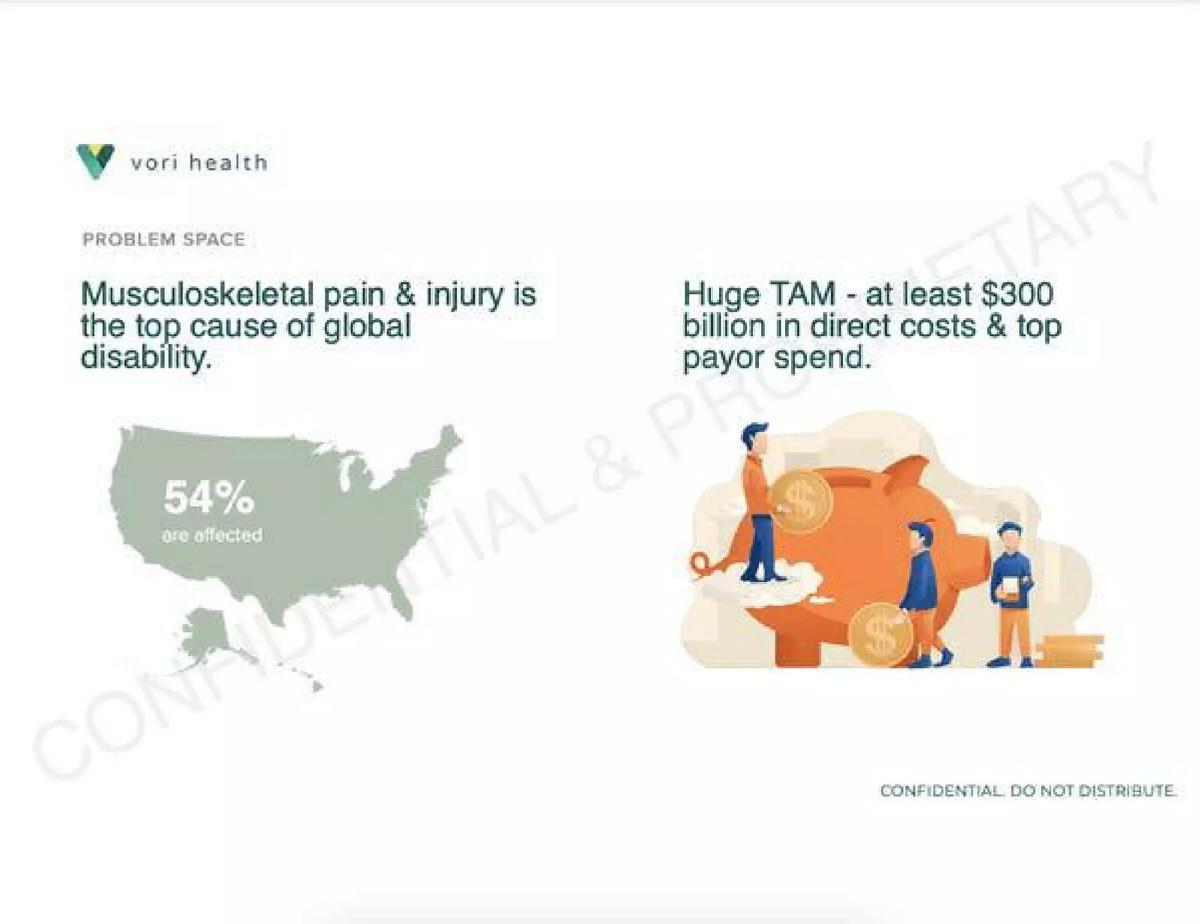
- Vori Health identifies a $300 billion TAM in direct costs for musculoskeletal pain, which it cites as the top cause of global disability (Slide 4).
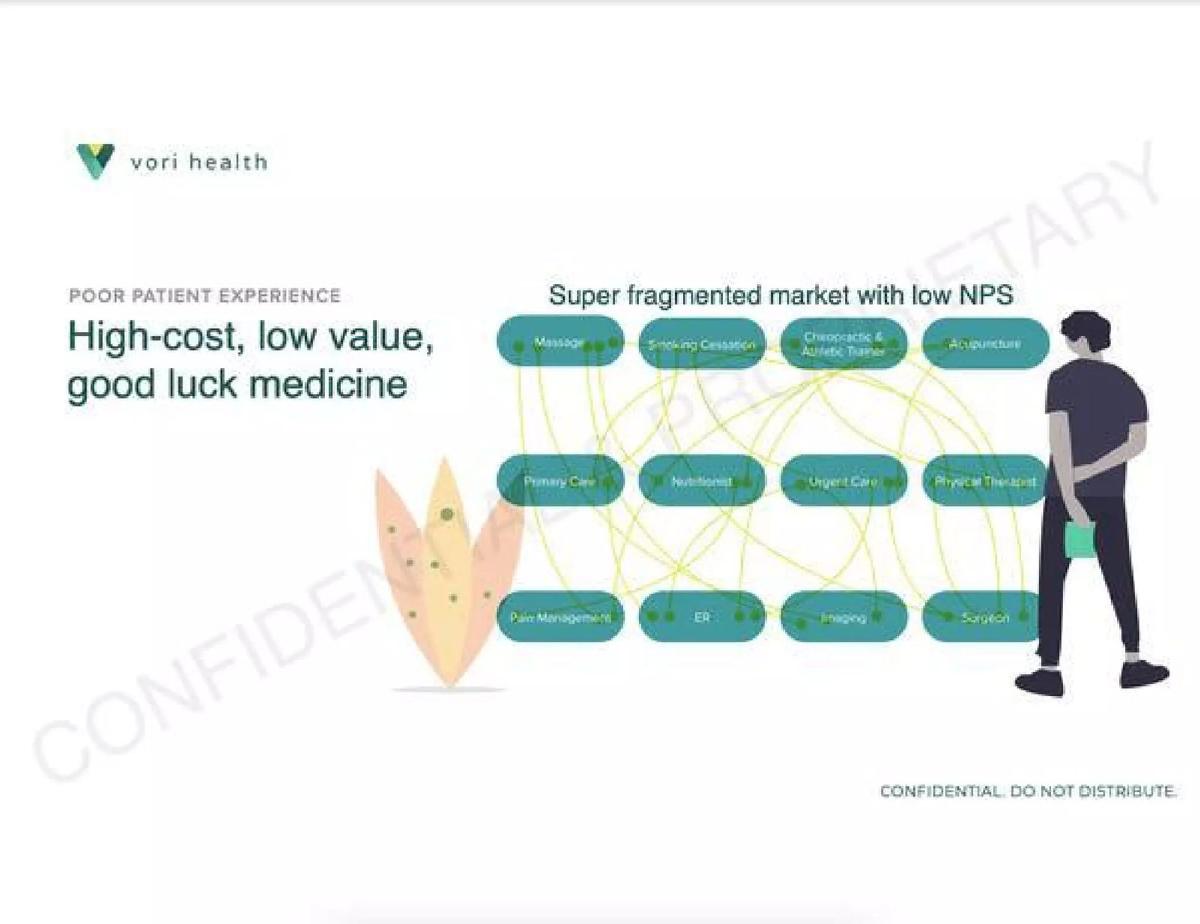
- The problem is framed as a 'super fragmented market' where patients suffer from 'high-cost, low value, good luck medicine' (Slide 5).
- The solution is defined as a 'virtual-first' care model that integrates medical doctors, physical therapists, and health coaches (Slide 9).
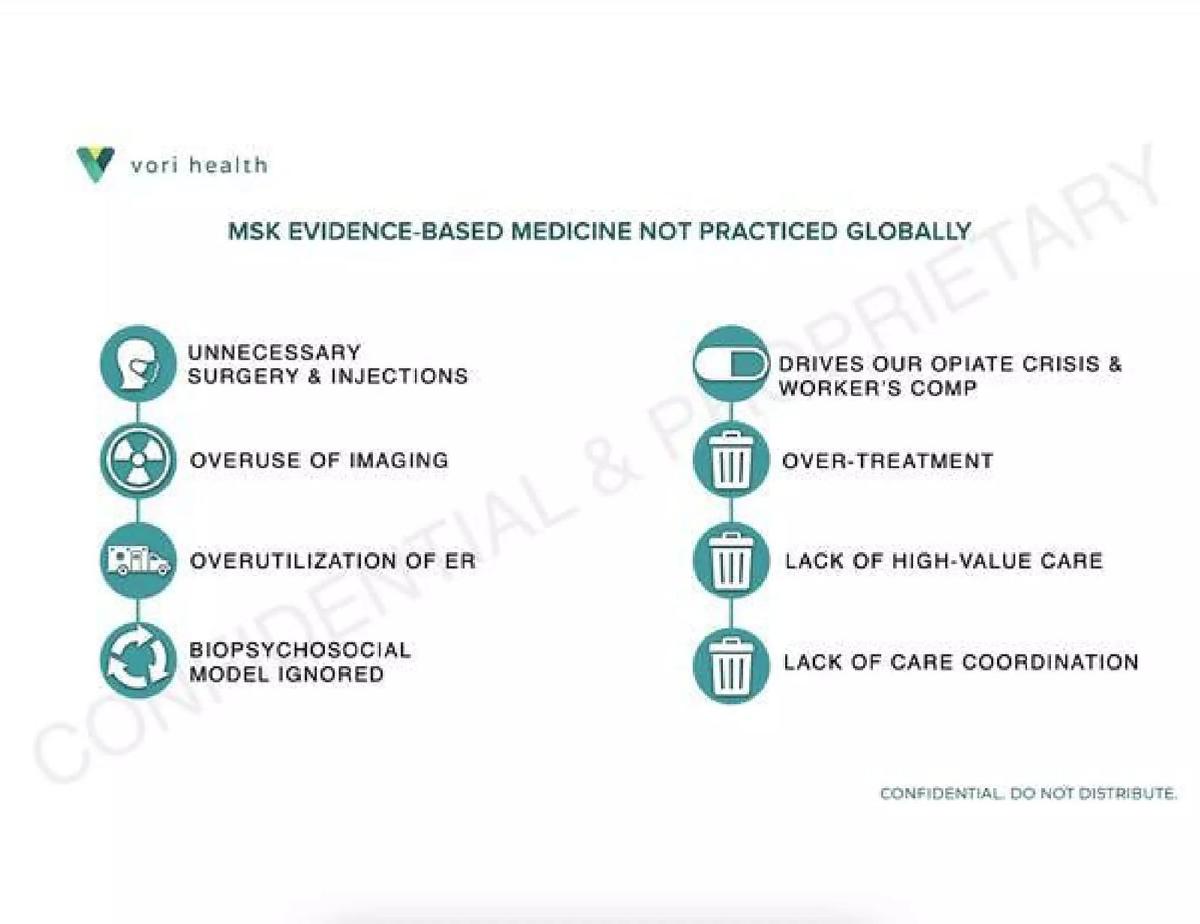
- The deck emphasizes a 'biopsychosocial model' to combat the opiate crisis and unnecessary surgeries (Slide 6).
- Product functionality is showcased through a mobile interface featuring integrated telehealth, personalized care plans, and progress tracking (Slide 10).
- The business model shifts from episodic treatment to a continuous lifecycle of 'Prevention, Integrated Care, and Maintenance Care' (Slide 11).
- Despite the $56.3M raise, the deck contains zero slides on financial projections, current revenue, or specific customer traction (Omitted).
The $56 Million Clinical Authority Play
Vori Health’s Series A pitch deck is a fascinating example of how clinical pedigree can substitute for traditional startup metrics in a high-stakes fundraise. In 2020, the company secured $56.3 million to reinvent musculoskeletal (MSK) care. The deck they used to do it is remarkably lean—just 11 slides—and almost entirely devoid of the charts, graphs, and revenue projections that typically dominate a Series A presentation. Instead, Vori Health leans heavily into the 'Who' and the 'Why.'
The MSK space is notoriously expensive and inefficient. By positioning themselves as a 'physician-led' and 'virtual-first' practice, Vori Health addressed the two biggest pain points for healthcare investors: the high cost of physical brick-and-mortar expansion and the lack of quality control in fragmented care. This teardown explores how they built a narrative of clinical excellence and market necessity.
The Team and the Mission (Slides 1-3)
Slide 1: Title The deck opens with a clean, lifestyle-oriented cover. The tagline, 'Empowering humanity to lead a healthier life,' is broad, but the accompanying imagery of a mobile app and a person in motion immediately signals a digital health focus. The URL www.vorihealth.com is prominently displayed.
Slide 2: World-Class Executive Team This is arguably the most important slide in the deck. In healthcare, the 'Who' is often more important than the 'How.' Vori Health showcases a heavy-hitting lineup: Founder & CEO Ryan Grant, MD (Yale-trained Neurosurgeon), Co-Founder & Chief Med Officer Mary O’Connor, MD (Former Chair at Mayo Clinic), and Co-Founder & CTO Sri Muthu (formerly of Wells Fargo and Zelle). By placing logos like Mayo Clinic, Yale, McKesson, and Zelle directly under the headshots, Vori establishes instant institutional credibility. This slide tells investors that the team has the medical expertise to design care and the operational experience to scale technology.
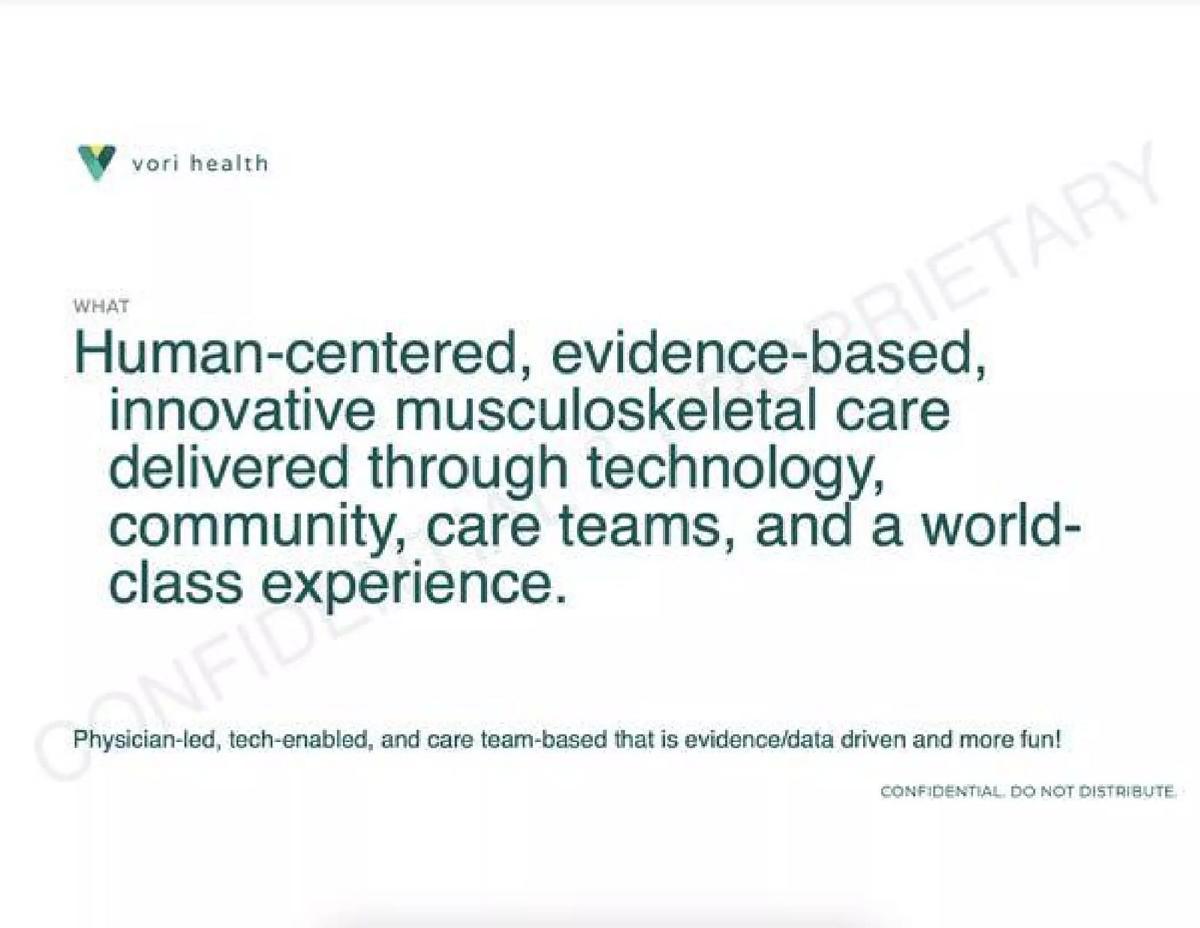
Slide 3: The 'What' This slide acts as a mission statement. It defines Vori as 'Human-centered, evidence-based, innovative musculoskeletal care delivered through technology.' It emphasizes that the model is 'Physician-led,' which is a critical differentiator in a market often crowded with wellness apps that lack true clinical oversight. The phrase 'and more fun!' at the bottom is a rare nod to the patient experience in a clinical deck.
Defining the $300 Billion Problem (Slides 4-6)
Slide 4: Problem Space Vori moves quickly to the market opportunity. They cite that MSK pain is the 'top cause of global disability' and that 54% of the US population is affected. The 'Huge TAM' is quantified at 'at least $300 billion in direct costs.' By highlighting that this is 'top payor spend,' they are speaking directly to the interests of insurance companies and self-insured employers who are desperate to lower these costs.
Slide 5: Poor Patient Experience This slide visualizes the 'Super fragmented market with low NPS.' It shows a chaotic web of providers—Massage, Primary Care, Urgent Care, Imaging, Surgeons—and a lone patient looking confused. They characterize the current state as 'High-cost, low value, good luck medicine.' This is a powerful rhetorical device; it frames the existing healthcare system as a gamble for the patient, setting the stage for Vori’s 'evidence-based' solution.
Slide 6: MSK Evidence-Based Medicine Not Practiced Globally Here, the deck lists the specific failures of the current system: 'Unnecessary surgery & injections,' 'Overuse of imaging,' and 'Overutilization of ER.' Most importantly, it links these failures to the 'opiate crisis.' By positioning their model as a solution to the opioid epidemic, Vori aligns itself with a major national health priority, making the investment feel not just profitable, but socially necessary.
The Vori Solution: Experience and Technology (Slides 7-9)
Slide 7: Experience Drives Outcomes Vori introduces a circular model where 'Experience Drives Outcomes.' The key pillars include 'Evidence-Based Care,' 'Standardized Pathways,' and 'Shared-Decision Making.' This slide is designed to reassure investors that Vori isn't just a telehealth platform; it's a disciplined clinical practice that uses data to 'decrease variation'—the holy grail of healthcare efficiency.
Slide 8: Technology-Enabled Platform This slide provides a high-level overview of the product's features. It lists Integrated Telehealth Visits, Coaching & Care Navigation, At-Home Therapy, Social Community, Personalized Care Plans, Nutrition, and Progress Tracking. It’s a 'one-stop-shop' approach to MSK care. The central image of a smartphone with the Vori app reinforces the 'virtual-first' delivery model.
Slide 9: Right Providers, In Right Location, At Right Time This slide illustrates the patient journey. It starts with 'Universal Intake & Triage' (digital or in-person) and moves to a multidisciplinary team including Health Coaches, Physical Therapists, and Physical Medicine MDs. The goal is 'Achieving Patients’ Goals' through follow-up and 'Appropriate Procedures & Surgery.' This acknowledges that while they are virtual-first, they still coordinate with the broader medical ecosystem for necessary surgeries.
Product Deep Dive and Ecosystem (Slides 10-11)
Slide 10: Product UI Slide 10 shows the actual user interface of the app. We see screens for 'Connect with Providers' (video call), 'Daily Playlist' (exercise videos), 'Track your Progress,' and 'Chat with your Health Coach.' The design is clean, modern, and looks more like a consumer wellness app than a clunky medical portal, supporting their earlier claim of making healthcare 'more fun.'
Slide 11: The MSK Ecosystem The final slide shows the full lifecycle of Vori’s care: Prevention, Integrated Care, and Maintenance Care. This is a strategic 'land and expand' slide. It suggests that Vori isn't just there for when your back hurts; they want to be the platform for 'Wellness,' 'Fitness,' and 'Performance Enhancement' long after the acute injury is treated. This implies a much higher lifetime value (LTV) per patient than a traditional episodic clinic.
What Works in the Vori Health Deck
The Authority Play: In a Series A, investors are looking for a reason to believe the team can execute. By leading with a former Mayo Clinic Chair and a Yale Neurosurgeon, Vori effectively bypassed the need for early traction data. In healthcare, clinical authority is the ultimate moat.
Clear Problem/Solution Fit: The deck does an excellent job of vilifying the current state of MSK care. By calling it 'good luck medicine' and linking it to the opioid crisis, they create an emotional and financial urgency for their solution.
Visual Simplicity: The deck is not cluttered. It uses high-quality illustrations and a consistent color palette. This reflects a 'human-centered' brand, which is exactly what they are selling to patients and payers.
What is Missing from the Vori Health Deck
Financial Projections: There is not a single dollar sign in this deck related to Vori’s own revenue, margins, or projections. While the TAM is $300B, investors eventually need to know how Vori captures its slice of that pie.
Unit Economics: There is no mention of Customer Acquisition Cost (CAC) or Lifetime Value (LTV). For a virtual-first model, understanding the cost of acquiring a patient versus the reimbursement rate is vital.
Traction and Milestones: The deck doesn't list current patient numbers, pilot programs with employers, or partnerships with insurance companies. It is a 'vision' deck rather than a 'results' deck.
Competitive Landscape: The MSK space is crowded with well-funded players like Hinge Health and Sword Health. Vori completely ignores these competitors, which can be a red flag for some investors who want to know how a company differentiates itself from other tech-enabled peers.
What a Founder Should Copy
The 'Who' Slide: If you have a team with deep industry expertise, put it at the very beginning. Don't bury your biggest asset on Slide 12. Vori’s Slide 2 is the reason they raised $56M.
The 'Status Quo' as the Enemy: Instead of fighting competitors on features, fight the current system on outcomes. Vori’s framing of the 'fragmented market' makes any alternative look better by comparison.
The Lifecycle Vision: Don't just show the product; show the ecosystem. Slide 11’s transition from Prevention to Maintenance shows that the company is thinking about long-term patient retention, not just one-off transactions.
Focus on the 'Why': Even without revenue data, Vori succeeded because they told a compelling story about why the world needs a better way to treat back pain. If your market is big enough and your team is good enough, the 'Why' can sometimes carry the 'How.'
Frequently asked questions
- How did Vori Health raise $56.3M with only 11 slides?
- The raise was likely driven by the exceptional pedigree of the founding team and the sheer size of the MSK market. Slide 2 features a former Chair at the Mayo Clinic and a Yale-trained neurosurgeon. In healthcare, clinical authority often outweighs early-stage traction data, as investors are betting on the team's ability to navigate regulatory and payer landscapes.
- What is the 'biopsychosocial model' mentioned in the deck?
- As shown on Slide 6, this model suggests that MSK issues are not just physical but involve psychological and social factors. Vori Health uses this to differentiate itself from traditional clinics that focus solely on 'imaging and injections,' arguing that their holistic approach leads to better outcomes and lower costs for payers.
- Does the deck explain how Vori Health makes money?
- Not explicitly. The deck mentions being 'top payor spend' on Slide 4 and 'value-based MSK specialty care' on Slide 8, implying a B2B2C model where they contract with insurance companies or employers. However, specific pricing, per-member-per-month (PMPM) fees, or reimbursement rates are entirely absent from these 11 slides.
- What are the biggest risks identified in this pitch?
- The deck highlights the 'super fragmented market' on Slide 5. The primary risk for Vori is the coordination of these fragmented services. While they propose an 'integrated' model, the complexity of managing a nationwide medical practice with physical therapists and physicians across different state lines is a significant operational hurdle not detailed in the deck.
- Why is there no competition slide?
- Vori Health chose to focus on the 'status quo' as the competitor rather than naming other digital MSK startups like Hinge Health or Sword Health. By framing the problem as 'unnecessary surgery' and 'overuse of imaging' (Slide 6), they position themselves against the traditional healthcare system rather than other tech players.