Black Hops Brewing’s deck is a study in community-led growth for a physical product business. Rather than leading with complex financial modeling, the company emphasizes 'social proof' and 'market pull.' By the time they sought $100,000, they had already pre-sold 14 kegs before brewing them and established a presence in notable Brisbane and Gold Coast venues. The deck highlights their transition from contract brewing to owning a facility, aiming to become Queensland’s 3rd largest privately owned brewery. While it lacks traditional venture capital metrics like CAC or LTV, it successfully commu…
Key takeaways
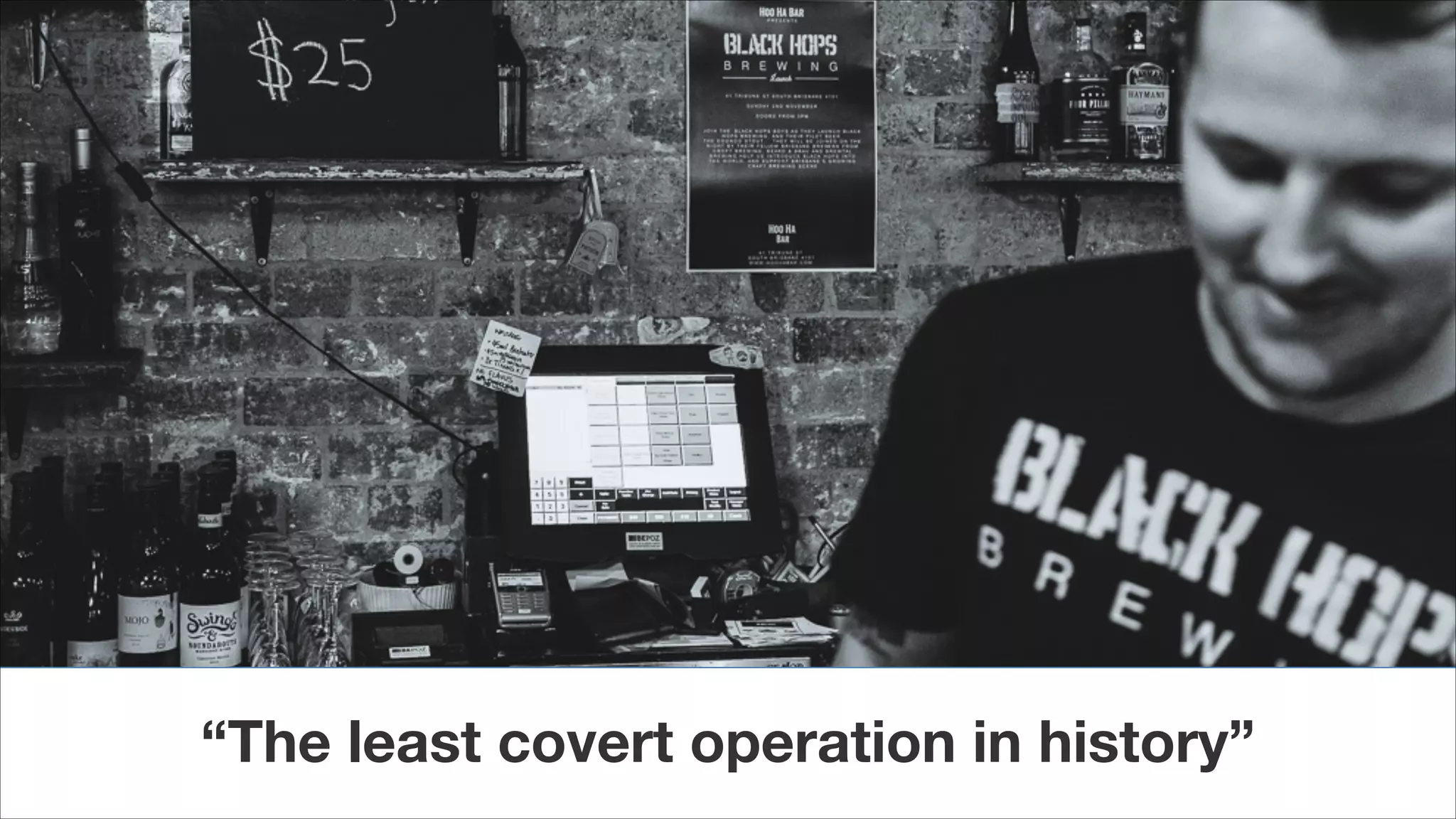
- The company positions itself as a community-driven project, using the tagline 'The least covert operation in history' on Slide 1.
- Black Hops Brewing aimed to become Queensland’s 3rd largest privately owned brewery in 2015, according to Slide 2.
- Early product validation was achieved through an 'Eggnog Stout' which received high ratings on social platforms, as shown on Slide 3.
- The founders utilized contract brewing to test 15 pilot batches before committing to their own facility, per Slide 4.
- Marketing strategy relies heavily on content creation, social media, and press from industry sites like The Crafty Pint, as noted on Slide 5.
- The deck claims significant pre-launch demand, stating they sold 14 kegs before the beer was even brewed, as detailed on Slide 6.
- The presentation omits a dedicated team slide, financial projections, and a specific use-of-funds breakdown in the provided 7 slides.
- The deck focuses on 'tap space' as the primary competitive battleground in the craft beer industry, cited on Slide 6.
Introduction: The Community-First Brewery Pitch
The Black Hops Brewing deck is a departure from the standard Silicon Valley software-as-a-service (SaaS) template. It represents a 'Main Street' or 'Craft' fundraising style where the primary assets are brand equity, community loyalty, and physical production capacity. Used to raise over $100,000, the deck focuses on the transition from a 'gypsy' or contract brewing model to a brick-and-mortar operation. The narrative is built around the idea that the demand already exists, and the capital is simply the bridge to fulfilling that demand.
Slide 1: The Hook
The cover slide features a black-and-white photo of a bartender or brewer behind a bar, with a chalkboard showing a '$25' price point and a 'Black Hops Brewing' poster in the background. The tagline, "The least covert operation in history," sets the tone for the entire pitch. It suggests a brand built on transparency and storytelling. In the craft beer world, where 'authenticity' is a major selling point, this tagline signals that the founders have been building in public, likely creating a pre-existing audience of potential investors and customers.
Slide 2: The Vision and Scale
Slide 2, titled "Enter Black Hops Brewing," defines the company's ambitions for 2015. It makes three specific claims: they are building "Queensland’s 3rd largest privately owned brewery," they are "levelling the playing field for contract brewers," and they are "putting the Gold Coast on the map as a craft beer destination." This slide is crucial because it moves from a vague 'we make beer' sentiment to a specific regional dominance play. By positioning themselves as the potential #3 player, they provide a sense of scale that justifies a six-figure investment. The mention of 'sharing our journey' reinforces the community-led growth model mentioned on the cover.
Slide 3: Social Proof and Traction
This slide is purely dedicated to validation. It features logos of four partner venues: Tomahawk Kitchen & Bar, Ze Pickle, Super Whatnot, and Brewskii. Below these are three user testimonials from what appears to be a beer-rating app (likely Untappd, though not named). The reviews for their "Eggnog Stout" are glowing, with Matthew D. calling it "Easily the best stout I have ever drunk!" For a physical product, showing that high-end bars are already carrying the product and that customers are 'chasing the kegs around Brisbane' (as Andrew T. claims) is more valuable than any theoretical market size chart.
Slide 4: Product Development
Slide 4 focuses on the 'Product.' It defines their style as "creative but approachable beer." The most important data point here is that they have "brewed 15 pilot batches." This informs investors that the product is not a prototype; it has been iterated upon extensively. The slide explicitly states they are "ready to release a full range of beers when we open our own facility." This frames the investment as a way to unlock a suppressed product pipeline rather than a way to fund R&D.
Slide 5: Marketing and Growth Strategy
The "Marketing and growth" slide outlines a four-pillar strategy: product quality, content/social media, existing story resonance, and industry networking. The right side of the slide features logos of industry press: 250beers.com, The Crafty Pint, Brewed Crude & Bitter, and CraftBeerReviewer.com. This demonstrates that the company has already captured 'earned media.' In a crowded market like craft beer, having industry gatekeepers already talking about the brand reduces the perceived risk of future customer acquisition costs.
Slide 6: Competition and Market Demand
The "Competition" slide is refreshingly honest. It acknowledges they are "competing with other craft breweries and big breweries for tap space in bars." However, it immediately counters this challenge with a massive traction metric: "selling our first 14 kegs before we brewed the beer." This is the 'holy grail' of early-stage pitches—proof of pre-sales. The slide also mentions "plenty of enquiries from interstate that we can’t yet fulfil," which directly points to the need for the capital: they need a bigger facility to meet the demand they have already generated.
Slide 7: External Validation
The final slide in the provided set is a full-page quote from 250beers.com.au. It speaks to the "loud buzz of expectation circling the Gold Coast" and venues "champing at the bit." Using a third-party expert to close the argument for demand is a strong psychological tactic. It moves the claim from 'the founders think people want this' to 'the industry experts say the market is waiting for this.'
What Black Hops Brewing Does Well
The strength of this deck lies in its focus on 'Market Pull.' Most early-stage decks spend too much time explaining why a product should exist. Black Hops spends its time proving that the product already has a line of people waiting to buy it. By citing specific venues, specific pre-sale numbers (14 kegs), and specific pilot batch counts (15), they ground the pitch in reality.
Furthermore, the regional focus is a smart strategic move. By aiming to be the 3rd largest in Queensland, they create a reachable, tangible goal. Investors can visualize what that looks like in a way they can't visualize 'disrupting the global beverage industry.'
What is Missing from the Deck
While the deck was successful in raising $100,000, it leaves several critical questions unanswered for a professional investor:
Team Slide: The provided slides do not show who is brewing the beer or who is running the business. In a craft industry, the pedigree of the head brewer is a major risk factor. · Financial Projections: There is no mention of revenue targets, margins per pint/keg, or how long the $100,000 will last (runway). · Use of Funds: While it is implied the money is for a facility, there is no breakdown of equipment costs, lease deposits, or working capital requirements. · Unit Economics: The deck doesn't explain the cost to produce a keg versus the wholesale price, which is essential for understanding the scalability of the brewery.
Founder's Guide: What to Copy
1. The 'Pre-Sale' Metric: If you are selling a physical product, nothing beats the statement "We sold X units before we even made them." Copy this approach by securing letters of intent (LOIs) or pre-orders before you walk into a pitch meeting.
2. Radical Transparency: The 'least covert operation' angle is highly effective for building a brand. Founders should consider how they can 'build in public' to create a community of advocates who can then be leveraged as social proof in the deck.
3. Specific Social Proof: Don't just say 'customers love us.' Show screenshots of reviews, name the specific high-end venues that carry your product, and quote industry-specific publications. This builds a layer of credibility that generic marketing language cannot match.
4. Iteration Proof: Mentioning the '15 pilot batches' shows a commitment to quality and a lack of ego. It tells the investor that the product has been tested and refined, reducing the risk of a 'bad batch' ruining the brand's reputation early on.
Conclusion
The Black Hops Brewing deck is a masterclass in momentum-based pitching. It doesn't rely on complex financial engineering; it relies on the undeniable fact that people are already drinking their beer and asking for more. For a $100,000 raise, this level of 'proof of concept' is often more than enough to tip an investor from 'maybe' to 'yes.'
Frequently asked questions
- How much did Black Hops Brewing raise with this deck?
- According to the source listing, this pitch deck was used to raise over $100,000. The deck itself focuses on the transition from contract brewing to establishing their own physical brewery facility in Queensland, Australia, to meet existing demand that they could not previously fulfill.
- What was the primary product used to prove market fit?
- The company led with a creative 'Eggnog Stout.' Slide 3 and Slide 4 highlight this specific beer, showcasing five-star user reviews and noting that it encouraged non-stout drinkers to try the brand. This served as a 'hook' to demonstrate their ability to create approachable yet creative products.
- What is the 'least covert operation' mentioned on the cover?
- This refers to the company's radical transparency and content-led marketing strategy. Slide 5 explains that they share their journey through blogs and social media. By being 'non-covert,' they built a loyal community that felt invested in the brewery's success before the physical doors even opened.
- What competitive advantage does the deck claim?
- The deck claims an advantage in 'market pull.' Slide 6 notes that they sold their first 14 kegs before brewing the beer and had interstate inquiries they couldn't fulfill. This suggests that their brand and community engagement created a level of demand that outstripped their initial supply capabilities.
- What key investor information is missing from these slides?
- The provided slides lack a team biography, detailed financial forecasts, unit economics (cost per keg vs. sale price), and a specific 'Ask' slide detailing how the $100,000 would be spent. It also lacks a clear exit strategy or long-term valuation roadmap common in tech-focused decks.