The Flame in the Flood pitch deck is a specialized gaming presentation that leans heavily on the 'Triple-A' pedigree of its founding team and the distinct visual identity of the project. Developed by The Molasses Flood, the deck uses a 'Toobin’ meets Oregon Trail' hook (Slide 2) to instantly categorize the gameplay loop for investors. While it lacks traditional business metrics like market size, monetization strategies, or a specific capital ask in the provided slides, it excels at world-building. The deck functions more as a creative vision document, using detailed asset sheets for character…
Key takeaways
- The deck uses a concise 'X meets Y' high-concept pitch: 'Toobin’ meets Oregon Trail' to define the game structure (Slide 2).
- Visual storytelling is prioritized, with dedicated slides for character variations, raft customization, and enemy design (Slides 3, 4, 7).
- The team slide emphasizes massive industry experience, citing lead roles on Bioshock Infinite, Halo, and Rock Band (Slide 8).
- Gameplay mechanics are demonstrated through mock-up UIs showing survival stats like hunger, thirst, and temperature (Slides 5, 6).
- The deck establishes a clear 'moment-to-moment' gameplay loop involving river navigation and island exploration (Slide 2).
- Atmospheric quotes are used to set the tone, such as 'All we are is what we leave behind' on the death mechanic slide (Slide 7).
- The presentation lacks standard venture capital components like a budget, roadmap, or market analysis in the available slides.
- The Molasses Flood LLC branding is consistent throughout, appearing as a watermark on every asset sheet (Slides 2-7).
The Flame in the Flood: A Visual-First Approach to Indie Game Fundraising
The Flame in the Flood pitch deck is a distinct departure from the data-heavy presentations typical of SaaS or Fintech startups. As a creative endeavor by The Molasses Flood LLC, this deck functions as a 'look and feel' document designed to sell a vision and a pedigree. The project, which eventually became a successful indie title, uses these slides to bridge the gap between a high-concept idea and a tangible product. By examining the eight slides provided, we can see a clear strategy: define the genre instantly, showcase the art style, and prove the team has the 'AAA' experience to deliver.
Slide 1: Title and Branding
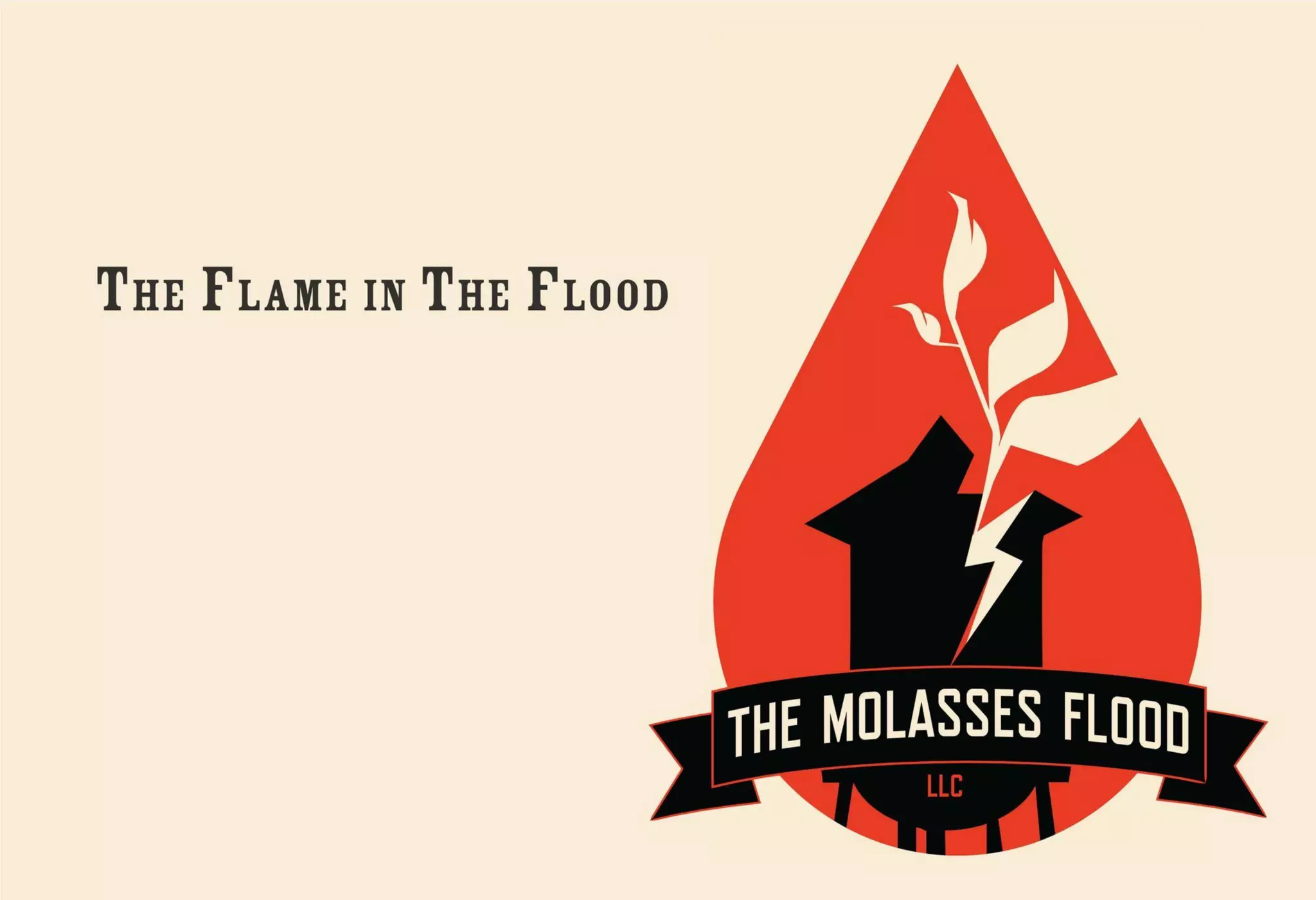
The opening slide is minimalist, featuring the game title 'The Flame in the Flood' and the logo for The Molasses Flood LLC. The logo—a stylized water tower inside a red droplet with a sprouting plant—establishes the company’s visual identity. There are no taglines or mission statements here; the focus is entirely on the brand and the project name.
Slide 2: The Game Structure - "Go With The Flow"
This is arguably the most important functional slide in the deck. It uses a 'high-concept' pitch: "Toobin’ meets Oregon Trail." This immediately tells an investor that the game involves river navigation (Toobin') and high-stakes survival/resource management (Oregon Trail). The slide shows a procedural map with islands marked by red stars and yellow house icons, indicating points of interest. A call-out box shows a 'moment to moment' gameplay view, proving the team has thought through the transition from macro-navigation to micro-exploration. The fine print at the bottom notes 'KS, Procedural, Moment to Moment Gameplay,' hinting that this deck may have been prepared in conjunction with a Kickstarter campaign.
Slide 3: Player One - "Scout"
This slide introduces the protagonist, Scout. Rather than just one image, it provides a 'preproduction unwrap' showing the character from multiple angles and in different states (e.g., cold/shivering, injured, and neutral). The inclusion of a quote from Ernest Hemingway—"The world breaks everyone and afterward many are strong in the broken places"—sets a somber, literary tone for the narrative. This slide demonstrates the 'Art/Design' capabilities of the team, showing a polished, unique aesthetic that differentiates the game from generic survival titles.
Slide 4: Player Raft - "Piece of Ship"
The raft is the player's primary tool and home. Slide 4 details the customization and technical components of the vehicle. It labels specific features like 'Player Storage,' 'Player Skins,' and 'Player Ornament.' The text defines the raft as a 'floating platform made of buoyant materials' and notes that its fate 'cannot be mastered; it can only be collaborated with.' This reinforces the survival theme—nature is a force to be reckoned with, not a system to be easily conquered. From a development standpoint, this slide shows the modularity of the game's assets.
Slide 5 & 6: Environmental Mockups and UI
These two slides show the game in action. Slide 5, 'Entering Thistledew Marsh Way,' shows a nighttime scene with a warm glow from a campfire, while Slide 6, 'Entering Hard Water Hammock,' shows a rainy, industrial-looking flooded zone. Crucially, these slides showcase the User Interface (UI). We see icons for hunger, thirst, temperature, and health. The top left corner tracks the passage of time ('8th Night,' '14th Day'). These mockups prove that the 'survival' aspect of the 'Oregon Trail' comparison is a core, functioning mechanic of the game design.
Slide 7: Player Demise - "Mangy Backwater Wolf"
Survival games are defined by their threats. Slide 7 introduces an enemy, the 'Mangy Backwater Wolf,' and the concept of 'Player Demise.' The art is aggressive and stylized, featuring a large, red-eyed wolf standing over a kill. The tagline 'All we are is what we leave behind' suggests a 'roguelike' mechanic where death is permanent but perhaps leaves something for future runs. This slide addresses the 'conflict' element of the game's design.
Slide 8: The Team - The "AAA" Pedigree
The final slide in this set is the 'Team' slide, and it is the deck's strongest argument for investment. The Molasses Flood founders are not amateurs; they are industry veterans. The slide lists:
Bryn Bennett: Tech Director on Freedom Force 2, Lead Programmer on Titan Quest, and Rock Band veteran. · Chad LaClair: Senior Level Builder on Bioshock Infinite. · Damian Isla: Lead AI Programmer on Halo 2, 3, and Bioshock Infinite. · Forrest Dowling: Design Lead on Bioshock Infinite. · Gwen Frey: Senior Technical Animator on Bioshock Infinite and Marvel Heroes. · Scott Sinclair: Art Director for Bioshock 1 and Bioshock Infinite.
By listing these specific, high-profile credits, the team effectively says: "We have built the biggest games in the world; we are a safe bet to build this smaller one."
What Works in This Deck
Visual Consistency: The deck uses a consistent color palette and art style that matches the game itself. This creates a cohesive brand experience for the reader. The 'X meets Y' Hook: The comparison to Oregon Trail is a brilliant shorthand. It saves the founders from having to explain complex mechanics by anchoring the game to a well-known classic. The Pedigree: In the gaming world, execution risk is high. By showing a team that has shipped multiple Game of the Year contenders, they virtually eliminate the concern that they won't be able to finish the project.
What Is Missing
The Business Case: Based on the 8 slides provided, there is no mention of market size, target audience, or financial projections. While common in creative pitches, a venture capitalist would eventually need to see how a survival roguelike turns into a 10x return. The Ask: There is no slide stating how much money is being raised or what the funds will be used for (e.g., hiring, marketing, porting to consoles). Roadmap: There is no timeline for development, alpha/beta testing, or release. Monetization: It is unclear if the game is intended to be a premium one-time purchase, a free-to-play title, or a live-service game.
What a Founder Should Copy
Use High-Concept Comparisons: If your product is hard to explain, find two famous things it sits between. It grounds the investor's imagination. Show, Don't Just Tell: Instead of saying "the game has survival mechanics," show the UI icons for hunger and thirst. Instead of saying "the game is atmospheric," show two different weather states. Lead with Your Strengths: If you have a world-class team, make that the climax of your deck. The Molasses Flood knew their resumes were their biggest asset, and they displayed them prominently.
Frequently asked questions
- What is the core gameplay loop described in the deck?
- The core loop is a river-based survival journey. Slide 2 describes it as 'Go With The Flow,' featuring a procedural map where the player navigates a river to reach various islands. Slide 5 and 6 show the 'moment-to-moment' gameplay, which involves managing survival metrics like hunger, thirst, and fatigue while navigating a raft through different environmental conditions like 'Thistledew Marsh Way' and 'Hard Water Hammock.'
- How does the team establish credibility without financial data?
- The team relies entirely on their professional history at major AAA studios. Slide 8 lists six founders with credits on blockbuster titles. Specifically, they mention roles such as Design Lead on Bioshock Infinite, Lead AI Programmer on Halo 2 and 3, and Art Director for Bioshock. This 'veteran' status suggests they possess the technical skills to execute a high-quality product without needing to prove their ability to code or design from scratch.
- What are the survival mechanics shown in the UI mockups?
- Slides 5 and 6 display a complex User Interface (UI). It tracks the time (e.g., '8th Night,' '34 Rains Gone-By') and features icons for health, hunger, thirst, temperature, and potentially infection or injury. The UI also shows an inventory system with a backpack capacity (e.g., '5/25') and a dedicated slot for a light source or tool.
- Is there a clear monetization or business model included?
- No. The provided slides focus exclusively on the creative and technical aspects of the game. There is no mention of the intended platforms (though 'KS' for Kickstarter is noted in the fine print of several slides), price point, DLC strategy, or projected sales figures. This is common for early-stage game pitches where the 'fun factor' and team capability are the primary selling points.
- What is the significance of the 'Player Raft' slide?
- Slide 4, titled 'Piece of Ship,' highlights a key progression and customization mechanic. It shows how a basic raft can be upgraded with 'Player Storage,' 'Player Skins,' 'Player Decals,' and 'Player Ornaments' (like a skull). This suggests a crafting or upgrade system that gives players a sense of ownership over their primary mode of transport, which is central to the game's identity.