TheFamily presents a highly unconventional pitch deck that functions as a critique of the 2012 French startup environment. Eschewing traditional metrics and financial projections, the deck focuses on the 'toxic' nature of the local ecosystem, citing a 14th place ranking in startup output compared to Silicon Valley's 1st (Slide 2). The company proposes a three-pronged approach—Education, Legal, and Mentorship—to transform 'dark matter' (hidden hackers) into high-quality deal flow (Slide 7). The deck is notable for its use of pop-culture imagery from Wes Anderson and The Godfather, signaling a…
Key takeaways
- The deck identifies a systemic failure in the French ecosystem, ranking Paris 17th in talent and 13th in funding according to the 2012 Startup Ecosystem Report (Slide 2).
- TheFamily positions itself as an educational entity that shapes 'informal rules' across individual, community, and 'dream' levels (Slide 3).
- A core value proposition is a 'Legal' stack that includes French SAS and Delaware C-Corp bylaws, which are 'paid only after fundraising' (Slide 4).
- The operational model relies on 'Countryside Weekends' every 7 weeks to foster group emulation and share experiences (Slide 5).
- Mentorship is defined as a 'Maieutic exercise'—a Socratic method to solve underlying issues unseen by founders (Slide 6).
- The strategy explicitly embraces chaos, stating that their method involves 'creating bottlenecks and then hitting them hard' to optimize complex systems (Slide 8).
- The deck completely omits a team slide, financial projections, competitive analysis, and a specific funding ask.
- The visual identity relies heavily on external intellectual property (Fantastic Mr. Fox, The Godfather) to establish a 'renegade' tone (Slides 1, 6, 8).
TheFamily: A Philosophical Manifesto for Ecosystem Reform
TheFamily’s pitch deck is a striking departure from the standardized templates popularized by Y Combinator or Sequoia. It does not lead with a product, a market size, or a growth chart. Instead, it leads with a provocation. The deck is built as a critique of the status quo in France, positioning the company not just as an accelerator, but as a necessary intervention in a 'toxic' environment. The use of cinematic imagery and philosophical terminology suggests a brand that values culture and 'hacker' mindset over traditional corporate structures.
Slide 1: The Visual Hook
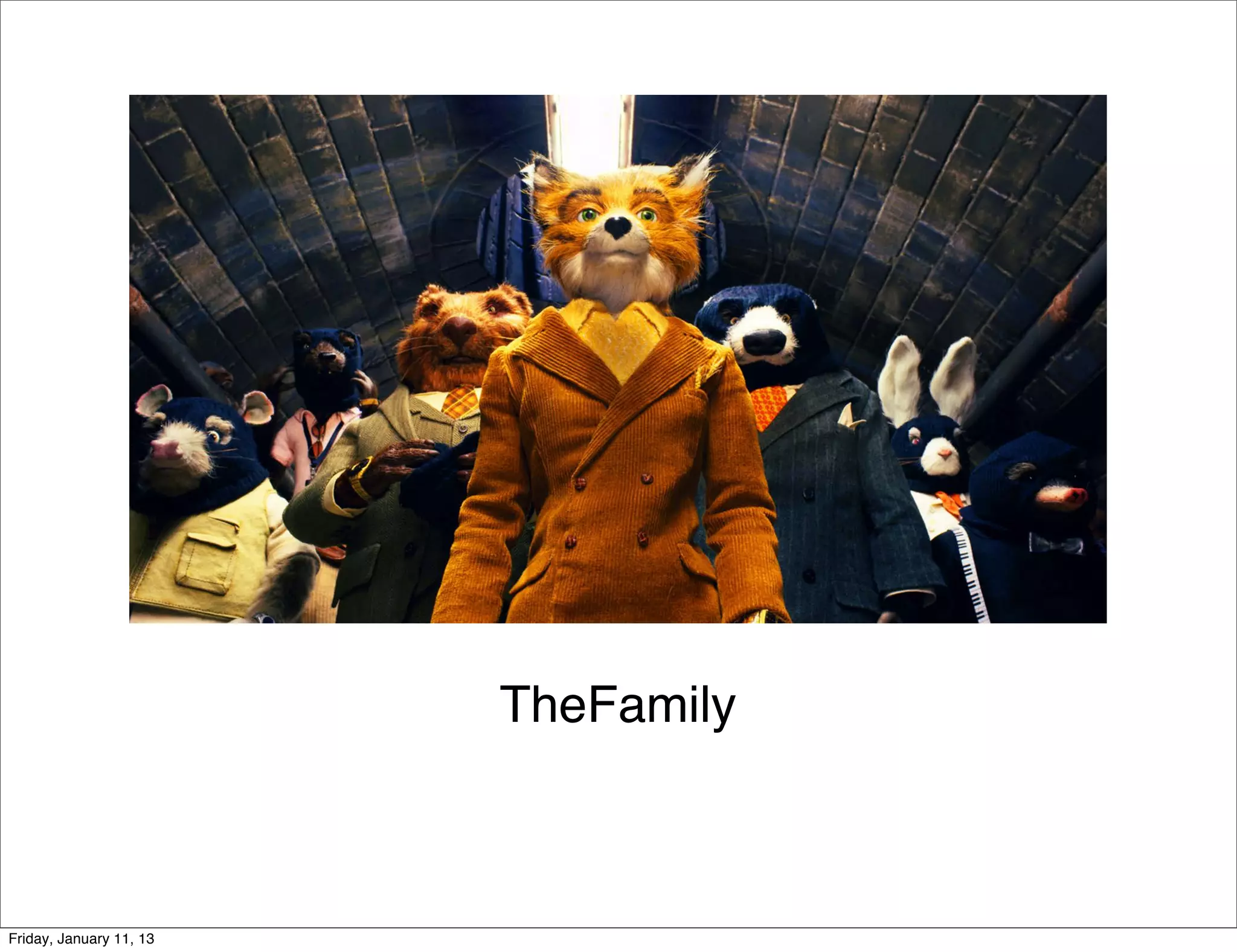
The cover slide features a still from Wes Anderson’s Fantastic Mr. Fox , showing a group of animals in suits looking determined. Below the image is the simple text: TheFamily . There is no tagline, no mission statement, and no date (though the footer indicates January 11, 2013). This sets a tone of 'us vs. them' and establishes a collective identity. It signals that the organization views itself as a tight-knit, perhaps slightly mischievous, group of outsiders.
Slide 2: The Toxic Ecosystem
Slide 2 provides the 'Why Now' and the 'Problem' simultaneously. Titled 'The French Startup Ecosystem is Toxic,' it uses data from the 'Startup Ecosystem Report 2012' to compare Silicon Valley and Paris. The contrast is stark: Silicon Valley ranks 1st across all categories, while Paris ranks 14th in Startup Output, 13th in Funding, and 17th in Talent. A radar chart visually demonstrates how Paris is dwarfed by the Valley. This slide is the foundation of their pitch: the current system is failing, and therefore, a radical new approach is required.
Slide 3: The Educational Philosophy
Titled 'One is not Born but rather Becomes an Entrepreneur,' this slide outlines TheFamily’s approach to founder development. They break education down into three levels:
Individual: Emotional resilience and understanding the stakes. · Community: Learning the 'pay-forward' culture. · Dream: Cultivating high ambition.
The slide concludes with a bracketed statement: 'Education means learning by doing. There is no one good way to educate. But the means can be improved.' This positions TheFamily as a laboratory for entrepreneurial growth rather than a traditional school.
Slide 4: Legal Infrastructure as a Service
One of the few 'tangible' product slides, Slide 4 focuses on 'Startups with the Right Legal Structure.' It lists a suite of services including bylaws (French SAS + Delaware C-Corp), IP templates, trademarks, and social templates (CDI, CDD). Crucially, the text on the left states these are 'PAID ONLY AFTER FUNDRAISING.' This is a powerful incentive for cash-strapped founders and suggests that TheFamily aligns its success with the startup's ability to attract outside capital.
Slide 5: The Countryside Weekend
This slide introduces a specific operational ritual: 'Every 7 Weeks, the Countryside Weekend Welcomes New [0] & Celebrates New [1].' Using the [0] to [1] notation (a nod to Peter Thiel’s philosophy), the slide explains that these retreats foster group emulation and experience sharing. The background is a busy, colorful illustration of various creatures, reinforcing the 'family' or 'tribe' aesthetic over a corporate one.
Slide 6: Maieutic Mentoring
The deck takes a cinematic turn with a still of Michael Corleone from The Godfather . The slide describes 'Office Hours to keep on track,' emphasizing one-on-one work with partners. The key term here is 'Maieutic exercise,' which a footnote defines as the Socratic method of bringing latent truth to the surface. The focus is on 'underlying issues unseen by members' and 'following up the relevant KPIs.' The choice of imagery is bold, perhaps implying a level of seriousness and 'family' loyalty that borders on the omertà, though applied to business strategy.
Slide 7: Transforming 'Dark Matter' into Deal Flow
Slide 7 addresses the sourcing of talent. It contrasts 'Facts' (Business Schools aren't product-driven) with 'Beliefs' (Anyone can be a hacker; Diversity is king). The 'Action' is to 'Leverage the Dark matter - all the hidden hackers, to transform it into a new deal flow.' This is a classic 'arbitrage' play: TheFamily claims to find value where others (traditional French institutions) are not looking.
Slide 8: The Strategy of Chaos
The final slide in this set returns to Fantastic Mr. Fox imagery. The text is a meta-commentary on their own operations: 'Things are always breaking, and they will break at TheFamily. Our strategy is to create bottlenecks and then hitting them hard.' This is an admission of an aggressive, iterative culture. It frames instability not as a failure, but as a method of optimization for complex systems. It is a 'move fast and break things' manifesto tailored for the French market.
What Works in This Deck
Strong Narrative Arc: The deck tells a compelling story of a broken system and a group of rebels fixing it. It moves logically from the problem (toxic ecosystem) to the solution (education, legal, mentorship) to the source of talent (dark matter). Differentiation: In a sea of professional, blue-and-white corporate decks, TheFamily stands out. The use of film stills and philosophical language creates a distinct brand identity that appeals to a specific type of 'hacker' founder. Alignment of Interests: The 'Paid only after fundraising' legal offer is a very strong hook for early-stage founders, proving that TheFamily has skin in the game.
What is Missing
The Team: There is no mention of who the partners are. In an accelerator or venture model, the pedigree and experience of the partners are the most critical factors for investors. Business Model & Unit Economics: The deck does not explain how TheFamily makes money. Is it through equity? Management fees? Success fees? Without this, it is a manifesto, not a business plan. Track Record: While the deck critiques the ecosystem, it provides no proof that TheFamily’s methods work. There are no mentions of portfolio companies, exit data, or follow-on funding rates. The Ask: The deck ends without a call to action. It is unclear how much money is being raised or what the capital will be used for.
What Founders Should Copy
Identify a Systemic Enemy: Founders should look at how Slide 2 identifies a 'toxic' status quo. By positioning your company against a failing incumbent system, you create an immediate reason for your existence. Define Your Rituals: The 'Countryside Weekend' and 'Office Hours' slides show that TheFamily has a specific way of working. Founders should clearly define the 'operating system' of their company to show investors that their culture is intentional, not accidental. Use a Unique Voice: While using copyrighted film stills is risky for a general pitch, the tone of the deck—rebellious, intellectual, and confident—is something founders can emulate to stand out in a crowded inbox.
Frequently asked questions
- What is the primary problem TheFamily aims to solve?
- TheFamily targets the 'toxic' French startup ecosystem. According to Slide 2, Paris significantly lagged behind Silicon Valley in 2012, ranking 14th in startup output and 15th in 'trendsetter' status. The deck argues that French business schools are not product-driven, resulting in a lack of scalable startups and a need for a new way to cultivate 'hidden hackers' into viable entrepreneurs.
- How does TheFamily's business model work based on the deck?
- The deck does not explicitly state its revenue model or equity requirements. However, Slide 4 suggests a 'pay-later' service model for legal infrastructure, where startups receive bylaws and IP templates but only pay after successful fundraising. This implies TheFamily likely takes equity or success fees, though the specific terms are omitted from these slides.
- What is 'Maieutic mentoring' mentioned in the deck?
- On Slide 6, TheFamily defines its weekly office hours as a 'Maieutic exercise.' A footnote explains this as the belief that 'truth is latent in the mind of every human being' and must be 'given birth' through intelligent questioning. In a business context, they use this Socratic method to help founders recognize and solve underlying issues they might otherwise miss.
- Who is the target audience for this pitch deck?
- Given the lack of financial data and the heavy emphasis on philosophy and ecosystem critique, this deck appears designed for early-stage investors who prioritize 'vision' and 'deal flow' over immediate unit economics. It also serves as a recruitment tool for founders who feel alienated by the traditional French corporate or academic path.
- What are the most significant omissions in this deck?
- The deck lacks almost all standard 'Series A' requirements. There is no slide introducing the founders or their track records. There is no mention of the total addressable market (TAM), no competitive landscape, no financial history of the accelerator itself, and no clear 'Ask' regarding how much capital they are raising or at what valuation.