Angage's 2013 pitch deck presents a localized solution for the mobile commerce (mCommerce) and mobile payment (mPayment) sector, specifically targeting the Philippines market. The company identified a critical gap: small merchants were unable to accept credit and debit card payments in physical stores or on the go. By offering a combination of hardware (detachable card reader dongles) and software (cloud-based shopping cart apps), Angage sought to bridge the digital divide for local vendors. Their strategy relied heavily on strategic integrations with regional banking networks like BancNet an…
Key takeaways
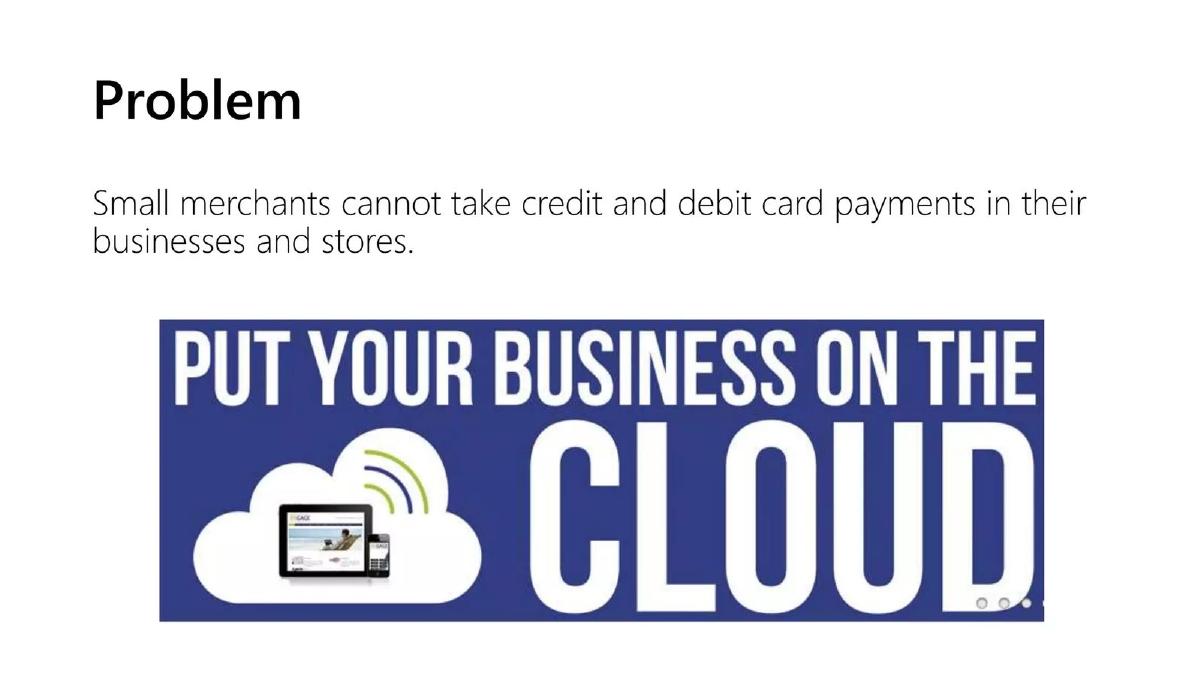
- The core problem addressed is the inability of small merchants to accept credit and debit card payments (Slide 2).
- Angage positions itself as a cloud app development platform with built-in shopping carts and mPayment capabilities (Slide 3).
- The solution utilizes a physical hardware component in the form of a detachable card reader dongle for mobile devices (Slide 3).
- A primary competitive advantage is cited as being the first to integrate with BancNet Philippines and UnionPay of China (Slide 4).
- The distribution strategy is bifurcated into B2C (weekend markets) and B2B (large retailers and associations) channels (Slide 5).
- Revenue is generated through four distinct streams: subscriptions, transaction fees, advertising, and cloud services (Slide 6).
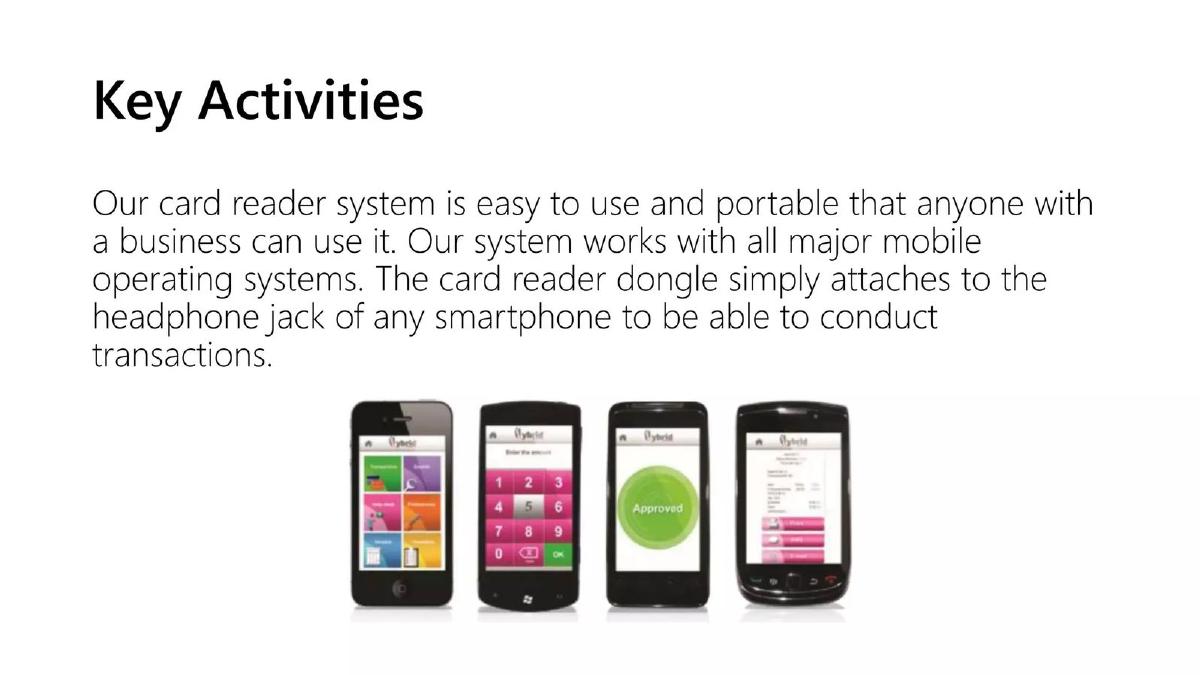
- The platform supports multiple operating systems including Apple iOS, Windows Phone, Android, and BlackBerry (Slide 7).
- The deck emphasizes 'no switching' for merchants, allowing them to use existing Philippine processor bank accounts (Slide 7).
Executive Summary
The Angage pitch deck, dating from approximately June 2013, represents a snapshot of the 'Square for Southeast Asia' era. The company focused on the Philippines, a market characterized by high mobile penetration but low credit card adoption. By integrating with local debit networks like BancNet, Angage attempted to solve the merchant acquisition problem that global players often overlooked. The deck is functional and clear about the product-market fit but lacks the depth of business operations and financial planning required for a high-level institutional round.
Slide 1: Title Slide
The deck opens with the company name, Angage Inc. , and a subtitle defining their space: mCommerce and mPayment App Solutions . The logo includes the tagline 'Engage your Customers with ANGAGE Cloud Apps and Websites.' The branding is straightforward, positioning the company as a dual-threat provider of both commerce platforms and payment processing.
Slide 2: The Problem
Slide 2 identifies a single, clear pain point: 'Small merchants cannot take credit and debit card payments in their businesses and stores.' This is a classic 'gap in the market' problem statement. In 2013, the infrastructure for small-scale digital payments in the Philippines was underdeveloped, leaving small and medium enterprises (SMEs) reliant on cash, which limits transaction volume and security. The slide includes a graphic urging businesses to 'Put your business on the cloud.'
Slide 3: Value Proposition
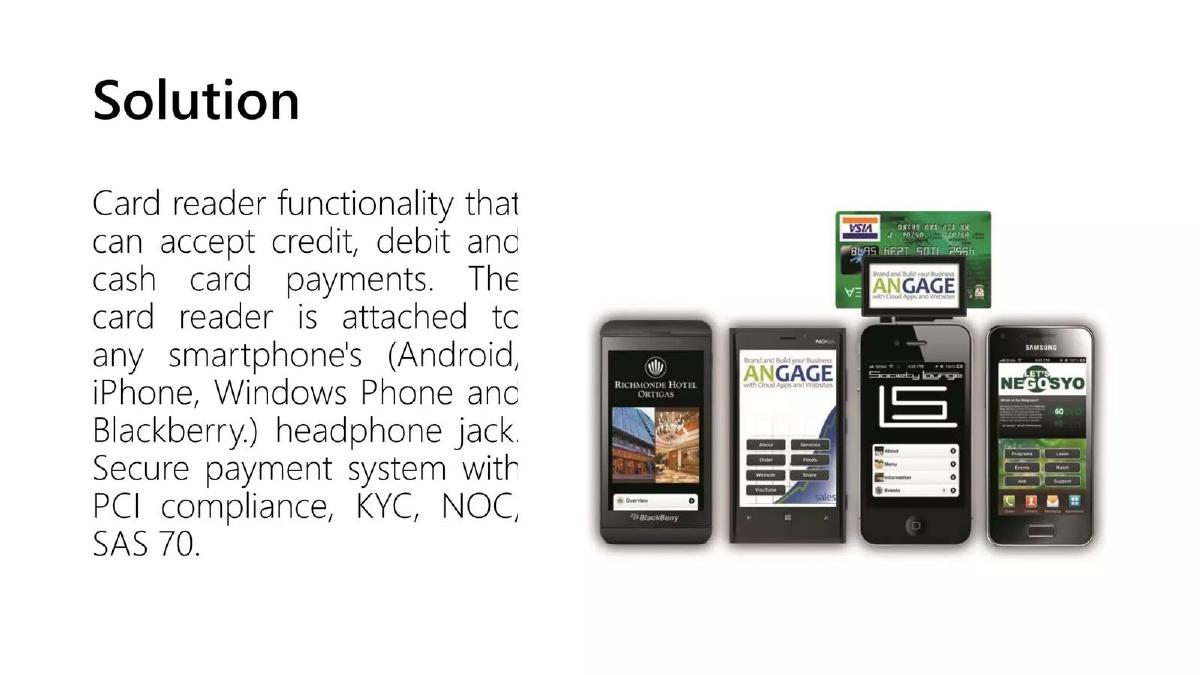
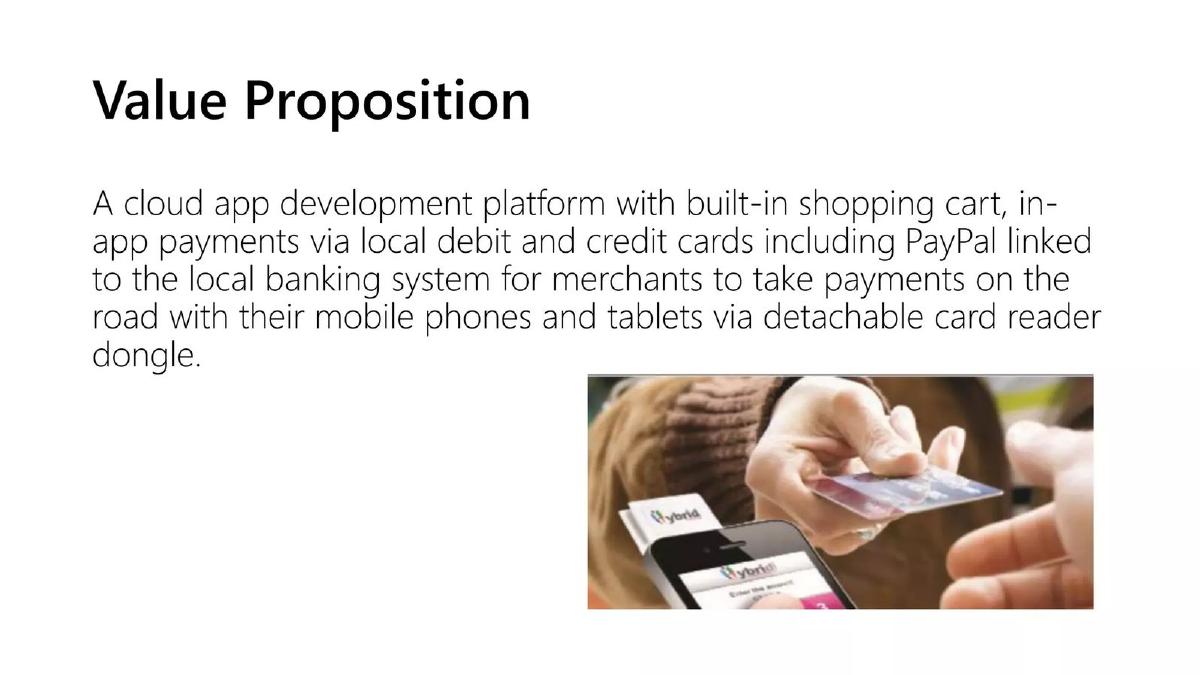
The value proposition is defined as a 'cloud app development platform with built-in shopping cart, in-app payments via local debit and credit cards.' The slide specifically mentions PayPal and the use of a 'detachable card reader dongle.' This indicates that Angage was not just a software provider but a full-stack hardware and software solution. The inclusion of 'local banking system' connectivity is a key differentiator from international competitors who might only process major credit cards.
Slide 4: Unfair Advantage
Angage stakes its competitive claim on being the 'first card reader mPayment system in the market with debit card, cash card and credit card integration utilizing BancNet Philippines and UnionPay of China banks.' By citing BancNet and UnionPay , Angage highlights its local relevance. In the Philippines, BancNet is the primary multi-bank network, meaning Angage could process the cards that the majority of the population actually carried, rather than just the elite tier of credit card holders.
Slide 5: Channels
The 'Channels' slide outlines the Go-To-Market strategy. It is split into two categories:
B2C: Focuses on high-traffic physical locations like Mercato Group , Banchetto weekend food markets , and Greenhills . These are iconic Filipino venues where hundreds of small vendors operate. · B2B: Targets large-scale organizations and aggregators such as GoNegosyo , Puregold (a major supermarket chain), Avon , Coke , Pepsi , and the Phil. Retailers Assoc.
This dual approach suggests they intended to use B2C markets for brand visibility and B2B partnerships for rapid scale.
Slide 6: Revenue Streams
Merchant's yearly subscription to the app and card reader system. · Fee per transaction/swipe (the standard merchant discount rate model). · In-app advertising . · Shopping cart app cloud subscription .
This is a diversified model, combining SaaS (Software as a Service) recurring revenue with transactional fintech revenue. However, the deck does not provide specific pricing points for any of these streams.
Slide 7: Product Overview and Features
The final slide in the set is a dense marketing flyer that summarizes the technical capabilities. It lists features such as 'No switching' (merchants keep their existing bank accounts), GPS mobile sales-tracking , and 'Captures signatures on the touch-screen.' It also notes support for Apple iOS, Windows Phone, Android, and BlackBerry . The slide lists 'Ideal For' categories including food delivery, fleet/logistics, and home sales (taxis, etc.). It reiterates the partnership with Hybrid Paytech and the banking networks.
What Works in This Deck
Local Specificity: The most compelling part of this deck is the focus on local integrations. By mentioning BancNet and UnionPay, the founders demonstrate a deep understanding of the Philippine financial landscape. For an investor looking at regional plays, this local 'moat' is more important than the technology itself.
Clear Problem/Solution Fit: The deck doesn't overcomplicate the narrative. Small merchants need to take cards; Angage gives them a dongle and an app to do it. The utility is immediate and easy to grasp.
Strategic Partnerships: Listing names like Puregold, Coke, and Pepsi under B2B channels shows that the company was thinking about enterprise-level distribution, which is often more cost-effective than acquiring individual small merchants one by one.
What Is Missing
The Team: There is no mention of who is building this. In early-stage startups, the 'who' is often more important than the 'what.' Without founder bios or a list of advisors, it is impossible to judge the execution capability of the company.
Market Size: The deck lacks a TAM (Total Addressable Market) slide. Investors need to know if this is a $10 million opportunity or a $1 billion opportunity. While they list channels, they don't quantify the number of potential merchants in the Philippines or the broader SE Asia region.
Financials and Traction: There are no charts showing growth, no mention of how many merchants were already signed up, and no projections for future revenue. This makes the deck feel more like a sales brochure than a fundraising document.
The Ask: The deck ends without a call to action. It does not state how much money is being raised, the valuation, or the specific milestones the company intends to hit with the new capital.
Founder's Guide: What to Copy
Use Logos for Credibility: Slide 5 effectively uses the logos of well-known local brands (Mercato Centrale, GoNegosyo). This 'borrowed credibility' helps a small startup look more established and trustworthy.
Focus on the 'Unfair Advantage': If your startup has a specific regulatory or technical integration that competitors lack, dedicate a full slide to it as Angage did on Slide 4. Don't bury your competitive edge in a list of features.
Segment Your Channels: Breaking down your market into B2C and B2B (Slide 5) shows that you have a nuanced understanding of customer acquisition costs and different sales cycles.
Conclusion
The Angage deck is a product of its time—a period when mobile payments were transitioning from a novelty to a necessity. While it excels at explaining the product and the regional advantage, it falls short of being a complete investment case due to the omission of team, financials, and a clear ask. For modern founders, this deck serves as a reminder that local integration is a powerful narrative, but it must be backed by a robust business plan and a capable team to win over institutional investors.
Frequently asked questions
- What specific problem does Angage solve?
- According to Slide 2, Angage solves the problem of small merchants being unable to accept credit and debit card payments in their physical businesses and stores. In 2013, many smaller vendors in emerging markets like the Philippines were cash-only due to the high cost and complexity of traditional Point of Sale (POS) systems.
- How does the Angage technology work?
- The solution is a hybrid of hardware and software. Slide 3 describes a cloud app development platform that includes a built-in shopping cart. For physical payments, merchants use a 'detachable card reader dongle' that plugs into mobile phones and tablets, allowing them to process local debit and credit cards, as well as PayPal, via the local banking system.
- What is Angage's 'Unfair Advantage'?
- Slide 4 claims their advantage is being the first card reader mPayment system in the market to integrate with BancNet Philippines and UnionPay of China banks. This regional integration is crucial because it allows the system to process local 'cash cards' and debit cards that are common in the Philippines and China, rather than relying solely on international credit card networks.
- Who are the target customers for this platform?
- Slide 5 and Slide 7 identify a wide range of targets. B2C targets include vendors at weekend food markets like Mercato Centrale and Banchetto, as well as school bazaars. B2B targets include large entities like Puregold, Avon, Coke, Pepsi, and various retail and franchise associations. Slide 7 also mentions field services like food delivery and taxis.
- What is missing from this pitch deck?
- The provided slides are missing several critical components for a professional fundraise. There is no 'Team' slide showcasing founder expertise, no 'Market Size' (TAM/SAM/SOM) analysis, no 'Financial Projections' or historical growth data, and no 'The Ask' slide detailing how much capital is being raised and how it will be spent.